









Highlight from the 2026 World Conference on Lung Cancer: Part 1
Key Takeaways
- Findings from the MAVERICK trial support MRI surveillance as an alternative to prophylactic cranial irradiation in selected patients with small cell lung cancer, emphasizing the importance of shared decision-making, cognitive outcomes, and adherence to surveillance schedules.
- The 8-year overall survival update from ADAURA reinforces the long-term benefits of adjuvant osimertinib in EGFR-mutated non–small cell lung cancer (NSCLC), highlighting the critical role of oncology APPs in managing toxicities, supporting adherence, and helping patients complete treatment.
- Results from DESTINY-Lung04 demonstrate improved progression-free survival with trastuzumab deruxtecan in HER2-mutated NSCLC, but the risk of interstitial lung disease underscores the need for proactive patient education, early symptom recognition, and prompt multidisciplinary intervention.
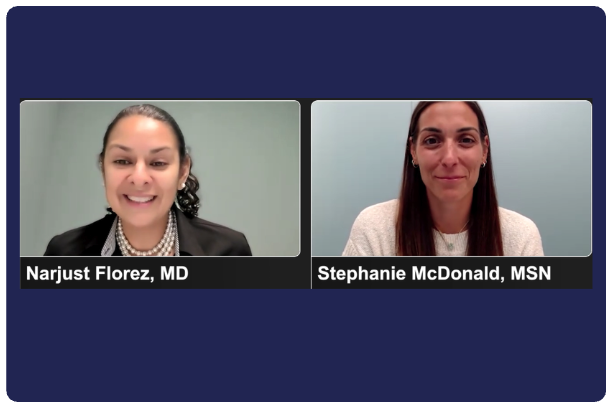
Narjust Florez, MD, thoracic medical oncologist at Dana-Farber Cancer Institute, assistant professor of medicine at Harvard Medical School, and co-director of the Young Lung Cancer Program at Dana-Farber, and Stephanie McDonald, MSN, FNP-BC, AOCNP, nurse practitioner at Dana-Farber Cancer Institute, discuss three practice-changing lung cancer studies presented at the 2026 World Conference on Lung Cancer in Seoul, South Korea. They review findings from the phase 3 MAVERICK trial comparing MRI surveillance with prophylactic cranial irradiation in small cell lung cancer, the 8-year overall survival update from the phase 3 ADAURA trial of adjuvant osimertinib in EGFR-mutated NSCLC, and the phase 3 DESTINY-Lung04 trial evaluating first-line trastuzumab deruxtecan in HER2-mutated NSCLC.
Throughout the discussion, Florez and McDonald emphasize the implications of these findings for oncology advanced practice providers, including the importance of shared decision-making when weighing cognitive risks against brain metastasis prevention, strategies to improve long-term adherence to adjuvant targeted therapy, and vigilant monitoring for potentially serious treatment-related toxicities. They also address limitations of the emerging evidence, including immature survival data and challenges interpreting treatment outcomes. Their discussion highlights the expanding role of oncology APPs in translating new lung cancer research into individualized treatment decisions, proactive supportive care, and improved patient safety.
Transcript
Stephanie McDonald, MSN, FNP-BC, AOCNP: Welcome to the OLN APP Institute. I'm Stephanie McDonald. I'm a nurse practitioner from Dana-Farber Cancer Institute with expertise in management of lung cancer in young individuals and small cell lung cancer.
Narjust Florez, MD: I'm Dr. Narjust Florez, a thoracic medical oncologist at Dana-Farber Cancer Institute, an assistant professor of medicine at Harvard Medical School, and I'm the co-director of the Young Lung Cancer Program here at Dana-Farber as well.
Stephanie McDonald: Narjust, we were both just in Seoul for the World Conference on Lung Cancer, and we each came home with a list of changes that we wanted to make in clinics. Today, we're going to go through five of these updates at WCLC. We're going to be looking at small cell, adjuvant EGFR, HER2 exon 20, and ROS1.
Narjust, let's just start by looking at small cell. We want to look at the MAVERICK study, which looked at MRI surveillance versus prophylactic cranial irradiation in small cell lung cancer. Can you give us the bottom line in just a minute or 2 about the study?
Narjust Florez: One of the things that MAVERICK has tried to do was to answer one of the most debated questions in thoracic oncology. And it's, do patients with limited-stage small cell lung cancer need prophylactic cranial irradiation? Prophylactic cranial irradiation does not come without a price. It can have changes in quality of life, changes in performance status.
One of the challenges was when the study was done, the new advancements in small cell, which include immunotherapy, tarlatamab, and also discrepancies in patients who were followed with CT scans versus MRIs.
MAVERICK also has another name. MAVERICK is the cool name, but it's also known as SWOG S1827. This is a phase 3 trial that randomized patients with limited- and extensive-stage disease, both of them, who had responded to first-line therapy. They were randomized to MRI surveillance or PCI, prophylactic cranial irradiation, plus MRI. The primary end point was overall survival. Do patients who receive prophylactic cranial irradiation live longer? But the study was modified a little bit due to the introduction of new therapies, and cognitive failure-free survival was a secondary end point.
What this study in 304 patients showed is that skipping prophylactic cranial irradiation did not impact survival and reduced cognitive decline. While watching the patients closely with MRIs, same survival, but less cognitive decline.
Now we can safely put that question to rest. These patients do need to be followed, though. They need to be followed like the study, which is MRI every 3 months. Not MRI once a year, like we do for non-small cell lung cancer.
Stephanie, you do treat a lot of small cell in your clinic. Who still gets PCI? Or how do you have that conversation about prophylactic cranial irradiation for these patients?
Stephanie McDonald: Any small cell lung cancer patient who's responded to initial therapy and has no brain metastases on the MRI should have that PCI versus surveillance conversation, whether they have limited- or extensive-stage disease.
Making surveillance work really means setting expectations very clearly with our patients. I try to talk to my patients in a language that keeps it collaborative, to be able to make a shared decision with the patient and their families and their health care team. It tells the patient that there's not a single right answer. It's about trade-offs, and that MRI surveillance is active management, not neglect. I want them to know that we're still actively monitoring them on follow-up with these MRIs.
Some patients that I think of for whom it would be more of a shared decision for PCI would be patients who can't reliably get MRIs, maybe because of devices or claustrophobia, or maybe their distance from our clinic or even compliance issues. MRIs every 3 months in year 1 and then every 6 months in year 2, and being able to build that into a care plan and for us to be able to track adherence. And telling patients that they need to be reporting neurologic symptoms right away. If they have any changes in any cognitive or neurologic symptoms, they're calling us so we can bring them in, work this up, and make the appropriate referrals depending on what's going on.
Narjust, one question I have for you is, what should these patients and caregivers hear from us?
Narjust Florez: One of the things that we have seen about PCI is that it does reduce the rates of brain metastases, but patients live the same time. We have to be very clear that patients know that the risk for brain metastases is large and that they're not being undertreated by not getting prophylactic cranial irradiation. This is a different concept because brain metastases tend to be very anxiety-provoking to all patients, regardless of histologic subtype.
We explain the risk. This is the risk. However, the time that you will have without prophylactic cranial irradiation, you will have no cognitive decline. We always can do radiation when the lesions come. But it can be 6 months, it can be a year, it can be 2 years in which you can try to live your best life. And now with new therapies like tarlatamab, that drug gets to the brain. It may not even be necessary. It's not about living longer, but it's also about living well.
Before we finish this very fast conversation about MAVERICK, what is one of the limitations that you saw in the analysis of the trial that would be good for our APPs to know? Because there's not a single trial that is perfect.
Stephanie McDonald: Absolutely. One important limitation that I found of MAVERICK to keep in mind is that overall survival data are still immature, and the trial wasn't powered to definitively prove noninferiority for overall survival. The trial planned for 668 patients and enrolled 304. The survival results are preliminary, and the confidence interval still allows for a small benefit from PCI. The final survival analysis at 190 deaths will matter.
While the cognitive benefit with MRI surveillance is compelling, we should be transparent that long-term survival equivalence isn't fully settled yet. That's why we present it as a shared decision with our patients. We want to balance that cognitive risk, what's important, the patient's values, and really this commitment for these regular MRI follow-ups will be important.
Narjust Florez: I don't think I'm going to be offering prophylactic cranial irradiation to patients, unless there is something that you discussed: access to MRI, claustrophobia, devices. What about you? Are you ready to say goodbye to PCI for everybody?
Stephanie McDonald: I think most of the patients. I just think the MRI imaging is so advanced now, and with these patients, if we're catching these brain metastases early, we're going to be able to treat them effectively. Like you said, with other systemic treatments and targeted radiation or meeting with neurosurgery, there are really good options that will prevent whole-brain radiation for the vast majority of these patients.
Narjust Florez: I think this is truly important, and we're very happy that MAVERICK is here. There was always the discussion. I wasn't already using PCI in the few small cell patients I have. Stephanie has more experience with small cell than I do, but I wasn't doing it already due to the cognitive declines. A lot of these patients are already elderly patients, so they already have a natural aging decline.
All right, now it's time to really change gears. We are going from PCI, extensive- and limited-stage small cell, to the 8-year overall survival data for ADAURA. This is not disease-free survival because we actually stopped tracking disease-free survival for this study since the publication in 2023, but we have overall survival.
Stephanie, in 1 line, or maybe a few lines, I think it's hard in 1 line, how will you summarize the update of ADAURA, which is adjuvant osimertinib versus placebo in patients with resectable EGFR-positive non–small cell lung cancer?
Stephanie McDonald: ADAURA was a double-blind phase 3 trial. It had 682 patients with resected stage IB to IIIA EGFR-mutated non-small cell lung cancer, and they were randomized to osimertinib or placebo for up to 3 years. The primary end point was disease-free survival. This is an exploratory 8-year survival update. At 8 years, 74% of stage II to IIIA patients on osimertinib were alive versus 58% on placebo, and the hazard ratio was 0.53.
What do we do with these patients who want to stop early? This is a conversation that comes up with a lot of our patients. We have this data, we have this exploratory 8-year survival update, and we are still going to have patients, and do already have patients, who want to consider stopping early. What are your conversations with these patients?
Narjust Florez: This is a very important question because I actually went to the mic and asked this question during the plenary. Our own research that was conducted and presented at the European Lung Cancer Conference this year showed that only 50% of patients in the real-world setting are completing the 3 years. The longer the patient stays on the adjuvant therapy, the higher the benefit.
We have to understand that cancer is mind and body. When patients have metastatic disease, they know that osimertinib is keeping them alive. There's an extra motivation, not only alive, but symptom-free. Because when the cancer grows, shortness of breath and fatigue come along. But in this setting, what we have seen in clinic is the more the negative scans keep coming up, the less motivation to take the medication. Because osimertinib, yes, is an oral agent that comes with diarrhea, fatigue, skin rash.
This information from this trial motivates us to motivate patients to stay longer because the longer you stay on osimertinib in the adjuvant setting, the higher the benefit. There are many things that you and I do in clinic all the time, which is dose reduction. Sometimes we do Monday to Friday, weekends off. Sometimes I think going to 40 mg is the second step. I don't go to 40 mg right away. I prefer to do the weekends off, and then we go to 40 mg. But the hope is that the patient stays on the drug.
Tyrosine kinase inhibitors like osimertinib, unfortunately, they don't cure anybody. They inhibit the clone. We have seen progression at 3 years, but we also saw patients who remain disease-free at this 8-year survival. The longer, the better. There are many things that can be done. Discontinuing the medication should be the last resort.
Trying to understand what gives the patient diarrhea, and this is a little tip that we have in our clinic, is that when you start osimertinib, no dairy. Osimertinib releases gastrin, and dairy releases a lot of gastrin, so that just mobilizes the GI tract and produces the diarrhea. No dairy for the beginning, then you introduce dairy later. Another thing is these patients are going to be on therapy for years. Their flora will change. Always be mindful of what gives them diarrhea.
And sunblock. They have to use sunscreen. The more sun you have, the more rash you're going to have. And to all our lovely male patients, you have to moisturize. You may not like it, but you've got to moisturize. Here in Boston, it's already getting cold, so you've got to moisturize.
Stephanie, for the APP team, because a lot of patients are on osimertinib for a while, what does this mean with an 8-year overall survival update when it comes to monitoring visits? What testing do you do? How do you talk to patients?
Stephanie McDonald: We want to be aggressive up front. Obviously, osimertinib is a 3-year adjuvant therapy. We're seeing this durable long-term benefit. The reason APPs matter so much is that we're helping the patients actually complete it, right? We're managing these chronic low-grade side effects, we're checking adherence, and we're supporting the patient through the years. We want to improve their quality of life, maintain their quality of life.
It's all about prophylaxis. We need to be prophylactic in their skin care for rash and paronychia. We need to be moisturizing. We need to be monitoring the nails. We need early management of the diarrhea. We need to be monitoring for mouth sores. At baseline, we're getting those ECGs, the echocardiograms. We're checking any drug-drug interactions. Anything that's going to be QT-prolonging, we need to consider carefully. And then really any development of a new cough or breathlessness, we need to hold treatment and expedite imaging, ideally the same day because of the ILD risk.
We need to ask about adherence and copays as well at every visit. Sometimes this is missed. We need to work with our specialty pharmacies because sometimes this could quite literally be this quiet issue that will end treatment for people. We need to help find them resources as well.
Completing therapy, I think, is tied to that durable survival benefit you discussed. Even these so-called minor toxicities, they can derail that if we don't stay on top of them. It's about prophylaxis, asking the detailed questions to your patients, and managing their symptoms early before we need to make a dose reduction. But again, every patient is individualized. We need to manage the uniqueness of everybody's care a little differently sometimes.
Narjust, what is the limitation to keep in mind for this study?
Narjust Florez: ADAURA has several limitations. One of the first is that people keep seeing or interpreting the data as chemotherapy is not necessary.One of my favorite things to do is to go to the supplemental or the appendix for the papers because that's when you really get the real deal. Chemotherapy is still necessary for 2 reasons. First, the majority of the patients at stage IB didn't get chemo, but the majority of patients at stage IIIA got chemo. What this suggests is that the benefit of chemotherapy was still there because the patients with more advanced stage IIIA got chemotherapy.
Making the assumption that chemotherapy in the adjuvant setting is not necessary is not appropriate based on what happened in the trial. Investigators had the opportunity to decide if patients would get chemo or not after surgery. In addition to that, when you don't do the chemotherapy, you are signing with blood on a piece of paper that this patient is going to complete the 3 years of osimertinib. Like we have seen over and over again, only 50% of patients do. You're giving up chemo and a fake or a hope promise because the patient has never been on osimertinib. You don't know how they're going to tolerate it. Get the chemo in if you can, particularly for stage IIA, IIB, and IIIA, definitely.
Second, overall survival. People forget that ADAURA did not allow crossover. The patients who were on placebo, most of them did not cross over to osimertinib, particularly because they were treated in many regions of the world in which osimertinib is not allowed in first-line therapy for resectable or metastatic disease. Many of them went to gefitinib or even earlier TKIs or other types of drugs. What happens when crossover is not allowed? The overall survival can get inflated because the patients did not get osimertinib, the potentially superior inhibitor, which FLAURA showed in 2017.
Finally, this 8-year analysis is a nonplanned analysis. We have longer follow-up for the patients who were in the osimertinib arm, but shorter follow-up, with 30 months, over 2 years' different follow-up for the placebo. What is very interesting, it really shows that patients need to stay on therapy as long as possible.
It has its limitations, but we cannot negate that osimertinib in the adjuvant setting is here. It has been 6 years since we saw this data for the first time at ASCO 2020, and the patients should have biomarker testing with early-stage disease so they can get benefits from osimertinib.
Stephanie McDonald: Important distinctions, for sure. For us clinically, I think the 8-year data give us a lot of confidence in durability, but day to day, our focus really needs to be helping keep these patients on therapy for the right reasons.
Let's switch gears again. We're going to switch over to DESTINY-Lung04. It's first-line trastuzumab deruxtecan versus chemoimmunotherapy in HER2-mutant non–small cell lung cancer. Narjust, our colleague here at Dana-Farber, Dr. Julia Rotow, presented this at the Presidential Symposium at WCLC. Can you review with us just briefly what it showed? Are you using it in the first line?
Narjust Florez: We're going to get to this last question last. Trastuzumab deruxtecan is approved in the second-line setting for HER2-positive non-small cell lung cancer. This is an antibody-drug conjugate that has effects similar to chemotherapy.
But in this study, DESTINY-Lung04 is evaluating chemo plus immunotherapy versus trastuzumab deruxtecan in the first line. The primary end point was progression-free survival, and it was superior. This is a form of targeted therapy. It is IV, but it's targeted therapy. 4.3 months versus 8.3 months, with a hazard ratio of 0.63. What that means is patients with trastuzumab deruxtecan stay longer on therapy.
However, for the interim survival analysis, there was no statistical significance. The data are still maturing, and it's an interim survival analysis. We need more time to find out. It has displaced chemo to second line, I think, DESTINY-Lung04 and the zongertinib trials.
But there is something that has to be brought to attention, and I want to talk to you about my next question. Progression-free survival, overall survival maybe not there. There were a lot of patients who went to other therapies. There was a lot of crossover.
However, the toxicity, I think, was a little more tricky. I'm skipping the question about what I use in first line until we talk about toxicity.
Stephanie, what's up with the toxicity with trastuzumab deruxtecan? You and I have one patient who got very sick and unfortunately ended up on oxygen, and that was the last therapy she got.
Stephanie McDonald: ILD was 21%, and there were 4 deaths. From an APP standpoint, I think about T-DXd monitoring really as a whole package for these patients, but ILD is the priority.
It's worth mentioning that there were delayed or suboptimal steroids seen in 90% of the grade 3 or higher cases, including all 4 deaths. I think speed is the intervention here. I want a solid pulmonary baseline. We're going to be getting baseline CT. On these patients, oxygen saturation, we're getting scans frequently, about every 6 to 9 weeks. I'm educating patients to call right away with any new cough, dyspnea, fever. At each visit, I'm asking specifically about those symptoms.
If I suspect ILD, we need to hold the drug immediately. We're bringing these patients in really same day. We need to be seeing them same day. We can't be delaying workup for these patients. We need to be getting chest imaging. High-resolution CT imaging is a priority. We're starting steroids quickly when indicated.
At the same time, we're also setting these patients up for success because there are other toxicities associated with it. Although ILD does take priority, we need to be proactive with antiemetics from cycle 1. We need to be getting baseline echocardiograms to monitor the ejection fraction with treatment and then continuing to check these depending on the risk factors for these patients. That way we're anticipating issues, not chasing them.
But the biggest priority is monitoring for ILD and being up front and educating these patients on when and how to call and not to delay calling.
Narjust Florez: I think it's very important. This is different than the pneumonitis we see with immunotherapy. The patients will not respond to steroids like we see with immunotherapy, in which the response is very quick. It takes longer. It's a monoclonal antibody. It stays in the body longer, and it has a payload. While we see magical responses with immunotherapy, you put a patient on prednisone, 2 days later they're breathing better. This can take longer.
Stephanie McDonald: I do think it's worth mentioning that it really does take a multidisciplinary approach to care. I think we're not only managing this by ourselves in our clinics, Narjust and myself. We're including our pulmonology team, sometimes infectious disease, where we are doing a really extensive workup and getting all hands on deck to figure out what is going on with this patient and how to appropriately manage them. Because sometimes, in some of these cases, it has been very challenging.
Narjust Florez: Yeah, it can be.
Stephanie McDonald: Narjust, what is the limitation here to keep in mind?
Narjust Florez: One of the things I briefly touched on was the maturity of the data. It's only 47% mature, and a lot of patients crossed over to the current first-line therapies. Trastuzumab deruxtecan is not approved in first-line therapy yet, only in second-line therapy, but a lot of patients got zongertinib, another approved therapy. That can influence the results. But I think it just shows that first-line HER2 chemoimmunotherapy is being moved to the end.
These are the 3 studies that we discussed at the World Conference on Lung Cancer. You can go to part 2, in which we're going to discuss 3 more studies. This will be another discussion, so stay tuned for the sequel.
Thank you.
Stephanie McDonald: Thank you.
© 2026 HMP Global. All Rights Reserved.
Any views and opinions expressed are those of the author(s) and/or participants and do not necessarily reflect the views, policy, or position of LL&M, Oncology Learning Network or HMP Global, their employees, and affiliates.
Related Content


The APP Institute is a new offering from the Oncology Learning Network that provides microburst education to oncology advanced practitioners. The platform offers year-round digital non-accredited learning modules through animated short videos, multimedia interviews with key opinion leaders, interactive content to test your knowledge, and more!




