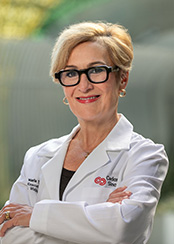
David Rubin, MD, on Histologic Outcomes of QUASAR Extension Study
Dr Rubin reviews data from the QUASAR phase 3 trial of guselkumab in patients with ulcerative colitis, specifically looking at histologic remission, which he presented at the ACG Scientific Meeting in Nashville.
David T. Rubin, MD, is the Joseph B. Kirsner Professor of Medicine, chief of the Section of Gastroenterology, Hepatology and Nutrition, and director of the Inflammatory Bowel Disease Center at University of Chicago Medicine.
Clinical Summary
Guselkumab QUASAR Data Track Histologic Healing in Ulcerative Colitis
- QUASAR phase 3 trials: David Rubin, MD, reported that examining histologic inflammation over time provided new insights into the microscopic level of activity among patients with moderately to severely active ulcerative colitis. Histologic inflammation improved rapidly in patients receiving guselkumab for moderately to severely active ulcerative colitis. Improvement persisted through maintenance and the long-term extension to week 140.
- Long-term findings: Patients in histologic remission at 1 year were more likely to remain in histologic remission at week 140. Histologic remission was more frequent than a Mayo endoscopic score of 0.
- Assessment domains: Symptomatic remission was more frequent than either histologic or endoscopic remission. Dr Rubin emphasized the importance of interpreting symptoms, endoscopy, and histology together over time.
TRANSCRIPT
Hello, it's David Rubin from the University of Chicago. I'm at the American College of Gastroenterology meeting in Nashville, Tennessee. And while here, I presented the results of the patients with ulcerative colitis who received guselkumab in the QUASAR phase 3 trials that led to its approval for the treatment of moderately to severely active UC. But what I presented was specifically looking at the histological inflammation of those patients over time.
We examined what the biopsy degrees of inflammation looked like through the maintenance element of the QUASAR study, and then into the long-term extension out to 140 weeks. Looking at how these changed over time gave us some new insights into what's happening at a microscopic level in patients with moderately to severely active ulcerative colitis. And what we found was that similar to the improvement in symptoms that was observed and improvement in endoscopy that was observed, histology improved fairly rapidly and stayed under control or achieved what we've termed histologic remission for most of the study and into the long-term follow-up.
Patients who had histological remission at one year were more likely, as you might suspect, to have histological remission going out to week 140, 3 years. But what was very interesting is that we then overlapped the histological findings at all those time points with the endoscopic findings at all those time points. And when you looked at a Mayo endoscopic score of 0, which is essentially a healed bowel as you see it through a scope, it was significantly less than the histological remission. In other words, we were seeing healing at a microscopic level more than we were seeing at the endoscopic level. Now, this may suggest that what we're seeing and calling endoscopic inflammation is not correlated as well with what's actually happening microscopically. It may be just the way we see the inflammation. It may also be the first time that we can start thinking a little bit more about what's the actual timing of different elements of how the bowel heals.
Does it heal microscopically before we see improvements in the erythema or other elements of the endoscopic inflammation? In other words, should we be relying a bit more on histology to predict what's going to happen otherwise? Now, of course, there's a prospective study looking at histological endpoints with vedolizumab called VERDICT, which is being presented soon and is going to be at the UEG meeting and published very soon after that. And I think it's interesting to know that in VERDICT, histological remission was not necessarily better than endoscopic remission at predicting sustained control or other outcomes, but that's a different question than understanding the timing of all these things. At the end of my QUASAR substudy presentation, we also overlapped symptomatic remission, which really has to do with the patient having no rectal bleeding and having their stool frequency improve back to a baseline or better. And the interesting thing about that is that the symptomatic remission was higher than the endoscopic remission and even higher than the histologic remission.
So now we're starting to finally overlap all these important domains of understanding biology and of course how patients feel. So I was really excited to present this work, to start thinking about new hypotheses and to really drive home the point that what we need to understand in predicting whether a patient is going to respond is not just how they're feeling, which we know is very important, but also how to interpret endoscopic histologic findings and when to look so that we're not misunderstanding what's actually happening. Very important work and I look forward to following it up.