Mechanical and Aspiration Thrombectomy With the InThrill Thrombectomy System for Treating Dialysis Access Thrombosis Without Adjunctive Thrombolytics
© 2026 HMP Global. All Rights Reserved.
Any views and opinions expressed are those of the author(s) and/or participants and do not necessarily reflect the views, policy, or position of Cath Lab Digest or HMP Global, their employees, and affiliates.
Yana Etkin, MD; Caitlin Dowling, MD
Northwell Health, New Hyde Park, New York
Disclosures: Dr. Etkin is a speaker for Stryker PV. Dr. Dowling reports no conflicts of interest regarding the content herein.
The authors can be contacted via Yana Etkin, MD, at etkinyana@gmail.com.
Acknowledgements: We would like to thank Inari Medical for providing medical writing assistance.
Abstract
Hemodialysis access maintenance is vital for end-stage renal disease patients, yet treatment is often disrupted by vascular access thrombosis. Endovascular management is now the preferred first-line strategy for restoring access. The InThrill Thrombectomy System (Inari Medical) is designed to remove thrombus from arteriovenous fistulas and grafts through combined mechanical and aspiration thrombectomy without adjunctive thrombolytics. Herein, we discuss the practical and technical considerations of adopting the device into our dialysis access management workflow. We also highlight two thrombectomy procedures with the device in which 100% of thrombus was successfully removed, access function was fully restored without complications or adjunctive thrombolytics, and patients resumed hemodialysis the following day. Notably, both accesses remained patent over 6 months obliviating reintervention. These findings underscore the system’s potential to streamline thrombectomy and reliably restore hemodialysis access.
Introduction
Vascular access thrombosis attributes to 65-85% of cases that result in permanent hemodialysis access loss.1 It not only disrupts hemodialysis treatment; thrombosis also necessitates prolonged or invasive interventions to restore access, further burdening a patient population already living with substantially diminished quality of life.2 The significant decline in quality of life is attributed to the cumbersome nature of hemodialysis treatment and its side effects, compounded by a variety of associated complications that include frequent infections and vascular access failure.2 Additionally, any failure to salvage a thrombosed access often mandates the creation of a new access or temporary reliance on central venous catheters and may result in missed hemodialysis treatment, hospitalization, and/or at times, even death.3
Endovascular treatment modalities have become the preferred first-line approach for hemodialysis access thrombosis.4 Over the years, we have employed various techniques, including thrombus maceration with balloon angioplasty, and rheolytic and continuous aspiration thrombectomy devices. However, existing options often yield suboptimal or inconsistent results. Thrombus maceration techniques, such as balloon angioplasty and thrombectomy devices that create a flow channel by mechanically disrupting thrombus, often do not debulk enough of the thrombus, particularly in arteriovenous fistulas (AVFs) with large diameters and/or aneurysmal segments. They also lack a mechanism for thrombus removal and therefore risk embolizing the macerated material into the central venous system. This concern is heightened in hemodialysis patients who have a 12-fold higher risk of pulmonary embolism and 8-20 times greater cardiovascular mortality risk than the general population.5 While rheolytic and continuous aspiration devices have a thrombus removal mechanism, they are less effective against organized or wall-adherent thrombus, and often require adjunctive thrombolytics.
Adjunctive thrombolytics are often used in combination with these techniques, yet thrombolytic-based treatments have notable drawbacks. Beyond the inconvenience of required dwell times that can prolong the procedure, a sizeable number of patients in this population are at a higher risk of complications related to thrombolytic therapy, due to advanced age ( >75 years) or recent surgeries (<2 weeks). The utilization of thrombolytics also carries inherent bleeding risks. In a recent study on catheter-directed thrombolysis for thrombosed AVFs, 14% of patients experienced bleeding complications, including one fatal intracranial hemorrhage.6
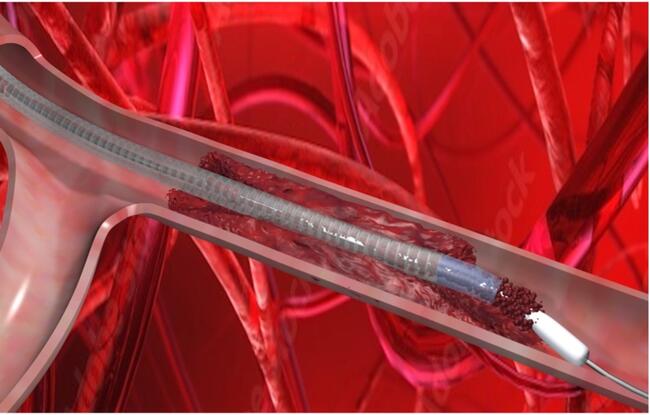
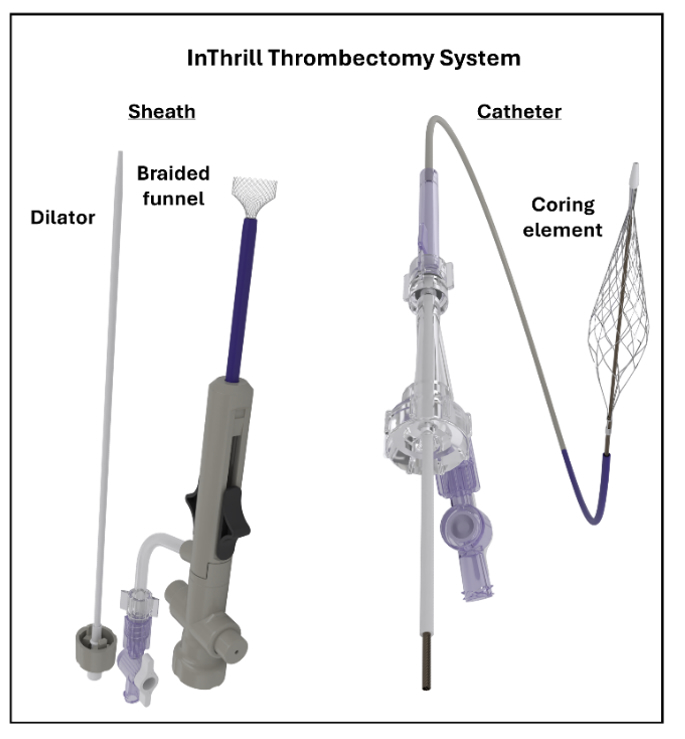
Recently, our practice adopted the InThrill Thrombectomy System (Inari Medical) as a first-line therapy for thrombosed AVFs and arteriovenous grafts (AVGs). Purpose-built for dialysis access management, this 8 French (Fr) system leverages both aspiration and mechanical thrombectomy to remove acute to chronic thrombi and emboli without thrombolytics. The platform consists of an aspiration-capable sheath with a retractable braided funnel and a side aspiration port, and a catheter with a self-expanding mechanical element designed to engage, disrupt, and capture thrombus of varying chronicity from 4-10mm diameter peripheral vessels (Figure 1).
In this report, we describe key practical and technical considerations for integrating the InThrill system into our practice, and present two cases demonstrating sustained flow restoration and rapid resumption of hemodialysis, achieved through single-session mechanical and aspiration thrombectomy.
Experience With InThrill Thrombectomy System
To date, we have performed 29 mechanical thrombectomy procedures with the device on thrombosed AVFs (59%) and AVGs (41%; Figure 2). InThrill employs two mechanisms for thrombus removal, enabling it to remove larger thrombus burden with a wide range of chronicities. After deployment, the device catheter's coring element self-expands into a basket that fully engaged the vessel wall, facilitating the mechanical disruption and subsequent removal of wall-adherent thrombus. Complementing this, aspiration of residual thrombus is performed through the device sheath, while its funnel at the distal tip can help guide displaced thrombus into the sheath. For cases in which the proximal segment is open and thrombectomy was only required to restore venous outflow, we found adjunctive thrombolytics not necessary with the device. For cases addressing arterial inflow, adjunctive thrombolytic therapy was occasionally used to soften the arterial plug prior to pulling with a balloon.
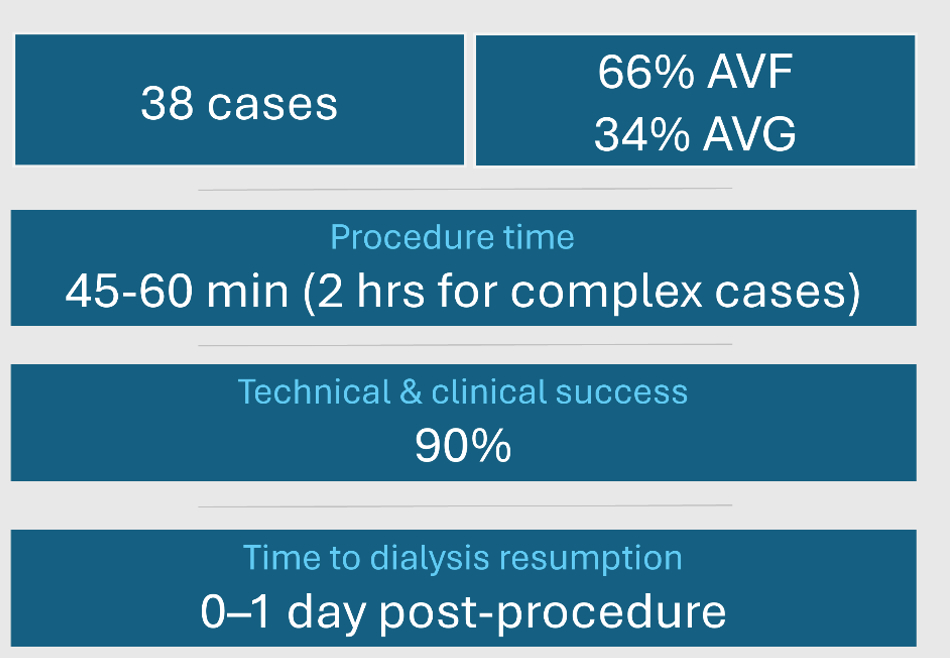
Depending on the complexity of the case, procedure times ranged from 45 to 60 minutes for straightforward cases and 2+ hours for complex cases. The few complications that we encountered — 2 embolic events that resolved during the procedure and 2 access site complications both occurring early in the learning curve — were successfully managed without any long-term impact. Patency was completely restored in 90% of cases, and patients were able to resume dialysis the same or next day.
Overall, the device is easy to use; proficiency can be achieved after 1 to 2 cases. Its smooth integration into our practice was facilitated by the absence of capital equipment or complex setup, which minimized the training required for the hospital staff. The device has delivered effective, reliable, and reproducible results. InThill has become our first-line treatment option due to its ease-of-use and effectiveness for managing a broad spectrum of dialysis access thrombosis cases.
Tips and Tricks
-
Avoid cases involving smaller or less mature (<2 months old) vascular accesses or radial artery accesses.
-
Dilate tract well before inserting the device sheath.
-
Use the device through existing stents with caution.
-
If the AVF is aneurysmal, it may be beneficial to insert a soft wire so the device can follow the curves of the fistula and aneurysm to ensure more thrombus removal instead of staying in a straight line.
-
Compressing the fistula from the outside may help push thrombus into the mechanical element of the thrombectomy catheter. However, be careful when manipulating the thrombus to prevent embolization. Do not place the device sheath so close to the arterial anastomosis if there is large thrombus burden.
-
For upper extremity vascular accesses, consider restoring arterial inflow using balloon angioplasty via transradial access, a potentially more ergonomic and efficient alternative to trans-fistula access7 when the patient’s radial artery is patent and non-dominant. Trans-fistula access requires hand positioning that could cause increased exposure to the primary radiation beam when working through the retrograde sheath. On the other hand, transradial access only requires one sheath that is positioned outside the radiation beam, limiting exposure.
Case Highlights: Case 1.
A 56-year-old male with ESRD undergoing hemodialysis via a transposed basilic vein AVF presented due to an inability to access the AVF for 48 hours. The AVF was created 6 months prior to presentation and had been functioning well without issues for the past 2 months. During this admission, duplex ultrasonography (DUS) showed stenosis with thrombosis of the outflow cephalic vein. Based on the patient’s symptom duration, the thrombus was estimated to be 7 days old. A decision was made to treat the thrombosed AVF using mechanical thrombectomy with the InThrill device.
The patient was administered local anesthesia and minimal intravenous sedation. The AVF was accessed directly with a micropuncture needle approximately 1-2 cm from the anastomosis, and an .035-inch guidewire (Terumo) was advanced through the thrombus into the axillary vein. Venography verified cephalic vein stenosis with thrombosis (Figure 3A). After pre-dilating the access site with a 10 Fr pre-dilator and anticoagulating with systematic heparin, the device sheath was advanced into the access site just proximal to the thrombus, and the sheath’s funnel was deployed. The device catheter was advanced over the guidewire under fluoroscopy until the proximal element marker passed the thrombus. The catheter’s coring element was deployed and then slowly retracted to the sheath under fluoroscopy at a rate of approximately 1-2 mm/s. Aspiration through the sheath using a 30 cc Luer lock syringe attached to the aspiration side port was performed to remove any residual thrombus. The catheter was removed, and the coring element was cleaned of thrombus. This process was repeated 4 times, until the venous outflow was clear of thrombus (Figure 3B). Venography confirmed full patency of the venous outflow (Figure 3C). The sheath funnel was recaptured, and the sheath was removed. The InThrill device time, including setup, insertion, thrombectomy, and removal, was approximately 10 minutes. Hemostasis was achieved using a figure-8 stitch and compression. The estimated procedural blood loss was 20 mL.
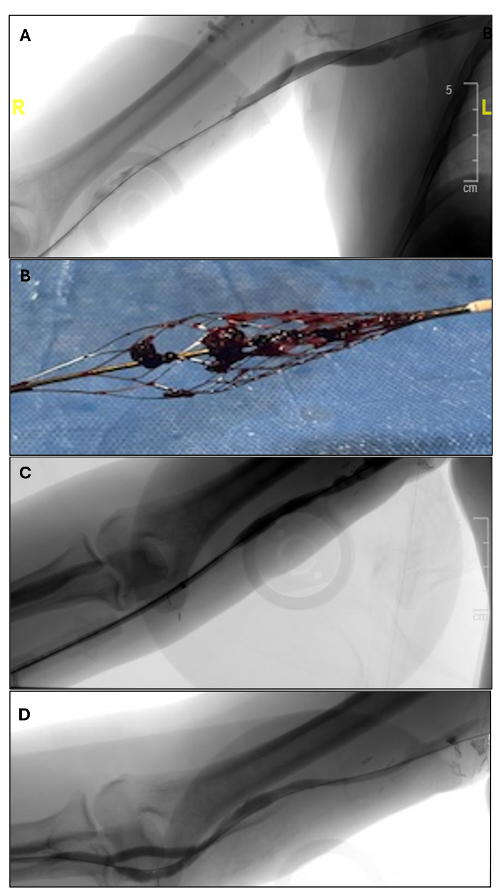
To evaluate the arterial side of the AVF, a non-dominant radial artery access was obtained at the wrist using a 5F Slender sheath (Terumo). Angiogram revealed high-grade stenosis in the juxta anastomotic segment, and angioplasty was performed. A completion fistulogram showed a patent access with rapid flow (Figure 3D). A strong thrill was observed immediately post procedure, and the patient successfully resumed hemodialysis treatment the next day. The patient was discharged without complications, and the AVF has been functioning well for 6 months.
Case Highlights: Case 2.
A 67-year-old female with a history of end-stage renal disease undergoing hemodialysis via a left forearm loop AVG presented due to an inability to access the AVG. DUS showed extensive thrombosis of the AVG. The thrombus was estimated to be 5 days old. A decision was made to salvage the AVG using mechanical thrombectomy.
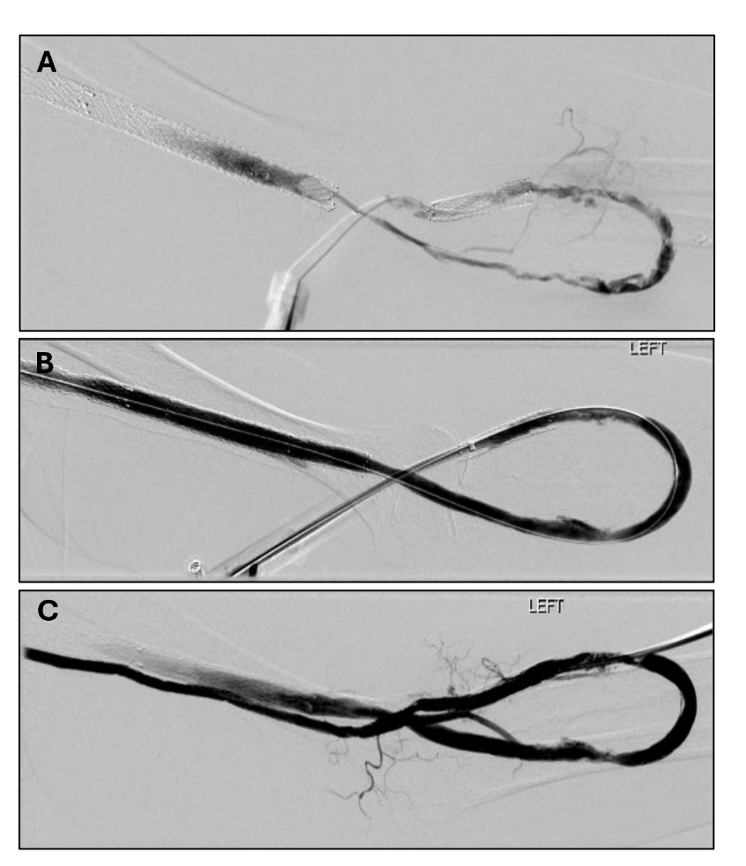
Access was obtained on the medial aspect of the AVG, and a 5 Fr sheath was inserted and upsized to a 7 Fr sheath. Venography was performed, confirming extensive thrombus throughout the AVG (Figure 4A). Thrombectomy with InThrill was performed following the technique described in Case 1. Multiple passes with the thrombectomy catheter, followed by aspiration with the device sheath, removed most of thrombus and opened the venous aspect of the loop graft, resulting in near-complete graft patency (Figure 4B). The InThrill device time was approximately 25 minutes. The estimated blood loss was 25 mL.
The stenosis in the arterial aspect of the AVG was addressed with balloon angioplasty via a secondary access with a 5 Fr sheath on the venous limb of the graft. Completion angiography showed full restoration of flow (Figure 4C). Hemodialysis treatment was successfully performed via AVG the next day, and the patient was discharged home.
Discussion
In our experience, the InThrill thrombectomy system was easy to use, reliable, and straightforward. Its simple setup allowed seamless integration into our clinical workflow, and the results were consistently reproducible without reliance on adjunctive thrombolytics. Consequently, InThrill has become our first-line device for dialysis access management.
The cases presented herein demonstrate the potential of the device to efficiently salvage thrombosed AVFs and AVGs without the need for adjunctive thrombolytics for the rapid resumption of critical hemodialysis treatment. Thrombectomy was performed safely without general anesthesia and with minimal discomfort to the patients. Thrombus clearance was achieved via both mechanical and aspiration thrombectomy to restore venous outflow. Vascular access function was restored with no complications and negligible blood loss, enabling the rapid resumption of hemodialysis treatment for each patient. Both vascular accesses have remained patent for about 6 months without need for further interventions.
Our experience with the InThrill device is consistent with published reports.8-10 Specifically, a retrospective review reported 20 thrombolytic-free single session treatments with relatively short procedure and device times, and no intraprocedural adverse events, to yield high technical and clinical success rates and patency rates at 1 and 3 months.10 While these preliminary results present promising implications, larger studies with extended patient follow-up are necessary to comprehensively evaluate the safety and efficacy of the device in managing thrombosed hemodialysis accesses.
Prior to this device, thrombectomy procedures were not performed frequently in our practice because they were long and tedious, often failing to remove a significant amount of thrombus. As a result, the outcomes were generally poor, which limited their adoption. The dual mechanisms of thrombus removal — mechanical thrombectomy with a nitinol element, combined with aspiration through a sheath equipped with a guiding funnel — enable InThrill to remove a greater thrombus burden, including wall-adherent clot. This integrated approach enhances the overall effectiveness of the procedure.
Incorporating the InThrill System in our practice has meaningful implications for patient care and the broader healthcare system. Our patients experience faster recovery, fewer complications, and more reliable continuity of hemodialysis treatment. Avoiding thrombolytics also has the potential to reduce procedure-related hospital stays and decrease the number of return visits for access-related issues. Collectively, these efficiencies can lessen the economic burden on both patients and hospitals. Ultimately, streamlined access salvage and reduced treatment disruption may translate into an improved quality of life for this vulnerable population.
Conclusion
In our experience, the InThrill thrombectomy system is easy to use, efficient, and effective, delivering reproducible results and favorable long-term clinical outcomes. The presented cases highlight the device’s potential to salvage thrombosed AVFs and AVGs via mechanical and aspiration thrombectomy in a single session, ensuring rapid restoration of critical hemodialysis access without the need for thrombolytics. Importantly, both patients have been maintained beyond 6 months without reintervention. Given the substantial challenges faced by hemodialysis patients, further evaluation of the device’s safety and efficacy, as well as continued innovation in dialysis access management, is warranted.
Yana Etkin, MD; Caitlin Dowling, MD
Northwell Health, New Hyde Park, New York
Disclosures: Dr. Etkin is a speaker for Stryker PV. Dr. Dowling reports no conflicts of interest regarding the content herein.
The authors can be contacted via Yana Etkin, MD, at etkinyana@gmail.com.
References
1. Quencer KB, Friedman T. Declotting the thrombosed access. Tech Vasc Interv Radiol. Mar 2017; 20(1): 38-47. doi:10.1053/j.tvir.2016.11.007
2. Dembowska E, Jaroń A, Gabrysz-Trybek E, et al. Quality of life in patients with end-stage renal disease undergoing hemodialysis. J Clin Med. 2022 Mar 13; 11(6): 1584. doi:10.3390/jcm11061584
3. Viecelli AK, Mori TA, Roy-Chaudhury P, et al. The pathogenesis of hemodialysis vascular access failure and systemic therapies for its prevention: Optimism unfulfilled. Semin Dial. May 2018; 31(3): 244-257. doi:10.1111/sdi.12658
4. Almehmi A, Sheta M, Abaza M, et al. Endovascular management of thrombosed dialysis vascular circuits. Semin Intervent Radiol. Feb 2022; 39(1):14-22. doi:10.1055/s-0041-1740941
5. Ocak G, van Stralen KJ, Rosendaal FR, et al. Mortality due to pulmonary embolism, myocardial infarction, and stroke among incident dialysis patients. J Thromb Haemost. Dec 2012; 10(12): 2484-2493. doi:10.1111/j.1538-7836.2012.04921.x
6. Yeo CB, Yong E, Hong Q, et al. Outcomes of catheter-directed thrombolysis for arteriovenous fistula thrombosis in Singapore: is it still relevant today? Ann Vasc Dis. Mar 25 2021; 14(1): 5-10. doi:10.3400/avd.oa.20-00112
7. Kohiyama M, Hoffstaetter T, Silpe J, Garlapati A, Landis GS, Etkin Y. Transradial access for balloon-assisted maturation of arteriovenous fistulas. J Vasc Surg Cases Innov Tech. Jun 2023; 9(2): 101133. doi:10.1016/j.jvscit.2023.101133
8. Devireddy RR, Qaqi O. Restoring access in a thrombosed hemodialysis reliable outflow graft using the InThrill thrombectomy system. Cureus. 2024/3/19 2024; 16(3): e56496. doi:10.7759/cureus.56496
9. Misono A. Early experience and key learnings of the InThrill thrombectomy system for treating arteriovenous access thrombosis in hemodialysis patients. Cath Lab Digest. April 2023 2023;31(4):1-7. https://www.hmpgloballearningnetwork.com/site/cathlab/original-contribution/early-experience-and-key-learnings-inthrill-thrombectomy-system
10. Katsiroubas J, Chitanvis M, Waldman R, et al. Mechanical thrombectomy with the InThrill device for thrombosed hemodialysis access: A single center experience. J Vasc Access. Aug 24 2024:11297298241273605. doi:10.1177/11297298241273605