Building a Culture of Accountability: Using Registry Data to Engage Physicians and Drive Performance
© 2026 HMP Global. All Rights Reserved.
Any views and opinions expressed are those of the author(s) and/or participants and do not necessarily reflect the views, policy, or position of Cath Lab Digest or HMP Global, their employees, and affiliates.
Carol Wesley, MSN, MHA, RN
Sr. Vice President, Consulting, Corazon
 In today’s rapidly evolving healthcare landscape, hospital executives face mounting pressure to deliver high-quality outcomes while maintaining financial sustainability. As reimbursement models shift toward value-based care and regulatory demands intensify, cultivating a culture of accountability becomes a strategic imperative. This culture engages clinicians, aligns them with organizational goals, and fosters transparency through the use of national cardiovascular (CV) registries.
Corazon believes that by integrating metrics from nationally recognized CV registries into clinical and operational workflows, hospitals can transform standardized, evidence-based data into actionable insights. These metrics, rooted in real-world outcomes and national benchmarks, empower organizations to drive performance improvements, enhance patient outcomes, and reinforce financial sustainability. With the support of skilled data abstractors and advanced analytics, data-driven CV programs empower hospitals to benchmark performance against national standards, identify gaps in care, and implement evidence-based improvements. These initiatives serve as catalysts for continuous quality enhancement, seamlessly aligning clinical excellence with strategic organizational growth.
The Strategic Role of Cardiovascular Registries
National registries have evolved from simple compliance tools into strategic assets, with the data they generate now serving as a foundation for clinical performance improvement, operational efficiency, and financial optimization across healthcare organizations. Registries such as the National Cardiovascular Data Registry (NCDR), Get With The Guidelines (GWTG), and the Society of Thoracic Surgeons (STS) provide validated benchmarks that allow hospitals to:
- Monitor performance in near real-time
- Identify care gaps and correct them proactively
- Strengthen payer negotiations with third-party validated data
- Align with value-based reimbursement models
Historically, registries were implemented to meet mandates from state health departments, such as reporting PCI outcomes through the NCDR CathPCI Registry or fulfilling stroke center requirements via GWTG. Today, forward-thinking organizations leverage registry data not only to meet mandates but also to drive clinical excellence and strategic decision-making.1
These registries enable the systematic collection and analysis of real-world data, which is then applied to improve care quality, enhance operational efficiency, and support ongoing performance improvement.
The Case for Accountability in Cardiovascular Care
Value-based care is reshaping the healthcare landscape, and CV services are at the forefront of this transformation. As one of the most resource-intensive and high-impact service lines in hospitals, cardiovascular care plays a critical role in influencing both clinical outcomes and financial performance. The urgency of this focus is underscored by the American Heart Association’s finding that CV disease remains the leading cause of death worldwide, responsible for 17.9 million deaths annually.2
Despite its importance, aligning individual physician performance with organizational goals can be a challenge. Physicians often operate independently, and without access to comparative data, it becomes difficult to identify areas for improvement or recognize excellence. Registry data-driven programs offer a solution by providing validated, real-world data that creates a shared language for performance and improvement.
Leveraging Registry Data for Physician Engagement
Engaging physicians in performance improvement efforts is essential to building a culture of accountability in cardiovascular care. One of the most effective ways to foster this engagement is through the strategic use of registry data. When presented transparently and in context, registry metrics offer clinicians a clear view of their performance relative to national benchmarks and peers. This data-driven approach not only builds trust but also encourages physicians to take ownership of outcomes, participate in collaborative improvement efforts, and align their practice with evidence-based standards.
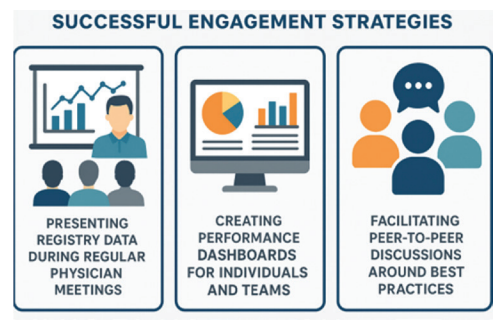
When shared transparently, this data becomes a powerful engagement tool (Figure 1). Physicians are more likely to trust and act on data that is standardized, risk-adjusted, and benchmarked against national norms. Interactive registry dashboards allow clinicians to view performance metrics in real time, promoting transparency and fostering a sense of ownership and accountability in clinical decision-making.
Building the Infrastructure for Data-Driven Accountability
To fully harness registry data for driving performance improvement and clinical excellence, service line leaders must establish a strong infrastructure that ensures data accuracy, accessibility, and strategic alignment. A key component of this infrastructure is having well-trained, experienced data abstractors who can reliably capture and interpret clinical information.
The role of a dedicated data abstractor is essential to driving quality and ensuring reliable participation in clinical registries.3 Beyond extracting key clinical data, abstractors are responsible for validating its completeness, consistency, and accuracy prior to submission to national or specialty-specific registries. Their work supports timely data entry, which is critical for real-time performance monitoring and meeting reporting deadlines. Additionally, abstractors often serve as vital liaisons between clinical teams and quality departments, translating clinical documentation into structured data that informs benchmarking, compliance, and continuous improvement initiatives.
Data abstractors assist in embedding registry metrics into clinical workflows by accurately extracting and standardizing data, which provides a reliable foundation for quality improvement and performance measurement.4 They act as a crucial bridge between raw clinical data and actionable metrics by ensuring data quality, enabling clinicians to focus on care, and providing the necessary data for performance reporting and compliance.
An essential component of a strong data infrastructure is moving beyond passive data collection. Corazon advocates for integrating registry metrics into daily clinical workflows to make data truly actionable. Embedding key performance indicators (KPIs) and registry metrics directly into the electronic health record (EHR) allows clinicians to access relevant insights at the point of care, supporting informed decision-making and reinforcing accountability. Real-time dashboards can visualize trends in outcomes, protocol adherence, and benchmarking data, empowering both frontline teams and leadership. Additionally, leveraging registry data to trigger alerts or reminders within the EHR helps clinicians follow best practices and reduce variability in care delivery.
Strategic Alignment with Value-Based Care
Registry data should not function in isolation. To maximize its impact, it must be strategically aligned with the broader goals of the organization, particularly in the context of value-based care.
- Linking to Strategic Objectives: Registry metrics should be intentionally selected to reflect the organization’s key priorities. These may include reducing hospital readmissions, improving procedural outcomes, enhancing patient satisfaction, or increasing care coordination. When metrics are aligned with strategic goals, they become powerful tools for guiding operational decisions and measuring progress.
- Supporting Value-Based Models: As healthcare reimbursement continues to shift from volume to value, the ability to demonstrate quality and outcomes is more important than ever. Registry data provides the evidence needed to support value-based care initiatives, justify clinical investments, and strengthen payer negotiations. It helps organizations quantify the value they deliver, both in terms of patient outcomes and cost effectiveness.
- Driving Continuous Improvement: Regular, structured review of registry data in multidisciplinary forums fosters a culture of transparency, accountability, and learning. Reviews encourage collaboration across departments, promote proactive problem-solving, and spark innovation. By using registry data to identify trends, gaps, and opportunities, organizations can continuously refine their practices and elevate care delivery.
Ultimately, aligning registry data with strategic goals ensures that data collection is not just a regulatory requirement, but a catalyst for meaningful change. It empowers healthcare leaders to make informed decisions, improve performance, and deliver high-value care in an increasingly competitive and outcomes-driven environment.
Driving Performance Through Peer Comparison and Benchmarking
One of the most powerful applications of clinical registry data is its ability to foster performance improvement through peer comparison and benchmarking. By enabling clinicians and healthcare organizations to evaluate their outcomes against national standards and peer institutions, registry data becomes a catalyst for accountability, transparency, and continuous improvement.
Corazon has seen that organizations can motivate improvement through comparative insight. When physicians and care teams can see how their performance stacks up against national benchmarks and their colleagues, it creates a natural incentive to improve. This visibility and transparency encourage self-reflection and identification of practice gaps and promote a culture of excellence. This culture of excellence provides an environment where teams strive to meet or exceed high standards and supports peer-to-peer learning, as high-performing sites share best practices with others.
Corazon has assisted many organizations in leveraging benchmarking data to consistently demonstrate improvements in patient outcomes, operational efficiency, and patient satisfaction, all key pillars of value-based care. And by leveraging national registries, standardized metrics offer risk-adjusted performance measures that are:
- Endorsed by the National Quality Forum (NQF), ensuring credibility and alignment with national quality standards.
- Suitable for public reporting, enhancing transparency and trust with patients and stakeholders.
- Integral to quality improvement programs, providing actionable insights for clinical and operational enhancements.
These registries provide a way for organizations to benchmark performance across a wide range of metrics, from procedural outcomes and complication rates to adherence to evidence-based protocols.
Corazon has assisted numerous organizations in maximizing the value of benchmarking by embedding these metrics and goals into strategic quality initiatives. To achieve meaningful impact, registry metrics should be integrated into performance dashboards and quality scorecards, enabling real-time visibility into clinical outcomes. Regular review of this data in multidisciplinary forums fosters collaboration between clinical and administrative leaders, driving targeted improvement strategies. When benchmarking results are aligned with strategic goals such as reducing care variation, improving throughput, or enhancing patient experience, hospitals and health systems can transform data into actionable insights and elevate their overall performance.
Sustaining a Culture of Accountability
Building a culture of accountability is not a one-time initiative. It requires ongoing effort. Embedding data review into regular governance structures, such as medical staff meetings or quality committees, ensures sustained focus. Recognizing and rewarding data-informed excellence through public acknowledgment, performance incentives, or leadership opportunities reinforces the value of accountability. Continuous feedback loops, where data is reviewed, discussed, and acted upon, create an environment of iterative improvement. Value-based care thrives when providers are held accountable for outcomes and supported with timely, relevant data.
A Consultant’s Perspective: Best Practices and Pitfalls to Avoid
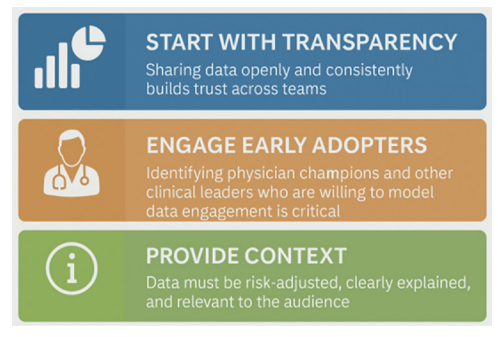
Corazon frequently guides organizations through the cultural transformation required to embrace data-driven accountability. This shift is not just technical. It is deeply rooted in leadership, communication, and trust (Figure 2).
Corazon also cautions against common pitfalls that can undermine data initiatives:
- ntroducing Data Without Adequate Explanation or Support: Simply presenting numbers without context or guidance can lead to confusion, resistance, or disengagement.
- Using Data Punitively Rather Than Constructively: When data is used to penalize rather than support improvement, it erodes trust and discourages collaboration.
- Failing to Align Data Initiatives with Strategic Goals: Data efforts must be tied to broader organizational priorities. Without alignment, initiatives risk becoming siloed or losing relevance.
Consultants can play a vital role in facilitating this transformation. Corazon’s approach focuses on building trust, aligning stakeholders, and ensuring that data initiatives are both technically sound and culturally sensitive. This includes helping organizations embed accountability into their operational framework, so that data is not just collected, but actively used to inform decisions, optimize resources, and elevate patient outcomes.
For hospital administrators, accountability in cardiovascular care is more than a compliance requirement. It is a strategic lever for institutional excellence. By effectively utilizing registry data, administrators can empower clinical teams, monitor performance in real time, and align care delivery with national benchmarks and value-based care objectives.
Embedding accountability into the organizational culture yields long-term benefits: improved quality metrics, enhanced operational efficiency, and a stronger, more resilient cardiovascular program positioned for sustainable success.
References
- Registry Partners. Optimizing resources with patient registry data amid workforce shortages. Published October 27, 2025. Accessed May 20, 2026. https://www.registrypartners.com/optimizing-resources-with-patient-registry-data-amid-workforce-shortages/
- American Heart Association. 2025 heart disease and stroke statistics: a report of U.S. and global data. Published January 27, 2025. Accessed May 20, 2026. https://www.heart.org/en/about-us/heart-and-stroke-association-statistics?uuid=1740
- American Data Network. How data abstraction drives quality improvements in healthcare. Published October 17, 2023. Accessed May 20, 2026. https://www.americandatanetwork.com/clinical-data-abstraction/clinical-data-abstraction-for-improved-patient-outcomes
- Gliklich RE, Leavy MB, Dreyer NA, eds. Registries for Evaluating Patient Outcomes: A User’s Guide [Internet]. 4th ed. Chapter 11: Obtaining Data and Quality Assurance. Agency for Healthcare Research and Quality; September 2020. Accessed May 20, 2026. https://www.ncbi.nlm.nih.gov/books/NBK562556/