Alabama Joins Other States With Law Allowing EMS Treatment and Transport of Injured Law Enforcement Dogs
Updated Saturday, Nov. 1 with an edit to K9 Lakyn's status.
Police K9s play a critical role in law enforcement activities such as detecting narcotics, locating missing persons, and assisting their human counterparts in high-risk operations. Unlike their human counterparts, however, police K9s haven’t always been entitled to emergency medical care, primarily due to legal concerns. Police K9s in Alabama will now be eligible for emergency medical services thanks to a new state law.
The Lakyn Canine Act was enacted in May 2025 and allows emergency responders to administer care and transport injured K9 officers without fear of legal liability. The law is named for K9 Lakyn, a military K9, who passed due to health issues after discharge. The act was presented in the Alabama House on behalf of Abby Smith, who was Lakyn’s handler.
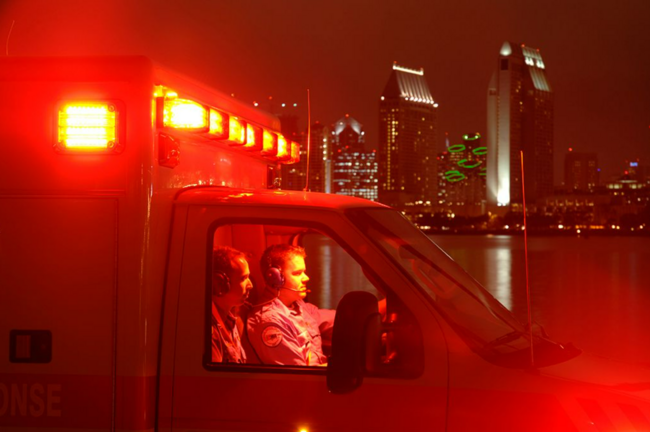
In essence, the law authorizes EMS personnel to provide emergency medical care to injured police dogs and to transport them to a veterinary clinic or veterinary hospital and provides immunity from liability arising from providing such medical care.
Key aspects of the law include:
- Allowing K9 transportation to a veterinarian facility if there is no human requiring medical attention or transport at that time.
- EMS personnel acting in good faith to provide emergency medical care to a police dog are immune from criminal or civil liability as it relates to any injury or harm caused to the
injured police dog. - EMS personnel are also immune from criminal or civil liability for refusing to treat or transport an injured police dog.
Law Provides Legal Protection for EMS
Alabama joins several other U.S. states with similar laws, including Arizona, Delaware, Florida, Illinois, Massachusetts, Michigan, Nebraska, New York, and Rhode Island. A common restriction among the laws is that care and transport transpires only when no human requires EMS transport.
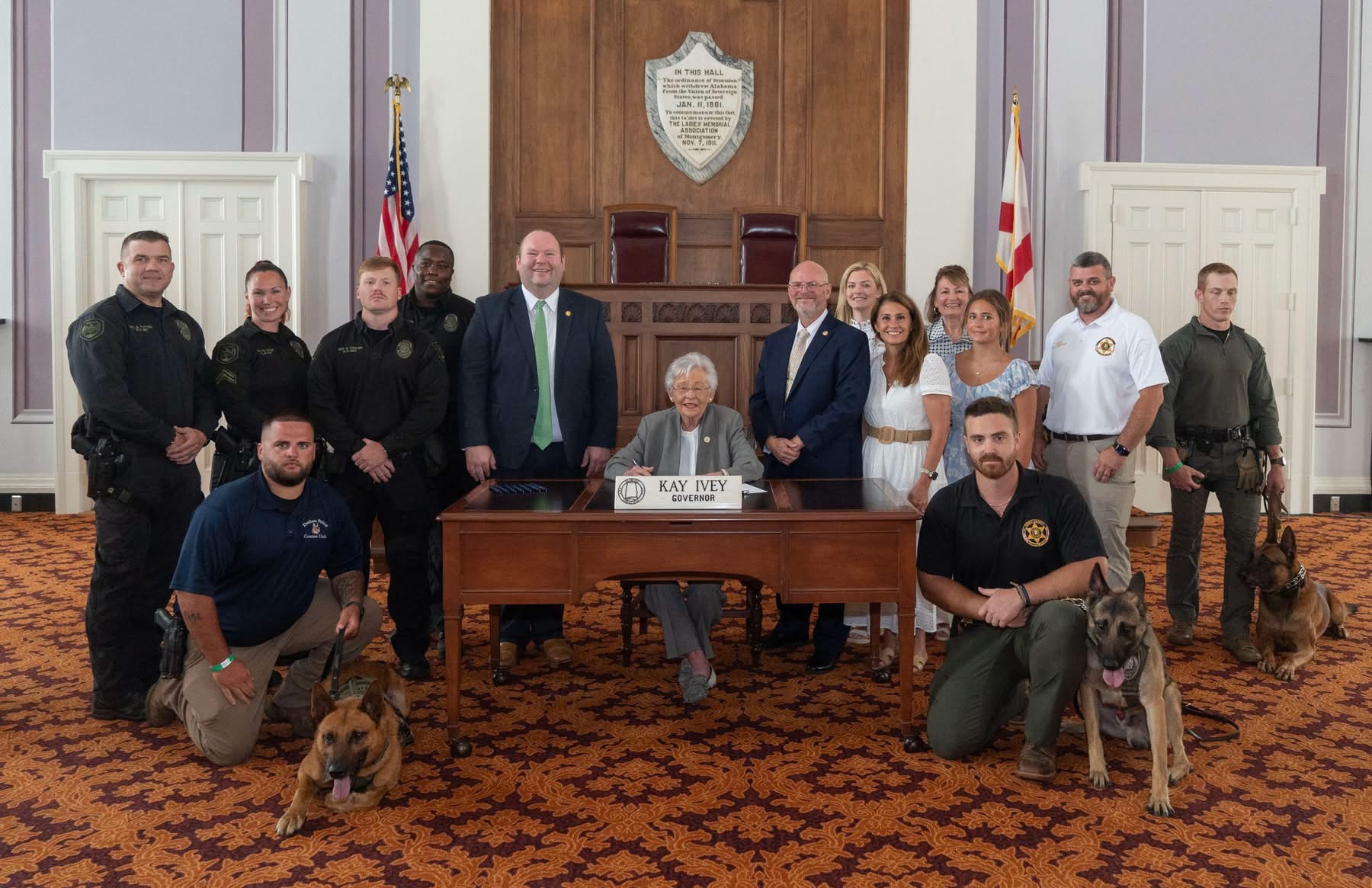
Alabama’s Lakyn Canine Act was sponsored by State Rep. Rick Rehm and ensures police dogs injured in the line of duty receive the same level of emergency treatment as their human counterparts.
According to Rehm and Henry County Sheriff Eric Blankenship, who supported the bill, the absence of legal protection had prevented EMS from rendering aid to police dogs, but the law mitigates that challenge.
Blankenship points to similar legislation passed in Florida following an incident during which law enforcement officers had a difficult time trying to get medical care for a K9 injured in the line of duty.
“We wanted to take a proactive approach here in Alabama before a similar incident happened,” he said, adding the support of Representative Rehm, who represents Henry County.
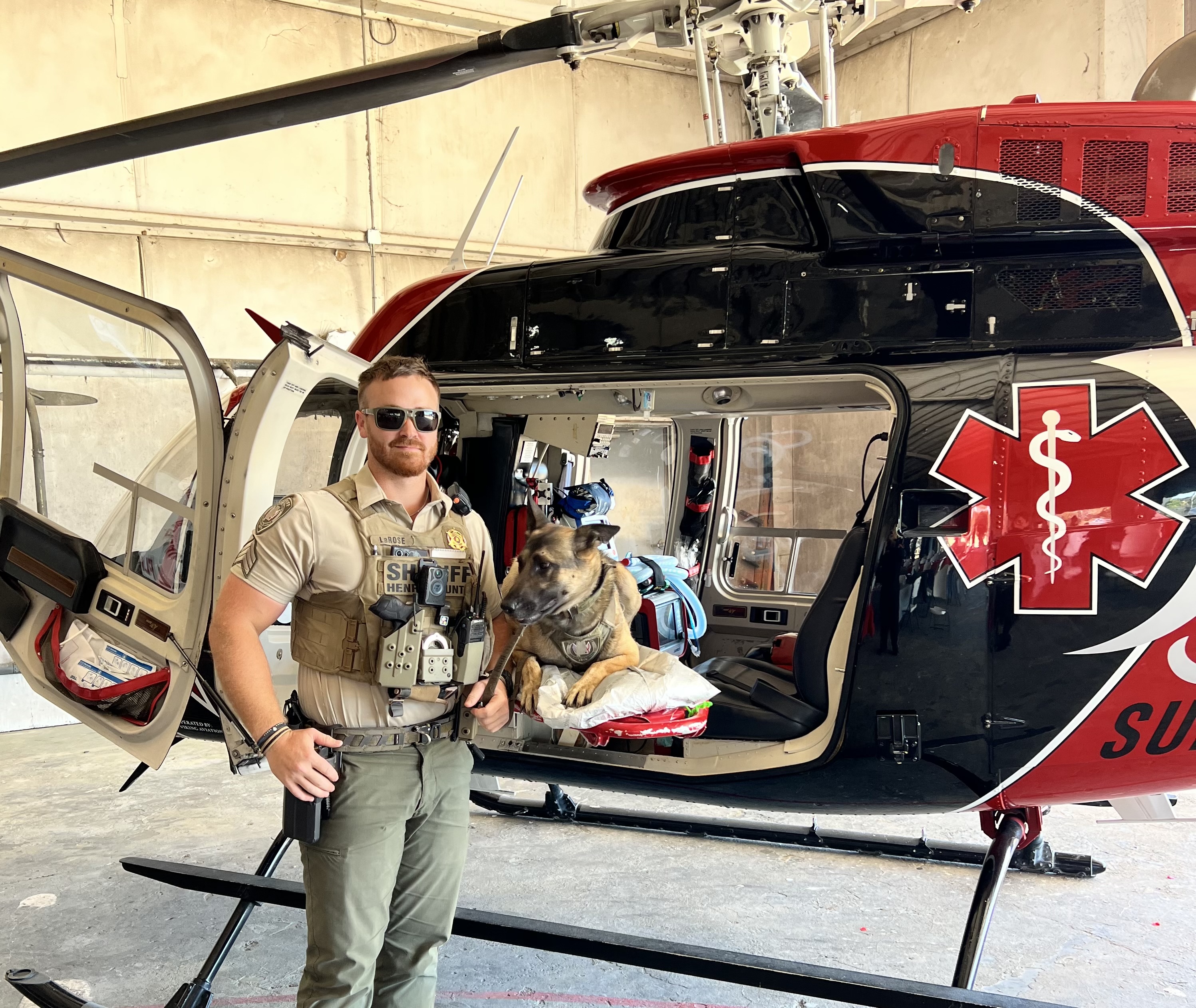
Blankenship pointed out the law allows EMS transport via ambulances and medical helicopters to transport K9s injured in the line of duty to an animal medical facility to receive treatment without liability. The law also allows the K9 handler to go with his or her K9 partner during transport to help keep the K9 calm.
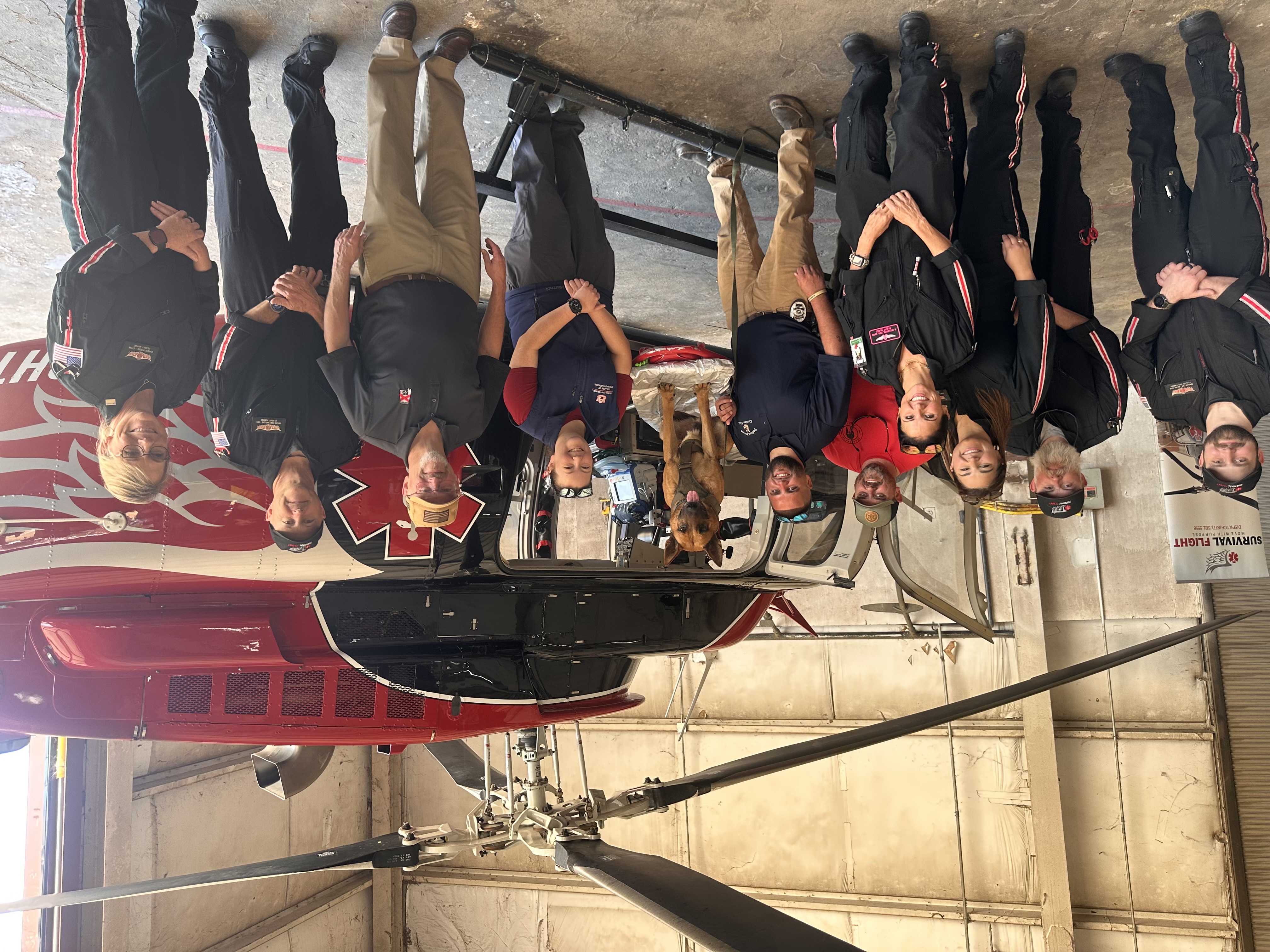
Survival Flight 15, a medical helicopter based in Headland, Alabama, in Henry County, has procedures in place to transport any injured K9s and also has procedures in place to transport directly to the veterinarian hospital at Auburn University to treat any injured K9s in the Wiregrass region.
Survival Flight also has five additional bases set up in Alabama, Florida, and Georgia to do the same, noted Blankenship, adding “they are working to get all aircraft set up the same way throughout their fleet.”
Blankenship said while no K9s in his county have ever been put in a position where they would have needed such a service, “I am thankful we took the proactive approach before something does happen.”
Blankenship said he is grateful to Rep. Rehm for sponsoring the legislation, the State Legislature for passing it, and Gov. Kay Ivey for signing it into law “to protect our valuable assets. I would also like to thank all the EMS personnel who have stepped up to help our K9s. We are truly blessed.”
K9s United Supports Legislative Efforts Across Country
Also helping to push the Alabama legislation through is K9s United, a nonprofit organization supporting law enforcement K9 units throughout the U.S. The organization conducts advanced training seminars, donates needed equipment that’s not being met with an agency’s budget and does portraits for every fallen K9 in the U.S. Debbie Johnson founded the organization after learning about the murder of K9 Baron in Florida’s St. Johns County.
K9 Baron was killed in October 2014 as he tracked a suspect in a swampy area off State Road 207. The dog’s handler found K9 Baron dead in the water. A massive manhunt led to a 27-year-old man who was arrested on charges of causing great harm or death of a police animal and resisting arrest without violence.
Johnson advocated for legislation in Florida after a March 2020 incident in Jacksonville, Florida where ATF K9 Bane was rescued by local firefighters and fellow officers after an electrical fire broke out in the vehicle in which he was resting during a lunch break.
The fire damaged the electrical system, preventing his handler from opening the kennel door to get him out. Other K9 handlers and firefighters used the jaws of life and other means to extinguish the fire and successfully free Bane from the burning car.
First responders administered oxygen before transporting him to a veterinary team.
“There was a little bit of blowback because they made the command decision to transport, which saved his life,” said Johnson. “I had already been working on legislation and was successful in passing a law in 2019 that strengthened the penalty if you kill a K9 in the state of Florida. I went back to Tallahassee and worked on and proposed a bill with Sen. Tom Wright for the EMS transport bill.”
She went on to work with Alabama officials to propose and pass similar legislation.
According to the Offer Down Memorial Page, by the end of September, there had been 20 line-of-duty deaths among K9s nationwide. Causes include blunt force trauma, duty-related illness, gunfire (one inadvertent), heart attack, heat stroke, struck by vehicle, vehicular assault, and vehicle pursuit.
The deaths occurred in Arizona (gunfire) and Florida (vehicular assault) where transport laws exist for injured K9s, as well as Georgia, Hawaii, Louisiana, Maine, Minnesota, Missouri, New Mexico, North Carolina, Ohio, South Carolina, Tennessee, Texas, Virginia, and West Virginia.
Johnson noted that rendering care to a fallen K9 is not much different than for a human. Her organization hosts hands-on first aid training seminars, which include EMS personnel and handlers “because it’s very important that the EMS personnel know how to work with the handler if there’s an injured dog.”
Training also includes working with the Survival Flight medical helicopter.
Johnson is currently working with the state of North Carolina to enact a law there.
“I’m trying to reach as many states as I possibly can, encouraging them to propose legislation,” she said. “Sometimes it’s a matter of life or death and these K9s are invaluable to our communities and what they do.”
EMS Field Guide for K9 Treatment
K9s United has consulted with veterinarians and leaders in the canine world to produce an EMS field guide addressing the many factors to consider when rendering aid to K9s during transport.
Johnson noted that K9 Chaos of the Nassau County Sheriff's Office in Florida was shot and seriously wounded in 2021 while searching for the suspect who killed Deputy Josh Moyers.
K9 Chaos survived and recovered.
“EMS transport did not know how to start an IV on the dog, but the handler was able to do it because he attended one of our training seminars,” Johnson said.
That field guide is titled "Field Guide for EMS Personnel Caring for Injured K9s As Adapted from TCCC K9, FEMA, and U.S. Military K9 Care Guides."
It addresses trauma management, airway management, altered mental status, respiratory, open abdominal wounds, shock, hyperthermia/heat injuries, hypothermia/cold injuries, orthopedic injuries and fractures, eye injuries, burn injuries, and gastric dilatation/bloat and volvulus.
It also addresses pad/paw injuries, allergic reaction to insect bites/stings, allergic reaction to reptile envenomation, vomiting and/or diarrhea, dehydration, toxic exposure/inhalation, opioid/fentanyl/occupational exposures, chemical/biological/radiological/nuclear and explosives, head/neck/trunk injuries, and pain management and sedation.
K9s are key members of the law enforcement community, noted Sean Gibson, executive director of the Southeast Alabama EMS Council.
“These animals become very close to their handlers and their handlers to them,” he said. “With the opportunity for emergency transport and care, the handler is afforded hope.”
Gibson said K9 care is a specialized course that many EMS providers do not possess. “The program is being offered more and more often; however, for those who are not formally trained, oxygen therapy and transport can be a lifesaving strategy that all can provide.”
Gibson points out that many agencies are now dealing with rendering aid to animals anyway through a pet being trapped in house fires.
“When removed, many animals are saved by EMS through oxygen and IV therapy,” he said. “They can provide bleeding control, fluid administration through IV behind the head between the shoulder blades, provide oxygen, provide ventilations with specialized masks, and provide chest compressions.”
Gibson said there is a K9 course offered throughout Alabama to help with these skills. Technical rescue teams also take a medical specialist course during which they receive K9 care education. He supports the idea of all states having similar laws to that of Alabama’s regarding injured K9 support.
“EMS is a system, and all systems are comprised of multiple parts,” Gibson said. “One of those parts is law enforcement and we should approach this topic as we would for one of our brothers or sisters in law enforcement. Their K9 partner is a very important component of the team and should receive our best.”
Blankenship said he believes there should be similar legislation in all U.S. states. “Our four-legged officers deserve the same treatment as their handlers,” he says. “They put their lives on the line every day to keep our communities safe.”