Building a Productive EMS Classroom moves EMS educators beyond test-driven instruction toward training that produces field-ready providers. Participants explore strategies for creating effective learning partnerships, developing clinical thinking and professional identity, leaving with ...
Prehospital blood programs are particularly important to rural communities who are often significant distances from trauma centers, increasing the transport time of patients to definitive care after critical incidents, such as motor vehicle crashes. But starting and maintaining these pr...
Are you still relying primarily on manual ventilation, or is your EMS system considering adding mechanical ventilation—or upgrading the ventilation capabilities you already have? New innovations in portable mechanical ventilation are changing what is possible in the prehospital environm...
Following a hugely popular June webinar exploring common documentation pitfalls, audit risks, and the operational pressures facing EMS agencies, we’re revisiting the topic to answer EMS leaders' questions. Using a workshop format, Digitech Head of Compliance Amanda Stark will review rea...
In this session, we will discuss the challenges public safety, and EMS practitioners in particular, face when they are called to the scene of a significant emergency. Whether cardiac arrest, your child's trauma, delivering a baby or helping out a friend or family member, the pressure is...
Effective EMS documentation is a critical professional skill that goes far beyond filling out a form. It reflects clinical thinking, supports patient care, and creates a legal and operational record that outlives the call. Thorough documentation of training and education is also critica...
Session Details
Breathing Life into Pediatric Care: Key Skills for Effective Airway Management is a hands-on skills discussion using real-world equipment that's designed to equip EMS professionals with practical, hands-on techniques for managing pediatric airway emergencies in the preh...
Did you know that two cannulas can look nearly identical, yet deliver very different results for your patients? Join us for a hands-on, visual exploration of single-nare sampling line design and the clinical impact of split-flow cannulas. Through real device demonstrations and clinical ...
Capnography provides real-time, continuous information that can assist in the early detection of respiratory distress, effectiveness of ventilation, and proper placement of advanced airway devices. Additionally, ETCO2 monitoring offers crucial insight into cardiac arrest resuscitation e...
Over the past decade, there has been a dramatic increase in lawsuits against EMS providers and agencies. High profile cases, such as the death of Elijah McClain, bring EMS providers and prehospital medicine into the spotlight.
In life-threatening emergencies, every second counts, and mastering airway management can make the difference between life and death. Airway Emergencies Unlocked dives deep into the critical skills and strategies needed to successfully navigate complex and high-pressure airway situation...
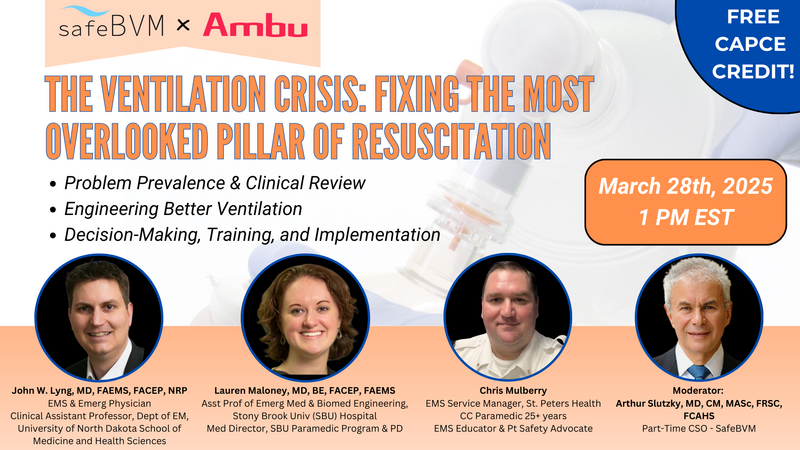
Manual ventilation plays a critical role in patient survival, yet it remains highly variable and often overlooked in resuscitation efforts. This webinar explores the science, challenges, and solutions behind improving manual ventilation, addressing common errors, engineering-driven inno...
WyoFile journalist Madelyn Beck's series on Wyoming’s embattled EMS industry unpacks a notoriously underreported field. Learn more about the series from the writer herself.
WyoFile journalist Madelyn Beck's series on Wyoming’s embattled EMS industry unpacks a notoriously underreported field. Learn more about the series from the writer herself.
Emergency department overcrowding, manifested by filled ER bays, overflowing waiting rooms, and more is widely reported in the US. However, many other developed countries face similar fallout from a lack of emergency capacity.
Emergency department overcrowding, manifested by filled ER bays, overflowing waiting rooms, and more is widely reported in the US. However, many other developed countries face similar fallout from a lack of emergency capacity.
Baltimore allotted 74.2% of its COVID-19 public safety funds to violence reduction and prevention efforts, 15.2% to the fire department, and 10.5% to police.
Baltimore allotted 74.2% of its COVID-19 public safety funds to violence reduction and prevention efforts, 15.2% to the fire department, and 10.5% to police.