National EMS Advisory Council Members Abruptly Terminated
Updated Aug. 18, 2025 with quotes from NEMSAC Co-Chair Tom Arkins
Washington, D.C.—All 25 members of the National Emergency Medical Services Advisory Council (NEMSAC) were terminated from their roles on Aug. 13, 2025, via official letter, which offers no explanation for the dismissal.
The letter, signed by Office of EMS Director Gamunu Wijetunge, reads, “As of the date of this letter, your appointment has been terminated.”
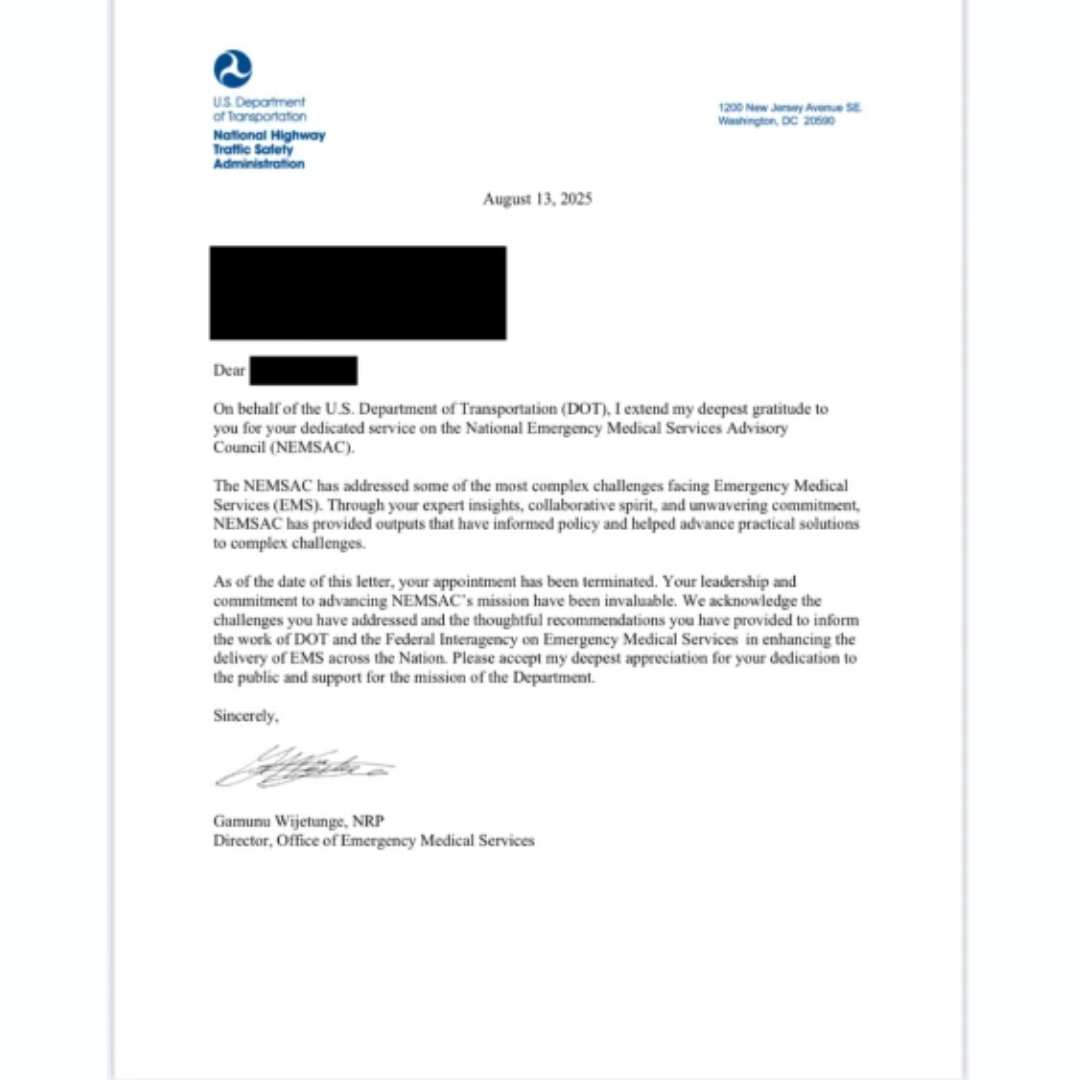
The letter extends appreciation for the council’s contributions, noting NEMSAC members “have addressed some of the most complex challenges facing Emergency Medical Services” and have “informed policy and helped advance practical solutions.”
Established in April 2007, NEMSAC is a statutory body composed of 25 experts and representatives across the EMS community. Members are appointed by the Secretary of Transportation for two-year terms and may serve up to two terms. The council provides non-binding advice and recommendations to the National Highway Traffic Safety Administration and the Federal Interagency Committee on EMS (FICEMS). NEMSAC’s work has been broad in scope: bridging communications between EMS and public health, investigating data usage and standards, and recommending improvements to patient safety, workforce preparedness, and system integration.
“The work of NEMSAC is essential. The 25 industry experts who volunteer their time to serve dedicate hundreds of hours each year to conceiving, researching, and developing important advisories and letters that support the essential work of EMS and the patients they serve,” outgoing Chair Brenden Hayden, BHA said in a statement to EMS World.
A previous statement from a United States Department of Transportation spokesperson provided some reasoning for the termination.
“These committees are long overdue for a refresh,” the spokesperson said. “Many have not held a single meeting in over a year, while others have not produced recommendations or advisory reports. Worse, some committees have lost sight of the mission and have been overrun with individuals whose sole focus is their radical DEI and climate agenda.”
However, records of the council’s meetings don’t show this as the case. The current term began in 2023, and the council immediately set priorities, such as improving 9-1-1 access and professional recognition. The most recent NEMSAC meeting occurred in November 2024; a scheduled February 2025 meeting was canceled. Meeting minutes are available for public inspection.
Hayden also refuted this claim. “NEMSAC is apolitical, and members are not paid federal employees,” he said. “There has been an assertion that this body has become stagnant and focused more on DEI and climate change rather than EMS. That is just is not the case. A quick review of NEMSAC advisories will show that the council's work is focused on delivery of care, recruitment and retention, funding, support of EMS as an essential service, pediatric and trauma care, resiliency, and much more.”
Co-Chair Tom Arkins said the council did consult with some experts on climate issues, but with the goal of bettering patient care. "This committee reviewed different aspects of EMS from various subject matter experts," he said. "Subject matter experts about climate change were brought in to review how climate change might impact caring for individuals experiencing a heat or cold emergency, experts from Canada were brought in to discuss how they are addressing assaults to EMS providers, and NASA physicians were brought in to discuss how EMS is preformed in space and are there any lessons learned that could be applied to conventional EMS."
“NEMSAC also produced more advisories and letters in the past two years than in any time prior,” Hayden said. These advisories are not binding, but can serve as resources for agencies writing protocols and policies or reports for local government bodies.
“By termination, the next council lost 13 council members who would have served as mentors and allow the work of NEMSAC to continue in an uninterrupted fashion when 12 new members were appointed," Hayden said. Any new council will undoubtedly spend at least the first year of their term having to learn the role, how to navigate the federal architecture, and be blind to the past work of the council including at least eight advisories and letters that were in development. This all comes at a time when EMS is in dire need of support nationwide. NEMSAC is the only voice that is empowered by charter to speak directly to the federal government on issues impacting EMS.”
Arkins agreed. "The council prides itself on reviewing all aspects of EMS and being informed to make sure that their recommendations are factual and accurate when presented," he said. "The removal of all the council members creates a gap in knowledge which will delay future advisories from moving forward and advancing the career or EMS. The council is made up of everyone who could engage in the care of an EMS patient from EMT’s, paramedics, firefighters, nurses, doctors, surgeons, and the general public with the single goal of advancing the profession and offering new and innovative ideas from a wide range of disciplines."