









Clinical Conversations on Dakin's: Matching Strength to Wound Needs, Part 1
This episode explores how concentration influences the antimicrobial activity and tissue response of Dakin’s solution. Dr. Jonathan Johnson, joined by Robert Snyder, DPM, MBA, and Alex Khan, APRN, ACNS-BC, MSN, WCP-C, EDS-C, examines how cytotoxicity data are derived and interpreted in clinical context. Grounded in evidence, the discussion introduces a concentration-dependent framework for understanding how Dakin’s may be used in practice.
Sponsored by:

This episode explores how concentration influences the antimicrobial activity and tissue response of Dakin’s solution. Dr. Jonathan Johnson, joined by Robert Snyder, DPM, MBA, and Alex Khan, APRN, ACNS-BC, MSN, WCP-C, EDS-C, examines how cytotoxicity data are derived and interpreted in clinical context. Grounded in evidence, the discussion introduces a concentration-dependent framework for understanding how Dakin’s may be used in practice.
Sponsored by:
This podcast is for educational purposes only.
Dr. Jonathan Johnson: Welcome back to another Wound Care Wednesday, your go-to podcast for all things wound-care related, healing, and innovation. Now, whether you're a health care professional, a caregiver, or just passionate about the advancement of wound management, you're in the right place. So grab your coffee, grab your water, or grab your glass of wine, and let's get rolling. I'm your host, Dr. Jonathan Johnson, also known as Dr. Wounds. And we're joined today by two superstars in the wound care field, Dr. Robert Snyder and Alex Kahn, NP, who are here to help us unpack the science behind Dakin's solution and the various strengths for application.
Now, the solution, Dakin's, has been adapted since the early days on the battlefield of World War I. These days, most strengths are now stable for a full 2 years, even after opening the bottle. And it is pH buffered. At the same time, it carries a persistent concern, the perception that it inherently is cytotoxic. So in this episode, we're taking a closer look at that narrative from a biochemical standpoint. What does the literature actually show? How does concentration influence tissue interaction? And how should clinicians think about matching strength to the wound care aids? So today's discussion is grounded in product education and published evidence. Our goal is clarity so that clinicians can make thoughtful, concentrated-based decisions in practice.
Now let's jump right in and talk about cytotoxicity from the start. One of our awesome guests today, Dr. Robert Snyder, we're going to talk a little bit about understanding the cytotoxicity concern. So before we discuss the strengths and wound matching, let's address the concern directly. Dr. Snyder, when clinicians describe Dakin's as cytotoxic, what are they typically referencing?
Dr. Robert Snyder: Well, thank you very much for the question. It is a problem that clinicians have, and unfortunately, in many cases, a misconception to a large extent. The cytotoxicity data that was originated was really in vitro evidence on fibroblasts and keratinocytes. And of course, as we all know, very often, in vitro data doesn't translate to in vivo data. It also is really highly dependent on concentration. One thing to keep in mind is if you have a clean wound that's granulating, that you do not feel has a significantly high bioburden, then obviously you could develop some cytotoxicity with any type of antiseptic. We're not talking about those wounds. We're talking about wounds that have very high levels of bioburden to a large extent, that could have necrotic tissue that may need to be exfoliated and debrided. So again, it really is not just a binary yes-no answer. There are a lot of gray areas, and it's truly dependent on the patient and the particular clinical picture that that patient is presenting with.
Dr. Jonathan Johnson: Makes sense. Makes sense. So we're looking at the biochemical standpoint. We're looking at in vitro fibroblasts, keratinocyte models. This is taking us back to the 4 stages of wound healing, which is literally the foundation of what we do as wound care clinicians and wound care practitioners. So great. Let's look at a follow-up question. How should clinicians interpret in vitro cytotoxicity findings in the context of real wounds with perfusion, exudate dilution, and intermittent application? Help us understand that a little bit more.
Dr. Robert Snyder: So I think it's a good question. I believe that you can't avoid looking at the in vitro data. I think it's important. But again, to reiterate, it doesn't very often translate into clinical practice. I think a lot of it, I would say virtually all of it, is dependent on what it is that you are seeing clinically. If you have a wound that is heavily exudating, that is clearly infected, you're going to be using one strength, one paradigm. If you have a wound that perhaps has a significant bioburden from the viewpoint of some increased drainage, maybe a malodor, etc, again, you may use a lower concentration. When you have a highly exudating wound, particularly if there's infection, it really doesn't matter whether there is cytotoxicity or not. I mean, you're interested really in destroying that bacterial load and decreasing the load to the point where that infection can be managed. Once that occurs, then you can step down as far as what your dosing would look like. So I think it's really entirely dependent on the dose that you're using and the clinical picture.
Dr. Jonathan Johnson: Right, exactly. So we're looking at really reading exactly what the wound is telling us from a clinical standpoint, right? We're looking at the moisture barrier aspect. We're looking at removing the bioburden. We're looking at making sure that granulation tissue is prominent so we help the wound progress through the 4 stages of wound healing without issues.
So one of the major concepts that we just finished discussing and talking about, and one of the major concepts as far as dosing that a lot of clinicians have questions on, is really focusing on concentration and why concentration matters. So Alex, help us understand a little bit more about how concentration and the availability of that Dakin's concentration is imperative to great wound treatment and great wound healing. Help us understand some of the key themes that we're discussing, specifically about Dakin's and its multiple strengths.
Alex Khan: Yes, thank you. So I think, first of all, we need to understand the problem, I think, in the wound care arena. Or actually, I want to step back for a second. Since 1936, sodium hypochlorite solution being utilized in the endodontics industry. When the root canals are being done, these dentists, they're using this in cleansing the root canal because, and again, the concentration, what I have learned that they are using is 2.5% to up to 6%. Okay, mind that, that this is, and these are the strengths that they are using in endodontics industry. But in wound care, it is available, when we talk about full strength, we are talking about 0.50%. That is the full strength. If we talk about half strength, we're talking about 0.25. And then, of course, the quarter comes to 0.125%. Now, also mind that there is a cleanser, which is for regular wound cleansing, which is technically held at a pH, which is a neutral pH level. Now, it does affect, because when you are talking about 0.50% of full-strength Dakin’s solution, that is capable of dissolving the necrotic tissue. So those matters. So if you are using on a highly infected exudating wound where there's a lot of necrotic tissues there, and chemical debridement is needed, that's where you start using the higher dosage, which is the full strength, and you would be able to achieve that solution because the pH level of 0.50% is an alkaline solution, about 12 pH, that's what we're talking. Which that allows the ability to Dakin's to dissolve that necrotic tissue. So if you would decrease the dose, you will not be able to achieve that dissolving action of the tissue. It's not going to happen. So therefore, answer to your question, yes, it matters that, whether you're using full strength, 0.50%, or half strength, if you're using half or a quarter, you may not achieve that necrotic tissue dissolution that you're looking for. That is not going to work.
Dr. Robert Snyner: One thing I would add, I think your explanation is spot on, one thing I would add is that we have to follow the patient very carefully, particularly when we're using full strength, because as we start to see improvement, that's where you may start to develop some cytotoxic effects. So you follow the patient carefully, and when you step down, then that could be of much greater benefit than staying at that very, very high concentration.
Dr. Jonathan Johnson: Great, great point. So the question is, just from a clinical application standpoint, are we looking at the concept that if there is an increased amount of bioburden, we need to increase the strength of the Dakin’s that we're utilizing at the wound site? Is that correlating with making sure the wound is progressing, healing, and we are removing that bioburden?
Alex Khan: I'd like to add this again, coming back to the point that if the purpose is because the wound base is covered with nonviable tissue or necrotic tissue, your concentration should be close to full strength. And like Dr. Snyder is saying, that's very true. As this nonviable tissue starts to come off, and now you have a wound that has a larger area, is exposed to granulation, healthy red tissue, and a very small area, and now the purpose is more to handle the bio-burden, then you will definitely decrease the strength and the concentration, and then okay, you can at that point you can go down from 0.5% to 0.25 or 0.125% because the purpose is to remove the biofilm.
Dr. Jonathan Johnson: Got it. So just from a clinical standpoint as well, just thinking from a wound-based application, can we use Dakin's with a topical antimicrobial agent, or are those two contraindicated utilizing them together?
Alex Khan: So we have not seen any specific data or studies to be done as a contraindication that you cannot use any other antimicrobial type of dressings while you're using Dakin’s solution. So no, there's no data about that. But at the same token itself, based on the concentration of Dakin's, you can achieve your objectives, whatever they are.
Dr. Robert Snyder: There is some data, by the way, regarding collagenase and using collagenase with Dakin’s. And they're clearly recommending through studies that that should not occur, that the Dakin’s should be used first, the wound should be cleaned up to the extent possible, because collagenase, at least from the evidence standpoint, does not really have an antibacterial effect. So the Dakin’s can really have a profound effect on bacterial burden. And at that point, if you need additional debridement or maintenance debridement, you could move to a topical debriding agent, which certainly could just piggyback on the debridement that's occurring with the Dakin’s solution.
Dr. Jonathan Johnson: Awesome. And I love this specific topic of treatment. How do we look at utilizing Dakin’s from a clinician standpoint when we're also utilizing sharp debridement? Do we need to be more aggressive with our Dakin’s concentrations if we're more aggressive with our type of debridement, or can they work in conjunction with each other?
Alex Khan: So in my practice, what I have done, as you see, the frequency of these patient visits are once a week. So if I have seen my patient for my first visit as a comprehensive assessment visit, usually I do not perform sharp debridements on my visits when we’re doing a head-to-toe or comprehensive physical assessment. And so now you have from your first visit to your second visit, there are 7 days in the middle. So usually I would prescribe the Dakin full strength on a wound that is a chronic wound covered with bioburden, has a lot of necrotic tissue. And so I'll order it to be utilized on a daily basis. And by the time I reach my next appointment with this patient, the Dakin’s has done its job, which is, the wound now there the slough is coming off and if it's an eschar it's a little bit loose and allows me to easily debride it or excisional using sharp instruments.
Dr. Jonathan Johnson: Great, love that concept. I think, just from our clinical practice, when we see heavy, necrotic, infected wounds, aggressive sharp debridement in the operating room is typically how I treat those patients and then pack with Dakin’s at least q-daily for that entire week until I can reassess the patient at that following week. So utilizing Dakin’s in conjunction with aggressive sharp debridement is key. Dr. Snyder, tell us a little bit about your thought process in this specific standpoint, as far as the different strengths and how clinicians should think about the variability.
Dr. Robert Snyder: My practice is a little different, particularly in the diabetic patient. I feel that debridement, either in an office setting or an operating room setting, is very, very important whenever possible. What is interesting, though, is that we're not only talking about the diabetic patient, we're talking about patients with venous leg ulcers, traumatic ulcers, etc. When you start to debride a venous leg ulcer without the ability to inject that patient with a local anesthetic, it could be very, very painful. So in that scenario, utilizing Dakin's initially on the first encounter, seeing that patient over a period of a week, and then allowing that loose, necrotic tissue and slough to be removed much more easily, it would be a lot more beneficial for the patient. Very often, if you debride a venous leg ulcer on the first visit, they'll come back and say, “Please don't do that again.” So it's very important that, again, you gauge your therapy to the patient.
And now as far as strengths and what I would use when, I think my colleague has clearly pointed out that if you have an infected wound, or you have a wound that's got significant amount of slough or necrosis and you feel that the wound is infected, then this is a wonderful alternative to be using either in conjunction with systemic antibiotics or just independently. We're in a world now where systemic antibiotics are becoming less and less effective. And that's why we're moving as clinicians. We're kind of reevaluating our feelings about topical antiseptics. If you look at some of the classifications like the diabetic wound classification systems that are currently out there, very often they are frowning upon utilizing antiseptics, but they're looking at them in the context of a wound, in my view, of a wound that is not infected. So when you have an infected wound in a diabetic patient or you feel that the wound bioburden is substantial—even in the absence of clinical signs and symptoms, which very often are absent in an immunocompromised patient—then this, I believe, is a very, very perfect scenario to begin considering topical formulations like Dakin’s. So if it's full strength, I would use that certainly in patients who have infections and who have a significant amount of granulation tissue.
As we step down, as the wound is improving, then certainly the dilution can decrease to the point where you may not need it at all. So I want to reiterate the fact that in this case, dose is extraordinarily important, because we can, in my view, wind up in a scenario where you can have cytotoxicity and you can, in some ways, delay wound healing if you're not careful. So as long as you're following the patient carefully and you're stepping down in an appropriate fashion, the likelihood, in my view, of that happening is very, very small. So the bottom line is not one-size-fits-all. You need to encourage reassessing the wound on a very regular basis. And you really have to support individualized care.
Dr. Jonathan Johnson: Yes, 100%. I mean, it's not a one-size-fits-all, as we discussed. We want to 100% encourage reassessment of the wound, look at the entire patient to make sure that they don't have any issues with quality of life, problems with pain, etc. And, my colleagues have very eloquently made sure that we all understand how to use Dakin's effectively, number one, but also looking at different type of wound types.
So that brings us to our second quick topic, matching strengths to the wound stage and the wound size. So we're all always looking at the different types of wounds, whether it's ischemic, whether it's venous, whether it's atypical, pressure, post-surgical, etc. Alex, help us understand a little bit about when assessing the wound, what characteristics should guide your strength selection? And how do you approach this from a practice standpoint? And specifically, help me understand these two points: Transitioning towards granulation tissue—when are you becoming a little bit more conservative in its use when you see granulation tissue buds—and what is your typical duration of use specifically from a Dakin’s standpoint? Help us understand those two concepts.
Alex Khan: When are you seeing a patient for the first time, and you try to collect the history about the wound from the patient or the family, you try to come back to the consensus you're trying to figure out if this wound is in the inflammatory phase, which means these chronic wounds are usually stuck in the inflammatory phase, and therefore you would not see any improvement or the reduction in size or you would see they look red to you but they have a biofilm developed on the top and they're highly, bioburden is very high. Of course, how do you know this? You cannot visualize this, but of course, by looking at the characteristics of the wound, by saying it's stalled or it's not moving, it's not healing. So the way I look at things is this wound has a biofilm, and this wound is stuck in the inflammatory phase. In order to jumpstart the process or reset the phases of wound healing, you would, usually I would do the sharp debridement because that is the way to remove the biofilm, one of the most effective ways.
But as I've said before that, utilizing the standards, your first visit, you do not do debridements on your first visits. You are technically following the CMS guidelines. You are conducting your comprehensive physical assessment. And after that, and usually I will put on the full strength. And again, one more time, I like to add in the contact time, which means if you just take the full-strength Dakin’s and wash off the solution and expect that it's going to eradicate all the bioburden, now it’s not going to happen that way. The contact time of the Dakin’s solution to the biofilm, I think that has shown to be effective; that more the contact time, that's what you see the effectiveness. So also, if you're using a gauze that is soaked in full-strength Dakin’s and applied directly to the wound base, it is a combination of mechanical debridement and chemical debridement, because there are two processes are happening, and you change it once a week. And again, for 7-day regimen, you put it on this protocol where the nurses or the patients changing the dressing once a day with the gauze, or I have utilized calcium, plain calcium alginate and soaked in full-strength, take and apply directly to the wound. But this would not do mechanical debridement because calcium alginate would not stick and do the same action as gauze would do, and that would fall under mechanical debridement.
So for first 7 days, you put them on, and then for your second visit, you're using dermal curette. You would technically scrape off the entire wound, and that would give you a nice, healthy wound base, which does not have biofilm because you clean up everything. And at that time, you are inflammatory phase last for 7 days. And then you would see, start changing the dressings and the strength of the Dakin’s, instead of 0.50 or 0.25, which is half, or the quarter strength, you would go to a regular cleanser. As I have said before, that a lot of people are not aware that strength is like writing a prescription, that you will not, the strength has to be, all the providers should know that you're not going to just write “Dakin’s”; you would say a full strength, 0.50 or 0.25 or 0.125 or just cleanse as a wound cleanser because now Dakin’s come in in a neutral pH and it is actually a wound cleanser rather than effectively addressing the antimicrobial effect of higher concentration.
Dr. Robert Snyder: I think the comment you made about doing a complete physical assessment is extraordinarily important because we have to make certain that the patient has adequate vascularity, what does the wound itself look like, what are the underlying comorbidities, does the patient have diabetes that's out of control, do you feel they'll be compliant, etc. My practice is a little different, at least in the diabetic patient. I do a complete, as you do, a complete history and physical examination on the patient, find out as much about the patient as we can before we move forward. Finding out, of course, looking at the wound bed preparation model, is the wound even healable? What's the underlying etiology? What are the patient-centered concerns? And then again, looking to wound bed preparation, utilizing Dakin's very often as part of that paradigm. And I use the acronym DIME: debridement, control of infection/inflammation, moisture balance/imbalance, and wound edge preparation. And I think, depending on what the wound looks like, to your point, will be very, very significant as to what strength you will use. If you're using it as maintenance, as an example, for a week at a time, then you may not want to use full strength. You may want to use a lower dose, again, depending on what the wound looks like. And some clinicians agree that, particularly in areas that could be very painful when you're debriding, you can use something like Dakin's to help loosen that necrotic tissue so that it will actually literally slide off when you see them the next visit.
Dr. Jonathan Johnson: So it looks like we had a chance to really discuss the concentration issues with Dakin’s. We're focusing a lot on the application, which type of wounds are really effective for applying Dakin’s. So as we finalize this great conversation, one concluding question I'd like Dr. Snyder and Alex to definitely take a crack at: If there was one real-world misconception about Dakin's that you'd like to clarify for clinicians, what would that be? Dr. Snyder?
Dr. Robert Snyder: Well, again, to reiterate, I think it's the concern that at any strength, are you going to get a cytotoxic effect, which could, in essence, delay wound healing? One other point I would bring out is the fact that patients very often are told to make Dakin’s solution at home with bleach and mixing it, etc. I am firmly against that. I think that that could lead to problems. So, to Alex's point, I think you need to write a prescription. You need to write the appropriate strength. And that really should go to a pharmacy, or you can order it in your office and dispense it there. But I think it has to be quality controlled to make certain that you are getting the dosage that you think you're getting.
Dr. Jonathan Johnson: Great point. Alex?
Alex Khan: Yeah, so I'd like to just reinforce what Dr. Snyder says, that we just need to understand your objectives, that if your objective is to remove the nonviable necrotic tissue, then you would use a full-strength Dakin’s solution. And as your objective will change, because now you're trying to, and your wound is from inflammatory phase to proliferation phase, I would never use a full-strength Dakin's in a proliferation phase where we are expecting granulation and re-epithelization. These are not the stages that you would be using Dakin’s full strength. So be mindful.
Another thing I like to add in is I have seen in practice many times, many physicians, medical providers are combining themselves, diluting the solution with normal saline. My thing is you don't have to do that because a wound cleanser is available as well with this, with Dakin wound cleanser, which is in a neutral pH, which is not cytotoxic to the granulation tissue. You can utilize that wound cleanser. But when we talk about a strength of 0.50% or, which is full strength, half strength, 0.25%, or a quarter, 0.125%, these could be cytotoxic to healthy granulation tissue. So therefore, you should not just take one of those bottles and try to mix it yourself. I don't think that it's needed. That is an old practice. We don't need to do that because now we do have a wound cleanser that is already diluted enough, which is a neutral pH. Now, remember, we talk about that the pH is an alkaline solution, it’s the pH at 12%. So 12 is pretty large number as compared to the neutral pH, which is not going to be cytotoxic to the granulation tissue. So I just want to remind the clinicians that.
Dr. Jonathan Johnson: Great points, great points. Dr. Snyder, anything else to add to that important question?
Dr. Robert Snyder: Again, to reiterate, I think clinicians have to take another look at Dakin's. They've put it on the back shelf for a long time because of the fear of the cytotoxicity. And again, I hope we've been able to, during this session, clarify what that really means, where the evidence has come from, and when you have to escalate, and when you have to de-escalate. And that really is entirely dependent on constant observation of what that wound looks like. And Alex's point, once you're at a stage where you're in the proliferative phase of wound healing and you have healthy granulation tissue, you don't have a lot of nonviable tissue or maybe no nonviable tissue, then there's no need for an antiseptic at that point. Then you can move to some other type of dressing or advanced closure or a graft. So there are many other opportunities. I think what this is doing is it's getting us to that stage, moving us out of the inflammatory phase of wound healing into the proliferative phase. And then considering what our options are at that juncture.
Dr. Jonathan Johnson: Right. I think the key is understanding, number one, how effective utilization is, understanding to incorporate the correct strength, and understanding what the wound is showing us and how to utilize Dakin's effectively based on what that wound is showing us. So today's discussion highlights an important shift in thinking. Cytotoxicity is not a blanket property. It's a concentration- and exposure-dependent-based resource. The key clinical question is not whether Dakin's has biological impact. The question is whether the appropriate strength is being selected for the wound that's in front of us and whether that choice is being reassessed as the healing progresses.
Now, in our next episode, we'll move from the scientific rationale to real-world application, examining how clinicians, which we have here, integrate Dakin's into practice across care settings and what the published evidence shows. Again, I'm Dr. Jonathan Johnson, also known as Dr. Wounds, and many thanks to our awesome guests, Dr. Robert Snyder and Alex Kahn, NP, for this informative discussion and for all of you joining us out there in the Wound Care Wednesday podcast world. We'll continue this conversation in our next Wound Care Wednesday episode. We will see you next time.

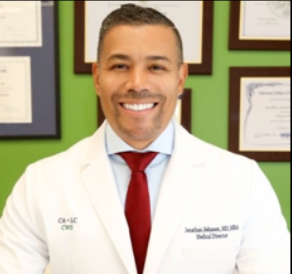
Dr Johnson is the founder and surgical director of Comprehensive Wound Care Services based in Washington, DC. Also known as “Dr Wounds,” he is board certified by the American Board of Wound Management and is a fellow of the American Professional Wound Care Association. Dr Johnson trained in general surgery with a fellowship as the Sylvester J. Carter Hand and Plastic Surgery fellow at Lincoln Medical and Mental Health Hospital Center of Cornell University. He holds a Master of Business Administration with a concentration in Healthcare Finance from The Carey Business School at Johns Hopkins University. He is a member of the American College of Healthcare Executives and a physician board member of the Association for the Advancement of Wound Care (AAWC) and the American Professional Wound Care Association (APWCA). Dr Johnson has numerous publications and research projects focused on wound care and decreasing health disparities in underserved populations. Dr Johnson is a board member of Capital Youth Empowerment Program (CYEP), a non-profit focused on fatherhood development and education, and he is a founding member of the Johnson-Jones Family Foundation. He is the founder and principal at Comprehensive Medical Investments focused on investments in minority healthcare funds servicing marginalized healthcare populations. A native of Denver Colorado, Dr Johnson enjoys outdoor activities, sporting events, art history, and spending time with his wife and three daughters. Dr Johnson resides in the suburban Washington, DC area.




