









Clinical Conversations on Dakin's: Matching Strength to Wound Needs, Part 2
This episode shifts from scientific rationale to practical application, examining how Dakin’s is used in real-world wound care. Dr. Jonathan Johnson, joined by Robert Snyder, DPM, and Alex Khan, APRN, ACNS-BC, MSN, WCP-C, EDS-C, discusses where Dakin’s fits within the treatment approach and how clinicians determine and adjust strength over time. Grounded in clinical experience and evidence, the conversation focuses on reassessment, de-escalation, and thoughtful integration into broader care strategies.
Sponsored by:

This episode shifts from scientific rationale to practical application, examining how Dakin’s is used in real-world wound care. Dr. Jonathan Johnson, joined by Robert Snyder, DPM, and Alex Khan, APRN, ACNS-BC, MSN, WCP-C, EDS-C, discusses where Dakin’s fits within the treatment approach and how clinicians determine and adjust strength over time. Grounded in clinical experience and evidence, the conversation focuses on reassessment, de-escalation, and thoughtful integration into broader care strategies.
Sponsored by:
This podcast is for educational purposes only.
Dr. Jonathan Johnson: Welcome back to another Wound Care Wednesday, your go-to podcast for all things wound care-related, healing, and innovation. Now, whether you're a health care professional, a caregiver, or just passionate about the advancement of wound management, you're in the right place. So grab your coffee, grab your water, or grab your glass of wine, and let's get rolling. In our previous episode, we examined the science behind Dakin's solution, specifically how concentration influences antimicrobial activity and tissue interaction. We discussed why cytotoxicity is concentration dependent and why strength selection matters.
So today, we're moving from theory to clinical practice. The question that I want everybody to remember and think about as we go through the podcast: How does Dakin's fit into real-world wound care? When should clinicians consider it? How do they initiate, adjust, and reassess strength over time? And what does the published evidence suggest about its appropriate role? I'm Dr. Jonathan Johnson, also known as Dr. Wounds, and again, I am joined by two experts in the field, Dr. Robert Snyder and NP Alex Kahn, who want to share their clinical insight and experience integrating Dakin’s into patient and clinical care. So let's kick this off with our first question for Dr. Snyder. When you're evaluating a wound, where does Dakin’s enter your decision-making process?
Dr. Robert Snyder: An interesting question, and it's really dependent on what we're seeing from a clinical standpoint. As an example, if you have a heavily colonized or infected wound, you have the presence of necrotic tissue or slough, perhaps this malodor, you're concerned about infection, a high wound bioburden, you want to, at least in the short term, utilize the highest concentration that we have available for Dakin’s solution. But of course, this should be dependent on what we're going to be seeing as the patient is followed. And it's very likely that this will be used for a relatively short period of time. And then we will de-escalate, if you will, and move down to a lesser strength until we get to a point where we feel that the wound has moved out of the inflammatory phase of wound healing into the proliferative phase of wound healing, in which case antiseptics may not be necessary at that juncture, and we could stop them and either move to something else, maybe an advanced product, maybe a skin graft, etc, etc. So you really have to base it on what you're seeing from a clinical point of view.
Dr. Jonathan Johnson: Great point. Great point. So really, we're looking at the tissue composition of the wound. We're looking at its overall clinical appearance and assessing how Dakin's can be used effectively. Alex, help us understand: Is Dakin's typically a first-line use? Is it situational? How are you utilizing it in your specific practice?
Alex Khan: Good question, Dr. Johnson. So in my practice, what I have learned, if after of course performing the first visit with the patient, doing a head-to-toe comprehensive assessment of the wound and the patient, and you determine your objective that you're trying, if this is a chronic wound, definitely in chronic wounds, wounds are stalled due to being stuck in inflammatory phase. And these inflammatory cytokines, they would not allow the wound to see any progress because you will not see these wounds are closing down or reducing in size. So we cannot see the biofilm, but if it's a clean wound, which means sometimes you have a clear red wound, but it's still not healing or it's not closing or reducing in size, in my practice what I do in such cases—because we are not trying to dissolve any tissue or perform any chemical debridement—what I have learned, 0.50% full Dakin’s would allow, it dissolves the necrotic tissue. So if your purpose is not to dissolve any tissue and the wound is already clean and it doesn't have any necrotic or nonviable tissue, or just a biofilm, then I will reduce the concentration from 0.50. I would not use 0.50 because I don't need to do a chemical debridement, but I still want to address the biofilm. So I would go with a half solution at that point, which is 0.25%. And then also after conducting a sharp debridement, removing all biofilm utilizing a dermal curette, then I will just go to the preventive solution, which is a Dakin's wound cleanser, which is with the neutral pH.
And also, I want our audience to understand that all the wounds are contaminated. And you must understand the continuum of infection, which is all the wounds are contaminated, and then they become colonized. And if you don't take care of them well, they become critically colonized, which is evidenced by purulent drainage, foul odor, redness, friable tissue, bleeding, things like this happening, these are the signs and symptoms of critical colonization. And then of course, the last thing on the ladder is infection. The question is that we as clinicians, what are we doing, the wound bed preparation is first focus, but when we're talking about the maintenance and prevention and keeping the bioburden at par—remember, we’re not trying to make the wounds sterile, because that is not what we're trying to do here, but understanding objectives, we want to make sure that anytime you cleanse the wound and the wound probably come back to the contamination, because the difference between contamination and colonization is the number of colonies per square centimeter in the wound. This is how the lab reads them. So now we understand what people need to know that, when we cleanse the wound, we take those colonies out and we clean the wound back to the contamination, which is the first level, right? So when we are trying to do the preventive phase or prevention, we will be using Dakin's wound cleanser rather than using a full strength of 0.50 or half or a quarter strength. I would not go there. So this is how I approach things, and based on how the wound characteristics are and what we need to do. So sometimes you escalate, you de-escalate based on how the wound is behaving.
Dr. Robert Snyder: Biofilm is a very interesting topic because even after you debride the wound, we all know that the evidence is clear that probably 100% of diabetic foot ulcers, as an example, have biofilm. And when you debride biofilm, it usually becomes a mature biofilm within 72 hours. The key here for me is to address the planktonic bacteria, which I think seeds to the biofilm and creates a scenario where new biofilm colonies can form. By using an antiseptic like Dakin's at various strengths, depending on what it is you're seeing clinically, you're keeping the level of planktonic bacteria as low as possible. So you prevent it from seeding to form new biofilm, and eventually this quiets things down.
Dr Jonathan Johnson: That's a great point, Dr. Snyder. So let's highlight some of the concepts that we just finished discussing, right? We're looking at utilizing Dakin's in heavily colonized or infected wounds. When we see the presence of necrotic tissue or slough, when there's malodor, when there's a high exudative burden, and specifically when we're talking about the colonization and critical colonization, for those that are taking any type of examinations, that is always on the examination, so make sure you understand that concept. Very, very important. The difference between colonization and critical colonization, it's typically a number with the power of 6. So, great point.
And that segues us into our second question. So, Dr. Snyder, in practice, how do you determine which concentration of Dakin’s to essentially start with? Help us understand clinically from a diabetic ulcer standpoint, how are you utilizing the correct strength initially to make sure the wound can progress through those four stages of wound healing?
Dr. Robert Snyder: So again, to reiterate, each patient has to be assessed and evaluated based on their own merits and based on what we're seeing clinically. So again, just to reiterate, if you're having a highly colonized or contaminated or infected wound that's straining and has malodor and has significant necrotic tissue, you're going to want to use a higher concentration. If you don't see that and if you just have concerns that perhaps the bioburden could, in essence, seed to form additional biofilm, etc, and there is some drainage, Alex talked about critical colonization, which we now refer to as occult infection. This very often in the diabetic patient is not apparent because the patient is immunocompromised. So again, you have to base it on looking at that wound on a regular basis, seeing that the wound is not progressing despite the fact that you're doing all the right things. And sometimes we don't use Dakin's, at least in my practice, as a first line. We may use it when we see that the wound is not responding. Sometimes a very good debridement is probably all you need. But on the other side of the coin, if you feel that the patient is at risk, then utilizing perhaps a lower strength of Dakin's at that point throughout the week could be very beneficial, almost as a maintenance, not only to help debride whatever is left over, but also to keep that bacterial burden as low as possible.
Dr. Jonathan Johnson: Great. And you had a great point in our first episode about quality of life and the patient's overall pain tolerance and level. And that's very, very important to make sure that we're assessing that when we're applying the Dakin’s as well, just to make sure our patients are comfortable.
Dr. Robert Snyder: I think the way we have to look at wounds is they're not just holes in legs and feet. Wounds are a disease. They are a disease that has to be treated as such. And we have to remember that the foot and leg or other parts of the body are attached to a person. And we really have to be looking very holistically at these patients. So it's not only just looking at the wound itself. It's evaluating the patient, what the patient we feel needs, what the vascularity is like, what their comorbidities are like. And there was some interesting data that just came out relating to venous leg ulcers and diabetic foot ulcers showing that the underlying comorbidities are very similar in both groups. So again, understanding exactly what we're dealing with from a holistic standpoint can really help us make the appropriate decisions as to how we're going to treat a particular wound.
Dr. Jonathan Johnson: Great point. And that's generally the theme of wound care and clinical medicine in general, that we're treating the entire patient, looking at any comorbidities, looking at the clinical signs and symptoms of the wound to make sure we're applying the right resource.
So Alex, you touched a little bit on the assessment and de-escalation strategy in our first episode. So I want to ask you a quick question. Help me understand one of the major themes of our first episode, again, was our escalation and de-escalation. How does this look in real clinical practice? And specifically, let me ask you this: If you see a wound that you've been able to remove a lot of that bioburden—because we do know that wounds reaccumulate that bioburden within 24 hours, very, very quickly—so we want to continue to apply our Dakin's regimen to remove that bioburden. So Alex, my question is, how often are you typically applying Dakin's or ordering Dakin's to be utilized? And if the wound is still stalled from a size standpoint, do you continue the Dakin’s or do you move on to a different clinical resource?
Alex Khan: In my practice, what I have seen and utilized Dakin’s for several years, and I can tell you that my focus is, again, if I'm trying to dissolve or to remove or dislodge necrotic or nonviable tissue, then I'm using full-strength Dakin’s. If the wound does not have any tissue that needs to be removed, but wound is still stalled, looks red—but as you know, the biofilm cannot be visualized—therefore, before I do the sharp debridement, I would use just half strength at that time once a day. Now, remember also, the contact time, that you need more contact time before Dakin’s to start to work. You can't just wash it off and hoping that this is going to work, because that's not how it works.
And then, of course, one more perspective, because I do come across malignant wounds. And in malignant wounds, sometimes I've seen the providers, they're mixing Dakin’s solution with normal saline and keeping 1 liter of that solution at the bedside. So I like to say that this is not a good practice and we should not do that. So therefore, I just want to clarify that what I do, I just go to 0.125%, which is a quarter strength. And these are malignant wounds, which means that our focus is not cytotoxicity. The tissue is already, you know, it's just dying. And I also want to add in that when we're using 0.125%, the quarter-strength Dakin’s, not only it maintains a clean wound environment in these malignant wounds, and plus it would decrease the odor. which is from the decay. And these wounds are polymicrobial. And when we say polymicrobial, they do have a bacteria and there are a lot of fungus or the fungal infection sets in and even viruses. So they say that utilizing Dakin’s can affect, and it decreases the odor and is very good. And again, for these malignant wounds, as you know, we don't have, we already know that there's not a whole lot we can do. But for the maintenance phase, I use 0.125, which is a quarter strength.
And again, coming back to the topic about the dosing, in my practice, we use wound cleansers instead of normal saline. Of course, saline is a cost-effective method. And of course, when cost matters, that's what you're using. But the question still is, I like to see this, that understanding, again, continuum of infection is that your wounds are contaminated, then they're colonized. And then because the colonies are increasing, they're multiplying and they turn into critical colonization and turn into infection ultimately. So the question is, how do we keep this bioburden at par? By using only the cleansers, which comes in a cleanser form, which is already formulated as a very, very less or—exact concentration, I don't know—but they are supposedly neutral pH, which means they're not cytotoxic. So we use it as prevention.
Now, also, I like to do, this analogy that when you go to sleep at night, you brush your teeth, you go to sleep, but when you wake up, your mouth may smell, you may have a foul odor. You know why? Because the bacteria, overnight in the warm, moist environment, continues to grow, and your mouth starts to stink. And when that happens, what do you do? Brush your teeth and you use a mouthwash. And this is how you maintain. So wounds are just like that. You just got to clean them up, open them up, and you're going to use the wound cleanser. You take a gauze and you nicely cleanse it and then apply the, whatever the dressing they're using. And that's the way it should be. And that's what we say, the maintenance phase. Yeah. You know, you brush your teeth and you use your mouthwash every day, don't you? So this is how you do on wounds, that you have to cleanse it. You've got to clean it because you leave it alone, these microbes, they're going to continue, multiply, multiply, multiply. And then they turn into from a contamination phase, they go straight into critical contamination and, of course, infection. So utilizing type of wound is very important, especially when we're dealing with malignant wounds where cytotoxicity doesn't matter because we already know this malignancy is causing tissue destruction and bleeding and foul odor.
Dr. Robert Snyder: I wanted to reiterate the issue of odor because very often, particularly in fungating wounds, malignancies and fungating wounds, there is a malodor. And unfortunately, in patients who have malignancies, very often, there's very little that we can do to help them. But their main problem is odor. And if we don't address it, they're not happy. So a Dakin's is one way of allowing us to be able to control odor, which will make the patient more comfortable and also allow them to be able to increase their quality of life to an extent. Why? Because they're able now to socialize with friends. They're able to perhaps be intimate with their spouses. They can play cards. They can go to restaurants. They don't have to be concerned about the fact that there's this terrible malodor which is coming from their body. So I think that's a very important point to keep in mind because sometimes it's not so much getting rid of the bacteria, it's decreasing the odor.
Dr. Jonathan Johnson: 100%. And Dr. Snyder, that's a great point because again, we're going back to treating the patient from a holistic standpoint, making sure we understand their quality of life and some of the goals they want to achieve with everyday living. And we need to pick the best clinical resources that helps the patient, number one, heal, but achieve that quality of life. Very important.
So as we understand, really, the concept of escalation and de-escalation, Dr. Snyder is well-versed on the research side in multiple different topics. And Alex actually has a poster that was focusing on real clinical evidence and some available literature that suggests about Dakin's its effectiveness, its efficiency, and its safety. Alex, tell us a little bit about that poster, and I definitely want Dr. Snyder to comment about that as well.
Alex Khan: I wanted to, of course, I've been using Dakin’s for, like I've mentioned, over a decade. And I wanted to really prove a point because when I talked to the fellow clinicians and misunderstanding about cytotoxicity was there, and I was like, okay, we need to do something about this and explain this a little better. So we selected like 5 patients, and they have full-thickness wounds. And we utilized calcium alginate soaked in full-strength Dakin’s. And we changed the dressing once daily on these wounds before we conducted a sharp debridement. And remember, these wounds were highly exudated wounds and they were technically in critical contamination phase because they had foul odor. And when we utilize this for 7 days, we can clearly see the difference. The clinical evidence is there. You can see, of course, compare their characteristics from day 1 to day 7, you can see that if they had any necrotic tissue, they would start to loosen up. Some of them were covered with, partially, with an eschar that was loosened, allowed me to do the sharp debridement and achieve a cleaner wound base. And that's what I understood. And again, like I said, I would also like to add in or to highlight that these are full-thickness wounds. We're not talking about partial-thickness wounds or skin tears and utilizing heavy doses of, or full or a half strength of Dakin's. No, we do not recommend for partial-thickness wounds. We're talking about full-thickness wounds with necrotic tissue or the wounds that are stuck in an inflammatory phase. And that's what we did. And so our findings were very consistent with a, by utilizing Dakin’s, we were able to achieve a cleaner or a better wound bed, and I think it's a great product for wound bed preparation.
Dr. Robert Snyder: I know also, Alex, that you had quoted some interesting and current data as well, which is extremely important. I like the fact that you used a calcium alginate rather than a gauze. And the reason why I say that is because, at least hypothetically, the Dakin's gets locked in the calcium alginate. And as the calcium alginate degrades, you likely will have the benefit of the Dakin’s for a longer period of time, at least in my view. So again, anecdotal, but certainly makes sense to me. So I congratulate you on that work. And I think perhaps moving forward, doing a larger study, with a larger sample size, probably would clearly make a very, very strong point and argument to utilize this therapy.
Alex Khan: I used a reference study by McCullough and Carlson, and it was printed in the journal [Annals] of Plastic Surgery 2014. And they used a very, they highlighted saying that contemporary wound care has shifted in paradigm from merely preventing infection to actively creating an optimal environment for tissue repair. So they use this terminology, saying an optimal environment utilizing Dakin's. And this was their published study that they did. And when I read that, I was like, oh, that's exciting. So technically, not only we're talking about chemical debridement or bioburden management, we're also talking about optimal wound environment. That's just the word to use, and I think it's just a great... For those people who think that Dakin’s is associated with only cytotoxicity, no, no, no. I think that's a misconception. And they need to understand that for optimal wound environment, based on what your objectives are, but you can use Dakin’s as just a wound cleanser and to maintain this optimal environment, which is conducive to granulation and proliferation, and of course, wound closure.
Dr. Robert Snyder: I wanted to reiterate too that therapies like this really are adjunctive, as you know, as we all know, to what we know is important for diabetics with offloading and venous leg ulcers with compression. So all those things are being used in conjunction with this therapy. And I think it's very important for clinicians to realize that, because you just cannot use one therapy and hope that it's going to work. You have to use it based on the evidence and based on what you know is traditionally utilized for various conditions. Now, the biochemistry of wounds is very similar along the continuum of all wound types. However, the way we treat these wounds with diabetics, offloading with venous leg ulcers, compression, etc, I think that in conjunction with Dakin's solution is very, very important to understand. That it's not just one therapy. This is adjunctive to a multimodal approach, and it is a disease.
Dr. Jonathan Johnson: Of course. No, it's a great point that Dakin's is a strong resource in our wound care toolbox. And again, understanding the holistic patient and looking at what the wound is clinically telling us is really key when we're utilizing Dakin's from a strength standpoint, from an application standpoint, etc.
So, Dr. Snyder, let me ask you this last quick question here. And we really appreciate everyone that has tuned into our Wound Care Wednesday podcast today. Help me understand where specifically, or the majority of the time, where do you clinically practice and how can we utilize Dakin's in other clinical settings? And what's your thought process about utilizing Dakin's in those clinical settings?
Dr. Robert Snyder: It's an interesting question because it's one of these therapies that can be used across all clinical settings. It can be used in the home. It certainly can be used in an office setting as a start and then transition to the home. You certainly can train a family member to change the dressing, or you can have a home health individual come in maybe midweek. It doesn't have to be changed every day, as Alex pointed out. But it can be used in outpatient clinics, long-term care, home health, acute care. It's very, very easy to develop a protocol for this. So again, it's not something that would be extraordinarily challenging to a family member, assuming they had the dexterity and were able to do it. Certainly, education is going to be key here. And of course, appropriate documentation is also going to be essential.
Dr. Jonathan Johnson: 100%. And I think really to summarize, where Dakin's can be utilized is multiple places of service, right? We're literally looking at home health all the way up to surgical centers and hospital inpatient, wound care centers and places where I practice where we're debriding really, really necrotic and infected wounds and placing Dakin's to really assist with that very aggressive surgical debridement. So it's really key to understand that this is a great resource in our specific toolbox.
Okay, gentlemen. So as we wind down to our last question, obviously I have one sign-off question, and I'd like both of you to take a crack at. So Alex, help me understand: If you could give clinicians one practical takeaway about utilizing Dakin’s in real-world practice, what would that be?
Alex Khan: Stay focused on the concentration and the time of contact time to the wound base, because those are the two most important things when using Dakin’s. You've got to remember it, that how much, or what is the concentration you're going to be using, and how long it's going to be in contact with the tissue in order to achieve your objectives of what you're trying to do.
Dr. Jonathan Johnson: Awesome. Dr. Snyder, same question.
Dr. Robert Snyder: You have to put aside for a moment this fear in a fear that every concentration of Dakin’s solution is going to be cytotoxic. It clearly is not. And again, the concentration is absolutely essential in order to prevent that. If you are doing it in the right way and if you're following the patient carefully, the likelihood of having problems in that regard, in my view, are very, very small. So that would be my takeaway is to remove those preconceived notions, if you will. I think the time for reconsidering the utilization of topical antiseptics is here. And the main reason is that the antibiotics that are given systemically are not working as well, and in many cases, not working at all. And there will be a time in the very near future where systemic antibiotics will no longer be effective. So I think we have to start looking at other alternatives. And this certainly, as an adjunctive process, could be very meaningful.
Dr. Jonathan Johnson: 100%. And just to wrap everything up, focusing on utilizing Dakin's is key because we're understanding the issues with removing that bioburden, that necrotic tissue, and really helping the wound progress through those 4 stages of wound healing effectively.
So over the past two episodes, we've explored both the science and the clinical application of Dakin's solution. Now the central message is clear. Antimicrobial activity and tissue interaction are concentration dependent. Thoughtful strength selection, ongoing reassessment, and alignment with the wound stage are what allow clinicians to utilize strategically Dakin’s within a broad-based care plan. We're really, really excited to be able to have our two awesome guests, Dr. Robert Snyder and NP Alex Kahn, sharing their clinical knowledge, sharing their research, sharing their breadth of wound care experiences. We want to thank these awesome guests for sharing their practical insight. And of course, we want to thank all of our listeners for joining us today and listening to the thoughts, the concepts, and all aspects of wound care focus. I'm Dr. Jonathan Johnson, and we will see you on the next Wound Care Wednesday.

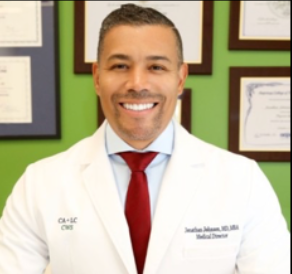
Dr Johnson is the founder and surgical director of Comprehensive Wound Care Services based in Washington, DC. Also known as “Dr Wounds,” he is board certified by the American Board of Wound Management and is a fellow of the American Professional Wound Care Association. Dr Johnson trained in general surgery with a fellowship as the Sylvester J. Carter Hand and Plastic Surgery fellow at Lincoln Medical and Mental Health Hospital Center of Cornell University. He holds a Master of Business Administration with a concentration in Healthcare Finance from The Carey Business School at Johns Hopkins University. He is a member of the American College of Healthcare Executives and a physician board member of the Association for the Advancement of Wound Care (AAWC) and the American Professional Wound Care Association (APWCA). Dr Johnson has numerous publications and research projects focused on wound care and decreasing health disparities in underserved populations. Dr Johnson is a board member of Capital Youth Empowerment Program (CYEP), a non-profit focused on fatherhood development and education, and he is a founding member of the Johnson-Jones Family Foundation. He is the founder and principal at Comprehensive Medical Investments focused on investments in minority healthcare funds servicing marginalized healthcare populations. A native of Denver Colorado, Dr Johnson enjoys outdoor activities, sporting events, art history, and spending time with his wife and three daughters. Dr Johnson resides in the suburban Washington, DC area.




