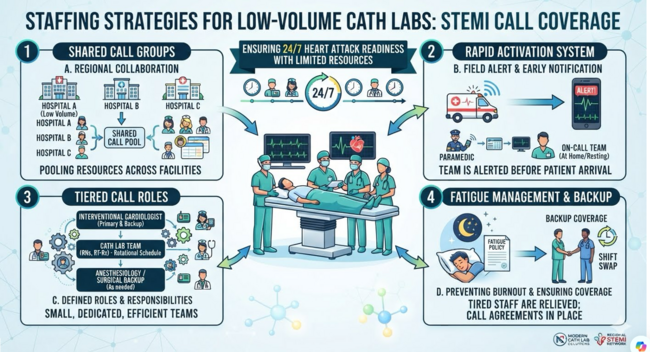
STEMI Readiness Cannot Be Conditional: The Case for a Protected Four-Person Cath Lab Call Team
© 2026 HMP Global. All Rights Reserved.
Any views and opinions expressed are those of the author(s) and/or participants and do not necessarily reflect the views, policy, or position of Cath Lab Digest or HMP Global, their employees, and affiliates.
Kimberly Perdue, MBA, RT(R)
Independent Cardiovascular Quality and Accreditation Professional, Beckley, West Virginia
Kimberly Perdue, MBA, RT(R), can be contacted at kim_2005_wehs@yahoo.com.
Disclosure: The author reports no relevant financial relationships.
Author Note: The views expressed in this article are those of the author and do not necessarily represent the views, policies, or official position of any current or former employer.
Author Biography
Kimberly Perdue, MBA, RT(R), is a cardiovascular quality and accreditation professional with experience spanning cardiac catheterization laboratory operations, frontline clinical practice, cardiovascular service line leadership, and primary PCI program oversight. Her background includes serving as a cath lab radiologic technologist and team lead, a cardiovascular service line director, and an accreditation review specialist. Her professional interests include rural cardiovascular access, STEMI systems of care, cath lab staffing, quality improvement, and sustainable cardiovascular program development.
Abstract
A hospital offering 24-hour primary percutaneous coronary intervention must be capable of responding to ST-segment elevation myocardial infarction (STEMI) consistently, not only when the cardiac catheterization laboratory team is unoccupied elsewhere. In many hospitals, the same personnel assigned to STEMI call also cover pulmonary embolism thrombectomy, deep vein thrombosis interventions, peripheral vascular procedures, elective cardiac catheterization and percutaneous coronary intervention (PCI), and interventional radiology. Although shared staffing may appear efficient, it creates a predictable conflict when two patients require procedural care simultaneously. This article proposes a protected four-person STEMI call model consisting of four concurrently necessary nonphysician functions:
• a registered nurse dedicated to moderate sedation and continuous patient assessment;
• a scrub person;
• a circulator, and;
• a monitor/documentation person.
This is not presented as a federally mandated staffing ratio. Rather, it is a risk-based patient-safety model supported by moderate-sedation expectations, the unpredictability of emergency PCI, and the operational reality that personnel actively caring for another procedural patient are not simultaneously available for STEMI response. A program without protected personnel or an immediately available replacement team has conditional, rather than dependable, STEMI readiness.
A Call Schedule Is Not the Same as Readiness
 Hospitals frequently describe their cardiac catheterization laboratories as available for primary PCI 24 hours a day, seven days a week. However, the presence of employee names on a call schedule does not establish that a complete team will be immediately available when a STEMI occurs.
This distinction becomes especially important when the designated STEMI team also covers pulmonary embolism (PE) thrombectomy, deep vein thrombosis (DVT) intervention, peripheral arterial and venous procedures, elective cardiac catheterization and PCI, cases extending beyond scheduled laboratory hours, interventional radiology procedures, and emergency embolization, thrombectomy, drainage, or vascular-access procedures.
Each of these services provides important patient care. The concern is not that one patient population deserves attention while another does not. The concern is whether the hospital has enough procedural capacity to care safely for both patients when demands overlap.
A staff member who is scrubbed into a PE thrombectomy, monitoring an interventional radiology patient, administering sedation during a DVT intervention, or circulating an elective PCI is already responsible for a patient. That individual cannot simultaneously function as an immediately available STEMI team member.
When the same team is counted for multiple services, the hospital's ability to perform emergency PCI depends on another service remaining inactive. That is not protected readiness. It is conditional readiness.
Four People Protect Four Functions
The case for a four-person STEMI call team should not be reduced to a debate over head count. Four personnel are needed because four distinct functions must remain available simultaneously. These roles are separate from the interventional cardiologist. Depending on state law, hospital policy, competency, and professional scope, qualified nurses and cardiovascular technologists may fill the scrub, circulation, and monitoring roles.
Four people are not four interchangeable bodies. They are four protected functions.
| Protected Function | Primary Responsibility |
|---|---|
|
Registered nurse: sedation and continuous patient assessment |
Administers medications according to physician direction and hospital policy while continuously assessing level of consciousness, ventilation and airway status, oxygenation, hemodynamic condition, pain, response to sedation, response to procedural events, and the need for escalation or rescue. |
| Scrub person |
Maintains the sterile field and directly assists the interventional cardiologist with wires, balloons, stents, thrombectomy devices, intravascular imaging, temporary pacing, and mechanical circulatory support equipment. |
| Circulator |
Performs nonsterile tasks required to keep the procedure moving safely, including retrieving medications and devices, obtaining emergency equipment, communicating with supporting departments, calling additional personnel, and coordinating escalation. |
| Monitor and documentation person |
Continuously observes rhythm, pressure waveforms, oxygenation, and procedural data while recording medications, activated clotting times, devices, interventions, complications, and critical reperfusion timestamps. |
Flexible Staffing Should Be Based on Risk
The 2021 Society for Cardiovascular Angiography and Interventions (SCAI) expert consensus statement does not establish a universal static staffing ratio. It states that nonphysician staffing may be flexible and should be based on the needs and risks of the procedure, and the possibility of moderate or deeper sedation. The statement was endorsed by the American College of Cardiology, American Heart Association, and Heart Rhythm Society.1
That guidance should not be interpreted as support for routinely operating with the fewest possible personnel. Flexibility is intended to permit staffing that reflects patient and procedural risk.
A stable elective diagnostic study and an emergency PCI involving an acutely ischemic patient do not have identical risk profiles. A STEMI patient may deteriorate suddenly because of ventricular arrhythmia, bradycardia or complete heart block, cardiogenic shock, respiratory compromise, acute pulmonary edema, coronary perforation, tamponade, no-reflow, major bleeding, device failure, or the need for temporary pacing or mechanical circulatory support.1,2
When escalation occurs, staff members cannot continue performing two essential functions at once. The person documenting cannot simultaneously provide uninterrupted hemodynamic surveillance and leave the room for equipment. The scrub person cannot maintain sterility while circulating. The sedation RN cannot focus on airway, ventilation, hemodynamics, medication response, and rescue while also acting as the primary circulator.
A risk-based approach therefore supports four protected functions for emergency PCI, even though professional guidance does not explicitly mandate a four-person ratio.
Moderate Sedation Supports a Protected RN Role
Moderate sedation provides an important foundation for the four-person model, but the regulatory argument must be stated accurately.
The Centers for Medicare & Medicaid Services (CMS) does not mandate a four-person cath lab team. CMS distinguishes moderate sedation from anesthesia and expects hospitals to establish policies, use appropriately trained personnel, monitor patients before, during, and after procedures, and maintain the ability to rescue a patient who unintentionally progresses to a deeper level of sedation.3
SCAI's moderate-sedation guidance states that a nurse providing moderate sedation must not have other responsibilities that compromise continuous patient assessment. It identifies consciousness, pulmonary ventilation, oxygenation, and hemodynamics as the principal monitoring areas during moderate sedation.4 The American Society of Anesthesiologists likewise emphasizes a designated individual whose primary responsibility is patient monitoring during moderate sedation.5
This does not mean that the sedation RN is physically prohibited from making any movement or performing every minor task. It means that other responsibilities cannot compromise the nurse's primary responsibility for continuous patient assessment.
Leaving the room to locate a covered stent, obtaining medication from another area, calling multiple departments, retrieving emergency equipment, coordinating blood products, or functioning as the only circulator during an unstable STEMI are not minor or reliably interruptible tasks.
Protecting the RN's sedation and assessment function leaves another qualified team member free to circulate without forcing the nurse to choose between managing the room and monitoring the patient.
Composite Operational Scenario
The following scenario is a composite created to illustrate a foreseeable staffing conflict. It does not represent a specific patient, hospital, or reported adverse event.
At 8:15 pm, the four-person cardiovascular call team is performing an urgent pulmonary embolism thrombectomy. The patient is anticoagulated and has large-bore venous access. The procedure is underway, and the patient remains tachycardic with borderline blood pressure.
The team consists of one RN administering sedation and assessing the patient, one scrub technologist assisting with the thrombectomy system, one circulator, and one person monitoring hemodynamics and documenting the procedure.
At 8:27 pm, emergency medical services transmits an electrocardiogram showing an acute STEMI. The patient is hypotensive and approximately 15 minutes from the hospital. The emergency department activates the cath lab. The employees listed on the STEMI call schedule are already in the PE procedure.
The hospital now has several options, none of which is satisfactory: interrupt the PE procedure, delay the STEMI procedure, divide the existing team, begin the STEMI with combined roles, or search for unassigned personnel after activation.
The conflict did not originate when the STEMI alert was transmitted. It existed before either patient arrived. The hospital had assigned one procedural team to provide simultaneous emergency capacity for two services.
The PE patient and STEMI patient both require uninterrupted, competent care. Neither patient should be placed at risk because the staffing plan assumed that competing emergencies would not occur together.
PE, DVT, Elective Cases, and IR Do Not Preserve STEMI Availability
Pulmonary Embolism Procedures
PE interventions may involve a patient who is hemodynamically unstable, receiving sedation, systemically anticoagulated, and undergoing large-bore venous intervention. Once the procedure has started, the assigned team cannot be considered immediately available for another emergency.
The fact that a PE procedure may be performed in the cath lab does not make it interchangeable with STEMI care. It creates another active procedural obligation.
Deep Vein Thrombosis Interventions
DVT procedures can include venography, thrombectomy, thrombolytic therapy, intravascular ultrasound, angioplasty, and venous stenting. These cases may be prolonged and may involve significant bleeding risk.
The team cannot safely pause a DVT intervention simply because a STEMI has arrived. If the same employees are assigned to both services, one patient must wait or one team must function below its intended staffing level.
Elective Cath and PCI
Elective cases do not always end as scheduled. A diagnostic procedure may convert to an ad hoc PCI. A straightforward PCI may become complex. Complications may require prolonged treatment, emergency equipment, additional access, hemodynamic support, or transfer.
A protected STEMI call team should not be consumed by an elective case extending into after-hours coverage unless another complete and qualified team has formally assumed STEMI responsibility.
Continuing an elective case with the only available emergency call team is an operational decision to make STEMI capability conditional for the duration of that procedure.
Interventional Radiology (IR)
Interventional radiology procedures may involve hemorrhage control, embolization, thrombectomy, drainage of infected collections, or other urgent interventions that cannot be abandoned safely.
When the same personnel cover both IR and STEMI without guaranteed replacement capacity, each service appears staffed only because the model assumes that the other service will remain inactive.
Cross-Training Is Not the Problem
Cross-training strengthens cardiovascular programs. A nurse or technologist who is competent in cardiac, peripheral, venous, PE, and IR procedures may provide valuable flexibility and professional depth.
However, cross-training and simultaneous cross-coverage are not the same.
Cross-training means that an employee is qualified to work in several procedural areas. Cross-coverage means that the same employee is counted as available to meet the immediate staffing requirements of several services at the same time.
One expands the employee's competency. The other may overstate the hospital's actual capacity.
A protected STEMI model does not prohibit call-team members from participating in other procedures. It requires that, before the designated team begins another procedure, a complete qualified team formally assumes STEMI responsibility.
The standard should be simple: The designated STEMI call team should not begin or support another procedure unless four qualified replacements are already available and have accepted STEMI coverage.
The replacement plan should not depend on locating staff after a STEMI has already been activated.
A Proposed Protected STEMI Call Model
1. Four qualified nonphysician personnel are assigned to STEMI call, in addition to the interventional cardiologist.
2. Four functions remain protected: sedation and continuous nursing assessment, sterile scrub assistance, circulation, and physiologic monitoring/documentation.
3. The designated call team is reserved for STEMI response and is not simultaneously counted as the available staff for PE, DVT, elective cardiovascular procedures, peripheral interventions, or IR.
4. Another procedure may use members of the call team only after complete replacement coverage is established.
5. Replacement personnel meet the same competency requirements as the individuals they replace, including applicable advanced cardiac life support (ACLS), moderate sedation, scrub, monitoring, emergency PCI, and device competencies.
6. Backup activation is prospective. It occurs before the competing procedure begins, not after a STEMI conflict develops.
7. The hospital defines what happens when four-person STEMI capability cannot be maintained. Options may include holding an elective case, activating backup personnel, arranging another procedural team, or temporarily initiating an established transfer pathway.
8. Simultaneous-demand events undergo quality review even when neither patient experiences documented harm.
Measure the Readiness the Schedule Conceals
Hospitals should not rely only on overall median reperfusion performance to determine whether staffing is adequate. Aggregate results may conceal individual delays, near misses, improvised staffing, and combined-role practice.
CMS requires hospitals to maintain an effective, hospital-wide, data-driven quality assessment and performance improvement program that reflects the complexity of the organization and focuses on improved outcomes and the reduction of medical errors.3 Staffing conflicts, delayed team availability, combined roles, and simultaneous-demand events are appropriate subjects for that review.
Programs should consider tracking:
-
Percentage of STEMI activations with all four functions available
-
Time from activation until the complete team is available
-
Number of activations occurring while call personnel are involved in another case
-
Type of competing case, including PE, DVT, elective cath/PCI, peripheral, or IR
-
Delays attributed to personnel being committed elsewhere
-
Number of procedures begun with combined roles
-
Number of times unassigned staff were called after activation
-
Number of times another patient's procedure was interrupted
-
Need for unplanned additional staff during emergency PCI
-
Sedation-related rescue events
-
Cardiac arrest, shock, perforation, tamponade, airway, and major bleeding events
-
Overtime, total call burden, fatigue, vacancies, retention, and turnover
-
Near misses related to staffing or competing procedural responsibilities
Addressing the Cost Argument
The most common objection to a protected four-person team will be cost, particularly in rural or lower-volume hospitals.
That concern is real. Maintaining separate capacity requires investment. However, combining services does not eliminate the demand for care. It transfers the operational risk to patients and frontline staff.
A complete financial analysis should include more than the wages of the fourth team member. It should also consider overtime associated with inadequate baseline staffing; turnover and vacancy costs; recruitment and orientation of specialized cath lab personnel; agency or temporary labor; delayed or transferred procedures; lost elective and emergency procedural revenue; staff fatigue and burnout; risk associated with interrupted procedures; emergency transfer when local PCI capacity is unavailable; and quality, regulatory, liability, and reputational consequences.
A staffing model is not efficient merely because it costs less when no conflict occurs. True efficiency must account for what happens when the predictable conflict does occur.
This Is a Position, Not a Claim of a Federal Ratio
The proposed four-person model should be presented honestly.
Neither CMS nor the SCAI consensus statement establishes a universal federal requirement that every STEMI procedure have exactly four nonphysician staff members. SCAI expressly permits staffing flexibility based on procedural needs, risk, and sedation requirements.1
The position advanced here is that applying that risk-based standard to emergency primary PCI supports four protected functions. It further proposes that personnel assigned to active PE, DVT, elective, peripheral, or IR procedures cannot also be counted as immediately available for STEMI.
The four-person model is therefore a patient-safety and operational-readiness proposal, not a misstatement of an existing CMS mandate.
Conclusion
A hospital's STEMI capability should not depend on whether another procedural service happens to be inactive.
A team performing a PE thrombectomy, DVT intervention, elective PCI, peripheral case, or IR procedure is caring for another patient. Those personnel are not simultaneously available for emergency PCI merely because their names remain on the STEMI call schedule.
A protected four-person call team preserves four essential functions: moderate sedation and continuous nursing assessment, sterile procedural assistance, circulation, and physiologic monitoring and documentation. Removing one team member does not eliminate the corresponding function. It transfers that responsibility to someone who already has another critical task.
Hospitals should define STEMI readiness by actual, simultaneous capacity, not by theoretical availability.
STEMI readiness cannot be conditional. It must be intentionally designed, adequately staffed, continuously measured, and protected.
Key Takeaways
-
Four-person STEMI staffing is a functional model, not an arbitrary head count.
-
The four functions are sedation and assessment, scrub, circulation, and monitoring/documentation.
-
CMS does not mandate four people, but hospitals must use trained personnel, monitor patients appropriately, and maintain rescue capability during sedation.
-
Staff actively caring for PE, DVT, elective cath/PCI, peripheral, or IR patients are not simultaneously available for STEMI.
-
Cross-training increases competency; unprotected cross-coverage can create conditional capacity.
-
Another procedure should use the designated call team only after complete STEMI replacement coverage is established.
-
Staffing conflicts and near misses should be measured through the hospital's QAPI structure.
References
1. Naidu SS, Abbott JD, Bagai J, et al. SCAI expert consensus update on best practices in the cardiac catheterization laboratory. Catheter Cardiovasc Interv. 2021;98(2):255-276. doi:10.1002/ccd.29744. https://doi.org/10.1002/ccd.29744
2. Society for Cardiovascular Angiography & Interventions. Management of cardiac arrest in the cardiac catheterization laboratory. Accessed July 22, 2026. https://www.scai.org/quality-improvement-tools/qi-tips/management-cardiac-arrest-cardiac-catheterization-laboratory
3. Centers for Medicare & Medicaid Services. State Operations Manual, Appendix A: Survey Protocol, Regulations and Interpretive Guidelines for Hospitals. Accessed July 22, 2026. https://www.cms.gov/regulations-and-guidance/guidance/manuals/downloads/som107ap_a_hospitals.pdf
4. Society for Cardiovascular Angiography & Interventions. Moderate sedation practices for adult patients in the cardiac catheterization laboratory. Accessed July 22, 2026. https://www.scai.org/quality-improvement-tools/qi-tips/moderate-sedation-practices-adult-patients-cardiac
5. American Society of Anesthesiologists. Practice guidelines for moderate procedural sedation and analgesia 2018. Anesthesiology. 2018;128(3):437-479. doi:10.1097/ALN.0000000000002043. https://doi.org/10.1097/ALN.0000000000002043
Find More
Find More:
Best Practices Management of STEMI in the Cath Lab: Overview of the 2024 SCAI Consensus Statement
Renal Denervation Topic Center
Cardiovascular Ambulatory Surgery Centers (ASCs) Topic Center
Grand Rounds With Morton Kern, MD
Peripheral Artery Disease Topic Center