Interventional Cardiology Coverage for the Low-Volume Cath Lab: Is One — and Only One — Interventionalist the Rule?
© 2026 HMP Global. All Rights Reserved.
Any views and opinions expressed are those of the author(s) and/or participants and do not necessarily reflect the views, policy, or position of Cath Lab Digest or HMP Global, their employees, and affiliates.
Mort Kern1 with contributions from Ted Bass, Jacksonville, Florida; James Blankenship, Albuquerque, New Mexico; Steven Goldberg, Monterey, California; Jeff Marshall, Atlanta, Georgia; Arnold Seto, Long Beach, California; Paul Teirstein, La Jolla, California.
1Clinical Editor, Cath Lab Digest; Interventional Cardiologist, Long Beach VA Medical Center, Long Beach, California; Professor of Medicine, University of California, Irvine Medical Center, Orange, California
Disclosures: Dr. Morton Kern reports he is a consultant for Abiomed, Abbott Vascular, Philips, ACIST Medical, and Opsens Inc.
Dr. Kern can be contacted at mortonkern2007@gmail.com
In these pages, we have addressed questions about cath lab coverage, on call pay,1 and whether the interventional cardiologist (IC) should have the day off following call.2
A new question was brought to our attention from Dr. Jeff Marshall of Atlanta. The issue is that Georgia law requires that each ST-elevation myocardial infarction (STEMI)-capable cath lab must have an IC covering that cath lab and only that one cath lab. Can the IC cover more than one low-volume cath lab (<60 time-dependent cardiac emergencies per year) for emergency cardiac care in rural areas?
We asked our experts, what do you do about IC coverage of low-volume cath labs for cardiac emergencies? What is appropriate pay for such coverage? Would locums be sufficient for this problem?
Mort Kern, Long Beach, California:
 My thoughts: Although I haven't taken call in >5 years, my IC coverage was confined to one hospital and pay for coverage was included in my annual salary.
Before that time (at least a decade before), my IC coverage included 3-4 hospitals and if 2 simultaneous calls came up, I would ask for the backup IC to come in. It was not ideal, but it functioned. Of course, no extra pay beyond clinical fees.
One solution for a small hospital needing IC coverage could be to use a locum. I have no idea about what is being paid to take call.
Ted Bass, Jacksonville, Florida:
This is a really challenging issue. I have spent the past year and a half of my retirement doing some locum STEMI call coverage at rural small hospitals, mostly just to see what the experience would be like working in a small setting without fellows. It is not uncommon for these small rural hospitals to seek locum coverage almost exclusively for STEMI call related to loss of IC coverage by local physicians.
Here’s some of my observations in no order. These local, small rural hospitals are really hurting financially, especially since the “Big Beautiful Bill” resulted in crippling Medicaid cuts to these institutions. They have similarly been hurt by both nursing and cath tech shortages, as these employees often seek a more stable, consistent work environment if their personal situation permits. As we all know, the pay has gone up considerably recently for cath lab staff and is quite competitive.
Accordingly, locum interventionists are hired to cover 24/7 call, often for a week straight. A boring job to say the least, as sometimes you can go days without a STEMI or other cath lab emergency coming in. The requirement for the locum is to be within 30-minute response time from the lab. Again, a deadly boring assignment with tons of down time and a 30-minute chain attaching you to the hospital.
[In my area] The IC locums pay for this is roughly $3200 a day, give or take several hundred dollars. A huge financial commitment for these already financially stretched institutions, many of which I suspect are somehow being supported by their parent referral center. I have no data supporting this concept.
The physicians participating in this work are frequently recent fellow graduates who might not have landed their ideal job the first years out of practice or who like shift work… [surprise surprise]. Maybe not the best plan for this group to start practicing in remote areas. Some older, retired MDs (moi) for whatever reason do it until their board certification forces them out of this type of practice. And of course, there are some mid-career physicians who just enjoy this type of practice, although this appears rare.
The patients coming in are often quite sick, as this model almost serves as a safety-net model. Many are un- or under-insured patients with huge comorbidities. Thus, a straightforward procedure can become a challenge in a low-volume institution.
Often the IC docs practicing there full-time, if not from that area, are there because of an international visa pathway.
I have no clear answers. The geography is challenging even if one was to simultaneously try to cover 2 low-volume labs, and of course eventually, luck would run out re simultaneous call-in. The only ones doing well on this model are the locum recruiters.
James Blankenship, Albuquerque, New Mexico:
 I worked for about 10 years in my prior job taking call at the “mother ship” (moderate-volume lab), while simultaneously taking call at a peripheral hospital (low-volume lab) half an hour away. I don’t recall any “simul-STEMIs” where they presented simultaneously. More commonly, we would get a call from one hospital while finishing a STEMI at the other so we could finish the one and rush to the other hospital, and still make a 90-minute door-to-balloon (D2B) time. Same for my current job for the past 5 years working at the mother ship and covering the local VA. Our strategy for simul-STEMIs presenting at the same time was (1) transfer the low-volume lab case to the mother ship and finish the mother ship case by the time the patient arrives, or (2) call a not-on-call interventionist at home and ask them to come in, or if necessary, (3) give thrombolytics.
A year ago, we proposed a contract for interventional services to a low-volume hospital. We obtained the cost of 24 hours of interventional coverage from 10 sources. The average (mean, not median) was $2672 per 24 hours of coverage.
Locums coverage should be adequate. Ted’s point about low-volume cath labs being in safety-net hospitals is very true. Complex, sick patients are challenging in any situation, but a low-volume lab with personnel not familiar with mechanical circulatory support or complex procedures offers additional challenges. An inexperienced or early career operator, or even an experienced operator who is a bit rusty, should be cautious about signing on for that gig.
Arnold Seto, Long Beach, California:
 I can share my observations from having done moonlighting as a locums in a rural hospital. The scenario of an IC covering 2 low-volume rural hospitals seems unlikely, as many of these are too far apart to be reachable within the same 30-minute driving distance.
The average pay rates have necessarily increased due to scarcity value of interventionalists, especially those who are independent and not precluded by their employment contracts from moonlighting for other hospitals. The pay for 24/7 coverage ranges somewhere between $3200 to $3800 for rural, underserved areas. One can presume that the locums company charges $5000+ to the hospital for providing that coverage. This is a significant expense for a small hospital, so presumably they would be incentivized to pay their full-time physicians accordingly.
A unique solution is the VitalSolution model, where an IC is flown out and back to a rural hospital for 1-2 weeks at a time and paid $600k-650k [annually] for two weeks a month. This provides the hospital with consistent coverage while providing the locums physician a more guaranteed role for a year or more.
In my experience, rural coverage includes both general and IC calls. Clinically, it can be interesting to utilize all of your skills as a general and interventional cardiologist, but you need to be comfortable with reading/reporting an echo, interpreting heart block, entering orders, and writing notes in various electronic health records (EHRs). Equally challenging are the patients who come in with cardiogenic shock and you have nothing but a balloon pump to help them.
The Society for Cardiovascular Angiography and Interventions (SCAI) is working with the ABIM to remove the percutaneous coronary intervention (PCI) volume requirement for IC board certification. Many of these rural hospitals perform fewer than 50 PCIs annually, making maintaining that number for each IC challenging.
Paul Teirstein, La Jolla, California:
 It is interesting to consider my colleagues’ responses, considering the debates we had nearly 40 years ago about thrombolytics vs percutaneous transluminal coronary angioplasty (PTCA) for STEMI. Many argued the USA was just too geographically large to achieve timely PTCA nationwide. They lost the debate, but it sounds like 40 years later, the critics of PCI availability were not all wrong.
Steven Goldberg, Monterey, California:
 Like some of the others, my experience has run the gamut from high-volume academic programs to low-volume rural programs, both as full-time employee and as a locums. In this experience, I have come to believe that generalizations are problematic, as every hospital has their challenges and their expertise. Low-volume, rural hospitals are sometimes staffed by highly experienced, senior individuals, who choose lifestyle over the pressure and intensity of large city/large hospital situations. I have been expected to cover STEMIs for more than one lab in a large city, where simply driving across town can take 30 minutes, not to mention dealing with the responsibilities that arise at each hospital, including simultaneous STEMIs.
I have been at hospitals with multiple simultaneous STEMIs, such that even though I was only responsible for one hospital, there was only one interventionalist and one cath lab team available. Probably everyone [responding here] has had to deal with challenges like that at one time or another, despite a wide variety of situations and cultures. My point is that we need to be careful about drawing generalizations focusing on narrow points of view, as the circumstances are always more complicated.
Having said all of that, I personally think that interventional cardiology in rural America is understudied and would benefit from more research — but not to “prove that things are better in high-volume, academic centers”, as is a typical approach, but rather to identify areas which could be improved. However, I doubt that the issue is being addressed, as coverage for more than one low-volume center for STEMI call is likely much more of a problem in the big picture.
Jeff Marshall, Atlanta, Georgia:
 Mort, it sounds like the solution for low-volume (read: rural) cath labs is to do some form of a shared coverage model or locum tenens arrangement. It also sounds like some form of compensation is offered for covering the second hospital. To be sure, I don’t speak for the State of Georgia Department of Public Health, Office of Cardiac Care, but I hope this exchange will be helpful to ICs caring for patients in rural hospitals.
The Bottom Line
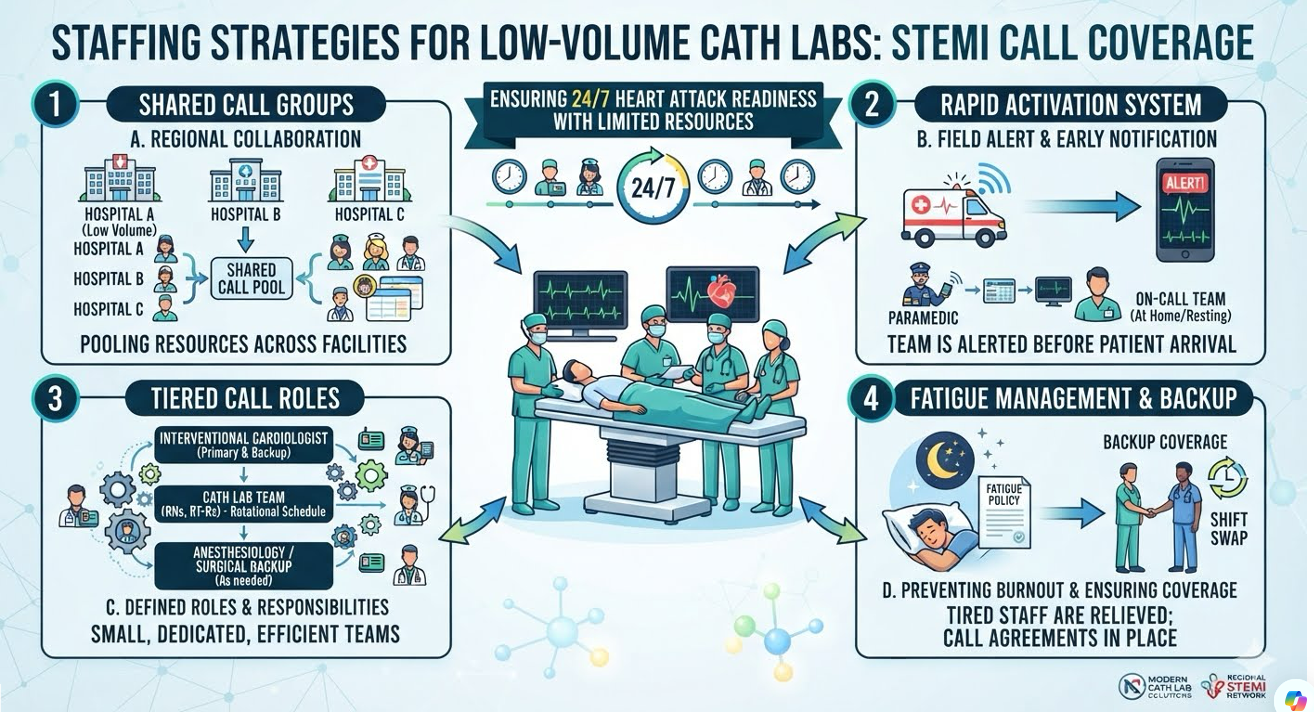
Figure Sources:
1. Writing Committee Members; Lawton JS, Tamis-Holland JE, Bangalore S, et al. 2021 ACC/AHA/SCAI guideline for coronary artery revascularization: a report of the American College of Cardiology/American Heart Association Joint Committee on clinical practice guidelines. J Am Coll Cardiol. 2022 Jan 18; 79(2): e21-e129. doi:10.1016/j.jacc.2021.09.006
2. Naidu SS, Abbott JD, Bagai J, et al. SCAI expert consensus update on best practices in the cardiac catheterization laboratory: This statement was endorsed by the American College of Cardiology (ACC), the American Heart Association (AHA), and the Heart Rhythm Society (HRS) in April 2021. Catheter Cardiovasc Interv. 2021 Aug 1; 98(2): 255-276. doi:10.1002/ccd.29744
3. Sentinel Event Alert 48: Health care worker fatigue and patient safety. Joint Commission. Issue 48, December 14, 2011. Addendum: May 14, 2018. Accessed August 12, 2026. https://www.jointcommission.org/en-us/knowledge-library/newsletters/sentinel-event-alert/issue-48
4. Jollis JG, Al-Khalidi HR, Roettig ML, et al; Mission: Lifeline STEMI Systems Accelerator Project. Regional Systems of Care Demonstration Project: American Heart Association Mission: Lifeline STEMI Systems Accelerator. Circulation. 2016 Aug 2; 134(5): 365-374. doi:10.1161/CIRCULATIONAHA.115.019474
_________
It appears that many low-volume emergency cardiac cath labs use site-specific strategies for coverage. Each location and hospital has different requirements and resources, and thus must tailor the options to their needs. Locking a single operator to a single small-volume lab does not make good clinical or economic sense. From my colleagues’ comments and some research, some alternative approaches would include the following:
1) Shared on-call teams with small pools of nurses, technologists, and doctors sharing the call duty. Smaller hospitals can share the call schedule with nearby competing hospitals. Consider the VitalSolution model of 2 weeks on/off.
2) Increased pay in rural areas (already existing regionally).
3) Shared/expedited privileges to more rapidly expand the pool of potential IC coverage.
4) Fewer contractual restrictive covenants and noncompete arrangements so that more employed physicians can moonlight.
5) Train and encourage more independent cardiologists.
Hopefully, this discussion will help implement new coverage and assist those currently covering small labs to make the best decisions for their community.
References
1. Kern M and colleagues. Conversations in cardiology: how are operators comped for being on call? TCTMD. August 18, 2023. Accessed August 10, 2025. https://www.tctmd.com/news/conversations-cardiology-how-are-operators-comped-being-call
2. Kern M and colleagues. Conversations in cardiology: should interventional cardiologists get paid for being on call? TCTMD. November 8, 2019. Accessed August 10, 2025. https://www.tctmd.com/news/conversations-cardiology-should-interventional-cardiologists-get-paid-being-call
Related Content