Advancing Pulmonary Embolism Care: Mechanical Thrombectomy, PERT Programs, and Post-PE Follow-Up
© 2026 HMP Global. All Rights Reserved.
Any views and opinions expressed are those of the author(s) and/or participants and do not necessarily reflect the views, policy, or position of Cath Lab Digest or HMP Global, their employees, and affiliates.
Pratik Sandesara, MD
Emory Heart & VascularAssistant Professor, Emory University School of Medicine, Atlanta, Georgia
This interview was sponsored by Penumbra, Inc.
Procedural and operative techniques and considerations are illustrative examples from physician experience. Physicians’ treatment and technique decisions will vary based on their medical judgment. The clinical results presented herein are for informational purposes only, and may not be predictive for all patients. Individual results may vary depending on patient-specific attributes and other factors.
Caution: Federal (USA) law restricts these devices for sale by or on the order of a physician. Prior to use, please refer to the Instructions for Use for complete product indications, contraindications, warnings, precautions, potential adverse events, and detailed instructions for use. For the complete Penumbra IFU Risk Summary Statements, please visit www.peninc.info/risk. Please contact your local Penumbra representative for more information.
Can you tell us about your work?
 I’m an interventional cardiologist specializing in complex coronary and endovascular interventions. I am also part of a multidisciplinary pulmonary embolism response team (PERT) at Emory Healthcare, so we are very involved in the care of patients with pulmonary embolism, both acutely in the hospital and during outpatient follow-up. I see patients across the entire spectrum, from their initial presentation in the emergency department through outpatient follow-up, sometimes many years after a PE.
What feels most different about PE diagnosis today compared with five years ago?
With the availability of catheter-based devices, there is now a greater focus on identifying patients who may benefit from early catheter-based intervention in addition to anticoagulation. Many institutions now have standardized risk-stratification and management protocols/algorithms that incorporate biomarkers such as troponin, BNP, lactate, and imaging to identify right ventricular strain/dysfunction. These tests are obtained early as part of a systematic approach rather than on an ad hoc basis, where some patients get them and others do not. Increasingly, they are routine components of a protocolized approach. As a result, we are identifying patients who may benefit from early catheter-based interventions much more quickly than we did five years ago (i.e., which patients are likely to decompensate and might benefit from earlier intervention).
The new clinical categorization guidelines1 aim to add more granularity beyond ‘intermediate’ and ‘high’ risk. How has that changed your decision-making for intermediate-risk patients?
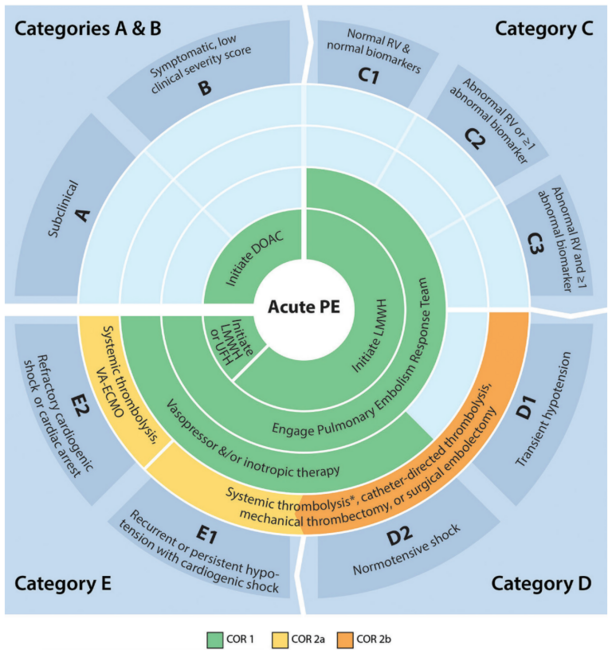
The new 2026 acute PE guidelines introduced five clinical categories, A through E, with subcategories designed to classify patients more precisely and provide evidence-based therapeutic decision-making.1 I think this reflects a conceptual shift away from an approach based primarily on anatomic clot burden and toward a more pathophysiologic approach that integrates clinical severity, biomarkers, imaging, and hemodynamics.
The respiratory modifier adds another variable that can help identify patients who are sicker than the traditional low-, intermediate-, and high-risk categories might suggest. It may allow us to recognize earlier which patients warrant intervention.
There is also an increased emphasis on PE response teams (PERTs) with a class 1 recommendation for the use of multidisciplinary PERTs to improve care delivery.
Overall, this categorization helps us further stratify intermediate-risk patients, and identify those who are more likely to decompensate and may benefit from earlier intervention with advanced therapies, including systemic thrombolysis and catheter-based or surgical interventions.
Can you describe Emory’s PERT program, how it was established, and how it has evolved?
Our multidisciplinary program has been in place for several years. It started with a few early champions of the program. They developed a comprehensive algorithm to identify which patients might benefit from catheter-based intervention or systemic thrombolysis. At the time, the catheter-based treatment options were primarily catheter-directed thrombolysis or systemic thrombolysis, and mechanical thrombectomy was just beginning to enter the field. That emerging technology helped drive their interest, and the program grew from there.
Today, it is a multidisciplinary program involving interventional cardiology, cardiac surgery, vascular medicine, hematology, and pulmonary critical care.
In addition to the acute PERT program, we also have a chronic thromboembolic pulmonary hypertension (CTEPH) program. Some patients present with acute-on-chronic thrombus, while others have an entirely acute event. When we suspect that there is more going on than an acute PE and that a patient may benefit from a broader CTEPH treatment approach, we involve the CTEPH team as well.
When clinicians call the PERT team, what are the main decisions they need help making?
Our approach is to be involved with every patient who has a PE, even if it is considered low risk. We provide recommendations on acute medical therapy and discharge planning, but the biggest priority is identifying patients who may benefit from catheter-based therapies and intervention.
The first question is whether the patient needs urgent treatment. We review the case and help determine who should go to the cath lab for immediate intervention versus who can be started on anticoagulation and undergo a more complete assessment the next day, particularly if the call comes overnight.
The second question is whether the patient needs any intervention at all or whether the PE can be managed with anticoagulation alone. We also help evaluate patients who are already on anticoagulation but present with a second or third event. In those cases, the team can guide the workup for etiology of recurrent events and potential evaluation for CTEPH.
Ultimately, the main questions are: Does this patient need something urgently, and if not, do they need an intervention at all? That is the guidance clinicians are usually looking for from the PERT team.
Can you share a recent case that shows how the PERT team manages a rapidly deteriorating patient and coordinates advanced therapy?
A few weeks ago, a patient presented around 4 am with a PE. The patient was hypotensive and had been started on low-dose vasopressors, and the PERT team was called. We felt this was someone who would likely benefit from early catheter-based intervention based on American Heart Association/American College of Cardiology Category E classification. The patient experienced cardiac arrest in the ICU before treatment could be initiated.
Because the PERT team was already involved, we were able to initiate extracorporeal membrane oxygenation (ECMO) quickly to stabilize the patient. They were then taken to the cath lab for mechanical thrombectomy to remove the high thrombus burden. Within about two days, the patient was decannulated and doing very well.
These borderline patients raise difficult questions. Do you give systemic tPA immediately? In this case, the patient was older, so bleeding risk was a concern. Do you place the patient on ECMO first and stabilize them, or take them directly to the cath lab with the risk that they may decompensate during transport? These decisions are very nuanced, and this is where the PERT team is especially valuable in helping ICU and emergency physicians determine the best course.
Stable patients often allow more time for evaluation, but these borderline, critically ill patients require the team to be highly engaged and hands-on. We work closely with the ICU team to assess severity and decide whether the patient needs mechanical circulatory support, urgent thrombectomy, or systemic thrombolysis.
Without a dedicated PERT program, it would be much more difficult to coordinate ECMO, transfer to the cath lab, and do a mechanical thrombectomy quickly enough to achieve this type of outcome. These are the situations in which a formal, multidisciplinary program is especially helpful.
How can mechanical thrombectomy affect ICU and hospital utilization?
One of the benefits of mechanical thrombectomy is the potential for improved resource utilization, including less time in the ICU and a shorter hospital stay. We have seen that in several clinical trials, our own practice, and market-access analyses from Penumbra have also examined those outcomes.
Many patients can go directly to the floor after the procedure because they stabilize immediately on the table. If our patient had not been on ECMO and had stabilized after thrombectomy, they probably would have gone directly to the floor, which is what happens in the majority of cases at our center. Even when patients start in the ICU, if we perform thrombectomy and they stabilize with immediate improvements in hemodynamics and pulmonary pressures, they can often transfer to the floor rather than return to the ICU. This can substantially improve ICU utilization and reduce total hospital length of stay. Instead of remaining hospitalized on anticoagulation for several days while waiting for symptomatic improvement, patients often feel better immediately after thrombectomy. That immediate clinical improvement is one of the biggest changes we have seen in the current era as mechanical thrombectomy procedures have become more widely available.
With the 2026 guidelines and recent trials, where do you see the biggest gap between evidence and real-world practice in intermediate-risk PE?
When you look at the guidelines, advanced catheter-based therapies, including mechanical thrombectomy, are considered reasonable for Category E1 patients and may be considered for Category D1-2 patients. The guidelines were written before the STORM-PE data were published, which looked at the use of Penumbra’s Lightning Flash® computer assisted vacuum thrombectomy (CAVT™) technology compared to anticoagulation alone.2 As we continue to generate more data, and as the evidence is reevaluated to incorporate STORM-PE along with trials such as HI-PEITHO3 that support advanced treatment, we may see stronger recommendations for intervention in selected intermediate-risk patients. I think that is probably what we will see in the next iteration of the guidelines. We will likely also see a shift in endorsement for catheter-based interventions in lower-risk patients as we continue to show the safety and efficacy of these devices and generate more supporting data, including STRIKE-PE, which is the largest single-arm study looking at the safety and effectiveness of mechanical thrombectomy to treat PE.
How do you approach treatment decisions when emerging evidence may be ahead of the current guidelines?
We have to remember that guidelines provide a road map for overall management; however, it may not be generalizable for all patients and so we sometimes have to individualize the decision-making. For me and a lot of my colleagues, it is important to engage in shared decision-making with the patient. We discuss the available data, including evidence gaps, and we talk through the benefits and risks.
A lot of patients want to feel better more quickly and get out of the hospital sooner. We often focus on acute, in-hospital outcomes, but one of the important aspects of STORM-PE was the evaluation of functional status and quality-of-life outcomes. That is significant because a substantial number of patients experience some degree of long-term limitation after PE. If we can improve not only their acute condition but also their longer-term symptoms and functional recovery, that is important information to include in the conversation.
When patients are acutely ill in the hospital, we can sometimes lose sight of what their recovery may look like after discharge. I now make a point of discussing the data supporting longer-term benefits and symptom improvement, not just the immediate procedural outcomes. The STORM-PE findings have definitely influenced how I have those conversations with patients.
How can hospitals without on-site PE intervention capabilities improve the transfer and treatment process for intermediate- and high-risk patients?
We receive transfer calls for PE patients all the time. We bring them in for further assessment and, when appropriate, mechanical thrombectomy. Sometimes a patient is transferred and ultimately does not undergo a procedure, but at least we know that a thorough evaluation has been completed.
I think one possible solution would be to establish regional centers of excellence where patients can be transferred when the referring hospital does not have the local capability to provide advanced PE treatment. Over time, we may need a model similar to STEMI systems of care. If a facility cannot provide the necessary intervention, the patient is transferred to a center that can. I think we should consider developing the same type of regionalized approach for patients with intermediate- and high-risk PE.
Looking ahead over the next 3-5 years, where do you see the greatest opportunities to improve PE outcomes?
One important area is the continued evolution of guideline recommendations for catheter-based intervention, especially mechanical thrombectomy as more evidence becomes available. Right now, these recommendations are Class 2a or 2b, depending on the clinical category. The question is: What additional evidence do we need to move toward a Class 1 recommendation? I think that is one area where we need to focus.
The other major opportunity is post-PE care. Many centers still do not have a structured follow-up program or a consistent approach to evaluate for chronic thromboembolic pulmonary hypertension. We need a more standardized way to manage patients after discharge and identify those who may develop longer-term complications. Longitudinal care has been emphasized in the new guidelines with a structured follow-up framework that is outlined. Emory is fortunate to be a large CTEPH center, with a dedicated multidisciplinary team who can offer balloon pulmonary angioplasty and pulmonary endarterectomy in addition to medical therapy. As a result, many of these patients receive a comprehensive evaluation and management.
What advances will be most important as PE treatment continues to evolve?
We are fortunate that there is so much interest in mechanical thrombectomy technology. The available data continue to show that these procedures are a valuable option for PE patients.
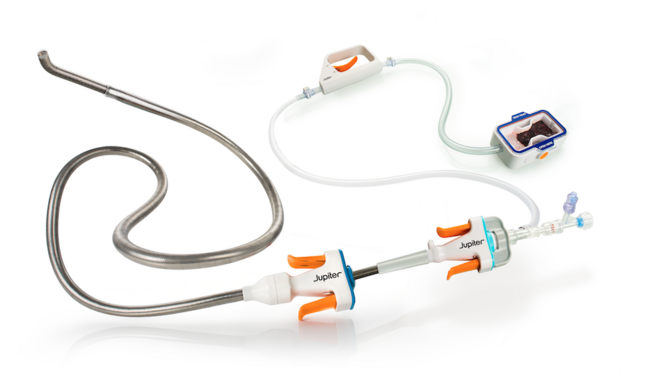
With each iteration of the technology, particularly with Penumbra’s CAVT technology, we have seen in my experience procedures get quicker with a consistent safety profile.2 These patients are already sick, so anything that can minimize blood loss and shorten procedure time is important.
The next step is making sure trainees are comfortable with catheter-based therapies so they can offer it to patients when they enter practice. I think PE intervention should be a core component of interventional training programs, alongside coronary and structural interventions. Not every center can currently offer mechanical thrombectomy, but broader access starts with education.
References
1. Creager MA, Barnes GD, Giri J, et al. 2026 AHA/ACC/ACCP/ACEP/CHEST/SCAI/SHM/SIR/SVM/SVN Guideline for the evaluation and management of acute pulmonary embolism in adults: a report of the American College of Cardiology/American Heart Association Joint Committee on Clinical Practice Guidelines. J Am Coll Cardiol. 2026 Apr 7; 87(13): 1626-1710. doi:10.1016/j.jacc.2025.11.005
2. Lookstein RA, Konstantinides SV, Weinberg I, et al; STORM-PE Trial Investigators. Randomized controlled trial of mechanical thrombectomy with anticoagulation versus anticoagulation alone for acute intermediate-high risk pulmonary embolism: primary outcomes from the STORM-PE trial. Circulation. 2026 Jan 6; 153(1): 21-34. doi:10.1161/CIRCULATIONAHA.125.077232
3. Rosenfield K, Klok FA, Piazza G, et al; HI-PEITHO Investigators. Ultrasound-facilitated, catheter-directed fibrinolysis for acute pulmonary embolism. N Engl J Med. 2026 May 28; 394(20): 1979-1990. doi:10.1056/NEJMoa2516567
Find More
Computer-Assisted Vacuum Thrombectomy (CAVT) Designed for Quick, Safe, and Effective Clot Removal
EMBOLIZE: Bringing Randomized Evidence to Pelvic Vein Embolization
Renal Denervation Topic Center
Cardiovascular Ambulatory Surgery Centers (ASCs) Topic Center
Grand Rounds With Morton Kern, MD
Peripheral Artery Disease Topic Center