Research From UK Air Ambulance Charity Highlights Importance of Invasive Blood Pressure Monitoring in Brain-Injured Patients
Source: Air Ambulance Charity Kent Surrey Sussex
KENT, U.K.—A pioneering study by Air Ambulance Charity Kent Surrey Sussex (KSS) reveals that using invasive arterial blood pressure monitoring in prehospital emergency medicine offers far greater precision in treating patients with brain injuries, potentially helping prevent further brain damage.
Published in the Scandinavian Journal of Trauma, Resuscitation and Emergency Medicine, the study is titled “Diagnostic accuracy of pre-hospital invasive arterial blood pressure monitoring for haemodynamic management in traumatic brain injury and spontaneous intracranial haemorrhage.”
Researchers compared the accuracy of invasive arterial lines, introduced by KSS in February 2022, with the traditional noninvasive method using an arm cuff.
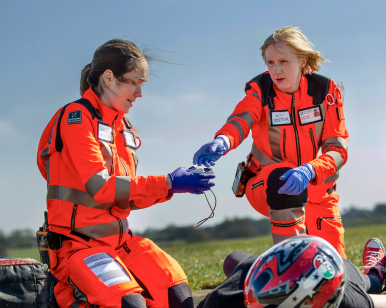
Patients with brain injuries, whether from trauma or spontaneous bleeding, need precise blood pressure management to prevent further brain damage. Previously, clinical teams would use a simple noninvasive arm cuff to guide treatment decisions.
The study found significant differences between the two methods, with the noninvasive arm cuff method tending to underestimate high blood pressure and overestimate low blood pressure.
The report’s authors conclude that invasive monitoring, widely used in hospitals, has the potential to provide more accurate patient care at the point of injury or illness, in some of the patients seen by KSS.
Jo Griggs, Head of Research and Innovation at KSS, said, “Our findings underline the critical importance of accurate blood pressure monitoring in managing brain injuries. The use of invasive arterial lines can significantly enhance the precision of treatment, supporting clinical decision-making and potentially improving outcomes for patients.”
The KSS research team, Jo Griggs, Scott Clarke, Rob Greenhalgh, Adam Watts, Silas Houghton Budd, Jack Barrett, Kat Hunter, Michael Dias, Richard Lyon, and Ewoud ter Avest, found that arterial lines offer superior accuracy compared to noninvasive arm cuffs, which are still widely used in emergency care. Better accuracy in monitoring blood pressure at the scene allows for more tailored interventions, reducing the risk of secondary brain injury.
This study, led by Jo Griggs, is the latest from the KSS Research and Innovation Team, which has an established reputation for helping to shape improvements in prehospital emergency medicine across the UK and internationally. Over the last 10 years the team has published over 50 papers in peer-reviewed journals, covering clinical and operational research.
Summary
The research by KSS supports the use of prehospital invasive arterial lines in specific patient groups to enable more precise treatment for brain-injured patients. The findings suggest that adopting this method can result in better patient outcomes by ensuring more accurate blood pressure management and thereby preventing further brain damage.
Visit aakss.org.uk.