Posterior Transsacrococcygeal Drainage for Presacral Abscess in an Irradiated Pelvis With Prior Pelvic Surgery
© 2026 HMP Global. All Rights Reserved.
Any views and opinions expressed are those of the author(s) and/or participants and do not necessarily reflect the views, policy, or position of Wounds or HMP Global, their employees, and affiliates.
Abstract
Background. The management of presacral abscess in patients with a history of pelvic irradiation presents significant challenges, because standard drainage routes may be unsafe or impractical, and wound healing is often compromised. Case Report. A 69-year-old female with a distant history of hysterectomy, bilateral salpingo-oophorectomy, and postoperative pelvic radiotherapy for uterine cancer presented with persistent purulent discharge from the sacrococcygeal region. Transrectal, transvaginal, transabdominal, and image-guided percutaneous drainage were deemed high risk, infeasible, or insufficient for effective drainage. Therefore, posterior transsacrococcygeal drainage was performed through a bony defect at the S4/5 level. Negative pressure wound therapy was used as a temporary adjunct. Although there was an improvement in granulation tissue, surrounding skin necrosis progressed, likely due to radiation-induced soft tissue damage. With ongoing conservative outpatient wound care, the wound eventually epithelialized. Conclusion. Posterior transsacrococcygeal drainage may serve as an effective extraperitoneal approach for managing presacral abscess in select patients with prior pelvic surgery and radiation exposure. In such patients, negative pressure wound therapy may serve as a temporary adjunct for wound management, although delayed healing and progressive skin necrosis due to radiation injury should be anticipated.
Pelvic abscesses are typically treated with a combination of antimicrobial therapy and either image-guided or surgical drainage.1,2 For many patients, percutaneous or transabdominal approaches provide adequate access.2 However, prior pelvic surgery and pelvic irradiation may lead to dense adhesions, fibrosis, altered anatomy, and impaired tissue healing.3,4 In such cases, conventional drainage routes may be technically challenging and carry a significant risk of bowel injury and other complications.
When safe access cannot be established, alternative strategies that avoid intraperitoneal dissection should be explored. Specialized techniques for deep, inaccessible intra-abdominal and pelvic abscesses, including presacral and other posterior approaches, have been reported to be safe and feasible in select patients.3 In addition, various transosseous or posterior routes, including trans-sacral-foramen, transsacral, and transcoccygeal approaches, have been documented to reach presacral abscesses.5-7
The current report presents the case of a presacral abscess in a patient with a history of pelvic irradiation and surgical intervention that was managed via posterior transsacrococcygeal drainage followed by extended wound care.
Case Report
A 69-year-old female presented with persistent purulent discharge from the sacrococcygeal region. Her medical history included a hysterectomy with bilateral salpingo-oophorectomy and postoperative pelvic radiotherapy for uterine cancer at age 37 years. The patient had good nutritional status, did not have diabetes mellitus, and was afebrile.
Ethical approval was waived by the institutional review board of Showa Medical University Northern Yokohama Hospital, Yokohama, Japan, because this study is a single case report and does not constitute human subjects research. The patient provided written informed consent for publication of this case report and accompanying images.
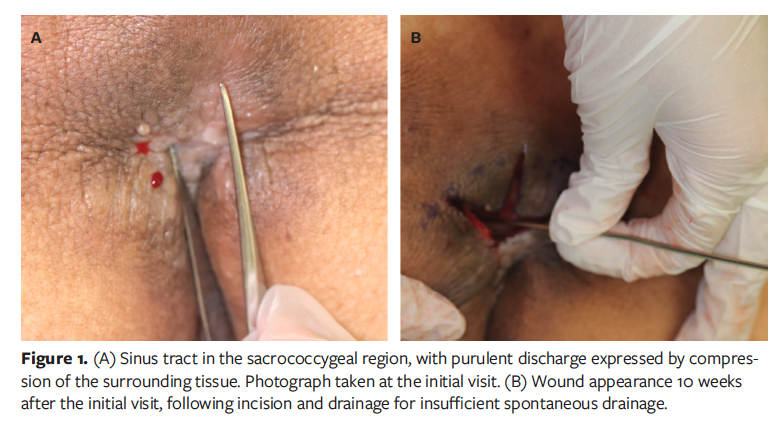
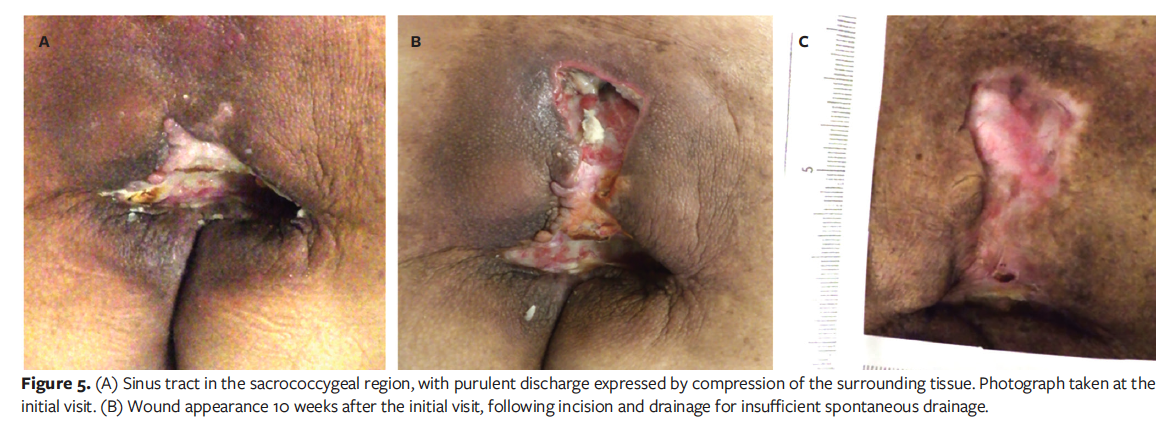
Approximately 1 month prior to her initial consultation at the institution of the authors of the current case report, the patient developed purulent discharge and was subsequently referred to the dermatology department after an initial evaluation by a local dermatologist. Upon examination, a sinus tract was observed in the sacrococcygeal region, and compression of the surrounding tissue resulted in pus expulsion (Figure 1A). Culture samples were collected, and antibiotic therapy was initiated. At follow-up, incision and drainage was performed due to insufficient spontaneous drainage (Figure 1B).
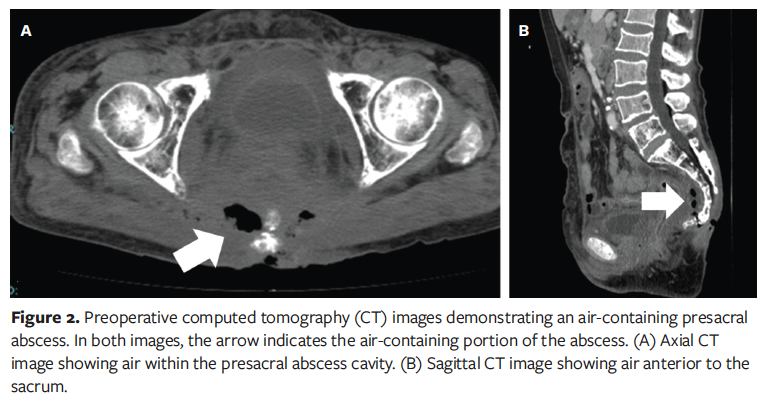
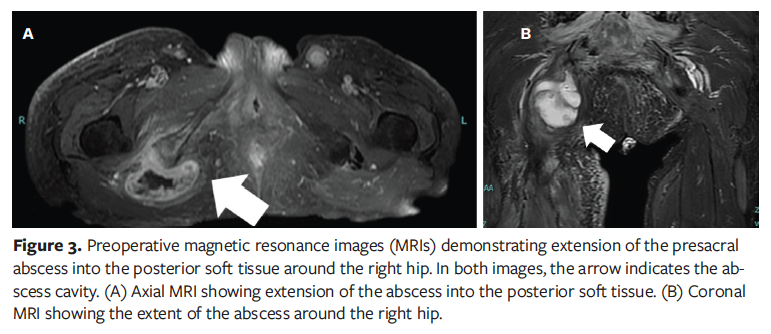
Despite conservative management, the clinical progression and imaging findings suggested a persistent presacral abscess in the context of previous pelvic irradiation and surgery. Preoperative computed tomography (CT) revealed the presence of a presacral abscess (Figure 2), and preoperative magnetic resonance imaging demonstrated extension of the lesion into the posterior soft tissue surrounding the right hip (Figure 3). Traditional drainage routes were considered inappropriate for the following reasons: a transrectal route was deemed high risk due to radiation-induced rectal changes and impaired tissue healing, a transvaginal approach was infeasible due to prior gynecologic surgery, and transabdominal drainage or repeat laparotomy was considered high risk because of anticipated adhesions and the potential for bowel injury. Although image-guided percutaneous drainage was considered, the configuration of the abscess cavity raised concerns about achieving adequate drainage.
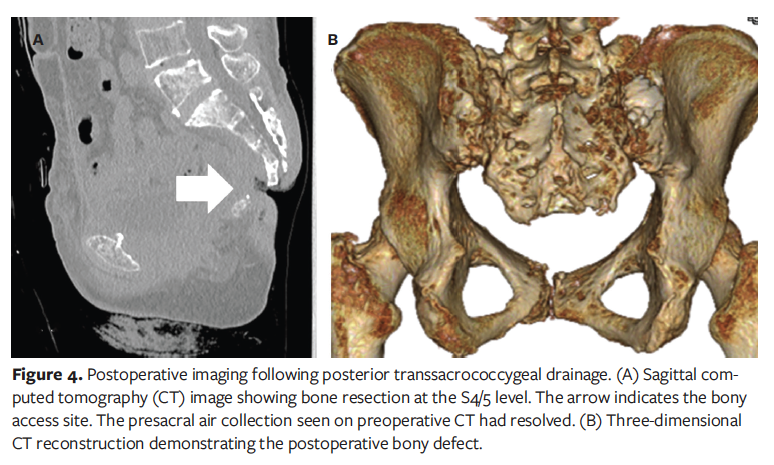
Therefore, posterior transsacrococcygeal drainage was selected. The procedure was performed under general anesthesia with the patient in the prone position. A posterior midline incision was made extending from the lower sacrum to the sacrococcygeal region. After exposure of the lower sacrum, fistulous tracts were identified bilaterally. The surrounding soft tissues were carefully dissected, and partial resection of the lower sacrum was performed using an ultrasonic bone curette. Through this posterior approach, the presacral abscess cavity was directly accessed, allowing drainage of purulent material. The cavity was thoroughly irrigated, and necrotic tissue was debrided. This approach allowed direct access to the abscess cavity without intraperitoneal dissection. Postoperative CT and 3-dimensional CT confirmed the surgical pathway and bony resection at the S4/5 level (Figure 4).
Negative pressure wound therapy was subsequently used as a temporary adjunct to enhance drainage control and promote granulation. The postoperative wound progression is shown in Figure 5. One month postoperative, the wound had not yet epithelialized (Figure 5A). Despite improvement in granulation tissue, surrounding skin necrosis progressively worsened. Additional debridement was performed during the postoperative period (Figure 5B). Vascularized flap reconstruction was considered due to the compromised tissue quality in the irradiated area; however, the patient opted for continued conservative management. With ongoing outpatient wound care and serial local treatments, the wound gradually improved and eventually achieved complete epithelialization (Figure 5C).
Discussion
The present case underscores 2 critical issues in managing presacral abscess in select patients with prior pelvic surgery and radiation exposure: the selection of a safe drainage route in a previously irradiated pelvis with prior pelvic surgical intervention and the challenges of wound management in irradiated tissues.
First, the pelvic environment significantly constrains standard treatment options. Image-guided percutaneous drainage is widely recognized as a safe and effective minimally invasive approach for managing abdominopelvic collections. However, successful outcomes depend on meticulous route selection and avoidance of surrounding critical structures.2 In cases of deep, inaccessible pelvic abscesses, specialized approaches such as presacral, transgluteal, and other modified routes have been reported to be safe and feasible, with high technical success rates in select patients.3 In the present case, a transrectal route was considered high risk due to radiation-related rectal changes, a transvaginal route was infeasible due to prior gynecologic surgery, and a transabdominal approach would have necessitated reentry into an irradiated pelvis with anticipated severe adhesions and an increased risk of bowel injury. Although CT-guided percutaneous drainage was considered, the anatomical configuration of the abscess cavity raised concerns about the feasibility of achieving adequate drainage.
Several posterior, transosseous, and coccygeal approaches to presacral abscess drainage have been described when conventional access is deemed unsafe or infeasible. These include CT-guided trans-sacral-foramen drainage, transsacral or transpedicular drainage, transcoccygeal drainage, and paracoccygeal infragluteal approaches.5-7 These reports support the concept that posterior or transosseous routes may be useful when conventional transabdominal, transrectal, or transvaginal pathways are unsuitable. However, most previously reported techniques involved image-guided percutaneous procedures, whereas the current case required an open posterior access because adequate drainage through a percutaneous route was considered difficult. In addition, unlike previously reported transsacral or transcoccygeal techniques, the approach in the present case involved bone resection through the bony defect at the S4/5 level to achieve direct access to the presacral abscess cavity. This method allowed effective drainage while avoiding intraperitoneal dissection in a previously irradiated pelvis with prior surgical intervention. Although this approach is more invasive than percutaneous techniques, it may be beneficial when conventional or image-guided access is considered unsafe or unlikely to achieve sufficient drainage. Reports describing open posterior drainage of presacral abscesses through a lower sacral bony defect at the S4/5 level remain limited.
Second, wound healing postdrainage was likely hindered by the effects of prior irradiation. Tissues subjected to radiation are susceptible to atrophy, fibrosis, ulceration, fistula formation, and impaired healing, with these changes potentially worsening over time.4 Recent reviews have emphasized that radiation-induced tissue damage can range from superficial skin alterations to deeper soft tissue and bony complications, significantly complicating wound management.8,9 In the current case, negative pressure wound therapy provided some temporary wound control and promoted granulation; however, it could not rectify the underlying tissue ischemia. Previous research has identified prior irradiation as a significant risk factor for delayed wound healing following negative pressure wound therapy.8 Thus, in severely compromised irradiated tissues, negative pressure wound therapy may serve as a temporary adjunct, but delayed healing should be anticipated.
Hyperbaric oxygen therapy (HBOT) may also be considered as an adjunctive treatment for delayed radiation-induced soft tissue injury because it can improve tissue oxygenation, promote angiogenesis, and facilitate wound healing in hypoxic irradiated tissue. In the present case, HBOT was not used because the treatment strategy focused on surgical drainage, debridement, infection control, and local wound management for an established presacral abscess requiring direct source control. Consideration was also given to treatment availability, treatment burden, and the need for repeated sessions. Although a favorable outcome was achieved without HBOT, it may represent a reasonable adjunctive option in selected patients with radiation-
associated pelvic wounds, particularly when wound healing is delayed or radiation-
induced tissue injury is substantial.
When vascularized flap reconstruction was suggested to the patient discussed in the current case report due to the potential benefits of well-vascularized tissue coverage for irradiated wounds with persistent soft tissue compromise,9 she declined further reconstructive surgery. Remarkably, despite these challenging circumstances, long-term outpatient management ultimately resulted in epithelialization. This favorable outcome suggests that, in select patients who are neither candidates for nor wish to undergo flap reconstruction, careful conservative wound care may still lead to wound closure, albeit with a protracted treatment course.
Limitations
This report presents a single case, thereby limiting the generalizability of this approach to other patients. In addition, due to the multiple interventions performed over time, it is not possible to delineate the specific contribution of each treatment component. Lastly, the favorable long-term outcome in this case may have been influenced by patient-
specific factors, including the anatomy of the abscess cavity and adherence to outpatient wound care.
Conclusion
Posterior transsacrococcygeal drainage may be an effective extraperitoneal option for managing presacral abscesses in select patients with a history of pelvic irradiation and prior surgical intervention. In such patients, negative pressure wound therapy may serve as a temporary adjunct for wound control; however, delayed healing and progressive skin necrosis due to radiation injury should be anticipated. In select cases, continued conservative outpatient wound care may ultimately facilitate epithelialization when reconstructive surgery is not pursued.
Author and Public Information
Authors: Yusuke Oshita, MD, PhD1; Takaharu Otsuka, MD, PhD2; Shinsuke Takagi, MD, PhD3; Yosuke Tomizuka, MD4; Yurika Gomi, MD, PhD5; and Yoko Shimada, MD5
Affiliations: 1Department of Orthopaedic Surgery, Showa Medical University Northern Yokohama Hospital, Yokohama, Japan; ²Division of Plastic and Reconstructive Surgery, Tokyo Takanawa Hospital, Tokyo, Japan; 3Department of Plastic and Reconstructive Surgery, Showa Medical University School of Medicine, Tokyo, Japan; 4Department of Plastic and Reconstructive Surgery, Showa Medical University Fujigaoka Hospital, Yokohama, Japan; 5Department of Dermatology, Showa Medical University Fujigaoka Hospital, Yokohama, Japan
Disclosure: The authors disclose no financial or other conflicts of interest.
Acknowledgment: The authors thank Syuryo Akamine, MD, PHD, and their colleague for their assistance as first assistants during surgery and for their support in managing negative pressure wound therapy.
Author Contributions: Y.O. contributed to drafting the manuscript and performing the surgical treatment, including osteotomy. Y.G. and Y.S. were responsible for the initial skin treatment, and T.O. was primarily responsible for wound management, with support from S.T. and Y.T. All authors reviewed, revised, and approved the final manuscript.
Ethics Statement: Ethical approval was waived by the institutional review board of Showa Medical University Northern Yokohama Hospital because this study is a single case report and does not constitute human subjects research. Written informed consent was obtained from the patient for publication of this case report and accompanying images.
Correspondence: Yusuke Oshita, MD, PhD; Department of Orthopaedic Surgery, Showa Medical University Northern Yokohama Hospital, 35-1 Chigasaki-chuo, Tsuzuki-ku, Yokohama, Kanagawa 224-0032, Japan; oshita@med.showa-u.ac.jp
Manuscript Accepted: August 14, 2026
References
1. Brook I. Microbiology and management of abdominal infections. Dig Dis Sci. 2008;53(10):2585-2591. doi:10.1007/s10620-007-0194-6
2. De Filippo M, Puglisi S, D’Amuri F, et al. CT-guided percutaneous drainage of abdominopelvic collections: a pictorial essay. Radiol Med. 2021;126(12):1561-1570. doi:10.1007/s11547-021-01406-z
3. Zhao N, Li Q, Cui J, Yang Z, Peng T. CT-guided special approaches of drainage for intraabdominal and pelvic abscesses: one single center’s experience and review of literature. Medicine (Baltimore). 2018;97(42):e12905. doi:10.1097/MD.0000000000012905
4. Haubner F, Ohmann E, Pohl F, Strutz J, Gassner HG. Wound healing after radiation therapy: review of the literature. Radiat Oncol. 2012;7:162. doi:10.1186/1748-717X-7-162
5. An QJ, Qin DA, Ma J. A novel transforaminal approach to presacral abscess. World Neurosurg. 2021;153:75-78. doi:10.1016/j.wneu.2021.07.016
6. Kodzis E, Jocius D, Lapteva O, Kručaitė R. Common options and overlooked alternative for drainage of inaccessible presacral abscess: a case report. Acta Med Litu. 2021;28(1):170-175. doi:10.15388/Amed.2021.28.1.13
7. Corso R, Maino C, Rovere A, Zarpellon N, Ippolito D, Leni D. Imaging-guided percutaneous trans-coccygeal drainage of a presacral abscess: a technical report. Medical Reports. 2025;12:100238. doi:10.1016/j.hmedic.2025.100238
8. Faisal M, Berend PD, Seemann R, et al. Impact of previous irradiation on wound healing after negative pressure wound therapy in head and neck cancer patients-a systematic review. Cancers (Basel). 2021;13(10):2482. doi:10.3390/cancers13102482
9. Simman R, Bach K, Abbas F, Klomparens K, Brickman BJ. Management of radiation-induced tissue injuries: a review of current treatment strategies. Plast Reconstr Surg Glob Open. 2023;11(6):e5043. doi:10.1097/GOX.0000000000005043