The Efficacy of a Novel 3-D Electrospun Synthetic Polymer Matrix (3DESPM) on the Management of Difficult-to-Heal Wounds
Wound care represents a significant cost in the US healthcare system with our aging population and the rising toll of diabetes and obesity. Clinicians need cost-effective treatment options to facilitate wound closure, but despite a wide range of advanced treatments currently available, providers must weigh risks, costs, and ease of use for each case. Even skin grafts come with a major concern of graft failure. And though recent reviews suggest skin grafts and skin substitutes may be effective treatments for diabetic foot ulcers (DFUs), there is insufficient evidence on the use of these products for venous leg ulcers (VLUs), largely due to small trial sizes.
According to the authors of a recent study, the optimal skin substitute and wound dressing should be a “non-immunogenic, bioresorbable scaffold that promotes cellular activity and granulation, mimics the extracellular matrix (ECM), and manages free radicals to transition the chronic wound to the acute state.”
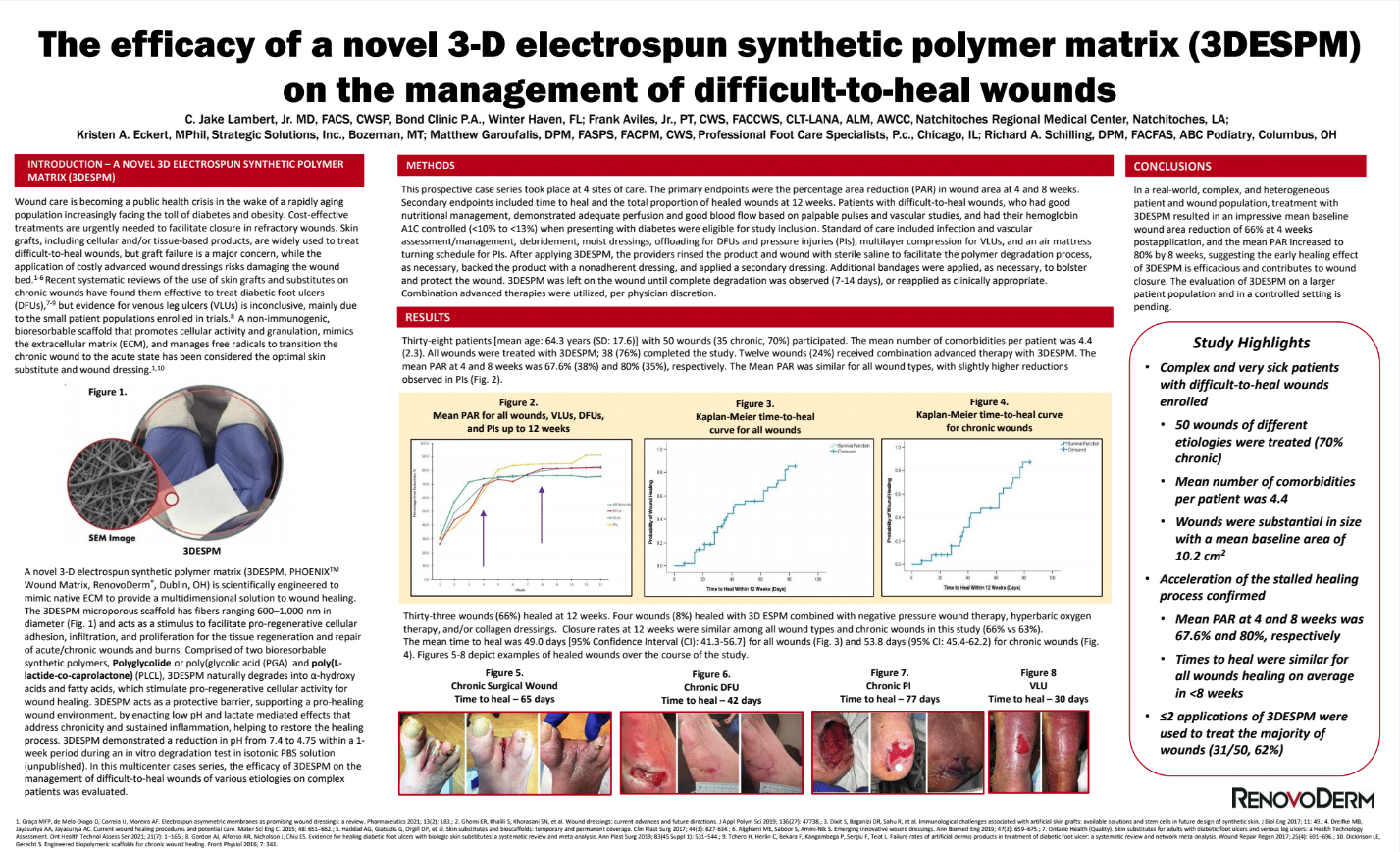
As such, a novel 3-D electrospun synthetic polymer matrix (3DESPM, PHOENIX Wound Matrix, RenovoDerm) is considered as a possible solution, with the electrospinning process creating a fibrous, microporous scaffold that mimics the natural ECM and facilitates pro-regenerative cellular adhesion, infiltration, and proliferation for the tissue regeneration and repair of both burns and acute/chronic wounds. The 3DESPM is comprised of 2 bioresorbable synthetic polymers with fibers ranging 600 to 1000 nm in diameter. The 3DESPM also acts as a protective barrier on the wound to promote a pro-healing environment and helps to address wound chronicity and sustained inflammation to restore the healing process.
This multicenter trial examined the effects of a 3DESPM on a variety of difficult-to-heal wounds across a diverse patient population, displaying promising results in wound healing. The study took place across 4 treatment sites and examined a primary endpoint of percentage area reduction (PAR) at 4 and 8 weeks, with secondary endpoints of time to heal and total proportion of healed wounds at 12 weeks. To be included in the study, patients were required to present with difficult-to-heal wounds, good nutritional management, adequate perfusion and blood flow, and controlled hemoglobin A1C (<10%-<13% depending on care site).
Patients were treated with standard of care, including infection and vascular assessment/management, debridement, application of moist dressings, offloading for pressure injuries (PIs) and DFUs, multilayer compression for VLUs, and scheduled air mattress turning for PIs. Following the application of the 3DESPM product, providers rinsed the wound area and product with sterile saline as necessary to facilitate the process of polymer degradation and applied a nonadherent dressing followed by a secondary dressing and additional bandages as needed. The 3DESPM was left in place for 7 to 14 days until complete degradation was observed, or reapplied as appropriate, and combination advanced therapies were used in some cases at physicians’ discretion.
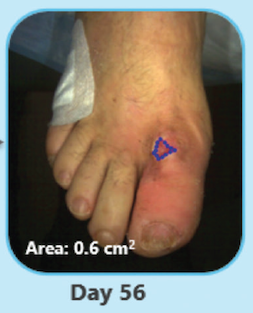
The study included 38 patients with 50 wounds, of which 70% were chronic. The included wounds were also substantial, with a mean baseline area of 10.2 cm2. Patients had a mean age of 64.3 years and a mean of 4.4 comorbidities. All wounds were treated with the 3DESPM product, while 12 (24%) were also treated with combination advanced therapy, and 38 wounds completed the study. At 4 and 8 weeks, the mean PAR was 67.6% and 80%, respectively, with mean PAR similar across all wound types and slightly higher PAR observed in PIs.
At 12 weeks, 33 wounds (66%) were considered fully healed. Four of these healed with a 3DESPM treatment combined with negative pressure wound therapy, hyperbaric oxygen therapy, and/or collagen dressings. The majority of wounds (31 out of 50, 62%) were treated with 2 or fewer applications of the 3DESPM product. Healing rates were similar among all wound types and chronic wounds at the 12-week time point, and the mean time to heal was 49 days for all wounds and 53.8 days for chronic wounds.
In conclusion, while evaluation in a larger patient population and controlled setting is pending, this real-world, complex, heterogenous patient and wound population displayed a baseline wound area reduction of 67.6% at just 4 weeks after initial application of the 3DESPM, with PAR increasing to 80% by 8 weeks, indicating the product contributes to efficacious early healing effects, wound closure, and acceleration of stalled healing processes.