Use of Natural Extracts and Oils in Healing Superficial Diabetic Foot Ulcer
© 2026 HMP Global. All Rights Reserved.
Any views and opinions expressed are those of the author(s) and/or participants and do not necessarily reflect the views, policy, or position of Wounds or HMP Global, their employees, and affiliates.
Abstract
Background. Diabetic foot ulcers are common and serious complications of diabetes, and they are associated with infections, amputations, and high morbidity. Treatment requires effective strategies to promote healing and prevent recurrence. Compounds containing natural extracts and oils have been widely used to promote tissue repair. Objective. To describe the healing process of superficial diabetic foot ulcers in the absence of peripheral arterial disease and infection in individuals treated with a compound based on natural extracts and oils. Materials and Methods. Between May 2024 and June 2024, a retrospective, documentary, and quantitative study evaluating the efficacy of a compound based on natural extracts and oils in healing superficial diabetic foot ulcers (in the absence of peripheral arterial disease and infection) was conducted at a nursing unit that specializes in clinical podiatry. Data were analyzed using simple descriptive statistics. The study received ethical approval. Results. The medical records of 9 participants with a total of 12 treated lesions were analyzed. There were 7 male and 2 female participants, with a mean patient age of 64 years. The superficial diabetic foot ulcers were mainly located in the metatarsal heads and hallux regions. Of the 12 lesions, 75% (n = 9) achieved complete healing, while 25% (n = 3) did not completely heal but did show improvement. Conclusion. The use of a compound based on natural extracts and oils in the treatment of superficial diabetic foot ulcers in the absence of peripheral arterial disease and infection resulted in favorable outcomes in the healing process, according to the validated assessment tool used, the pressure ulcer scale for healing (PUSH) score.
In the Americas, there are at least 62 million individuals with diabetes mellitus (DM), with approximately 40% of the population unaware of their condition. If current trends continue, the number of people with diabetes in the region may reach 109 million by 2040.1
In Brazil, this phenomenon is reproduced in a marked way, with a predominance of type 2 DM in individuals aged 20 years to 79 years. Approximately 16.6 million Brazilians live with the disease, and it is estimated that by 2050 this number will reach 24.0 million.2
On average, 20% of all individuals with DM will develop diabetic foot ulcer (DFU) at some point in their lifetime. Diabetic foot syndrome, including DFU, is one of the most serious and costly complications of DM, representing a challenge for global health systems and, in particular, for Brazil.3 In 2024, the estimated prevalence of DM in adults in Brazil was 9.89%, and the nation has one of the highest absolute numbers of people with the condition in the world.2 This high prevalence is directly reflected in the incidence of pressure ulcers, which are the leading cause of hospitalization for chronic complications of DM and the precursor to up to 85% of nontraumatic lower limb amputations.4
Additionally, in Brazil, the protocol for managing DFU follows the guidelines of the International Working Group on the Diabetic Foot, in which actions consolidate and refine a structured model of action based on fundamental pillars, in which the specialized work of the nursing team, particularly nurses with competencies in clinical podiatry, is recognized as crucial.5
The Brazilian clinical care protocol for the treatment of DFUs involves 5 pillars: (1) systemic assessment and metabolic control, (2) debridement of nonviable tissues and halo of hyperkeratosis (except in situations of ischemia) and control of bacterial load, (3) advanced topical therapy and dressings, (4) pressure relief (off-loading), and (5) education and continued follow-up.5 The implementation of these pillars by a multidisciplinary team is imperative to reduce the incidence of amputations, improve patients’ quality of life, and optimize health resources.5
Nurses play a key role in managing patients with wounds. The nursing team’s responsibilities may include evaluating wounds, prescribing dressings, and performing wound care for lesions of various etiologies and degrees of tissue loss.6
The nurse’s approach to wound treatment must focus on eliminating barriers to healing. Anatomical and physiological risk factors are crucial for classifying the wound type and defining the best therapeutic approach, through careful assessment of clinical evidence such as glycemic control; wound healing phase; wound location, shape, size, and depth; tissue type in the wound bed; and characteristics of exudate, wound edges, and the perilesional area.6
Historically, humans used plants for therapeutic purposes. Many medicinal plants are used to treat a variety of ailments. In wound healing in particular, medicinal plants have been used since prehistoric times, often in the form of poultices to stop bleeding and promote tissue repair.7
Several studies, especially ethnobotanical research conducted in Africa and in developing countries elsewhere, have documented the healing potential of plants and herbs in diabetic ulcer treatment. Supported by this evidence, many scientists have validated such use of plants and herbs through various experimental models.8 A systematic review reports that natural agents such as essential oils—particularly Melaleuca alternifolia and Salvia sclarea extract—exhibit antiseptic properties by inhibiting bacterial colonization and expansion in wound beds.9 Research highlighting the use of natural agents for wound treatment is relevant to clinical nursing practice, because nurses are directly involved in wound management.9
Bioactive compounds extracted from plants represent a promising alternative for optimizing wound healing and minimizing scar formation. These natural extracts, which have antimicrobial, antioxidant, and regenerative properties, act by stimulating blood coagulation, preventing infections, and accelerating the tissue repair process.10
Aloe vera is a natural compound with B vitamins, folic acid, and vitamins A, E, and C that has healing, anti-inflammatory, photoprotective, and emollient action. Aloe vera also contains essential amino acids and polysaccharides, such as acemannan, which has healing, immunomodulatory, and antifungal activity.11
Papain, a proteolytic enzyme obtained from the latex extracted from Carica papaya (ie, papaya), is constituted by a compound of the thiol group of the cysteine-25 molecule that has enzymatic action. In addition to its proteolytic action, papain has anti-inflammatory, bactericidal, and bacteriostatic effects, and it can be used in topical debridement and for degradation of devitalized tissue.11
Neem oil (derived from Azadirachta indica) demonstrates significant antimicrobial activity, which justifies its therapeutic use, particularly against bacterial infections. Among the most sensitive pathogens are Staphylococcus aureus, Escherichia coli, and Pseudomonas aeruginosa. These bacteria are the most frequently cited in studies of neem oil and are the subject of great current clinical concern due to their notorious resistance mechanisms.12
Despite literature reporting the healing potential of such natural agents, clinical evidence supporting their use for diabetic wound healing remains scarce. Most studies are experimental, and publications specific to Brazilian populations are limited.8
Thus, the aim of the current study was to determine how the wound healing process of diabetic ulcers occurs when they are treated with a compound based on natural extracts and oils.
Materials and Methods
Study design and setting
This is a cross-sectional, documentary, retrospective study with a quantitative approach. The study was conducted at a nursing unit specializing in clinical podiatry, the Laboratory for the Production of Care and Technologies in Clinical Podiatry, located at the Piquet Carneiro University Polyclinic of the State University of Rio de Janeiro, which is an outpatient referral center for the care of people with chronic diseases in the state of Rio de Janeiro, Brazil, that performs an average of 99 consultations per month.
Study population and selection criteria
Medical records of individuals with DM with foot ulcers treated exclusively with a compound based on natural extracts and oils were selected. The compound used in this study was the DiabeTran (TCI Biotechnological Laboratory; Minas Gerais, Brazil) and contains the following active ingredients: vitamin E, castor oil, Aloe vera extract, fermented glycolic extract of Carica papaya, Melaleuca alternifolia oil, and neem seed oil (Azadirachta indica). This ointment, which is registered with the Brazilian Health Regulatory Agency (Anvisa; number 81866189004), is indicated for wound treatment and skin protection.13
Medical records of patients with peripheral arterial disease or with incomplete documentation were excluded from the study.
Data collection
Data collection was conducted from May 2024 to June 2024 using an instrument that included the following variables: age, sex, ulcer location, and ulcer classification and staging according to the University of Texas classification (based on depth and the presence of infection and/or ischemia, and the PEDIS [perfusion, extent, depth, infection and sensation] clinical infection severity scale for clinical severity of infection, which categorizes ulcers into grades 1 to 4.14
The healing process was assessed using the pressure ulcer scale for healing (PUSH) score, which evaluates healing based on 3 parameters: wound area in centimeters squared (length × width), exudate amount (scant = 0, minimal = 1, moderate = 2, copious = 3), and predominant tissue type in the wound bed (closed wound = 0, epithelial tissue = 1, granulation tissue = 2, slough = 3, necrotic tissue = 4). These parameters generate a score ranging from 0 to 17, with 0 indicating complete healing.15
Additional data collected included average healing time, lesion size before and after treatment, and average percentage of healing.14 Initial and final PUSH scores were recorded, along with treatment duration and final clinical outcome.
All patients were equivalent in relation to the following criteria: having type 2 DM, wound etiology (ulcer on the foot of an individual with diabetic neuropathy), and weekly care with dressing changes performed by the nurse under the same conditions (ie, cleaning the wound with 0.9% saline solution and use of a primary dressing with natural extract, secondary dressing with gauze, and occlusion of the dressing with a bandage). In addition, patients were using a removable off-loading device (healing sandal to relieve pressure). Furthermore, patients received instructions, prescriptions, and materials for performing dressing changes at home daily. The materials were provided to the participants on the first day of treatment. Additionally, participants were instructed on wound care and dressing changes, such as protecting the wound with waterproof plastic film during bathing, washing hands, putting on gloves, and cleaning the lesion with 0.9% saline solution, followed by application of the primary dressing of natural extract, the secondary dressing of sterile gauze, and finally, occlusion with a crepe bandage.
Data analysis and processing
Collected data were organized in an Excel 2010 (Microsoft) spreadsheet and analyzed using simple descriptive statistics. Frequencies (absolute and relative) were presented graphically, illustrating the healing progression of DFUs according to the PUSH scale.
Ethical approval
The study was approved under Opinion No. 6.919.954, in accordance with Resolution No. 466/2012 of the National Health Council, which concerns ethical principles for research. Because this was a retrospective study involving documentary analysis of medical records and internal service records, the requirement for informed consent was waived.
Results
A total of 9 medical records were analyzed; there were 7 male and 2 female patients. One participant was younger than 50 years (11.11%), 6 (66.67%) were aged between 51 years and 70 years, and 2 (22.22%) were older than 70 years. The mean patient age was 64 years. Twelve lesions were recorded in these medical records, with 1 patient having 4 lesions that were treated with the compound.
Concerning ulcer location, 3 of the 12 ulcers occurred in the hallux region (25%), 3 (25%) occurred in the metatarsal region, 2 (16.67%) occurred in the third toe region, and 1 each occurred in the malleolar, dorsum of the foot, midfoot, and tibial regions (8.33% each).
According to the University of Texas classification, which evaluates lesion severity based on tissue involvement, infection, and/or ischemia, all 12 ulcers (100%) were classified as grade 1, stage A, indicating superficial lesions without infection or ischemia. Based on the PEDIS classification, which assesses the presence and severity of foot infections in people with DM, all 12 lesions (100%) were classified as grade 1 (not infected), indicating no local or systemic signs of infection and characterizing the ulcers as small and superficial.
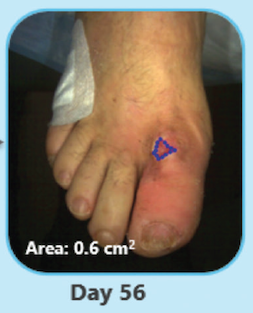
Healing progression was evaluated using the PUSH score. The results are shown in the Table. The average initial ulcer area was 5.41 cm². Of the 12 lesions, 9 (75%) had an area between 0.7 cm² and 5 cm², 1 (8.33%) had an area between 5.1 cm² and 10 cm², and 2 (16.67%) were larger than 10.1 cm². Seven ulcers (58.33%) had a minimal amount of exudate, 4 (33.33%) had a moderate amount of exudate, and 1 (8.33%) had scant exudate.
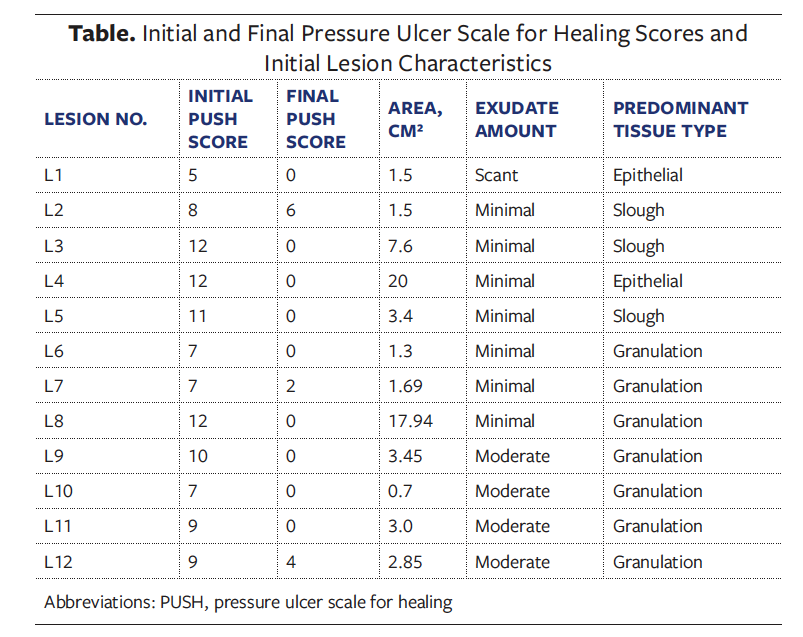
Concerning tissue type, 7 lesions (58.33%) had granulation tissue, 3 (25%) had slough, and 2 (16.67%) had epithelial tissue. Initial PUSH scores ranged from 5 to 12, with a score of 5 to 7 in 4 cases (33.3%), 8 to 10 in 4 cases (33.3%), and 11 or 12 in 4 cases (33.3%).
At the final assessment, 9 lesions (75%) had a PUSH score of 0, indicating complete healing. The remaining 3 lesions (25%) did not fully heal but did exhibit score reductions, with the lesion 2 score decreasing from 8 to 6, the lesion 7 score decreasing from 7 to 2, and the lesion 12 score decreasing from 9 to 4, demonstrating good clinical progress.
Healing time ranged from 7 days to 86 days: 8 lesions (66.67%) healed within 7 days to 30 days, 2 lesions (16.67%) healed in 31 days to 70 days, and 2 lesions (16.67%) required more than 70 days for healing. The shortest healing time was 7 days and the longest was 86 days (average, 21.5 days).
Discussion
DM affects approximately 3% of the global population, with an expected increase by 2030, driven mainly by population aging.16 In 2015, the International Diabetes Federation (IDF) estimated that one in 11 adults, approximately 537 million, between 20 and 79 years of age has type 2 diabetes.17,18
DFUs are among the most common and serious complications of DM, affecting between 19% and 34% of individuals with the disease, with an annual incidence of approximately 2%. Even after successful healing, recurrence rates remain high—40% within 1 year and 65% within 3 years—making DFUs a major factor in increased DM-related morbidity and mortality.18,19
Peripheral neuropathy is a main cause of DFUs, because it leads to the loss of protective sensation and to functional changes in muscles and tendons. These changes cause foot deformities due to denervation, altering plantar pressure distribution. The resulting mechanical overload, accumulated during repeated gait cycles, leads to tissue breakdown. As a result, ulcerations typically appear on the forefoot, especially on the hallux and metatarsal heads.18,19
Medicinal plants and herbal products have been used worldwide as cost-effective strategies to prevent or manage complications of DM.20 Brazil, with its vast biodiversity and over 55 000 cataloged species of flora, has great potential in this area.18 The demand for phytotherapeutic products is increasing due to their natural origin, lower cost, and reduced side effects compared with synthetic drugs.18
A recent review highlighted the favorable characteristics of natural bioactive compounds for wound healing and described new delivery formulations using phytotherapeutics.20 It also noted patents involving herbal-based healing products. Nanotechnology applications for treating skin infections have demonstrated numerous benefits, with essential oils such as lavender, tea tree, sesame, and olive oil showing promising wound healing properties.20
The compound used in the current study exhibits antiseptic and moisturizing effects and helps form a protective barrier over injured skin, mainly due to the natural oils and extracts in its composition. These components contribute to rapid symptom relief in cutaneous lesions.13
As mentioned previously, the main ingredients of the compound in this study include
• Vitamin E (α-tocopherol), a fat-soluble antioxidant that protects cells from oxidative stress, supports immune function, and helps maintain endothelial integrity and normal coagulation21
• Castor oil, which is known for its antimicrobial, anti-inflammatory, analgesic, antioxidant, wound healing, and vasoconstrictive properties, with its primary constituent, ricinoleic acid, acting on bacterial membranes by coagulating proteins and altering ionic permeability22
• Aloe vera, which contains gel rich in mannose 6-phosphate, which stimulates fibroblasts, macrophages, and angiogenesis, and which also contains anthraquinone, which has antimicrobial and antifungal activity23
• Papain (Carica papaya), which has anti-inflammatory and debriding properties that are effective in different wound healing phases, which lowers wound pH, stimulates cytokine production, enhances cell replication, and creates an unfavorable environment for pathogens24
• Melaleuca oil (tea tree oil), which is rich in monoterpenes, especially terpinen-4-ol (≈40%), reduces inflammation, and stimulates white blood cells involved in immune response and wound healing25
• Neem oil (Azadirachta indica), which is traditionally used for its wide range of biological effects and which contains secondary metabolites (glycerides, fatty acids, sulfur compounds, flavonoids), offering antioxidant, anti-inflammatory, antibacterial, antifungal, and regenerative properties.26
Importantly, the compound used in the current study proved effective even in the context of DM, where wound healing is usually impaired. Melaleuca oil, alone or combined with other phytotherapeutic agents, may assist in preventing colonization and promoting healing.27
The current study reports an average healing time of 21 days and a healing rate of 75% in wounds treated with natural extract. A randomized clinical trial with 12 patients, which used olive oil as a healing agent, reported an average healing time of 59 days and a healing rate of 33%.28 This suggests better performance of the natural extract used in the current study compared with olive oil; however, the paucity of data on the compound used in the current study makes such comparison difficult.
Limitations
The main limitation of the current study is its small sample size, which limits the generalization of findings. The absence of a control or comparison group is another limitation. Future clinical studies with more patients and with control treatment are recommended to investigate the effectiveness of compounds based on natural extracts and oils in managing superficial diabetic foot ulcer.
Conclusion
DM affects millions of people in the Americas, including millions in Brazil alone. Approximately one-fifth of individuals with DM will develop DFU. This retrospective study demonstrated that the use of a compound based on natural extracts and oils in the treatment of superficial foot ulcers in individuals with DM (in the absence of peripheral arterial disease and infection) yielded favorable outcomes in the wound healing process, as measured by a validated assessment tool.
Author and Public Information
Authors: Eugenio Fuentes Pérez Júnior, PhD1,2; Maria Natália de Paulo Ferreira, RN, CNS1; Francisco Gleidson de Azevedo Gonçalves, PhD1; Advi Catarina Barbachan Moraes, MSc1; Ellen Marcia Peres, PhD1; Eduardo de Oliveira Carrilho Padula, MSc1;
Antonio Marcos Tosoli Gomes, PhD1; Livia Fajin de Mello, PhD1; Ana Carolina Coelho-Oliveira, PhD2,3; Ana Gabriellie Valério-Penha, MSc2,3; Danúbia da Cunha de Sá-Caputo, PhD2,3; and Ariane da Silva Pires, PhD1,2
Affiliations: 1Department of Medical-Surgical Nursing, Faculty of Nursing, State University of Rio de Janeiro, Rio de Janeiro, RJ, Brazil; 2Laboratory of Mechanical Vibrations and Integrative Practices, Department of Biophysics and Biometrics, Roberto Alcantara Gomes Institute of Biology, Piquet Carneiro University Polyclinic, State University of Rio de Janeiro, Rio de Janeiro, RJ, Brazil; 3Graduate Program in Clinical and Experimental Pathophysiology, State University of Rio de Janeiro, Rio de Janeiro, RJ, Brazil
Disclosure: The authors declare no financial or other conflicts of interest.
Ethics Statement: This study was approved under Opinion No. 6.919.954, in accordance with Resolution No. 466/2012 of the National Health Council, respecting ethical principles. Because this was a retrospective study involving documentary analysis of medical records and internal service records, the requirement for informed consent was waived.
Correspondence: Ariane da Silva Pires; Department of Medical-Surgical Nursing, Faculty of Nursing, State University of Rio de Janeiro, Avenida Marechal Rondon, 381, 20950-003, Rio de Janeiro, Brazil; arianepiresuerj@gmail.com.
Manuscript Accepted: May 7, 2026
References
1. Conselho Federal de Enfermagem (Cofen). Resolução Cofen nº 567, de 29 de janeiro de 2018. Regulamenta a atuação da Equipe de Enfermagem no Cuidado aos pacientes com feridas. Published February 6, 2018.
2. International Diabetes Federation. Brazil. IDF Diabetes Atlas. Accessed July 21, 2026. https://idf.org/our-network/regions-and-members/south-and-central-america/members/brazil/
3. International Diabetes Federation. IDF Diabetes Atlas. 10th ed. International Diabetes Federation; 2021.
4. Armstrong DG, Boulton AJ, Bus SA. Diabetic foot ulcers and their recurrence. N Engl J Med. 2017;376(24):2367-2375.
5. Bus SA, Armstrong DG, Crews RT, et al. Guidelines on offloading foot ulcers in persons with diabetes (IWGDF 2023 update). Diabetes Metab Res Rev. 2024;40(3):e3647.
6. Silva Filho BF, Duque CB, Yarid SD, Souza Júnior EV, Sena ELS, Boery RNSO. Nurse autonomy in caring for people with chronic injuries. Rev Bioét. 2021;29(3):481-486. doi:10.1590/1983-80422021293484
7. Cai M, Liu Z, Sun Z, Qi Y, Mei X, Liu S. Advances in the development of medical dressings for the treatment of diabetic foot wounds. Chem Eng J. 2024;498:155575. doi:10.1016/j.cej.2024.155575
8. Kumar S, Bharali A, Sarma H, Kushari S, Gam S, Hazarika I. Traditional complementary and alternative medicine (TCAM) for diabetic foot ulcer management: a systematic review. J Ayurveda Integr Med. 2023;14:100745.
9. Nascimento AS, Tamiasso RSS, Morais SFM, Gnatta JR, Turrini RNT, Calache ALSC. Essential oils for healing and/or preventing infection of surgical wounds: a systematic review. Rev Esc Enferm USP. 2022;56(spe):e20210442. doi:10.1590/1980-220X-REEUSP-2021-0442en
10. Criollo-Mendoza MS, Contreras-Angulo LA, Leyva-López N, Gutiérrez-Grijalva EP, Jiménez-Ortega LA, Heredia JB. Wound healing properties of natural products: mechanisms of action. Molecules. 2023;28(2):598.
11. Leite LRV, de Araújo ICR, Oliveira FS. Aspectos farmacêuticos da farmacoterapia de feridas: uma revisão de literatura. Educ Ciênc Saúde. 2020;7(1):281-300. doi:10.20438/ecs.v7i1.262
12. Melo EG, de Mendonça CMS, Nunes LE, de Araújo ÍDR. Atividade antimicrobiana da planta Azadirachta indica (nim indiano) – uma revisão integrativa. Diversitas Journal. 2022;7(4):2615-2636. doi:10.48017/dj.v7i4.2350.
13. Med4 Produtos Médicos. Hycos Diabetran 50 g. Accessed July 21, 2026. https://www.med4.com.br/produtos/hycos-diabetran-50g/
14. Schaper NC, van Netten JJ, Apelqvist J, Bus SA, Fitridge R, Game F, et al; IWGDF Editorial Board. Diretrizes práticas sobre a prevenção e o tratamento da doença do pé relacionada ao diabetes: atualização IWGDF 2023. International Working Group on the Diabetic Foot; 2023. Accessed July 22, 2026. https://iwgdfguidelines.org/wp-content/uploads/2024/10/Portuguese-IWGDF-Guidelines-2023.pdf
15. Silva RC, Pires AS, Júnior EFP, Conceição MMB, Gonçalves FGA, Andrade PCST. O uso do pressure ulcer scale for healing na avaliação do processo de cicatrização da lesão por pressão. R Pesq Cuid Fundam. 2023;15:e10867. doi:10.9789/2175-5361.rpcfo.v15.10867
16. Sethuram L, Thomas J, Kikherjee A, Chandrasekaram N. A review on contemporary nanomaterial-based therapeutics for the treatment of diabetic foot ulcers (DFUs) with special reference to the Indian scenario. Nanoscale Adv. 2022;4:2367-2398. doi:10.1039/D1NA00855E
17. Muzy J, Campos MR, Emmerick I, Silva RS, Schramm JMA. Prevalência de diabetes mellitus e suas complicações e caracterização das lacunas na atenção à saúde a partir da triangulação de pesquisas. Cad Saude Publica. 2021;37(5):e00076120. doi:10.1590/0102-311X00076120
18. Carvalho AC, Oliveira AAS, Siqueira LP. Plantas medicinais utilizadas no tratamento do diabetes mellitus: uma revisão. Braz J Hea Rev. 2021;4(3):12873-12894.
19. Isabel CN, Sacco L, Lucovéis MLS, Thuler SR, Parisi MCR. Diagnóstico e prevenção de úlceras no pé diabético. Diretriz Oficial da Sociedade Brasileira de Diabetes. 2024. doi:10.29327/5412848.2024-11
20. Tian M, Bai Y, Tian H, Zhao X. The chemical composition and health-promoting benefits of vegetable oils: a review. Molecules. 2023;28(17):6393. doi:10.3390/molecules28176393
21. National Institute of Diabetes and Digestive and Kidney Diseases. Vitamin E. In: LiverTox: Clinical and Research Information on Drug-Induced Liver Injury [Internet]. Bethesda, MD: National Institute of Diabetes and Digestive and Kidney Diseases; 2012-. Updated June 10, 2021. Accessed July 22, 2026. https://www.ncbi.nlm.nih.gov/books/NBK548283/
22. Santos MGS, Oliveira RGS. Efeito modulador do óleo de rícino, avaliado por meio do teste para detecção de clones de tumores epiteliais (WARTS) em Drosophila melanogaster. Perquirere. 2018;15(1):252-268.
23. Lira HSL, Neto FNR, Neto FFM, et al. Efeitos do uso de Aloe vera na cicatrização de feridas. Rev Eletrônica Acervo Saúde. 2020;(53):e3571. doi:10.25248/reas.e3571.20.
24. Leite AP, Oliveira B, Soares MF, Barrocas DLR. Uso e efetividade da papaína no processo de cicatrização de feridas: uma revisão sistemática. Rev Gaúcha Enferm. 2012;33(3):198-207. doi:10.1590/S1983-14472012000300026
25. Farias WS, Silva WM, Silva AP, et al. Propriedade terapêutica do óleo essencial da Melaleuca alternifolia aplicado ao tratamento de lesão. Braz J Develop. 2022;8(1):4748-4757. doi:10.34117/bjdv8n1-315
26. Patil SM, Shirahatti PS, Ramu R. Azadirachta indica A. Juss (neem) against diabetes mellitus: a critical review on its phytochemistry, pharmacology, and toxicology. J Pharm Pharmacol. 2022;74(5):681-710. doi:10.1093/jpp/rgab098
27. Silva LL, Almeida R, Verícimo MA, Macedo HW, Castro HC. Atividades terapêuticas do óleo essencial de melaleuca (Melaleuca alternifolia): uma revisão de literatura. Braz J Hea Rev. 2019;2(6):6011-6012.
28. Abdoli A, Shahbazi R, Zoghi G, et al. The effect of topical olive oil dressing on the healing of grade 1 and 2 diabetic foot ulcers: an assessor-blind randomized controlled trial in type 2 diabetes patients. Diabetes Metab Syndr. 2022;16(12):102678. doi:10.1016/j.dsx.2022.102678