Evaluation of a Novel Negative Pressure Wound Therapy All-in-One Seven-Day Dressing
© 2026 HMP Global. All Rights Reserved.
Any views and opinions expressed are those of the author(s) and/or participants and do not necessarily reflect the views, policy, or position of Wounds or HMP Global, their employees, and affiliates.
Abstract
Background. While use of polyurethane foam dressings for negative pressure wound therapy (NPWT) is well-established, the dressings may be difficult to apply and they promote granulation tissue ingrowth, potentially causing wound bed disruption, bleeding, and pain upon removal. An all-in-one dressing with an encapsulated polyurethane foam core and silicone-acrylic adhesive drape is available for longer wear. Objective. To present the findings of a pilot evaluation of an all-in-one dressing. Materials and Methods. Ten patients from 2 hospitals in Chile were treated by 3 clinicians experienced with NPWT. After removing the release liner, an all-in-one dressing was applied to the wound and periwound, and −125 mm Hg or −150 mm Hg continuous negative pressure was initiated. The first dressing change occurred after 3 days to 5 days, and subsequent dressing changes were performed once or twice weekly. Results. Evaluation results indicated a dressing application time of less than 3 minutes, with removal time less than 20 seconds for all patients. No patients reported pain at dressing removal. No adverse events or concerns were noted. Users reported that the all-in-one dressing was easier and faster to apply and remove, and less traumatic for patients, compared with polyurethane foam dressings. The dressing remained sealed for the intended 4- to 7-day duration for all patients. NPWT with the all-in-one dressing was preferred over polyurethane foam dressings by all clinician users. Conclusion. Use of the all-in-one dressing may improve patient and clinician experience with NPWT. Larger, controlled clinical trials and scientific studies are needed to evaluate the efficacy of this dressing with NPWT across various wound types.
Reticulated open-cell polyurethane foam dressings are traditionally used in negative pressure wound therapy (NPWT) to help manage open wounds by creating an environment that promotes healing and prepares the wound bed for closure.1 Use of the traditional foam dressings involves a multistep process of measuring and cutting foam and adhesive components during application and ensuring no foam remnants are left behind during dressing removal. The time required for effective NPWT dressing application depends on the size, shape, and location of the wound as well as clinician skill. Prolonged use of polyurethane foam dressings may lead to granulation tissue ingrowth and may potentially cause wound bed disruption, bleeding, and pain upon dressing removal.2,3
A novel all-in-one dressing (Solventum V.A.C. Peel and Place Dressing; Solventum Corporation) streamlines application by integrating NPWT dressing components and eliminating the need for fitting and cutting. This dressing includes a fenestrated nonadherent layer that extends onto periwound skin and has been shown in animal studies to limit granulation tissue ingrowth and enable wear of up to 7 days.4,5 The current report presents the findings of a pilot evaluation assessing usability and simplicity of the all-in-one NPWT dressing.
Materials and Methods
This prospective, observational user evaluation of the all-in-one dressing was conducted in accordance with the Declaration of Helsinki. All patients provided voluntary, informed consent. The information reported herein was presented as a poster at the Symposium on Advanced Wound Care Fall meeting in Las Vegas, Nevada, October 2-5, 2024.6
A human-centered design approach was used to evaluate users’ perception of usability, simplicity, and intuitiveness. No information was collected on dressing safety or clinical outcomes. The evaluation occurred in 2 general hospitals in Santiago, Chile. Sponsor Kinetic Concepts Inc (Solventum) provided the dressings and financial compensation for clinicians’ time.
Dressings were evaluated by 3 clinicians who applied them in 11 wounds (n = 10 patients). All 3 clinicians had prior experience using NPWT with traditional foam dressings. Patients with chronic, acute, or surgical wounds, or with partial-thickness burns, flaps, or grafts were included for evaluation. The evaluation facilitator (L.G.), an employee of the dressing manufacturer, was present solely as an observer during all dressing changes.
Dressing size was selected according to wound dimensions. The dressing was applied as a single unit. The release liner was removed, and the dressing was placed over the wound and periwound, extending at least 1 cm beyond the wound perimeter. The dressing was connected to an NPWT unit (either the Solventum V.A.C. Ulta Therapy System, or the Solventum InfoV.A.C. Therapy System; Solventum Corporation), and continuous −125 mm Hg or −150 mm Hg negative pressure was applied.
In patients 1 through 5 the initial dressing was changed after 3 days or 4 days, and in patients 6 through 10 the initial dressing was changed after 5 days. Subsequent dressing changes were performed once or twice weekly. Therapy could be applied for up to 30 days per patient and discontinued at any time at the clinician’s discretion. Clinicians completed a customer preference test observation form after each dressing change and completed a dressing product survey for each patient at the end of the evaluation. Collected information included time and skill required for dressing application and removal, ease of application, patient-reported pain at dressing removal, maintenance of seal integrity, wear time between dressing changes, clinician or patient concerns, and/or adverse events.
Results
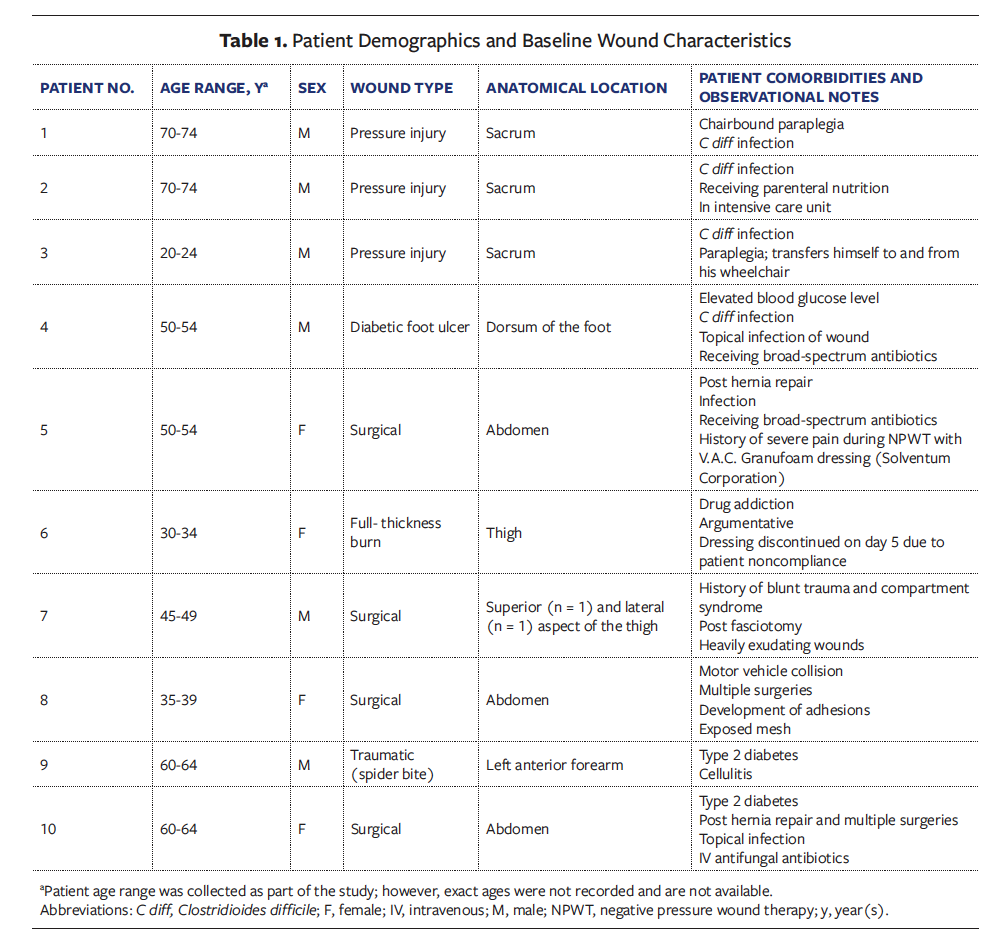
Patient demographics and baseline wound characteristics are presented in Table 1. Six of the 10 patients were male (aged 20-74 years), and 4 were female (aged 30-64 years). Clinicians completed 30 observation forms (3 per patient) and 10 product survey forms during the 27-day evaluation period. Therapy for patient 6 was discontinued after 5 days due to noncompliance.
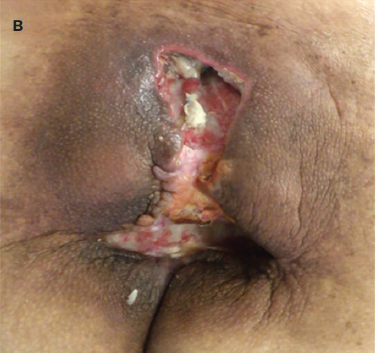
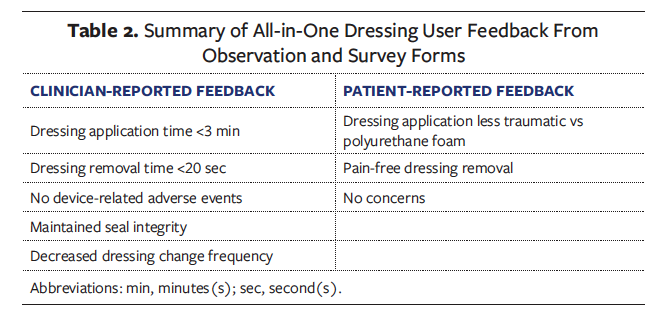
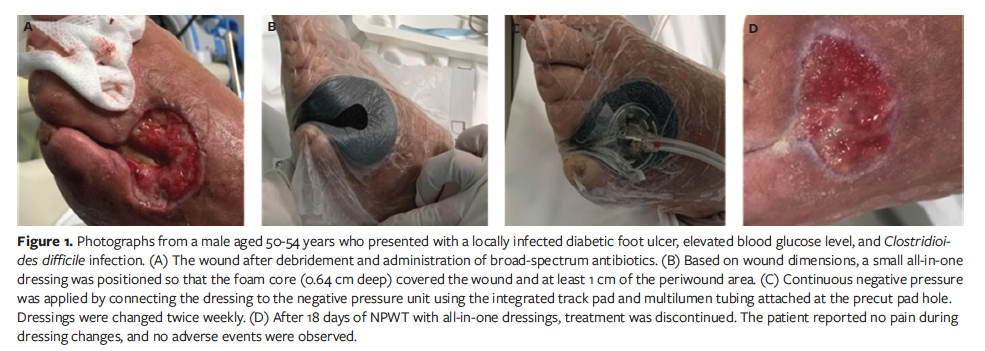
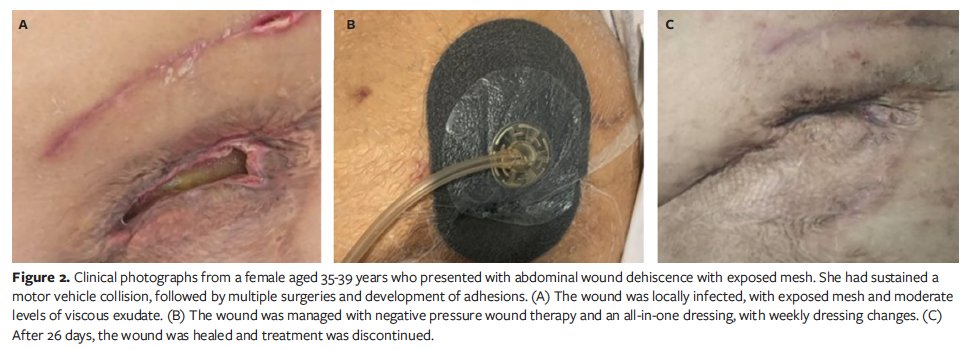
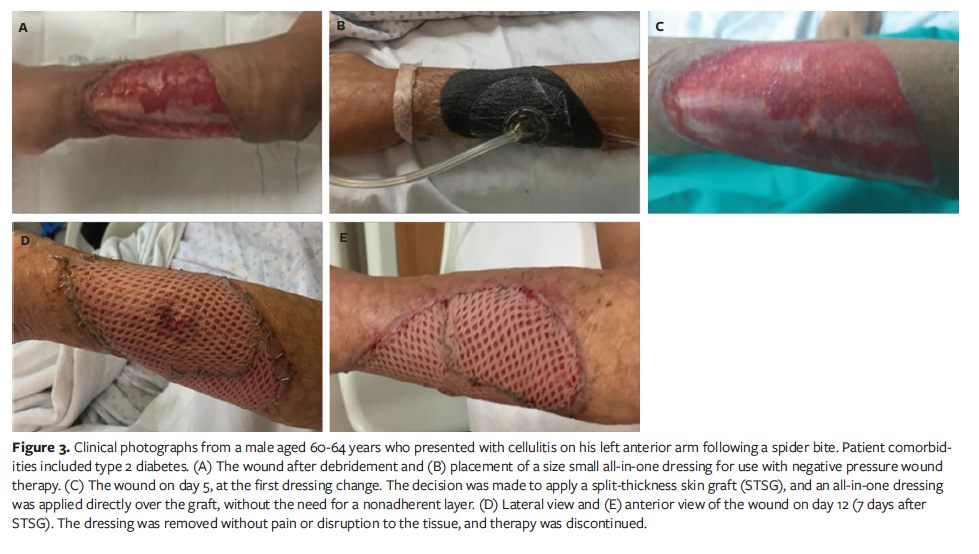
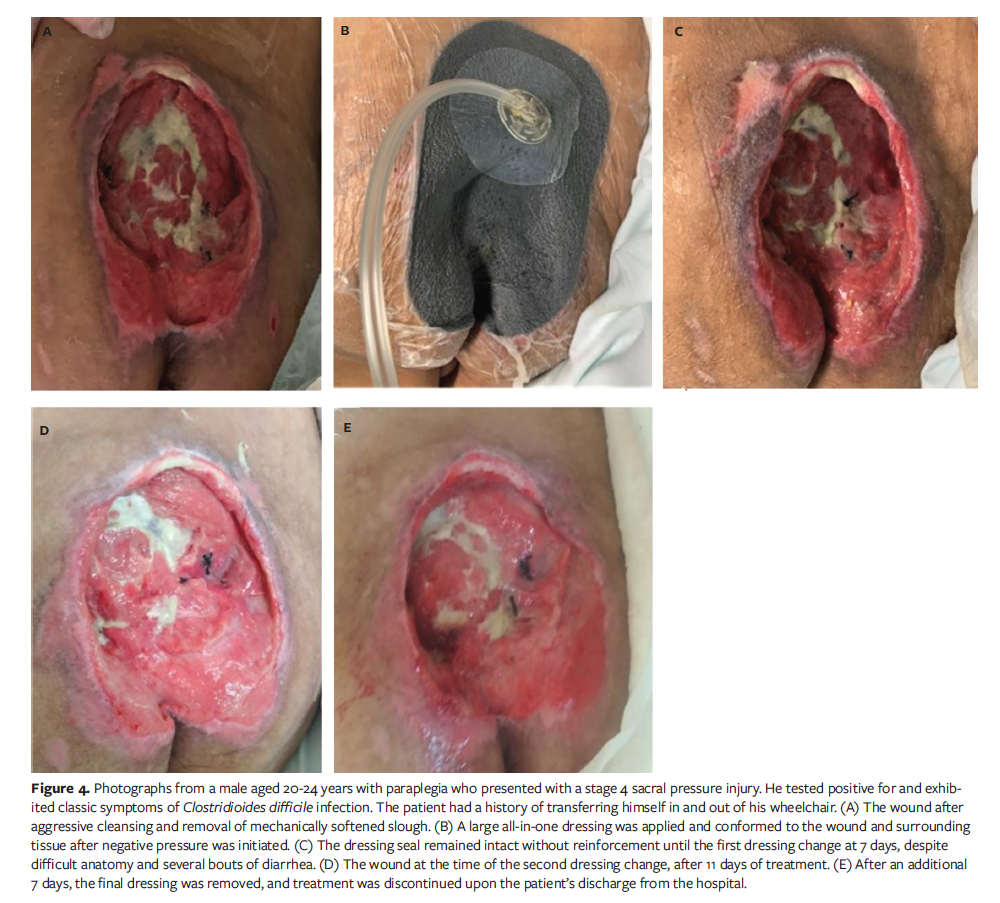
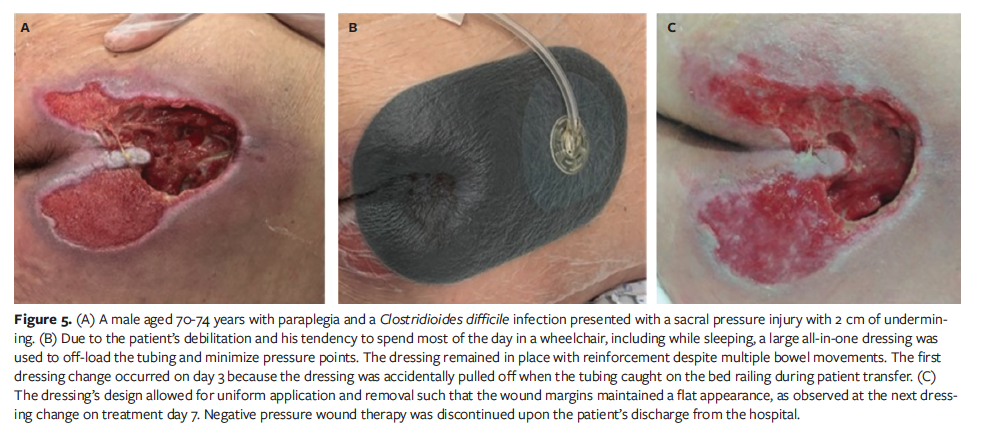
Evaluation results are summarized in Table 2. For all patients, dressing application took less than 3 minutes, and removal took less than 20 seconds. Clinicians reported that the all-in-one dressing was quick to apply and remove and that it required less expertise compared with other dressings. Time between changes ranged from 4 days to 7 days, and no leaks occurred during the intended dressing duration. No patients reported pain at dressing removal, and no device-related adverse events or patient concerns were noted. Representative cases are shown in Figures 1-5.
Discussion
Despite its nonclinical nature, this product evaluation offers insight into the types of patients and wounds that may benefit from the novel all-in-one dressing. Clinicians reported wear times of up to 7 days with consistent maintenance of seal integrity even over challenging anatomical regions, while patients reported no pain upon dressing removal. This result marks a departure from NPWT with traditional polyurethane foam dressings, and with supporting clinical evidence it could signal a shift in how NPWT is approached in practice.
Results showed that dressing application required less specialized experience versus traditional polyurethane foam dressings, which suggests that it could be useful to a broader range of health care providers, including those with limited NPWT experience, and across more health care settings, including outpatient clinics and home health. Additionally, the dressing’s integrated design and ability to be applied over periwound skin may facilitate faster and easier use for wounds for which NPWT with traditional dressings may not have been considered, such as small wounds, areas with multiple superficial wounds, or wounds managed by staff with limited specialization.
The reduced dressing change frequency with this novel dressing may lead to lower costs, time savings for clinicians and patients, and fewer outpatient care visits. Absence of pain during dressing changes could greatly improve the patient experience, potentially broadening use of the dressing among patients who previously could not continue NPWT with traditional foam-interface dressings.7,8 Future controlled clinical trials are necessary to evaluate the efficacy of the all-in-one dressing.
Limitations
Limitations of this preliminary evaluation include its small sample size, short evaluation duration, lack of clinical outcomes data, restricted product exposure, lack of randomization and control, and the potential for sampling bias associated with observer involvement and industry sponsorship. Efforts were made to minimize these influences.
Conclusion
This pilot evaluation showed preference for NPWT with a novel all-in-one dressing over NPWT with traditional polyurethane foam dressing. The preference for the novel dressing was due to easier dressing removal and application even in anatomically challenging areas, pain-free dressing changes, quicker dressing changes, and reduced dressing change frequency. These observations suggest that the all-in-one dressing may improve patient and clinician experiences. Further research in the form of large controlled trials and scientific studies is needed to determine the mechanisms of action and clinical performance of the all-in-one dressing.
Author and Public Information
Authors: Lydia Galarza, RN, BSN; Jessica Peña, BS; and Kristine Kieswetter, PhD, MBA
Affiliation: Medical Solutions Division, Solventum, San Antonio, TX, USA
Acknowledgments: The authors thank Marjorie Fabiola Guzman Muñoz (Hospital San Juan de Dios, Santiago, Chile) and Carol Michelow (Medcorp S.A., Santiago, Chile) for patient engagement and clinical support, Stephanie Sandoval (Solventum) for clinical support, and Karen Beach (Solventum) and Maritza Quintero (Solventum) for assistance with manuscript preparation.
Funding: Kinetic Concepts Inc (KCI), now part of Solventum Corporation, sponsored the study and provided the dressings and financial compensation for clinicians’ time.
Disclosure: All authors are employees of Solventum Corporation, Maplewood, MN.
Previous Presentation: This information was presented at the Symposium on Advanced Wound Care Fall in Las Vegas, Nevada, October 2-5, 2024.
Ethics Statement: All patients provided voluntary, informed consent. This study was conducted in accordance with the Declaration of Helsinki.
Correspondence: Lydia Galarza, RN, BSN; Solventum, Global Medical & Clinical Affairs, 6203 Farinon Drive, San Antonio, TX, USA 78249; lgalarza@solventum.com
Manuscript Accepted: May 06, 2026
References
1. Morykwas MJ, Argenta LC, Shelton-Brown EI, McGuirt W. Vacuum-assisted closure: a new method for wound control and treatment: animal studies and basic foundation. Ann Plast Surg. 1997;38(6):553-562. doi:10.1097/00000637-199706000-00001
2. Borgquist O, Gustafson L, Ingemansson R, Malmsjo M. Tissue ingrowth into foam but not into gauze during negative pressure wound therapy. Wounds. 2009;21(11):302-9.
3. Fraccalvieri M, Ruka E, Bocchiotti MA, Zingarelli E, Bruschi S. Patient’s pain feedback using negative pressure wound therapy with foam and gauze. Int Wound J. 2011;8(5):492-9. doi:10.1111/j.1742-481X.2011.00821.x
4. Allen D, Mann S, Robinson T, Schmidt M, Kieswetter K. Preclinical assessments of a novel peel and place extended-wear negative-pressure wound therapy dressing for up to 35 days in a porcine model. Adv Wound Care (New Rochelle). 2024;13(6):291-307. doi:10.1089/wound.2023.0096
5. Allen D, Robinson T, Schmidt M, Kieswetter K. Preclinical assessment of novel longer-duration wear negative pressure wound therapy dressing in a porcine model. Wound Repair Regen. 2023;31(3):349-359. doi:10.1111/wrr.13084
6. Galarza L, et al. Evaluation of novel negative pressure wound therapy peel and place seven-day dressing. Poster presented at: Symposium on Advanced Wound Care (SAWC) Fall; October 2–5, 2024; Las Vegas, NV
7. Upton D, Andrews A. Pain and trauma in negative pressure wound therapy: a review. Int Wound J. 2015;12(1):100-105. doi:10.1111/iwj.12059
8. Waldie K. Pain associated with negative pressure wound therapy. Br J Nurs. 2013;22(6):S15-S21. doi:10.12968/bjon.2013.22.Sup4.S15