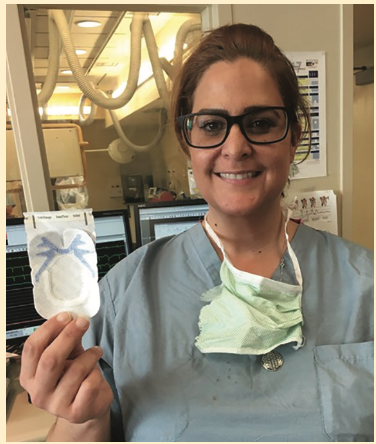
Figure 1. Roya Lisboa, RN, holding a SorbaView bandage (Centurion Medical Products).
Small innovations can make a big difference. It’s a recurrent theme in interventional cardiology. Small changes or new application of a common piece or equipment, supply, or method can make a difference in your lab.1,2
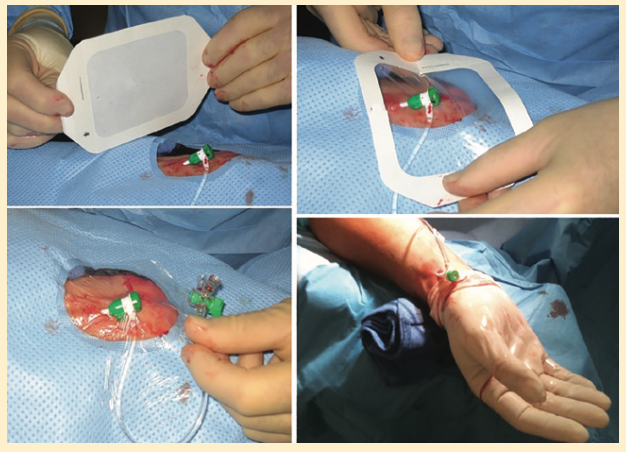
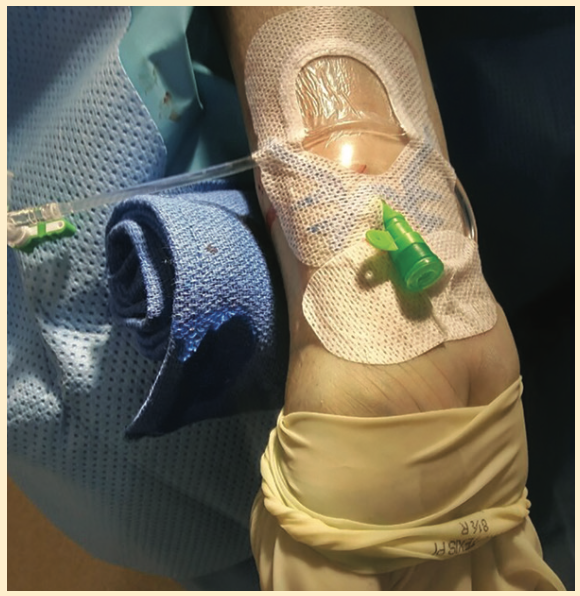
Figure 2. The Tegederm bandage being applied to the radial sheath. Lower right, view of draping for our radial procedures using the Armen glove method.3
Last week, Roya Lisboa (Figure 1), one of our super cath lab nurses, handed me an IV bandage to secure the radial sheath. I’d been complaining, as many of my colleagues have reported, that the usual Tegederm clear plastic bandage (Figure 2) with a slit, holds the sheath in place for most routine cases but fails for longer procedures, especially when blood gets under the plastic.
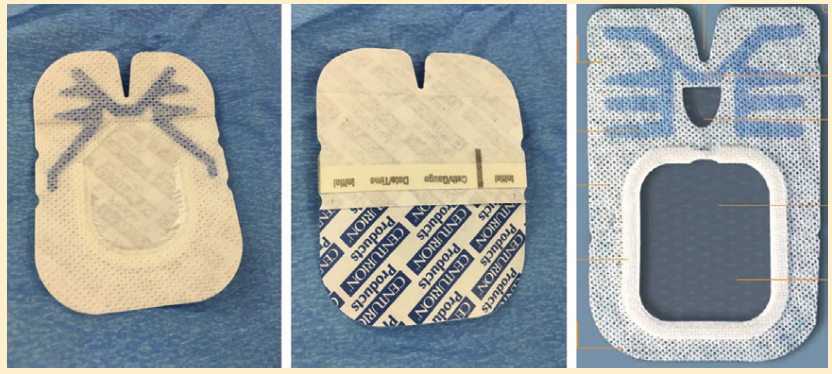
Figure 3. The SorbaView bandage. Left, adhesive side before removal of paper covers; middle, front side of SorbaView bandage; right, different size SorbaView bandage showing clear window and a port to see hub of catheter/sheath/IV. Blue lines are reinforcing tapes incorporated into bandage.
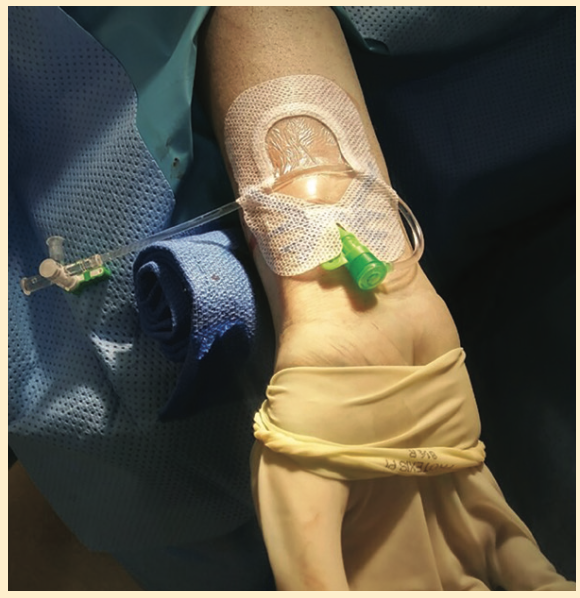
The SorbaView bandage (Centurion Medical Products) (Figure 3) has a clear window and fabric adhesive border with a locking piece of adhesive added after the bandage is placed. It is usually used to protect IV needles and catheters. The fabric border prevents blood from leaking into the puncture area. To secure the radial sheath, we made sure to attach the fabric adhesive to the hub of the sheath with the side arm passing under the adhesive and the locking patch over the side arm (Figure 4).
Figure 4A. Application of the SorbaView bandage to the radial sheath. The fabric tape is adhered to the sheath hub. The side arm is looped to the top of the arm and covered by the SorbaView clear window and fabric border.
I asked my expert colleagues what they used for securing their radial sheaths and the answers were interesting:
Most respondents used Tegederm, but complained that its securing function is short-lived and if blood gets under it, it is a mess and stops working. This usually occurs involving a long case with multiple catheter exchanges.
Figure 4B. Final SorbaView application with locking patch holding the side arm as it exits the sheath. The bandage stayed dry for the entire procedure and was easy to remove.
Several operators use long sheaths with no securing technique needed.
Several operators use a suture if the sheath needs to be secured for long case.
One European operator doesn’t use sheaths and goes sheathless for his procedures.
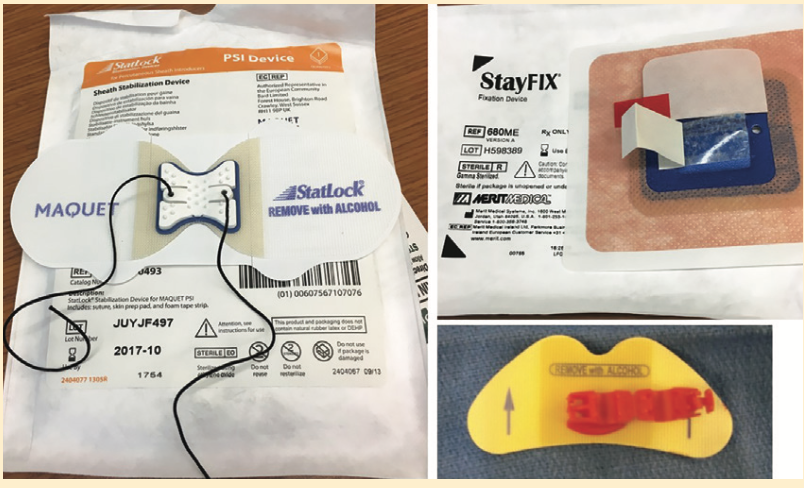
Figure 5. Three sheath-securing devices. Left, Statlock (Maquet); top right, StayFIX (Merit Medical); bottom right, StatLock arterial ultra-stabilization device (Bard Access Systems).
Several other devices available in our lab were investigated but none seemed suitable (Figure 5). While only a small change in our radial technique, the use of a new securing method may be a big advance for the procedure. It’s always a good idea to keep your eyes open in the cath lab.
References
Kern MJ. New ideas from cardiac cath lab staff. Cath Lab Digest. 2008 Mar; 16(4). Available online at https://www.cathlabdigest.com/articles/New-Ideas-Cardiac-Cath-Lab-Staff. Accessed Dec 12, 2017.
Kern MJ. Small innovations can make a big difference: the role of staff initiatives to drive efficiency in the cath lab. Cath Lab Digest. 2017 Feb; 25(2). Available online at https://www.cathlabdigest.com/article/Small-Innovations-Can-Make-Big-Difference-Role-Staff-Initiatives-Drive-Efficiency-Cath-Lab. Accessed December 12, 2017.
Kern MJ. The Armen glove for radial access prep — a better way. Cath Lab Digest. 2010 May; 18(5). Available online at https://www.cathlabdigest.com/articles/The-Armen-Glove-Radial-Access-Prep-%E2%80%93-A-Better-Way. Accessed December 12, 2017.
WINREVAIR, an activin signaling inhibitor, is FDA-approved for the treatment of adults with pulmonary arterial hypertension (PAH, WHO Group 1 pulmonary hypertension) to improve exercise capacity and WHO functional class (FC), and reduce the...
WINREVAIR, an activin signaling inhibitor, is FDA-approved for the treatment of adults with pulmonary arterial hypertension (PAH, WHO Group 1 pulmonary hypertension) to improve exercise capacity and WHO functional class (FC), and reduce the...
Mölnlycke Health Care US, LLC. has launched a new surgical glove range designed to reduce clinician hand exposure to scattered radiation during fluoroscopy-guided, interventional and other image-dependent procedures.
Mölnlycke Health Care US, LLC. has launched a new surgical glove range designed to reduce clinician hand exposure to scattered radiation during fluoroscopy-guided, interventional and other image-dependent procedures.
Physicians now have immediate access to the SELUTION SLR™ DEB, a next-generation drug-eluting balloon designed to deliver sustained sirolimus therapy without leaving a permanent implant behind.
Physicians now have immediate access to the SELUTION SLR™ DEB, a next-generation drug-eluting balloon designed to deliver sustained sirolimus therapy without leaving a permanent implant behind.
An international team of researchers, working closely with scientists at the universities of Zurich and Greifswald, has developed and validated a diagnostic scoring system designed to identify Takotsubo syndrome before cardiac catheterization...
An international team of researchers, working closely with scientists at the universities of Zurich and Greifswald, has developed and validated a diagnostic scoring system designed to identify Takotsubo syndrome before cardiac catheterization...
The new hybrid cardiac catheterization lab is a 730-square-foot suite equipped with advanced imaging equipment to perform complex minimally invasive procedures with greater precision, such as Transcatheter Aortic Valve Repair (TAVR),...
The new hybrid cardiac catheterization lab is a 730-square-foot suite equipped with advanced imaging equipment to perform complex minimally invasive procedures with greater precision, such as Transcatheter Aortic Valve Repair (TAVR),...
Researchers followed more than 6,000 adults for 10 years and found that, for the overall study population, adding a coronary artery calcium score provided only a small improvement over PREVENT, the American Heart Association's primary...
Researchers followed more than 6,000 adults for 10 years and found that, for the overall study population, adding a coronary artery calcium score provided only a small improvement over PREVENT, the American Heart Association's primary...
The score could eventually help clinicians assess risk in real time during emergency angiography or it could help identify patients who need closer monitoring after a blocked artery is reopened. The score may also help doctors decide which...
The score could eventually help clinicians assess risk in real time during emergency angiography or it could help identify patients who need closer monitoring after a blocked artery is reopened. The score may also help doctors decide which...
WASHINGTON—The American College of Cardiology (ACC), The Society of Thoracic Surgeons (STS), and the Society for Cardiovascular Angiography and Interventions (SCAI), released the following joint statement on the transcatheter aortic valve...
WASHINGTON—The American College of Cardiology (ACC), The Society of Thoracic Surgeons (STS), and the Society for Cardiovascular Angiography and Interventions (SCAI), released the following joint statement on the transcatheter aortic valve...
Edwards Lifesciences issued the following statement in response to the national coverage determination (NCD) for transcatheter aortic valve replacement (TAVR) released by the Centers for Medicare & Medicaid Services (CMS).
Edwards Lifesciences issued the following statement in response to the national coverage determination (NCD) for transcatheter aortic valve replacement (TAVR) released by the Centers for Medicare & Medicaid Services (CMS).
The new tool, called ECG-CLIP, was trained using over 1.7 million ECGs collected from more than 540,000 people and paired with clinicians’ notes, embedding the tool with knowledge that may make it more adaptable for different disease...
The new tool, called ECG-CLIP, was trained using over 1.7 million ECGs collected from more than 540,000 people and paired with clinicians’ notes, embedding the tool with knowledge that may make it more adaptable for different disease...