Treat the Mechanism First: Preparing Recurrent ISR for Drug-Coated Balloon Therapy
© 2026 HMP Global. All Rights Reserved.
Any views and opinions expressed are those of the author(s) and/or participants and do not necessarily reflect the views, policy, or position of Cath Lab Digest or HMP Global, their employees, and affiliates.
Brian K. Jefferson, MD, FACC, FSCAI
Centennial Heart, HCA Healthcare TriStar Centennial Medical Center, Nashville, Tennessee
This article is sponsored by Boston Scientific.
Dr. Brian K. Jefferson is a paid consultant for Boston Scientific and was an investigator in the AGENT IDE trial.
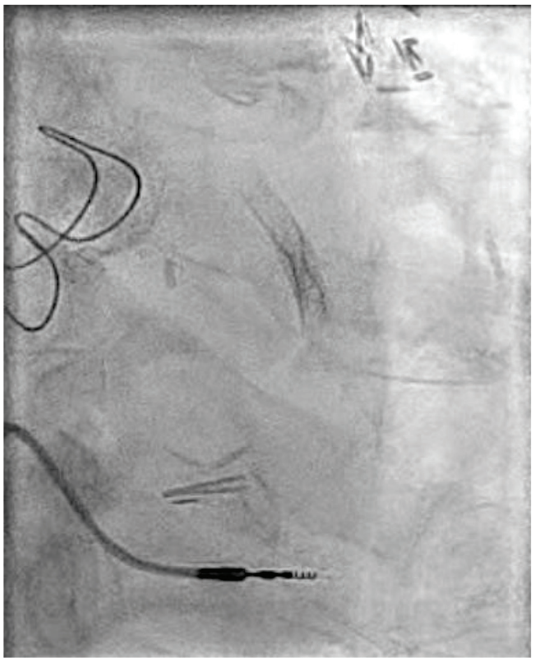
Recurrent in-stent restenosis (ISR) is one of those problems where the angiogram is usually only the last chapter of a much longer story. Our complex coronary program routinely receives referrals for patients with recurrent disease after multiple prior interventions, often when treatment options are becoming limited. This patient had undergone coronary artery bypass graft (CABG) surgery, surgical aortic valve replacement, and multiple prior percutaneous coronary interventions (PCIs) when he was referred to us with recurrent ISR of the mid circumflex (Figure 1). Because we were also participating in the AGENT IDE trial, he was a potential candidate for drug-coated balloon therapy.
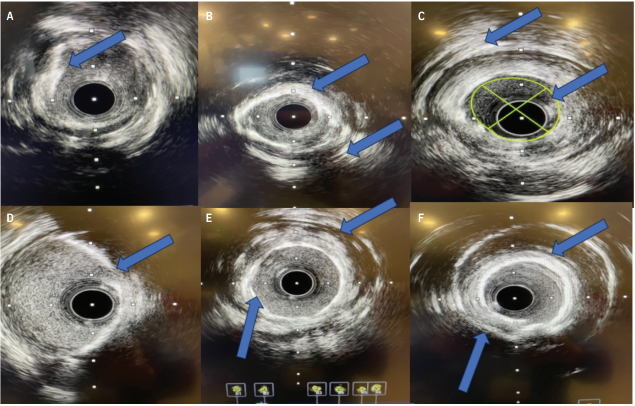
underexpansion of one stent layer, related in part to untreated tissue between the stent layers, at the recurrent ISR site.
The patient knew his symptoms well. He had been through this enough times that he recognized when the restenosis was back. Clinically, the recurrence was clear. The question was why it kept happening and whether we could do something different this time.
In our lab, these cases always start with intravascular imaging. Angiography tells us where the lesion is; intravascular imaging tells us why it is there. In this case, intravascular ultrasound (IVUS) confirmed multiple stent layers, including significant underexpansion of one layer, related in part to untreated tissue between the stent layers. This was not simply recurrent tissue growth within a well-expanded stent. IVUS showed significant underexpansion of one stent layer, related in part to untreated tissue between the stent layers. That changed the goal of the procedure. We were trying to correct the responsible mechanical problem enough that whatever treatment came next had a better chance for a durable result.
Lesion preparation is the critical part of treating ISR. Appropriate lesion preparation starts with understanding why the restenosis occurred, because the etiology should determine how we prepare the lesion. In this case, the dominant problem was mechanical underexpansion, so preparation required correction of that mechanical problem before moving on to definitive therapy. That mechanism-based approach is consistent with current expert guidance, which emphasizes intravascular imaging to define the etiology of ISR and tailor treatment accordingly.1,2 We started with serial high-pressure noncompliant balloon inflations, then moved to intravascular lithotripsy. When that still did not provide adequate preparation, we escalated to laser atherectomy, high-pressure scoring balloon angioplasty, and stent ablation with rotational atherectomy. No single device fixed the problem, but each step got us a little further. We escalated based on what IVUS showed us after each step and whether we had made enough progress to proceed.
We kept going back to IVUS and angiography. After each step, we asked the same question: had we corrected enough of the underexpansion to move on? We were not looking for a perfect result. We wanted meaningful improvement in stent expansion and a vessel that we believed was adequately prepared for definitive therapy. Once we had achieved that, the patient could proceed to randomization in AGENT IDE.
The patient was randomized in the AGENT IDE trial to treatment with the AGENT drug- coated balloon (DCB) (Boston Scientific). AGENT IDE evaluated a paclitaxel-coated balloon against uncoated balloon angioplasty for coronary ISR, with randomization occurring only after successful lesion preparation.3
At the time, though, I was not convinced the result would last. We had manipulated the vessel aggressively, and I thought there was a good chance the patient would suffer recurrent restenosis no matter what arm he was randomized to. If you had asked me at the end of the case whether this was going to be durable, I probably would have said no.
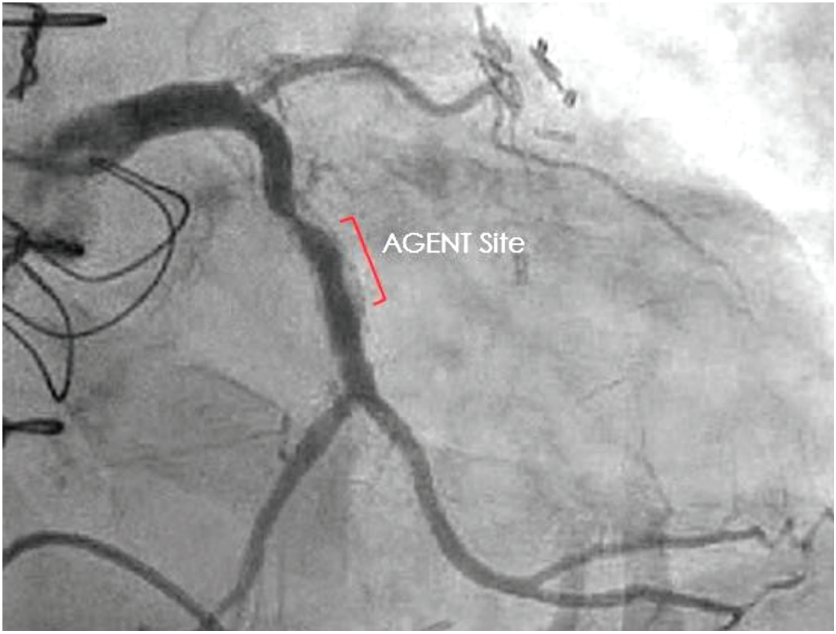
Thirteen months later, he returned with recurrent symptoms and underwent repeat catheterization. I expected to find restenosis exactly where we had treated him. Instead, the original AGENT-treated segment remained patent (Figure 2). The patient had in-stent restenosis but it was proximal to the treated segment, just outside the area that had received drug from the AGENT DCB. Given how aggressive the original preparation had been, my suspicion was that we had created injury in the adjacent untreated segment — essentially a geographic miss for where the drug was delivered in the initial procedure. That is an inference, but the location was difficult to ignore.
It got my attention, not because one anecdotal experience proves that a device works; it doesn’t. But this was one of the more difficult ISR cases I had treated, and the segment that received the AGENT DCB was still open while the adjacent untreated segment had failed.
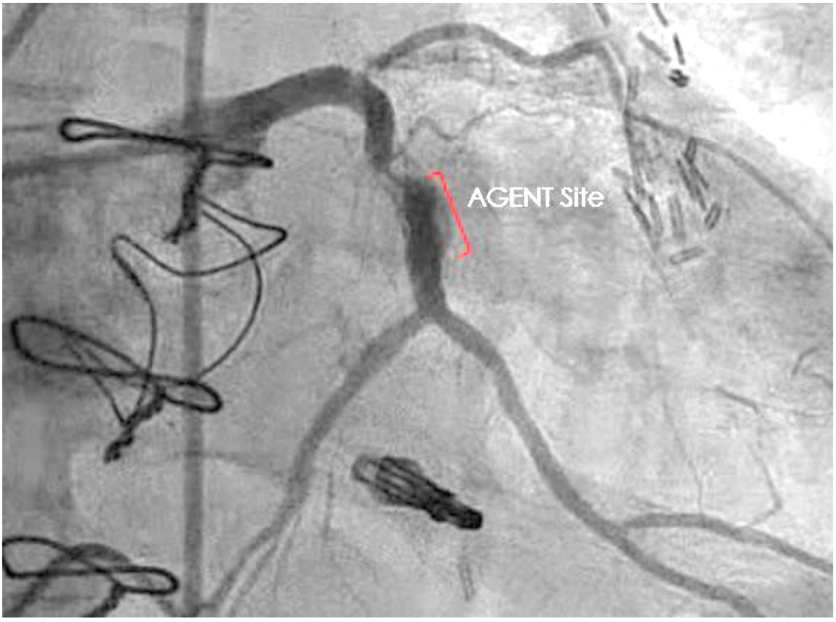
AGENT was not yet commercially available, so we treated the new proximal lesion with plain old balloon angioplasty (POBA) to avoid adding another layer of metal; there were already two layers of stent present. Six months later, while the patient was vacationing in Florida, he presented with an NSTEMI. Repeat angiography showed that the original AGENT-treated segment remained patent, while the adjacent POBA-treated segment had restenosed (Figure 3) and ultimately required treatment with a drug-eluting stent (DES).
Within the same coronary artery, we had treated two adjacent segments differently and then saw very different outcomes over time. The two segments were different lesions treated at different times, so I do not view this as a controlled comparison between DCB and POBA. It was still a single patient, and it is certainly not a substitute for randomized data. Still, seeing the original AGENT-treated segment remain patent while the adjacent POBA-treated segment restenosed was clinically striking. More than three years later, the patient continues to do well, and the original AGENT-treated segment remains patent.
The randomized AGENT IDE data later provided the broader evidence base for the context of this case, showing lower 1-year target lesion failure (TLF) with AGENT DCB than with uncoated balloon angioplasty (17.9% vs 28.6%).3 A subsequent prespecified analysis is especially relevant to this case: among patients with multilayer ISR, 1-year TLF was 23.8% with AGENT DCB vs 40.0% with uncoated balloon angioplasty, while the treatment effect was statistically consistent across multilayer and single-layer ISR.4 I view the trial and this case differently. The trial tells us what happened across a population. This case changed how I think about the procedure itself. AGENT IDE compared DCB with uncoated balloon angioplasty and this case should not be interpreted as evidence that DCB is the preferred strategy for every patient with ISR. The definitive treatment still depends on the mechanism of failure, the number of existing stent layers, vessel anatomy, and whether the lesion can be adequately prepared.1-3
My experience with this case made me even more disciplined in how I treat ISR, particularly in establishing the mechanism of failure and focusing on lesion preparation. ISR is not one disease. If the main problem is stent underexpansion, drug alone is not going to fix the mechanical failure. And if you do not image the lesion, you may not even know that is what you are treating.
In our lab, the approach now is straightforward: image first, correct what is correctable, image again, and then choose the treatment. Sometimes another stent is the right answer. For refractory recurrent ISR, brachytherapy or surgical revascularization may also need consideration.1,2 But when we can avoid adding another layer of metal, particularly in a vessel that already has multiple layers, we prefer to do so.
The main lesson for me from this case is that lesion preparation is the critical part of treating ISR, regardless of the mechanism. Appropriate preparation starts with defining the etiology and tailoring the approach to what caused the restenosis. In this case, underexpansion required aggressive mechanical correction. In other cases, lesion preparation may look very different, but the principle is the same: understand the mechanism, prepare the lesion appropriately, and then choose the definitive therapy. The device matters, but it only gets a fair chance if the lesion has been properly prepared for the treatment we choose.
Acknowledgments. I would like to recognize the cath lab team at TriStar Centennial Medical Center for their tireless work, exceptional technical expertise, and dedication to our patients. We care for some extraordinarily complex patients, and none of what we do would be possible without the skill, judgment, teamwork, and commitment of the nurses, technologists, and staff in our lab. Their willingness to take on difficult cases and consistently deliver outstanding care is something I never take for granted. I am grateful to work alongside a team that is committed every day to providing our patients with the highest level of cardiovascular care.
References
1. Klein LW, Nathan S, Maehara A, et al. SCAI expert consensus statement on management of in-stent restenosis and stent thrombosis. J Soc Cardiovasc Angiogr Interv. 2023; 2(4): 100971. doi:10.1016/j.jscai.2023.100971
2. Giustino G, Colombo A, Camaj A, et al. Coronary in-stent restenosis: JACC state-of-the-art review. J Am Coll Cardiol. 2022; 80(4): 348-372. doi:10.1016/j.jacc.2022.05.017
3. Yeh RW, Shlofmitz R, Moses J, et al. Paclitaxel-coated balloon vs uncoated balloon for coronary instent restenosis: the AGENT IDE randomized clinical trial. JAMA. 2024; 331(12): 1015-1024. doi:10.1001/jama.2024.1361
4. Kirtane AJ, Shlofmitz R, Moses J, et al. Paclitaxel-coated balloon for the treatment of multilayer instent restenosis: AGENT IDE subgroup analysis. J Am Coll Cardiol. 2025; 86(7): 502-511. doi:10.1016/j.jacc.2025.05.062