Global Medical Response Helps Design New AMS Helicopter
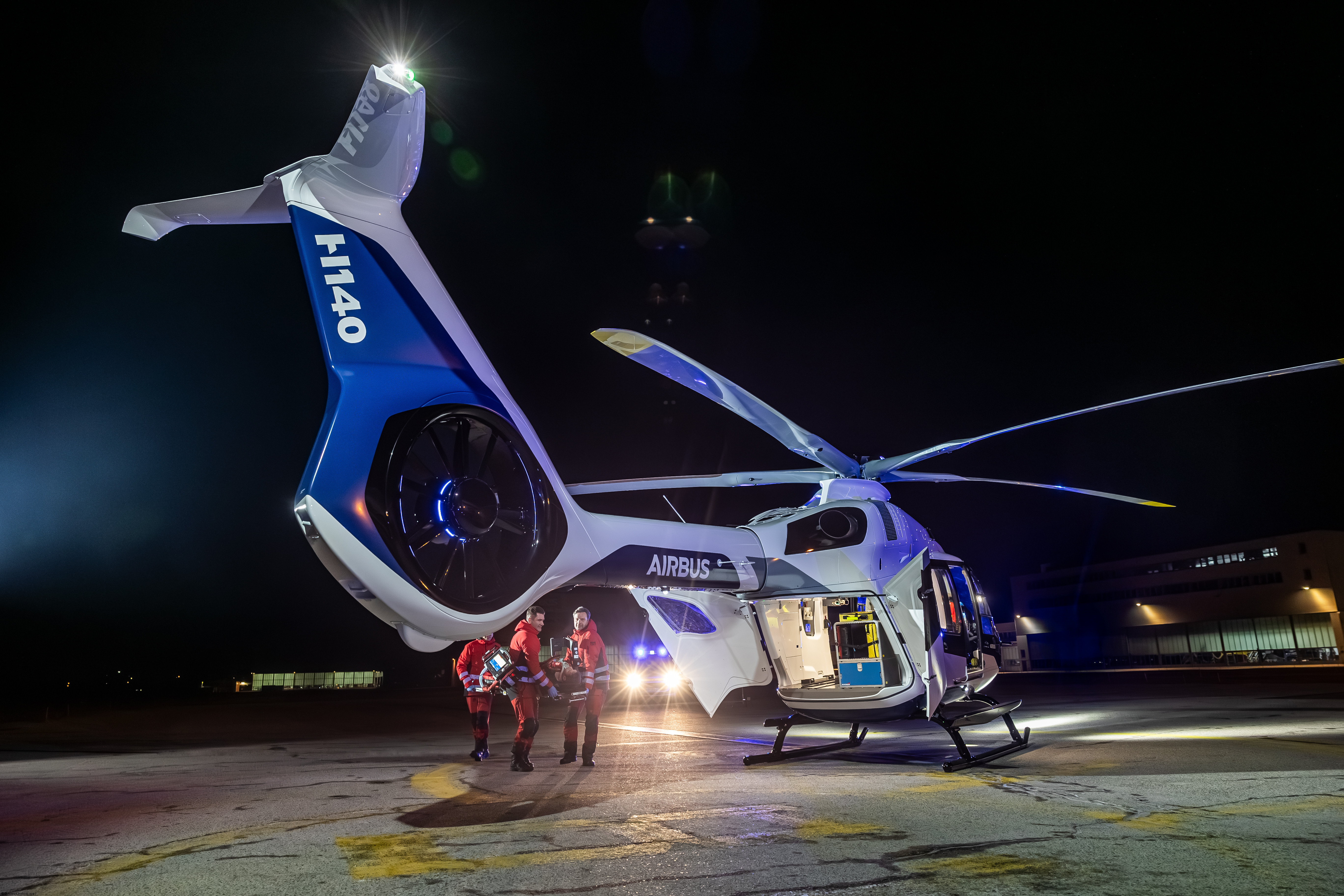
Historically, air medical services (AMS) companies have created their air ambulances using helicopters configured for commercial, general, or military aviation. However, Airbus’ new H140 helicopter is an exception to this rule. It is a twin-engine helicopter with side and back doors that has been purpose-built for AMS, with input from AMS companies.
One of those companies is Global Medical Response (GMR). It provides AMS and ground-based emergency medical services across the United States using 392 helicopters, 112 fixed-wing aircraft, and 7,286 ambulances.
“GMR is the largest nonmilitary operator of helicopters in the country,” said Ted Van Horne, GMR’s Chief Operating Officer. “We’ve been communicating with Airbus for years, telling them about what we and other AMS companies need from our helicopters. When Airbus asked companies like ours to join their H140 advisory design team in 2022, we were happy to help.”
To make this happen, GMR sent a multi-disciplinary team to Airbus’ H140 factory in Donauwörth, Germany. “I went over as an AMS pilot. We sent one of our lead maintenance technicians and then we sent over two people with clinical medical backgrounds,” said Mike LaMee, COO with GMR’s Med-Trans Corporation. “We spent a week over there going through every aspect of the aircraft from the pilot's perspective to the maintainers' challenges with the current EC135 aircraft, and to the clinicians' needs for access and treatment.”
Airbus’ willingness to listen to AMS experts impressed everyone on GMR’s team. “I've never seen this done before in the industry,” LaMee said. “Airbus focused on what we do and built the H140 from the ground up to support AMS.”
After some 600 suggestions from GMR and other AMS partners, Airbus came up with this version of the H140. According to the company’s website, the H140’s cabin features a floor layout tailored for helicopter emergency medical services (HEMS). This includes “the option to have the stretcher on the left or right-hand side, or the possibility to have two stretchers,” it said. Stretcher access at the rear of the H140 has been improved by raising the helicopter’s tail boom, placing the horizontal stabilizer on top of the vertical fin, and enlarging the rear door opening. “The H140 will also have specific HEMS lighting systems, externally, in the cabin and for loading,” the Airbus website said.
As far as LaMee is concerned, what Airbus has created with its AMS-focused H140 is a flying emergency room with ample room for equipment onboard. “The interior has plenty of room for customization, so that you can configure the H140 to meet mission requirements in a range of locations, and with the improved engine performance this includes hot and heavy flying conditions.”
Here are the other H140 AMS features that Airbus is highlighting:
- Improved maintenance with easier access to frequently serviced components, increasing aircraft uptime, which is critical for AMS fleets operating on demand.
- Smoother rides thanks to an advanced rotor system that reduces vibration, enhancing patient comfort and aircraft longevity.
- Greater payload and range than other AMS helicopters.
- Four-axis autopilot system for improved flight stability and safety, even during complex operations and inclement weather conditions.
“All told, the Airbus H140 fills a critical gap in the market,” said Van Horne. “It offers more capability than the Airbus H135 while being a more affordable and practical option than the larger H145. It sits nicely between them as an AMS option.”
If all goes to plan, GMR will be the first AMS operator in North America to fly the H140. The company has 15 H140s on order and hopes to enter the first of these helicopters into its service in 2029.
“The Airbus H140 is more than a new aircraft—it’s a new advance in AMS,” Van Horne concluded. “It shows what’s possible when AMS operators and an aircraft manufacturer are able to work together from the start.”