Your Captain Speaking: Blood Draws: Rainbows, Blue Tops, and the Stick You Already Made
Dick: Samantha, does the order of blood tubes matter on the truck? Do hospitals use what we draw or toss it? And when is a field stick just another hole in the patient? I wondered whether I was doing the procedure correctly.
In the left seat of a B-747 aircraft, we used a checklist because the sequence mattered. Mix up the fuel panel and the airplane still flies just fine — until it doesn’t. Blood tubes are the same kind of problem. They look like a handful of colored caps in a cabinet. They aren’t interchangeable. The order you fill them isn’t a lab superstition. It is a contamination-control procedure written because a drop of the wrong additive in the next tube can change the number the physician treats.
The question we keep hearing in the bay is not academic. A medic draws a “rainbow” on scene (a rainbow is when you pick every color tube you have in the truck). We label the tubes on a bouncing bench seat and hand them over with the patient. Two hours later the same patient gets stuck again. The crew wants to know: Did we waste a stick? Did we do it wrong? Does anybody even run what we brought in?
Short answers, then the why.
Yes, the order matters. Yes, hospitals sometimes process field tubes and sometimes they don’t — usually for reasons you can prevent or negotiate. No, drawing blood in the field isn’t automatically abusive. Drawing it badly, drawing it when the receiving lab has already decided to discard EMS tubes, or drawing a full rainbow on every call “just in case” is wrong.
The order isn’t a memory game. It’s additive physics.
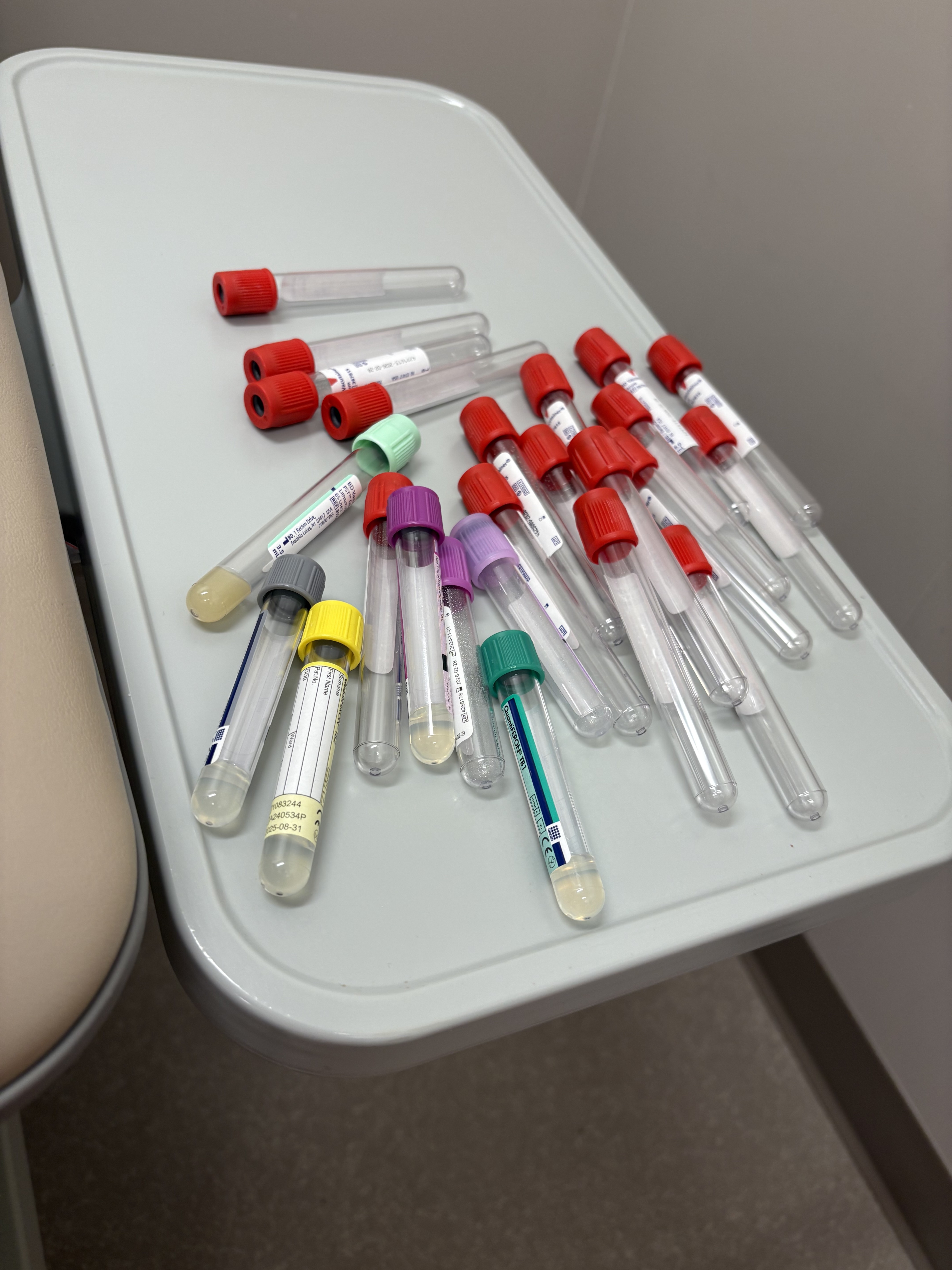 The Clinical and Laboratory Standards Institute (CLSI) sets the sequence used in U.S. labs. Current guidance (GP41/PRE02 family) is built to keep additives from walking from one tube into the next through the needle or the hub. That carryover is small. It’s still enough to wreck a result.
The standard venous order of draw:
1. Blood culture bottles. Almost never done on a 9-1-1 truck, but we have to list it as the first in the line.
2. Light Blue/Blue: Coagulation (Clotting factors). You MUST fill the tube completely. Highly susceptible to contamination. It has an additive called sodium citrate. This tube lives and dies by a 9:1 blood-to-citrate ratio. Under-fill it and the extra citrate makes the blood look like it cannot clot. Overfill it and you dilute the anticoagulant.
3. Red/Gold/Tiger (SST): Serum, with or without clot activator and gel. Basic chemistry, many drug levels, and serology. Lots of tests are run from a red top after a spin in a centrifuge.
4. Green: contains heparin (lithium or sodium, with or without gel). Stat chemistry, some ammonia and ionized calcium work. Needs to be inverted gently 8 to 10 times right after the draw to mix.
5. Lavender/Pink: Has an additive (EDTA). Used for CBC, differential, A1c, type, and screen (pink in many systems). EDTA additive chelates (grabs onto) calcium. If it contaminates a chemistry tube, potassium goes up and calcium goes down. That is a false hyperkalemia that can launch treatment the patient doesn’t need.
6. Gray: Has fluoride/oxalate additives. Glucose and lactate when the lab wants glycolysis (the breakdown of sugar) stopped. Also, for blood alcohol testing. Careful on the legal implications if blood is collected in connection with a DWI at the request of the police. Just stay within your protocol or call your medical control for guidance.
If your service uses a butterfly or any winged set and the first real tube is the blue top, draw a discard tube first. The tubing holds about half a milliliter of air. That air steals volume from the light blue citrate tube and wrecks the ratio. A straight needle into a holder doesn’t have that dead space.
What goes wrong on the truck
The mistakes we see aren’t exotic. They’re the same ones the lab sees from a busy ED at 0200, only we add diesel vibration, gloves that just came off a bloody sheet, no ice, and a patient who is still in a ditch.
Wrong order under pressure. Lavender first because “CBC is what they always want.” Then the green or gold. EDTA walks into the chemistry. The potassium prints high. The ED treats a number that was manufactured in the hub.
Under-filled light blue tops. The vacuum dies because the vein collapsed, the angle changed, or somebody pulled the tube early. Coags get rejected. That is the tube hospitals are least willing to trust from the field.
Drawing through a small gauge IV with a hard vacuum. Hemolysis is the No. 1 reason field and ED tubes get tossed. Forcing a Vacutainer onto a 22-gauge in the hand is a blender. Antecubital, larger catheter, shorter tourniquet time, and not yanking with a 10-mL syringe through a tiny hub all cut hemolysis. Straight stick still beats a line draw when the lab is picky.
Shaking (always wrong) instead of inverting. Each tube has a count. Blue tops want a few gentle turns. EDTA and heparin want more. You are mixing additive, not making a cocktail. Foam and wrecked cells are how potassium and LDH lie to the doctors.
Pouring a syringe into tubes in whatever order is handy, but wrong. Closed-system carryover is debated in clean phlebotomy rooms. Open syringe technique in a moving ambulance is not a clean phlebotomy room. Fill in order. Don’t decant leftover blood from a purple top into a gold top because you came up short.
Labeling after the fact, or labeling the bag instead of the tube. Wrong-patient blood is a catastrophic event, not a paperwork miss. Name, date of birth or unique ID, date, time, and your name on the tube before it leaves your hand. If your hospital requires a signature on a pink top, that isn’t optional color commentary.
Samantha: Filling out the label in a bouncing ambulance within the tiny space of a tube is nearly impossible.
Drawing “the rainbow” on a patient who needed one stick for a line and a glucose check. Extra volume from a sick kid or a little old lady is not free.
Do hospitals run our tubes or pitch them?
Both happen. Some hospitals won’t accept EMS tubes as policy — period. Some will accept chemistry and CBC and refuse coags and type-and-screen. Some will accept the tube and still redraw because the printer label from their system is what the analyzer is married to. Some pitch anything drawn through an IV. Some pitch anything that sat in a warm ambulance for 40 minutes.
So, the operational answer is local and perhaps shift-dependent depending on who is on duty. If your receiving lab has never agreed to take your tubes, every field draw is a second stick waiting to happen. That isn’t a reason to sneer at field phlebotomy. It’s a reason to sit down with the lab director, the ED nurse manager, and your medical director and write the rules: which tubes, which labels, maximum time to lab, ice or no ice for lactate and ammonia, whether line draws are allowed, and what happens when the sample is hemolyzed. Discuss with all parties whether there can be different labels made to go on the tubes you’re bringing in that are easier to write on than attempting to write directly on the tube while bouncing down the road. If so, these can be tucked in the zip-lock bag with the tubes that are ready to go. Do you have specific protocols for certain medical problems such as a stroke, a STEMI, or a trauma, and do you have agreements with specific hospitals for these problems? Without that agreement you are collecting worthless souvenirs.
Is a field draw abusive?
A needle is a procedure. It hurts. It can infiltrate, bruise, clot a future access site, or scare a child who already had a bad day. Doing it twice for the same information is a waste.
Field blood is justified when four things are true. First, the result will change time-sensitive care — sepsis workup, chest pain, altered mental status, overdose, gastrointestinal bleed, trauma panels your trauma bay actually uses. Second, you can collect a usable sample without delaying airway, bleeding control, or transport in a time-critical case. Third, the hospital in front of you will run it. Fourth, you are within protocol!
Field blood isn’t justified as a habit. It isn’t a box on the PCR. It’s not “we always get labs.” It’s not a way to look busy while the engine company finishes the wrap. If the patient is two minutes from a staffed ED and you don’t have an indication that starts the clock, the kindest stick is the one the phlebotomist makes under lights with a printer label.
A working standard for the truck
Lay the tubes out in order before the needle goes in. If you can’t remember the sequence under adrenaline, tape the list inside the cabinet door. Blood cultures, blue, gold or red, green, purple, gray. That’s the whole poem. Have the tubes been kept in a clean condition? Use a separate zip-lock bag for the usual set of tubes. Put the order of the tubes on a note in the bag.
Fill the blue top all the way or don’t send it. Invert, do not shake. Label the tube, not the memory. Do not draw through a struggling 22-gauge in the wrist if you can get an antecubital. Don’t cook lactate on the dash. If the hospital wants a discard tube with a butterfly, put discard tubes in the kit so nobody has to invent one from a leftover red top that already has clot activator in it.
Now close the loop. Ask the charge nurse what happened to EMS blood samples. If they are in the trash, fix the process or stop drawing. If they are in the analyzer 20 minutes sooner, keep drawing.
The patient doesn’t care which uniform held the hub. They care that the potassium on the screen is theirs, accurate, timely, and that nobody stuck them twice to get it.
Samantha: Multiple points in this article are action elements: Put the tubes needed for a call in a clean zip-lock bag so they are ready. Second, I need to ask some questions on my next visit to the various EDs: Do you process or pitch blood tubes we bring in? Then I can take these answers to my management so there can be discussions at a higher level.
References
1. Clinical and Laboratory Standards Institute. Collection of Diagnostic Venous Blood Specimens. GP41 (and successor PRE02 guidance). Wayne, PA: CLSI.
2. CLSI. Order of Blood Draw Tubes and Additives. CLSI blog guidance summarizing GP41 sequence.
3. Why Collect Blood Samples Prehospital? JEMS. 2019. Practical EMS tube-kit discussion aligned with CLSI GP41.
4. Heyer NJ, et al. Preanalytic factors associated with hemolysis in emergency department blood samples. Arch Pathol Lab Med / related ED hemolysis literature: straight stick, antecubital site, larger gauge, shorter tourniquet.
About the Authors
Dick Blanchet (Retired), BS, MBA, worked as a paramedic for Abbott EMS in St. Louis, MO, and Illinois for more than 22 years. As a Captain with Atlas Air for 22 years on the Boeing 747, he has more than 21,000 flight hours. A USAF pilot for 22 years, he flew the C-9 Nightingale Aeromedical aircraft and retired as a Lt. Colonel. A USAF Academy graduate with a Bachelor of Science degree, his Master’s in Business Administration is from Golden Gate University. Email contact: ACLS911@aol.com
Samantha Greene is a paramedic and field training officer for the Illinois Department of Public Health Region IV Southwestern Illinois EMS system, a paramedic and FTO for Columbia (IL) EMS, and was a full-time paramedic and House Supervisor at the St. Louis South City Hospital Emergency Department. She was previously recognized as a GMR Star of Life.