Advancing Complex Arrhythmia Care With Dual-Energy Ablation
© 2026 HMP Global. All Rights Reserved.
Any views and opinions expressed are those of the author(s) and/or participants and do not necessarily reflect the views, policy, or position of EP Lab Digest or HMP Global, their employees, and affiliates.
EP LAB DIGEST. 2026;26(10):6-9.
Interview by Jodie Elrod
In this interview, Mohamed Kanj, MD, discusses his experience with the Affera™ mapping and ablation system and Sphere-9™ catheter (Medtronic) and their role in treating complex arrhythmias. He highlights the value of the Sphere-9 catheter’s dual-energy capabilities, wide-area focal lesions, tissue contact, and mapping functionality for tailoring ablation strategies and efficiently creating reliable lesion sets in challenging arrhythmias.
Can you provide an overview of the electrophysiology (EP) program at the Cleveland Clinic, including annual procedural volume and the key technologies in use—specifically in reference to the Affera mapping and ablation system?
 First, thank you very much for having me. I’m one of the co-directors of the EP lab at the Cleveland Clinic’s main campus. We have multiple hospitals, but I primarily work at the main hospital on the Cleveland Clinic’s main campus. We perform a little more than 7500 to 8000 cases per year. A large proportion of these are atrial fibrillation (AF) ablations, as well as procedures for complex arrhythmias that have previously been treated elsewhere, either within the health system or at centers inside or outside Ohio. We perform around 2000 or more AF ablations, and approximately 450 to 500 ventricular tachycardia (VT) ablations. We consider many of these to be complex arrhythmias because a significant number have undergone prior ablation.
We use multiple technologies. Historically, we relied primarily on radiofrequency (RF) ablation because we have more than 20 to 30 years of experience with the technology, and it has a number of advantages. However, over the past 2 and a half to 3 years, we have seen a significant shift toward pulsed field ablation (PFA). There is still an important role for RF ablation, but over the past couple of years, we have seen the use of cryoablation decline. Currently, most operators are using RF and PFA for different types of arrhythmias.
I think the biggest advantage of PFA is its tissue specificity. What I mean by that is thermal injury does not differentiate as readily between one tissue type and another. When tissue is heated, thermal energy can extend from the targeted tissue into adjacent tissues.
PFA offers a number of advantages because its effects are more specific to certain tissue types. It can affect other tissues, but it is less likely to do so. Therefore, we can use this technology to preferentially ablate myocardial cells while reducing the potential impact on nerves, smooth muscle, the esophagus, and other structures surrounding the heart.
We have been using the Affera mapping and ablation system since it became available. We frequently use it for complex arrhythmias, particularly VT, redo AF ablations, and other complex atrial arrhythmias, including AF and atrial flutter (AFL).
What key factors or considerations have guided your decision-making when choosing among the available PFA technologies for your practice?
It depends on the patient. For first-time AF ablation, a lot of operators have moved toward single-shot catheters, especially if they were trained in or previously used cryoablation. Some operators who previously used RF or point-by-point ablation have moved toward either single-shot catheters or a large-footprint focal AF catheter.
If I’m treating a patient who has had a prior AF ablation or an AFL ablation where I need to create linear lesions, my go-to catheter a lot of times is the Sphere-9 catheter because it can deliver a slightly wider and safer lesion than RF, but at the same time, not as large a lesion set as what you’d see with a single-shot catheter.
Sphere-9 is called an “all-in-one” catheter. What features of Sphere-9 make it a true “all-in-one” catheter, and how have those capabilities—including its dual-energy functionality—affected your workflow and clinical practice?
One of the biggest advantages is its dual-energy capability. You can use RF when you want to use RF, and you can use PFA where you want to use PFA.
The second advantage is the lesion set, or the lesion dimensions, that this catheter creates. The lesions are not too small, as with RF energy, and they are not too large, as with a single-shot catheter. So, when you’re aiming to create certain lines, for example, or you want to perform a focal ablation, instead of delivering multiple ablations around a focal area, you could deliver just 1 or 2 ablations in that area.
Similarly, when you’re creating a line of ablation—meaning you’re trying to block a circuit from point A to point B and create a line of block to prevent that circuit from propagating—a lot of times we don’t rely on a single line. With RF ablation, we used to worry that if you created a single line, that line would be thin and you might not achieve a transmural lesion in certain areas along the line.
However, with the Sphere-9 catheter, because the lesion dimension it can create is around one and a half centimeters or so, it creates a wide enough line of block that you can trust is less likely to have conduction across that line.
Can you describe when and where you rely on Sphere-9’s dual-energy capabilities during a typical procedure?
The advantage of PFA is its tissue selectivity, but no method is ideal. PFA carries a very small risk of vasospasm, so when ablating near blood vessels such as the coronary arteries, I believe RF may be safer while still creating an effective lesion.
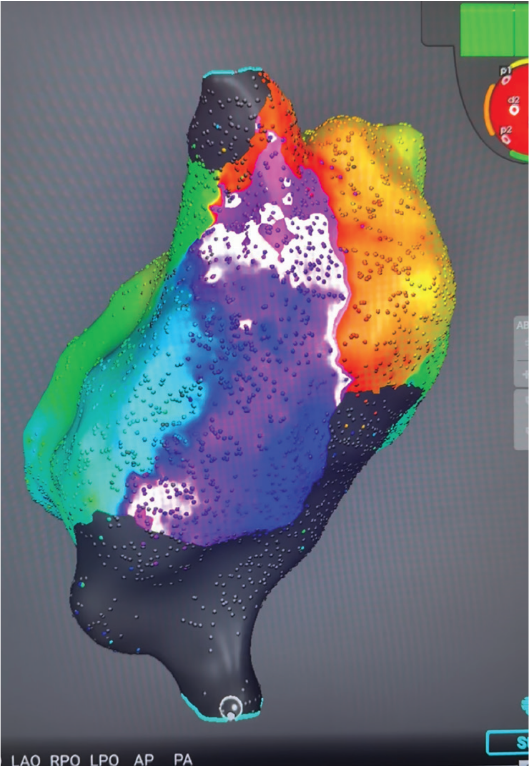
For example, when creating an ablation line for typical or peri-mitral AFL, or a line between the tricuspid annulus and the inferior vena cava or between the mitral annulus and one of the pulmonary veins (PVs), I prefer RF ablation close to the coronary arteries, such as near the mitral and tricuspid annulus. As I move away from those areas, we can use PFA. This allows us to use each energy source where we believe it is safest.
Another issue with PFA is that it does not affect the nerve cells that help slow the heart rate. With RF ablation, we often saw a patient’s heart rate increase by 10 to 15 beats per minute because some of these cells were also ablated during the procedure.
We see a lot of patients with sinus node dysfunction and AF, or tachy-brady syndrome, whose heart rate is fast during AF but very slow otherwise. We previously used RF ablation around these ganglia to help improve the sinus node rate after the procedure.
For patients with AF and sinus node dysfunction who want to avoid a pacemaker, one option is to use PFA on the posterior wall, where there is less risk of injuring the esophagus. RF may also be used in front of the right superior PV if there is no risk to the phrenic nerve. Ablating these areas may help improve the patient’s heart rate after the procedure.
What makes the lattice design (ie, form factor) of the Sphere-9 catheter unique compared with other PFA or dual-energy ablation catheters, and how does that difference affect your procedural workflow?
There are several advantages. The Sphere-9 catheter has 9 electrodes that sense from multiple areas at once, which can make mapping faster. Its footprint is also slightly larger than that of a focal PFA catheter, allowing for a somewhat wider area of ablation.
Another feature I like is how well it maintains tissue contact. It’s soft, lattice-like design is atraumatic and helps prevent excessive pressure while providing enough friction to remain stable against the tissue.
PFA depends on consistent tissue contact. This catheter provides reliable contact to help deliver an effective lesion.
Do you find the wide-area focal lesions of Sphere-9 to be precise enough for pulmonary vein isolation (PVI)-only procedures and discrete linear lesion sets? If so, how does this capability help you tailor treatment to each patient’s individual needs?
Yes, I think the wide-area focal lesions that the Sphere-9 catheter creates are fairly precise. The mapping system is reliable, so you can easily complete a procedure in a relatively short period of time. It has significantly shortened these procedures compared with the days when we used RF ablation, and that is due to 2 things. First, the lesion duration is shorter. The other is that, instead of dealing with point-by-point ablation, you have a wide-area focal lesion, so you can perform circumferential ablation much faster.
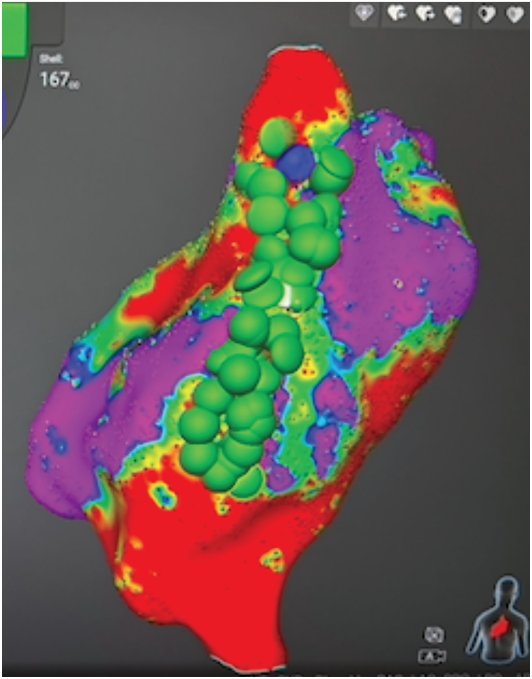
I think this catheter really shines when it comes to linear ablation. Its ability to deliver a wide enough linear lesion is excellent, and because you have reliable tissue contact, you can rely on it to deliver good lesion sets. For other linear lesions that you need to create beyond the PVs and posterior wall—for example, if you’re creating flutter lines or performing ablation for AFLs and need lines to interrupt those circuits, whether they’re in the right or left atrium—I think this catheter really shines.
What features of the Affera mapping and ablation system do you believe contribute most to creating high-quality ablation lesions and achieving procedural success?
I think the dual-energy capability is definitely important. This way, we as operators or physicians can deliver an ablation lesion using whichever energy we think is safest, depending on the location of the tissue we’re interested in ablating.
I think the mapping system has also significantly improved over the years. Compared with other systems, we have seen significant improvements in their mapping system. I believe the newest version that was just released has improved capabilities that will help us apply this technology to VT. I haven’t talked a lot about VT, but I think this catheter has a lot of potential for VT ablation.
For example, the new version of the mapping system includes beat matching, so you can acquire points that are related only to premature ventricular contractions (PVCs) and exclude the other sinus beats. I think pace tagging is also important, and that’s going to help us a lot with PVC mapping. Automatic reference is also going to be key in helping us map arrhythmias.
So, I think there are a lot of new features in the mapping system that were just released that are going to be very helpful for both atrial and ventricular arrhythmias. I think we’re going to see greater applicability of catheters like this one in ventricular arrhythmias because you can use both RF and PFA for difficult-to-reach areas or when you want to create deeper lesions, and that’s going to help us a lot in the ventricle.
The transcripts were edited for clarity and length.
Disclosures: Dr Kanj has completed and returned the ICMJE Form for Disclosure of Potential Conflicts of Interest, and has no conflicts of interest to report.
This content was published with support from Medtronic.