More Evidence That Apixaban Causes Less Bleeding Than Rivaroxaban
© 2026 HMP Global. All Rights Reserved.
Any views and opinions expressed are those of the author(s) and/or participants and do not necessarily reflect the views, policy, or position of EP Lab Digest or HMP Global, their employees, and affiliates.
EP LAB DIGEST. 2026;26(8):5.
Bradley P Knight, MD, FACC, FHRS
Dear Readers,
Direct oral anticoagulants (DOACs) have largely replaced warfarin (Coumadin) for stroke prevention in patients with atrial fibrillation (AF). In the United States, the 2 primary options have been rivaroxaban (Xarelto) and apixaban (Eliquis). Both have been shown to reduce the risk of stroke and have been similarly priced. Rivaroxaban offers the clear advantage of once-daily dosing compared with apixaban, which is administered twice daily. But which DOAC should be prescribed, and does it matter?
Because no large randomized head-to-head trial has compared apixaban with rivaroxaban in patients with AF, most available comparisons have come from meta-analyses of the pivotal trials comparing each drug with warfarin and from studies of matched cohorts derived from large patient databases. In the February 2022 issue of EP Lab Digest, the results of a nonrandomized cohort study comparing rivaroxaban to apixaban were reviewed.1 Using claims data from approximately 600,000 United States Medicare beneficiaries, the investigators found that treatment with rivaroxaban, compared with apixaban, was associated with a significantly increased risk of both major ischemic and hemorrhagic events.2
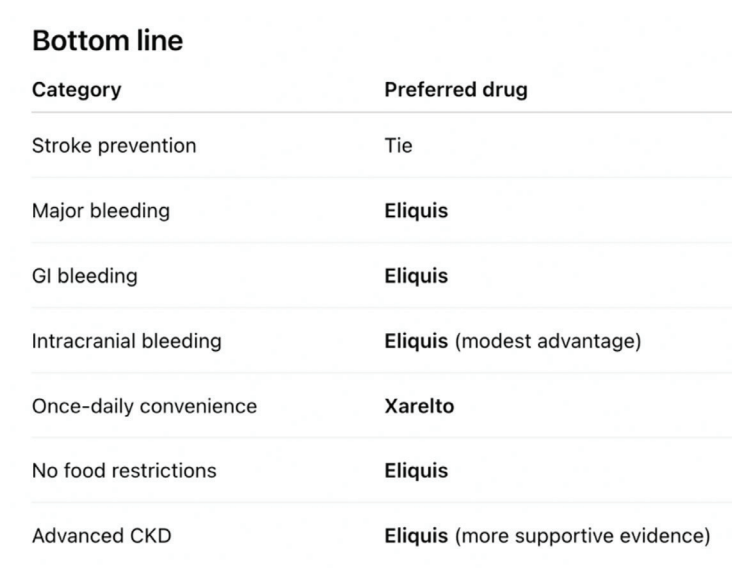
The conclusion from most studies is that apixaban is associated with a lower risk of bleeding. Interestingly, a request to ChatGPT comparing Eliquis and Xarelto concluded that Eliquis had a clear advantage with respect to major bleeding, gastrointestinal (GI) bleeding, intracranial bleeding, lack of food restrictions, and stronger supporting evidence in patients with advanced kidney disease (Figure). One possible explanation for the higher bleeding risk with rivaroxaban is that its once-daily dosing, compared with the twice-daily dosing of apixaban, results in greater fluctuations in the anticoagulant effect, making bleeding events more likely when plasma drug levels peak. Another possible explanation is that rivaroxaban has a more direct effect on the gut lining, increasing the risk of GI bleeding.
For the first time, we now have data from a prospective, randomized, controlled trial directly comparing rivaroxaban to apixaban—the COBRRA trial.3 Although the study enrolled patients with acute symptomatic pulmonary embolism (PE) or deep venous thrombosis (DVT), rather than AF, and was designed to compare only the safety of the 2 drugs, it used chronic DOAC doses similar to those used for stroke prevention. Investigators assigned 2760 patients with PE or DVT to receive apixaban or rivaroxaban for 3 months. Apixaban was administered at a dose of 10 mg twice daily for 7 days, followed by 5 mg twice daily, and rivaroxaban was administered at a dose of 15 mg twice daily for 21 days, followed by 20 mg daily. The primary outcome was clinically relevant bleeding, defined as a composite of major bleeding or clinically relevant nonmajor bleeding during the 3-month trial period. A primary outcome event occurred in 3.3% of patients in the apixaban group and 7.1% of patients in the rivaroxaban group (relative risk, 0.46; 95% confidence interval [CI], 0.33-0.65; P<0.001). The increased risk of bleeding with rivaroxaban persisted after patients were switched to the lower maintenance dose typically used for patients with AF. The authors concluded that the risk of clinically relevant bleeding was significantly lower with apixaban than with rivaroxaban during the 3-month treatment period.
Many studies have provided indirect evidence that apixaban is associated with a lower risk of bleeding than rivaroxaban. Although the COBRRA trial enrolled patients with venous thromboembolism rather than AF, it is the first randomized trial to directly compare both DOACs and found that rivaroxaban was associated with approximately twice the rate of clinically relevant bleeding as apixaban. That is a big difference.
Disclosures: Dr Knight has served as a paid consultant to Medtronic and was an investigator in the PULSED AF trial. He has served as a consultant, speaker, investigator, and/or has received EP fellowship grant support from Abbott, AltaThera, AtriCure, Baylis Medical, Biosense Webster, Biotronik, Boston Scientific, CVRx, Philips, and Sanofi; he has no equity or ownership in any of these companies. Dr Knight reports payment or honoraria from Convatec for a lecture.
References
- Knight BP. Letter from the editor. Rivaroxaban or apixaban? EP Lab Digest. 2022;22(2):6.
- Ray WA, Chung CP, Stein CM, et al. Association of rivaroxaban vs apixaban with major ischemic or hemorrhagic events in patients with atrial fibrillation. JAMA. 2021;326(23):2395-2404. doi:10.1001/jama.2021.21222
- Castellucci LA, Chen VM, Kovacs M, et al. Bleeding risk with apixaban vs. rivaroxaban in acute VTE. N Engl J Med. 2026;394:1051-1060. doi:10.1056/NEJMoa2510703