







Beyond Skin Clearance: What Does Treatment Success Mean in Psoriasis Today?
 Explore why skin clearance remains an important treatment goal while symptoms, quality of life, high-impact disease locations, and patient priorities can provide a more complete picture of treatment success.
Skin clearance has become an achievable goal in plaque psoriasis, one that formal treatment targets now reflect. Objective measures capture visible disease well but not symptoms, function, or the sites where disease is most disruptive. A fuller view of treatment success pairs those measures with patients' reports.
Treatment Expectations in Psoriasis Have Evolved
Formal treatment targets for psoriasis are a recent development. The European consensus defines treatment success as a score of 75% or greater in the Psoriasis Area and Severity Index (PASI) that allows treatment to continue.1 Prior to 2017, the United States had not yet established defined treatment targets.1 The Medical Board of the National Psoriasis Foundation (NPF) established targets the following year, setting a high standard. The goal at 3 months after starting therapy is to have a body surface area (BSA) of 1% or less. A BSA of 3% or less, or a 75% or greater improvement from baseline, is considered an acceptable response. The maintenance target at each 6-month evaluation is again a BSA of 1% or less.1 Achieving high levels of skin clearance is increasingly possible and remains a central goal of care. This progress prompts an important question: Does visible skin clearance alone define treatment success for every patient?
What Clinical Measures Tell Us—and What They May Not
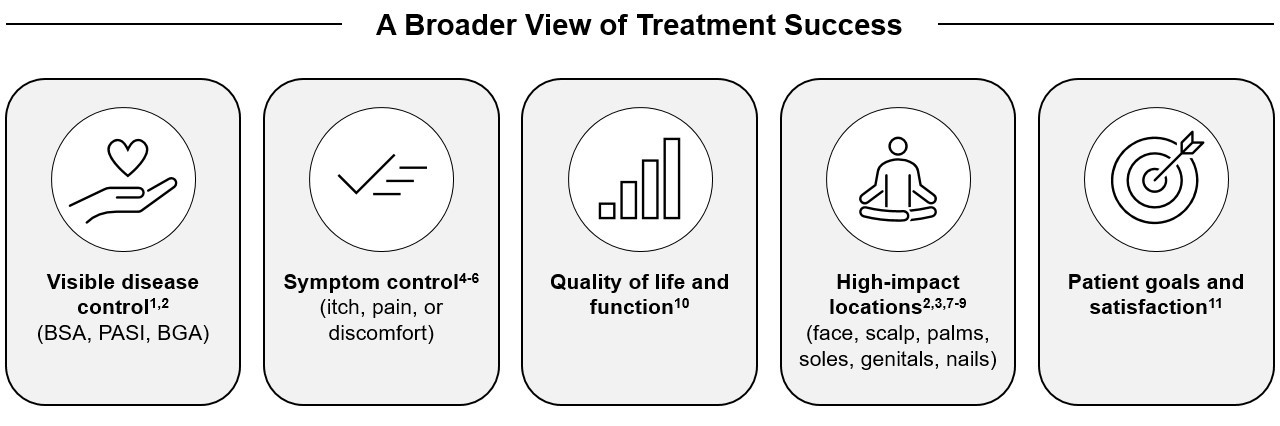
BSA, PASI, and the Physician Global Assessment (PGA) form the backbone of how to quantify psoriasis severity. Joint American Academy of Dermatology (AAD)–NPF guidance recommends BSA for assessing severity and treatment response in the clinical setting and PASI primarily for clinical trials, describing it as a research tool that is not frequently used in practice.2 The guidance also describes the limitations of these tools. BSA does not consider location on the body, the clinical characteristics of the plaques, symptoms, or quality of life.2 PASI does not account for symptoms or quality of life either, and the guideline notes that it is not ideal for measuring nail, palmoplantar, and genital psoriasis.2 The International Psoriasis Council reached the same conclusion but through a different approach. Involvement of the face, palms, soles, genitalia, scalp, or nails is now considered sufficient on its own to qualify a patient for systemic therapy, whatever the BSA.3
Click image to expand.
Persistent Burden Beyond Visible Skin Disease
Visible disease can resolve while other aspects of the burden do not. Meaningful disease burden may persist even as visible skin disease improves.
- Residual symptoms. Itch affects more than 70% of patients with psoriasis, and its severity and consequences are often not formally assessed in practice.4 Skin pain is also common and under-evaluated.5
- Symptoms that outlast clearance. In a prospective study of patients treated with a biologic, 18.2% of those who achieved an absolute PASI score of 0 at week 48 had a Dermatology Life Quality Index score of 2 or more, which the investigators classified as incomplete health-related quality-of-life improvement.6 At week 48, all 13 patients who had a score of 2 or more alongside an absolute PASI of 0 to 2 reported itching.6
- High-impact locations and psychosocial burden. Disease of the scalp, palms, soles, nails, and genitalia can affect quality of life out of proportion to the surface area involved.7,8,9 Psychosocial effects can persist as well. In one ethnographic study, patients established on biologic therapy regained confidence as their skin improved, but psychological effects remained.10
A Multidimensional View of Treatment Success
Skin clearance remains an important treatment goal, and objective measures remain essential for assessing visible disease. These objective measures are not in question; they provide important information about the extent and severity of visible disease. However, evaluating how the patient is doing addresses aspects that objective measures cannot, such as symptoms, function, quality of life, satisfaction, and individual priorities. These perspectives may differ. In a multinational survey, patients and dermatologists agreed on disease severity in 55% of cases and on satisfaction with disease control in 39% of cases.11 Objective scores alone do not reveal such gaps. Registry data also indicate that unmet needs persist for some patients, even in the biologic era.12
| Patient A | Patient B | |
| Body surface area | 2% | 2% |
| Sites involved | Trunk; easily covered by clothing | Palms, soles, and genitalia |
| Symptoms | Minimal itch | Persistent itch |
| Functional impact | None reported | DIfficulty gripping tools and standing through a shift |
| View of current control | Satisfied | Not Satisfied |
*Hypothetical patients, shown for illustration. Objective measures do not account for lesion location, symptoms, or quality of life.2,3,7,8,9
Clinical Takeaway
Objective disease measures remain essential to psoriasis care. Three questions can help place them in the context of the individual patient:
- Is the patient satisfied with their current level of disease control?
- Are residual symptoms, or disease in high-impact locations, affecting daily life?
- Does the patient’s experience align with what objective measures suggest?
References
- Armstrong AW, Siegel MP, Bagel J, et al. From the Medical Board of the National Psoriasis Foundation: treatment targets for plaque psoriasis. J Am Acad Dermatol. 2017;76(2):290-298. doi:10.1016/j.jaad.2016.10.017
- Elmets CA, Korman NJ, Prater EF, et al. Joint AAD-NPF guidelines of care for the management and treatment of psoriasis with topical therapy and alternative medicine modalities for psoriasis severity measures. J Am Acad Dermatol. 2021;84(2):432-470. doi:10.1016/j.jaad.2020.07.087
- Strober B, Ryan C, van de Kerkhof P, et al. Recategorization of psoriasis severity: Delphi consensus from the International Psoriasis Council. J Am Acad Dermatol. 2020;82(1):117-122. doi:10.1016/j.jaad.2019.08.026
- Taliercio VL, Snyder AM, Webber LB, et al. The disruptiveness of itchiness from psoriasis: a qualitative study of the impact of a single symptom on quality of life. J Clin Aesthet Dermatol. 2021;14(6):42-48.
- Snyder AM, Taliercio VL, Webber LB, et al. The role of pain in the lives of patients with psoriasis: a qualitative study on an inadequately addressed symptom. J Psoriasis Psoriatic Arthritis. 2022;7(1):29-34. doi:10.1177/24755303211066928
- Miyagi T, Kanai Y, Murotani K, et al. Itch as a critical factor in impaired health-related quality of life in patients with plaque psoriasis achieving clear or almost-clear skin: analysis of the single-arm, open-label, multicenter, prospective ProLOGUE study. JAAD Int. 2022;8:146-153. doi:10.1016/j.jdin.2022.06.013
- Butacu AI, Toma C, Negulet IE, et al. Updates on psoriasis in special areas. J Clin Med. 2024;13(24):7549. doi:10.3390/jcm13247549
- Lupulescu AM, Savu AP, Bucur Ş, Şerban ED, Popescu S, Constantin MM. Hard-to-treat areas in psoriasis: an underevaluated part of the disease. Life (Basel). 2025;15(3):425. doi:10.3390/life15030425
- Dopytalska K, Sobolewski P, Błaszczak A, Szymańska E, Walecka I. Psoriasis in special localizations. Reumatologia. 2018;56(6):392-398. doi:10.5114/reum.2018.80718
- Narayanan S, Guyatt V, Franceschetti A, Hautamaki EL. Disease burden and patient reported outcomes among patients with moderate to severe psoriasis: an ethnography study. Psoriasis (Auckl). 2015;5:1-7. doi:10.2147/PTT.S74906
- Griffiths CEM, Augustin M, Naldi L, et al. Patient-dermatologist agreement in psoriasis severity, symptoms and satisfaction: results from a real-world multinational survey. J Eur Acad Dermatol Venereol. 2018;32(9):1523-1529. doi:10.1111/jdv.14937
- Ukkola-Vuoti L, Klåvus A, Toppila I, Hällfors J, Veijalainen L, Mälkönen T. A population-based registry study on psoriasis-associated burden of disease in Finland. Front Med (Lausanne). 2025;12:1605100. doi:10.3389/fmed.2025.1605100
© 2026 HMP Global. All Rights Reserved.




