What Is “SALT” and How Is It Used in Practice?
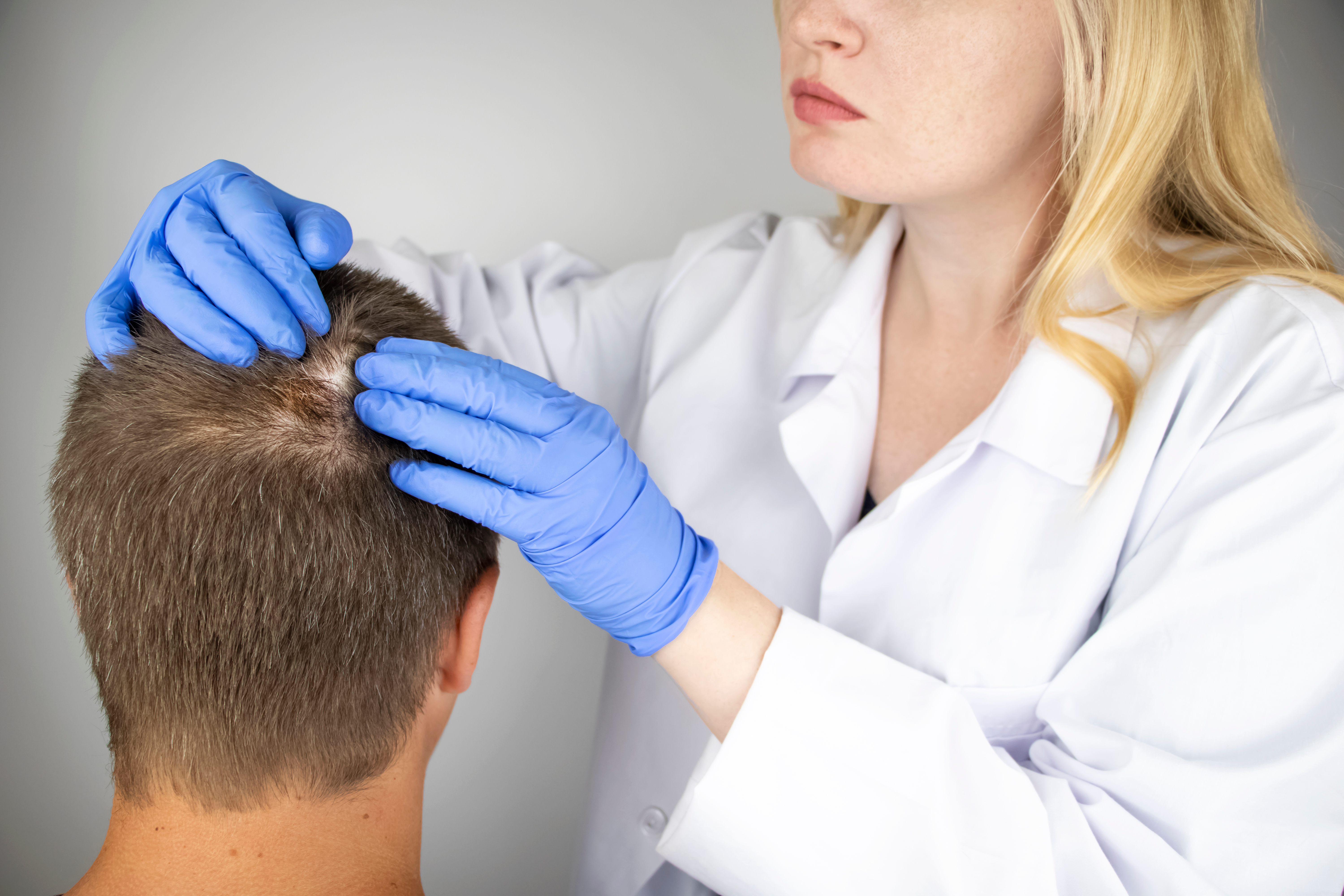
Alopecia areata (AA) is an autoimmune condition in which patients experience varying degrees of hair loss.1 Therefore, estimating severity is crucial for proper diagnosis. Determining the extent of hair loss is essential for making treatment decisions, monitoring patient improvement, and predicting long-term outcomes,1 which underscores the need for standardized instruments in clinical practice and research.
Several assessment tools are currently in use to quantify AA severity.1 The Severity of Alopecia Tool (SALT) is a commonly used objective method for determining scalp hair loss.2
How the SALT System Works
Scalp hair loss is graded using the SALT score, with 0% signifying no hair loss on the scalp and 100% signifying complete scalp hair loss. It is a standardized quantitative instrument for determining the extent of scalp hair loss.2 The scalp is divided into four specific areas: the vertex (40%), right profile (18%), left profile (18%), and posterior or nape area (24%).2 Evaluators assess hair loss in each scalp area by estimating how much hair is missing compared to what normal hair density would look like.2 Visually mapping out areas with reduced hair thickness and identifying spots where hair is missing entirely help to create a detailed picture of hair loss across the scalp.2,3 For example, if the left profile shows 90% hair loss, this contributes 16.2% to the total score (90% × 0.18). By performing similar calculations for each region—for example, the right profile (95% x 0.18 contributing 17.1%), vertex (90% x 0.40 contributing 36%), and posterior (65% x 0.24 contributing 15.6%)—the total SALT score is the sum of all areas, which in this example yields a score of 84.9%.
Weighing the Pros and Cons
SALT scores are straightforward to interpret, with specific percentages signifying the following: 0%, no hair loss, 1%–24%, mild hair loss, 25%–49%, moderate hair loss, 50%–74%, severe hair loss, 75%–99%, extremely severe hair loss, and 100%, total scalp hair loss.2 Standardized comparisons in clinical trials and treatment evaluations are made possible by the SALT system's capacity to offer a quantitative and objective assessment.
Nonetheless, it is critical to recognize SALT's limitations.2 The tool measures only scalp hair loss and ignores body hair loss and the psychological effects of AA.1 Furthermore, SALT does not take into account a patient's overall experience or other possible symptoms, such as nail involvement.1 It is not made to monitor hair regrowth or loss in specific lesions or slight changes in hair density over time, which makes it more difficult to evaluate changes at follow-up appointments.1 Even with its limitations, SALT is a useful tool for clinicians to make treatment decisions and monitor disease progression in AA.1,3
In practice, the SALT score is primarily used to measure and track scalp hair loss in alopecia areata patients by assigning a score based on hair loss in 4 scalp regions.4 In clinical trials, such as the BRAVE-AA1, SALT scores are used to determine patient eligibility for the trial and track treatment effectiveness over time.4 A significant reduction in the SALT score (eg, from 50 to below 20) indicates clinical improvement.4 This standardized approach allows for consistent tracking of disease progression and treatment response, making it a valuable tool for clinicians and researchers alike in managing AA.4
SALT for Determining AA Severity
The SALT scoring system is useful for determining the severity of AA, but physicians and researchers must be mindful of its limitations to provide patients with comprehensive care. More research and improvement of assessment tools are crucial to improving patient outcomes and AA management.
References:
- King BA, Senna MM, Ohyama M, Tosti A, Sinclair RD, et al. Defining severity in alopecia areata: current perspectives and a multidimensional framework. Dermatol Ther (Heidelb). 2022;12(4):825-834. doi:10.1007/s13555-022-00711-3. Epub 2022 Mar 31.
- Olsen EA, Hordinsky MK, Price VH, et al. Alopecia areata investigational assessment guidelines—part II. National Alopecia Areata Foundation. J Am Acad Dermatol. 2004;51(3):440-447. doi:10.1016/j.jaad.2003.09.032
- Olsen EA, Canfield D. SALT II: A new take on the Severity of Alopecia Tool (SALT) for determining percentage scalp hair loss. J Am Acad Dermatol. 2016;75(6):1268-1270. doi:10.1016/j.jaad.2016.08.042
- Atanaskova Mesinkovska N, King BA, Vañó-Galván S, et al. Visualizing Severity of Alopecia Tool (SALT) scores in the clinical setting using patient images from a clinical trial. J Clin Dermatol. 2024;3(2):528-535. Published January 10, 2024. doi:10.1002/jvc2.327
Related Content