COMPARE Trial Update and RANGER DCB in Long Lesions
 Presenting an update on the COMPARE trial, Marianne Brodmann, MD, from Medical University Graz in Graz, Austria split her presentation into 2 parts: the first, 1-year data from the RANGER II SFA long lesion cohort, and the second, a 2-year update of the COMPARE randomized controlled trial.
Data from patients with lesions 100 mm or longer from the Ranger drug-coated balloon (DCB) arm of the RANGER II SFA randomized trial and the long balloon substudy (Ranger DCB lengths 120–200 mm) were pooled for analysis of 1-year safety and efficacy.
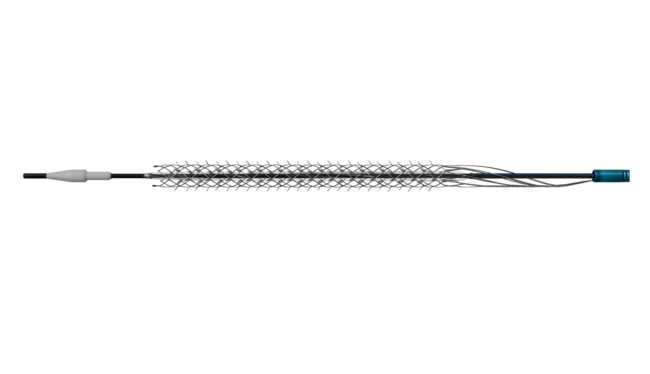
The long lesion cohort included 129 patients with symptomatic PAD and stenotic lesions of the superficial femoropoliteal segment. All were treated with the Ranger DCB (Boston Scientific), a next generation DCB utilizing a Sterling Balloon 0.018-inch platform with 0.014 inch/0.018-inch guidewire compatibility, and TransPax™ coating technology eluting paclitaxel 2 ug/mm2.
Mean age was 71.1 years, mean lesion length was 144.5 mm, Severe calcification was present in 58.1% (75 of 129), and 32.6% (42 of 129) had 100% occlusions.
All were treated with the Ranger DCB, a next generation DCB utilizing a Sterling Balloon 0.018-inch platform with 0.014 inch/0.018-inch guidewire compatibility, and TransPax coating technology eluting paclitaxel 2 ug/mm2.
Twelve-month core-lab adjudicated primary patency was 88.0%. Freedom from TLR was 95.1% and all major adverse events (MAEs) were clinically-driven TLR. Twelve-month mortality was 2.4%.
Fully 87.5% of patients improved at least 1 Rutherford category after treatment and without reintervention (primary sustained clinical improvement) and 84.2% were Rutherford category 0 or 1 at 12 months.
“So just to summarize, patients with lesions longer than 10 centimeters in length treated with Ranger DCBs had 1-year safety and efficacy results similar to that previously reported overall for the RANGER II SFA randomized control trail with a mean lesion length of 8.25 centimeters,” concluded Dr. Brodmann.
In the second part of her presentation. Dr. Brodmann reviewed the 2-year findings of the COMPARE randomized controlled trial. COMPARE was an investigator-initiated effort designed to evaluate efficacy and safety of two different coating technologies and paclitaxel dosages in patients with symptomatic femoropoliteal lesions.
After successful lesion crossing, patients were randomly assigned 1:1 to DCB angioplasty with either low-dose paclitaxel coating (Ranger Paclitaxel-Coated PTA Balloon Catheter, Boston Scientific) or high-dose (In.Pact Admiral or In.Pact Pacific, Medtronic Vascular).
Mean age of the 214 participants was 68 years, about 37% were female, and the majority (about 82% were Rutherford class 3 patients. Total occlusion were seen in 42% and grade 4 calcification in 17%, with no differences between groups.
Primary patency through 790 days did not differ between groups, with rates of 70.6% for the low-dose DCB and 71.4% for the high-dose DCB at 730 days (p-value = 0.96). Similarly, in those with lesions >10 cm but less than £20 cm or in those with lesions between 20 cm and £30 cm, no differences were seen in primary patency.
Through 790 days, all-cause mortality was 3.6% in the low-dose DCB arm and 2.2% in the high-dose DCB arm (p=0.60). There were no device or procedure-related deaths and one major amputation (in the high-dose group). Clinically-driven TLR was seen in 17.3% and 13.0%, respectively (p=0.30).
“Again, good category improvement with around 70% of patients with no or minimal symptoms at 2 years,” reported Dr. Brodmann.
“There is consistent patency and safety across studies, including patients with longer lesions of more than 10 centimeters treated with Ranger DCB who show high patency and low reintervention rates through 1 year,” she reported. The COMPARE findings show excellent primary patency through 2 years and the results suggest the low dose DCB is as effective at maintaining patency as high dose DCB in mid- to long-length lesions.”
When these findings were first presented at LINC 2021, Dr. Brodmann commented that the similar patency seen with the low-dose Ranger device is reassuring and might compel clinicians to opt for a low-dose device over a high-dose device, but she stressed also that more data on the low-dose device is needed.
The one-year results of COMPARE were published in July 2020 in the European Heart Journal (Steiner S, et al).