Revascularizing Femoropopliteal Chronic Total Occlusions With Atheroplasty: A Case-Based Discussion
Key Summary
- This case report follows a 73-year-old with Rutherford 3 peripheral arterial disease and a challenging 30-cm femoropopliteal chronic total occlusion (CTO) treated with the Santreva™-ATK Endovascular Revascularization Catheter (AngioSafe).
- The CTO was crossed antegrade into the distal true lumen without multiple CTO wires, re-entry, or retrograde access. Final angiography showed restored flow with preserved 3-vessel runoff.
- The case illustrates the application of the Santreva-ATK system in a complex femoropopliteal CTO and demonstrates how simultaneous intraplaque crossing and initial vessel preparation may be incorporated into a contemporary lesion-specific endovascular treatment strategy.
© 2026 HMP Global. All Rights Reserved.
Any views and opinions expressed are those of the author(s) and/or participants and do not necessarily reflect the views, policy, or position of Vascular Disease Management or HMP Global, their employees, and affiliates.
VASCULAR DISEASE MANAGEMENT. 2026;23(8):E119-E124
Introduction
Chronic total occlusions (CTOs) of the femoropopliteal arterial segment remain among the most technically demanding lesions encountered during endovascular treatment of peripheral arterial disease (PAD). Although contemporary endovascular technologies have substantially expanded the range and complexity of lesions amenable to percutaneous treatment, successful traversal of the occluded segment remains a fundamental prerequisite for subsequent vessel preparation and definitive therapy. Failure to cross a CTO may prolong procedure and fluoroscopy times; increase contrast exposure; necessitate additional access sites, crossing, or re-entry devices; and ultimately prevent successful endovascular revascularization.
Current treatment concepts increasingly favor a lesion-specific rather than purely device-specific approach to femoropopliteal intervention. In the recently published Global Algorithm for the Endovascular Treatment of Chronic Femoropopliteal Lesions: An Interdisciplinary Expert Opinion Statement, Korosoglou et al proposed an interdisciplinary framework integrating lesion morphology, crossing characteristics, vessel preparation, and definitive treatment.¹ Particular attention is given to lesion length, degree and distribution of calcification, CTO morphology, in-stent restenosis, and the route of lesion crossing. These variables may substantially influence the selection of vessel preparation techniques and subsequent definitive treatment with drug-coated balloons, drug-eluting stents, interwoven nitinol stents, covered stents, or other therapeutic strategies.¹
CTOs represent a particularly important component of this treatment paradigm because successful guidewire passage alone does not necessarily constitute adequate lesion preparation. Historically, treatment of complex femoropopliteal CTOs has represented a multistep procedure consisting of lesion crossing followed by vessel preparation and, finally, definitive therapy. The crossing route itself may influence subsequent procedural steps. While intraluminal or intraplaque crossing maintains the treatment pathway within the occlusive material, subintimal crossing may result in extensive dissection and alteration of the native vessel architecture. Although subintimal recanalization is an established and frequently successful strategy, extensive dissection may necessitate re-entry techniques and potentially increase the need for additional balloon angioplasty or scaffold implantation. Consequently, controlled intraplaque crossing may be particularly attractive when preservation of the native vessel architecture and a “leave nothing behind” strategy are intended.
The technical challenge of CTO crossing is further amplified by the considerable heterogeneity of femoropopliteal plaque morphology. Occlusions may range from relatively soft fibrotic material to dense fibrocalcific plaque and severely calcified lesions. Experimental work by Roy et al demonstrated marked differences in the forces required to penetrate peripheral arterial plaque, highlighting the mechanical limitations inherent to a single conventional guidewire strategy across different CTO morphologies.² Low-profile guidewires provide excellent trackability and maneuverability but may offer insufficient penetration force against resistant calcified proximal caps. Conversely, escalation to increasingly stiff or high-penetration-force guidewires may facilitate plaque penetration but can compromise directional control and increase the likelihood of subintimal passage.
Several strategies have therefore evolved to overcome difficult femoropopliteal CTOs, including antegrade guidewire escalation, intentional subintimal recanalization, dedicated crossing and re-entry devices, and retrograde approaches. An interdisciplinary expert consensus on infrainguinal CTO crossing proposed a structured escalation algorithm based on lesion characteristics and procedural progress, emphasizing that no single crossing technique is appropriate for all CTOs.³ Increasing lesion length, ambiguous proximal or distal caps, and severe calcification may substantially increase procedural complexity and the likelihood that alternative crossing strategies are required. The subsequent global algorithm further extended this concept by linking crossing characteristics with vessel preparation and definitive treatment.¹
This distinction is clinically important because CTO crossing and vessel preparation have traditionally been regarded as sequential but separate procedural steps. After successful wire passage, additional devices are generally required to create an adequate lumen and modify resistant plaque before drug delivery or scaffold implantation. Depending on lesion characteristics, vessel preparation may involve conventional balloon angioplasty, specialty balloons, atherectomy, intravascular lithotripsy, or combinations of these technologies.¹
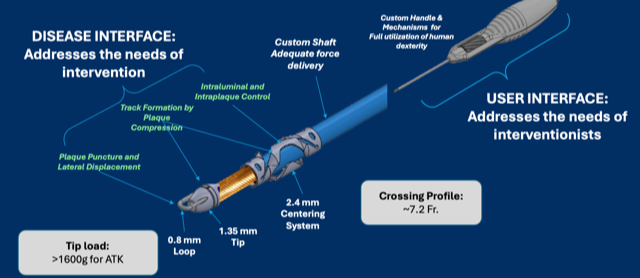
The Santreva™-ATK Endovascular Revascularization Catheter (AngioSafe) was developed to address this separation between CTO crossing and initial vessel preparation. In contrast to conventional guidewire-based approaches, Santreva-ATK is a manually controlled, wire- and power-free crossing system designed to apply substantial axial penetration force while maintaining controlled rotational and lateral plaque displacement.6 The catheter has an approximately 7.2F crossing profile and a tip load exceeding 1600 g. Its mechanism combines plaque puncture, lateral displacement, and orbital compression to create an intraplaque channel during advancement. This mechanism, termed atheroplasty, is intended to simultaneously achieve CTO traversal and initial plaque modification without external energy delivery.
The device concept therefore differs fundamentally from that of a conventional crossing wire. Rather than creating only a small pathway through the occlusion for subsequent devices, Santreva-ATK is designed axially to disrupt and laterally to enable assessment as to whether additional vessel preparation is required.5,6 This concept is particularly relevant in the context of the contemporary femoropopliteal treatment algorithm proposed by Korosoglou et al.¹ Whereas conventional treatment generally follows the sequence of CTO crossing, vessel preparation, and definitive therapy, Santreva-ATK potentially integrates the first 2 steps by combining controlled intraplaque crossing with simultaneous mechanical plaque modification.
The prospective, multicenter RESTOR-1 pivotal study evaluated the Santreva-ATK catheter in 74 patients with de novo femoropopliteal CTOs.⁴ The mean target lesion CTO length was 84 mm, and severe calcification was present in approximately one-third of patients. The primary endpoint—facilitating guidewire placement into the distal true lumen in the absence of device-related major adverse events—was achieved in 87.8% of patients. Importantly, success remained 86.7% among patients with moderate-to-severe calcification. In a per-protocol cohort of 70 subjects, this success rate was 90% overall, and 88.2% in moderate to severe calcification.
Intravascular ultrasound (IVUS) demonstrated exclusively intraplaque crossing in 80% of evaluable cases. Device passage itself produced substantial luminal enlargement, with a mean post-crossing diameter of 2.87 ± 0.74 mm and an approximately 59% luminal gain relative to the reference vessel diameter in one pass. No device-related major adverse events (flow-limiting dissections, perforations, embolism, and bail-out stenting) were reported through 30 days.⁴
These findings suggest that controlled intraplaque CTO crossing combined with simultaneous plaque modification by atheroplasty may represent an alternative to the traditional sequential paradigm of guidewire crossing followed by separate vessel preparation. However, RESTOR-1 was a prospective single-arm study without a randomized comparator; therefore, superiority over conventional wire escalation, subintimal recanalization, or other dedicated CTO crossing technologies cannot currently be inferred. Furthermore, whether the luminal gain achieved during atheroplasty reduces the requirement for additional vessel preparation or scaffold implantation remains to be established in comparative studies.
The following case illustrates the application of the Santreva-ATK system in a complex femoropopliteal CTO and demonstrates how simultaneous intraplaque crossing and initial vessel preparation may be incorporated into a contemporary lesion-specific endovascular treatment strategy.
Case Report
A 73-year-old patient presented with symptomatic PAD of the right lower extremity, classified as Rutherford category 3. The patient reported severe lifestyle-limiting intermittent claudication with a maximum pain-free walking distance of approximately 50 meters despite conservative management. Based on the severity of symptoms and the marked functional limitation, endovascular revascularization was planned.
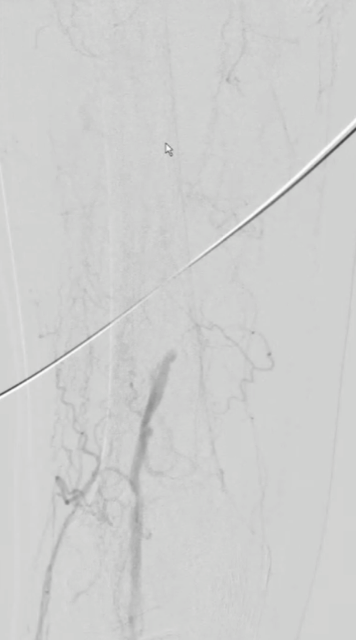
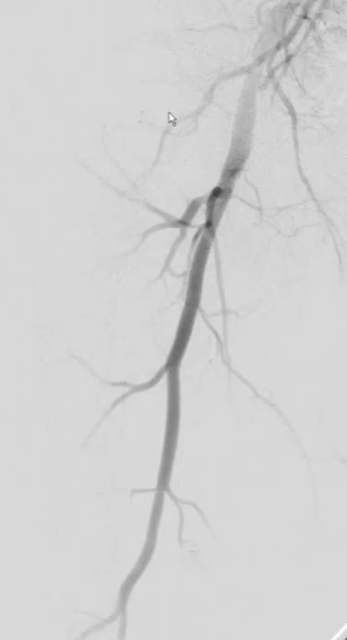
Diagnostic angiography demonstrated a 30-cm CTO of the femoropopliteal segment (Figure 1 and Figure 2). Distal angiography demonstrated preserved 3-vessel runoff below the knee, supporting an endovascular revascularization strategy.
The procedure was performed using a contralateral crossover approach from the left common femoral artery. A 6F, 65-cm Fortress guiding sheath (Teleflex) was advanced across the aortic bifurcation and positioned to provide stable support for the intervention.
Given the length and complexity of the CTO, the Santreva-ATK catheter was selected for lesion crossing (Figure 3). The device was advanced to the proximal cap of the occlusion (Figure 4) and used according to its intended atheroplasty mechanism. Controlled advancement and rotational manipulation of the catheter enabled uncomplicated fast traversal of the entire CTO. The distal true lumen was successfully reached without the need for escalation to multiple CTO guidewires, a dedicated re-entry device, or an additional retrograde access.
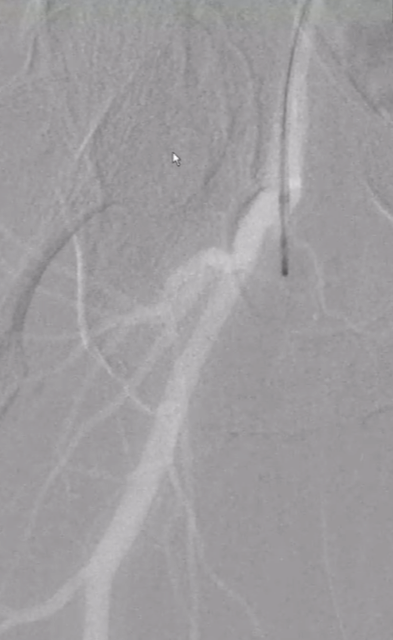
Following successful crossing, a guidewire was advanced into the patent distal vessel, establishing a stable working position for subsequent therapy. Vessel preparation was then performed using a 5.0 × 300-mm scoring balloon (Figure 5), allowing treatment of the long femoropopliteal segment with a single long balloon platform.
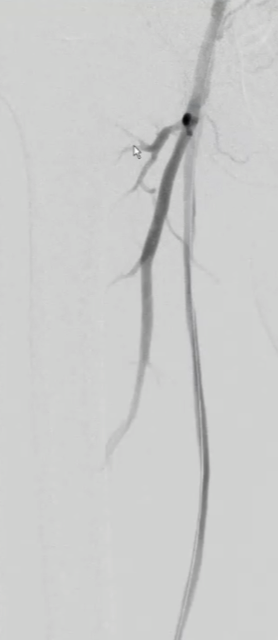
Definitive antiproliferative therapy was subsequently performed using a sirolimus-coated DCB. Following DCB angioplasty, the majority of the treated femoropopliteal segment demonstrated an acceptable angiographic result without the need for routine scaffold implantation. However, the superficial femoral artery distal to the CTO showed an unsatisfactory focal result requiring bailout stenting. A 6.0 × 125-mm BioMimics stent (Veryan Medical) was therefore implanted selectively in this segment.
Final angiography demonstrated restoration of continuous antegrade flow through the treated femoropopliteal artery with a satisfactory angiographic result. Importantly, flow to the below-the-knee arteries was preserved, with 3-vessel runoff to the lower leg at completion of the procedure (Figure 6).
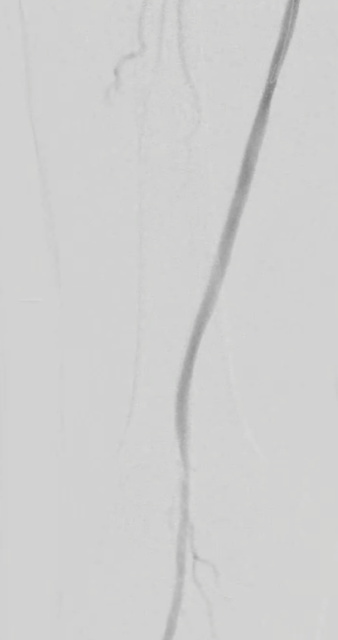
Despite the extensive occlusion, successful antegrade crossing was achieved without a prolonged wire-escalation strategy or the need for alternative crossing or re-entry techniques. After Santreva-ATK crossing, treatment could proceed directly to balloon-based vessel preparation and drug delivery, with stent implantation limited to a focal distal segment requiring bailout scaffolding.
Discussion
The present case illustrates an important challenge in the endovascular treatment of long and complex femoropopliteal CTOs: achieving successful lesion crossing is not only a prerequisite for revascularization but can also represent one of the most time- and resource-consuming components of the procedure. This becomes particularly relevant in long, calcified, or otherwise resistant CTOs, in which conventional guidewire escalation may require multiple wires, support catheters, crossing devices, alternative access strategies, or re-entry systems before the distal true lumen is successfully reached.
The Santreva-ATK catheter offers a potentially different approach to this procedural challenge. Its mechanism of atheroplasty is intended not only to traverse the occlusion but also to create a channel through simultaneous plaque displacement and compression, while staying predominantly intraplaque. Thus, crossing and initial lesion preparation, which are traditionally considered separate procedural steps, may partly be combined, and the probability of deploying a “leave nothing behind” strategy as definitive therapy increases.
The Santreva-ATK concept is supported by RESTOR-1, in which the primary endpoint was achieved independent of degree of calcification and CTO length, and IVUS demonstrated exclusively intraplaque crossing in 80% of evaluable cases.4
Our case demonstrates the practical implications of this concept. The ability to establish a controlled pathway through a complex CTO without prolonged guidewire escalation can potentially simplify the crossing phase and create an angiographically visible channel in the process, thereby allowing the interventionist to proceed more rapidly to definitive treatment. Particularly in lengthy occlusions, avoiding repeated exchanges between different CTO wires and support catheters may translate into fewer procedural steps and fewer periprocedural adverse events. Furthermore, successful antegrade intraplaque traversal may reduce the need for more complex bailout strategies, such as retrograde access or dedicated re-entry devices.
An additional potential advantage is that Santreva-ATK does not simply cross the lesion. Following passage through the CTO, the device creates an angiographically visible channel by mechanical radial plaque compression. In RESTOR-1, Santreva-ATK passage resulted in a mean lumen diameter of 2.87 ± 0.74 mm, corresponding to approximately 59% luminal gain relative to the reference vessel diameter.4 This observation is relevant because conventional CTO crossing typically leaves only a guidewire pathway and requires subsequent vessel preparation before definitive treatment. The ability to simultaneously cross and modify the lesion may therefore reduce procedural complexity and potentially the amount of additional higher-energy vessel preparation required.
These procedural considerations also have potential economic implications. Complex peripheral interventions generate costs not only through the definitive treatment device but through the cumulative use of guidewires, microcatheters, support catheters, crossing devices, re-entry systems, balloons, and additional vascular access equipment. A strategy that achieves predictable CTO crossing with fewer device exchanges could therefore reduce disposable material utilization. Shorter crossing times may additionally reduce catheter laboratory occupancy, fluoroscopy exposure, contrast utilization, and staff time and may improve laboratory throughput.
The economic argument, however, should not be reduced to the acquisition cost of an individual crossing device. A more appropriate assessment is the total procedural cost of achieving successful revascularization. A dedicated device may appear more expensive than an individual CTO guidewire, but this comparison becomes less meaningful when a difficult CTO requires multiple wires, support devices, prolonged procedural time, and potentially bailout crossing or re-entry technologies.
Future studies should therefore incorporate health-economic endpoints, including crossing time, number and cost of adjunctive devices, fluoroscopy and procedure duration, contrast consumption, bailout device utilization, and overall catheter laboratory costs.
Nevertheless, our experience suggests that the value of Santreva-ATK in complex femoropopliteal CTOs may extend beyond crossing success alone. By combining controlled intraplaque crossing with simultaneous plaque modification, the technology has the potential to simplify the procedural workflow, reduce device utilization, and shorten the pathway from initial CTO engagement to successful definitive revascularization. Particularly in long and calcified lesions, this combination of procedural predictability, efficiency, and potential resource savings may represent an important advantage of the atheroplasty concept. n
Affiliations and Disclosures
Michael Lichtenberg, MD and Stefan Stahlhoff, MD, are from the Arnsberg Vascular Center, Arnsberg, Germany.
Dr Lichtenberg has received consulting fees and honoraria from AngioSafe; Dr Stahlhoff reports no financial relationships or conflicts of interest regarding the content herein.
Manuscript accepted August 13, 2026.
Address for correspondence: Michael Lichtenberg, MD, Arnsberg Vascular Center, Stolte Ley 5, 59759, Arnsberg, Germany. Email: klichte@gmx.net
References
1. Korosoglou G, Schmidt A, Lichtenberg M, et al. Global algorithm for the endovascular treatment of chronic femoropopliteal lesions: an interdisciplinary expert opinion statement. JACC Cardiovasc Interv. 2025;18(5):545-557. doi:10.1016/j.jcin.2024.11.038
2. Roy T, Liu G, Shaikh N, Dueck AD, Wright GA. Puncturing plaques. J Endovasc Ther. 2017;24(1):35-46. doi:10.1177/1526602816671135
3. Korosoglou G, Schmidt A, Lichtenberg M, et al. Crossing algorithm for infrainguinal chronic total occlusions: an interdisciplinary expert opinion statement. JACC Cardiovasc Interv. 2023;16(3):317-331. doi:10.1016/j.jcin.2022.11.036
4. Banerjee S, Metzger C, Thatipelli M, et al. Safety and effectiveness of the Santreva™-ATK Endovascular Revascularization Catheter in the RESTOR-1 Peripheral CTO Crossing Pivotal Study. Am J Cardiol. 2026;263:33-42. doi:10.1016/j.amjcard.2026.01.007
5. Krishnan P, Tarricone A, Ali Z, et al. Intravascular ultrasound is an effective tool for predicting histopathology-confirmed evidence of adventitial injury following directional atherectomy for the treatment of peripheral artery disease. J Endovasc Ther. 2016;23(4):672-673. doi:10.1177/1526602816647364
6. Tarricone A, Ali Z, Rajamanickam A, et al. Histopathological evidence of adventitial or medial injury is a strong predictor of restenosis during directional atherectomy for peripheral artery disease. J Endovasc Ther. 2015;22(5):712-715. doi:10.1177/1526602815597683