








Tumor Ablation Review Maps Next Phase of Cancer Care
Key Summary
- A June 2026 green paper by the EU Joint Action Networks of Expertise on Cancer (JANE-2) examines expanding applications for radiofrequency ablation, microwave ablation, cryoablation, irreversible electroporation, and electrochemotherapy.
- The authors report that tumor ablation is increasingly used for selected small tumors, oligometastatic disease, oligoprogression, and symptom relief.
- AI, robotics, systemic therapy combinations, and targeted drug delivery are shaping future ablation strategies, but implementation barriers to broad clinical adoption still remain.
Introduction
Advances in technology are expanding the role of tumor ablation across the cancer care continuum, according to a new European review published on June 26, 2026, in Radiology and Oncology. Authored by Gehl and colleagues, the EU Joint Action Networks of Expertise on Cancer (JANE-2) green paper examines emerging applications and strategies for integrating physical tumor ablation methods into oncology care.1
The JANE-2 Project
The goal of the JANE-2 project is to establish networks in the European Union through which experts can share best oncological practices and expand access to advanced treatments. The project comprises 7 domains, one of which is dedicated specifically to physical tumor ablation. This domain encompasses both thermal and nonthermal ablation techniques and seeks to influence European clinical practice guidelines, as well as support technology adoption, medical education, and visibility to patients and the public.
Review Summary
The authors evaluated several established and emerging ablative approaches, including radiofrequency ablation (RFA), microwave ablation, cryoablation, irreversible electroporation, and electrochemotherapy. These techniques offer less-invasive, targeted approaches that can be applied across different cancer histologies.
The review identifies several roles for ablation in contemporary cancer care. Ablation may even be curative in selected patients with small primary or secondary tumors, including some liver tumors, and plays a key role in treating oligometastatic disease and oligoprogression. It can also be used to relieve tumor-related symptoms that impair quality of life.
The authors particularly emphasize emerging technologies and treatment combinations. These include artificial intelligence (AI)-driven personalization, robotic assistance to improve procedural precision, and hybrid strategies combining ablation with systemic therapy, immunotherapy, or targeted drug delivery.
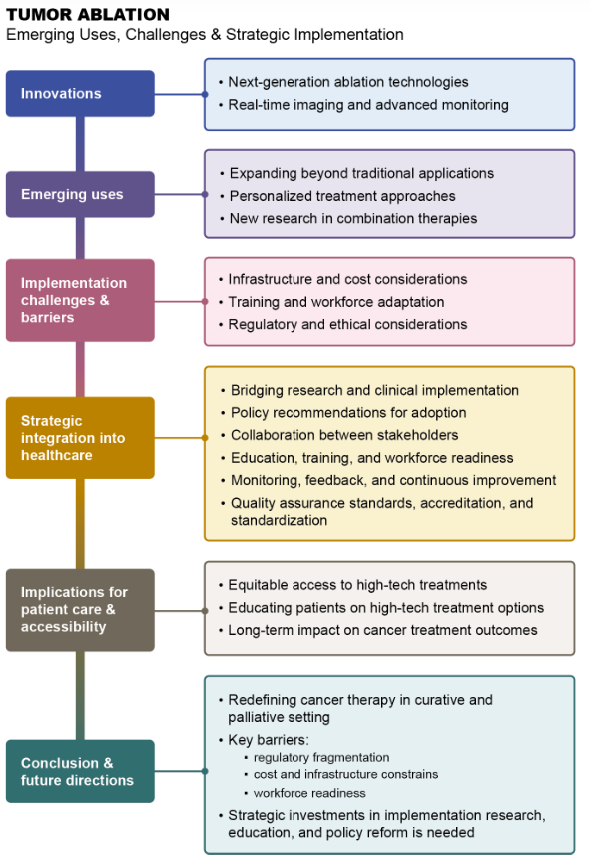
However, they acknowledge that technological capability alone will not determine adoption. The review identifies infrastructure, education, regulation, ethics, equity, and patient trust among the issues that must be addressed as advanced ablation therapies become more widely incorporated into healthcare systems (Figure).
Clinical Implications
Multidisciplinary team (MDT) involvement
The review positions tumor ablation as more than a collection of isolated procedures. The authors describe MDTs as “a fixture in modern cancer care,” and underscore the incorporation of knowledge of ablative treatments into MDT decision-making to support more personalized cancer care.
Technological innovations
Technological advances in applicator design, energy control, predication, guidance, and monitoring are making tumor ablation more precise and adaptable. AI has allowed clinicians to tailor energy delivery in real-time based on tissue response, and machine learning models are improving the safety and efficacy of ablation procedures with simulations and predicative abilities.
Robotics have demonstrated the potential to improve applicator placement and procedural consistency, particularly for difficult-to-target tumors, such as in the liver. Advanced imaging techniques—including CT with image fusion (which is becoming the standard approach for ablation zone confirmation), MRI with real-time thermometry, contrast-enhanced ultrasound, and PET-CT—are also improving tumor targeting, treatment monitoring, and assessment of residual disease.
Emerging applications
RFA, MWA, and cryoablation are expanding beyond their traditional use in nonsurgical candidates and are increasingly being investigated as first-line treatments for selected early-stage tumors and as local therapy for recurrent or oligometastatic disease. Advances in precision medicine involving AI, radiomics, and multi-omics may further improve patient selection, treatment planning, and prediction of recurrence or response.
Researchers are also investigating combinations of thermal and nonthermal ablation with immunotherapies, including immune checkpoint inhibitors which have been shown to amplify systemic anti-tumor immune responses. Additionally, ablation devices can be used to deliver chemotherapeutic drugs, cytokines, or nanoparticles directly to tumors.
Obstacles to implementation
Widespread adoption of high-tech tumor ablation across Europe remains limited by upfront infrastructure costs, inconsistent reimbursement policies, and unequal access to specialized equipment and personnel. Expanded training, multidisciplinary education, and standardized international guidelines will be needed as clinicians increasingly incorporate advanced imaging and AI into ablation procedures.
The authors also emphasize the need for cost-effectiveness research and cohesive reimbursement strategies, as well as the possibility of centralized competence centers and mobile facilities to reduce disparities in access. Finally, evolving AI and robotic technologies introduce regulatory and ethical concerns—including transparency, bias, accountability, and patient safety—that will require thorough validation and coordinated oversight.
Integration pathways
Integrating high-tech ablation into routine cancer care will require structured pathways that connect research with clinical implementation, supported by academic-industry partnerships, centers of excellence, and adaptive clinical trials. The authors also highlight the importance of collaboration between healthcare-system stakeholders, who can help balance clinical and economic value with social needs—examples given are interdisciplinary advisory tumor boards, public-private partnerships, professional societies, and patients and their caregivers.
Disparities and accessibility
High-tech ablation therapies have the potential to improve cancer care but could also widen disparities if strategies are not put in place to expand access and affordability. Patient education, shared decision-making, and digital literacy will be important to ensure patients understand their options and can participate effectively in treatments that are being increasingly fueled by technology.
Conclusions
Recent technological advancements have the potential to significantly expand the application and capabilities of tumor ablation. However, wide implementation is contingent on overcoming regulatory, infrastructure, and reimbursement obstacles, for which multidisciplinary collaboration will be essential.
Additionally, although early evidence suggests possible benefits of ablation for local tumor control and reduced treatment burden, additional prospective studies, registries, and real-world data are needed to establish long-term clinical and economic outcomes and refine personalized treatment strategies.
Reference
- Gehl J, Pereira PL, Cantwell CP, et al. Tumor ablation: emerging uses, challenges, and strategic implementation. A green paper by the Network of Expertise in Cancer (JANE-2), High Tech Medical Resources, network on Physical Methods of Tumor Ablation. Radiol Oncol. 2026;60(2):153-165. doi:10.2478/raon-2026-0030




