Survey: Clinicians Describe How CTP Utilization Is Changing in Practice
Key Takeaways
- Reduced utilization, cost-conscious product selection, and increased documentation are the most reported changes.
- Clinicians are adopting more cautious approaches, including delayed initiation and tighter patient selection.
- Changes are often multifactorial, reflecting the combined impact of reimbursement, compliance, and operational pressures.
As regulatory and reimbursement pressures continue to shape the use of skin substitutes (CTPs), clinicians are not only reporting via a recent survey that their behavior has changed—they are also providing insight into how those changes are playing out in real-world practice.
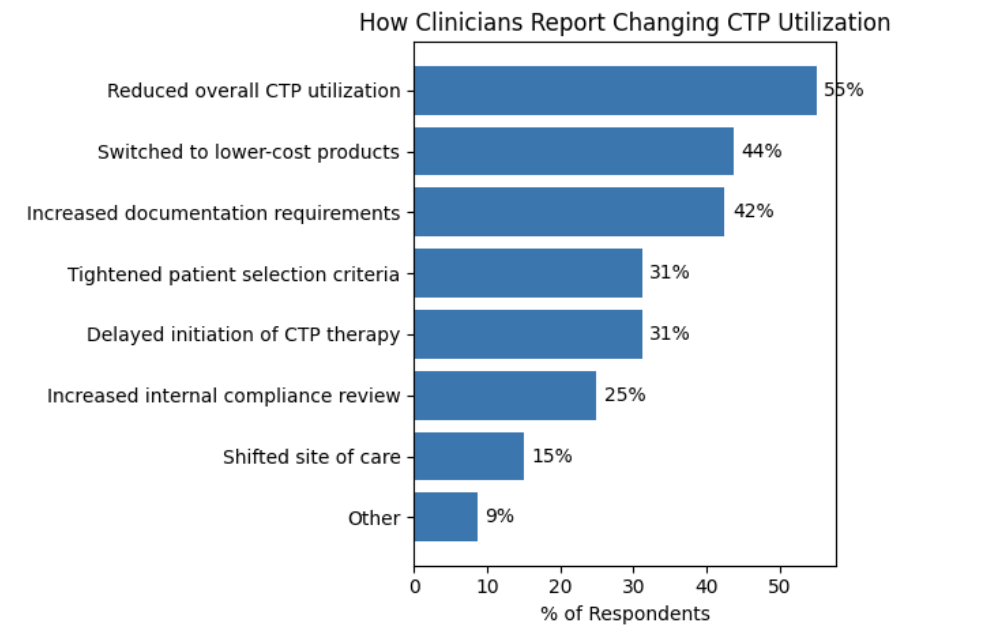
In this survey of 80 respondents conducted around the SAWC Spring meeting, clinicians who reported shifts in CTP utilization were asked to identify specific ways their approach has evolved. Responses suggest that changes are both operational and clinical, with many clinicians adjusting multiple aspects of care simultaneously.
Reduced Utilization and Cost-Conscious Decision-Making Lead Reported Changes
Among the most frequently selected responses, reducing overall CTP utilization emerged as the leading adjustment, reported by more than half of respondents who indicated a change.
Closely following this trend was a shift toward lower-cost products, highlighting the growing influence of financial considerations in treatment selection. This pattern suggests that cost management—whether driven by reimbursement constraints, coverage policies, or institutional pressures—is playing a central role in clinical decision-making.
At the same time, many clinicians reported increased documentation requirements, reinforcing the administrative component of these changes. Together, these responses point to a dual shift: not only what products are being used, but also how their use is being justified and recorded.
Delays and Tighter Selection Reflect More Cautious Use
Beyond cost and documentation, a notable portion of respondents indicated changes that may directly affect the timing and eligibility of care.
Approximately one-third of clinicians reported delaying initiation of CTP therapy, while a similar proportion described tightening patient selection criteria. These adjustments suggest a more cautious or selective approach, potentially influenced by coverage limitations, prior authorization requirements, or internal compliance considerations.
While these strategies may support alignment with current policy expectations, they also introduce additional decision points into the care pathway—potentially impacting how quickly patients receive advanced therapies.
Compliance and Oversight Are Increasing
A smaller but still meaningful segment of respondents reported increased internal compliance review, reflecting heightened scrutiny at the practice or organizational level.
This aligns with broader survey findings pointing to administrative burden as a key concern. Rather than isolated documentation changes, these responses suggest a more systemic shift toward oversight, with practices implementing additional layers of review to ensure alignment with evolving policies.
Site-of-Care Shifts Remain Limited
Compared to other changes, relatively few respondents reported shifting the site of care (e.g., between hospital outpatient and office settings). While site-of-care dynamics are often discussed in the context of reimbursement, this finding suggests that, at least within this cohort, changes in how and when CTPs are used may be more prominent than changes in where they are delivered.
A Multifactorial Shift in Practice
Importantly, many respondents selected multiple changes, reinforcing that these adjustments are rarely isolated. Instead, clinicians appear to be navigating a multifactorial shift, balancing cost pressures, documentation demands, compliance considerations, and clinical judgment.
This layered response reflects the complexity of the current environment. Changes in utilization are not occurring in a vacuum—they are interconnected, with decisions in one area (e.g., reimbursement) influencing behavior across others (e.g., product selection, timing of care).
A Directional View of Practice Adaptation
While this survey represents a snapshot in time, the consistency across responses offers a directional view of how clinicians are adapting to a changing policy landscape.
From reduced utilization and increased cost sensitivity to tighter patient selection and expanded documentation, the reported changes suggest a practice environment that is becoming more structured, more scrutinized, and, in many cases, more constrained.
As regulatory and reimbursement frameworks continue to evolve, these patterns may provide an early indication of how policy shifts are translating into day-to-day clinical decision-making.
© 2026 HMP Global. All Rights Reserved.
All information regarding reimbursement, legislation, regulations, policy, and legal proceedings, is provided as a service to our audience. Commercially reasonable efforts have been made to ensure the accuracy of the information within this resource but HMP Global, their employees, their affiliates, contributors, commenters, and reviewers do not represent, guarantee, or warranty that any information provided within this resource is error-free. HMP Global, their employees, their affiliates, contributors, and reviewers disclaim all liability attributable to the use of any information, guidance, or advice contained in this resource. The responsibility for verifying information accuracy for individual use and in individual circumstances lies solely with the audience member. The information in this resource is also not a substitute for legal, medical, or business advice, and is for educational purposes only. Any views and opinions expressed are those of the author(s) and/or participants and do not necessarily reflect the views, policy, or position of Wounds or HMP Global, their employees, and affiliates.