Clinicians Describe the Impact of Current CTP Policy: Access and Financial Pressure Lead Concerns
Key Takeaways
- Patient access and financial pressure are clinicians’ top concerns. Many clinicians reported that current CTP policies are making it harder for patients to receive timely treatment while simultaneously increasing financial strain on practices, particularly around reimbursement and product utilization decisions.
- Administrative burden continues to grow without clear clinical benefit. Many respondents described significant increases in documentation requirements and payer-related administrative tasks, with several questioning whether the added workload is improving patient outcomes or care delivery.
- Clinicians see mixed value in increased oversight. Although a smaller group of respondents felt the current environment may encourage more appropriate utilization, even supportive comments were often paired with concerns about implementation challenges and unintended consequences for patient care and practice operations.
As part of ongoing details from an April 2026 HMP survey on skin substitutes, clinicians were asked how they perceive the current regulatory and reimbursement environment. Responses point to a landscape shaped primarily by concerns around patient access and financial pressure, alongside continued administrative complexity.
Access and Financial Pressure Emerge as Leading Concerns
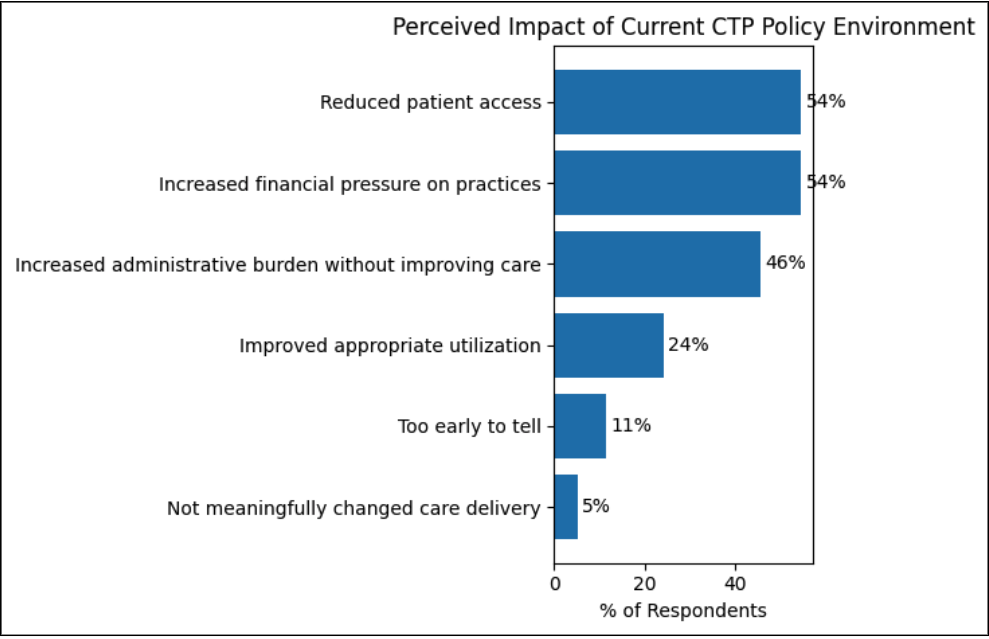
Among the most frequently reported impacts, clinicians pointed to both reduced patient access and increased financial pressure on practices, each cited by more than half of respondents.
These findings suggest that, from the clinician perspective, current policies may be influencing not only operational workflows, but also the ability to deliver care.
As one respondent noted, “restrictions are making it harder for some patients to receive treatment in a timely manner.” Another highlighted the financial dimension, stating that “reimbursement changes are making it harder to justify certain products, even when clinically appropriate.”
Together, these responses reinforce the interconnected nature of access and reimbursement in shaping real-world utilization.
Administrative Burden Remains a Significant Factor
In addition to access and financial pressures, nearly half of respondents reported increased administrative burden without a corresponding improvement in care.
Clinicians described growing documentation requirements and ongoing challenges navigating payer expectations. One respondent noted that “the amount of documentation required has increased significantly, but it hasn’t changed outcomes,” reflecting a broader concern that administrative demands may not be translating into improved care delivery.
These findings align with earlier survey responses, where increased documentation requirements were among the most reported changes in practice behavior.
Mixed Views on Policy Effectiveness
While concerns dominated, a subset of clinicians indicated that the current environment may support more appropriate utilization, suggesting that increased oversight could have some intended effects.
However, this perspective was less commonly reported and often tempered by concerns about implementation.
One respondent described policies as “well-intentioned,” but noted that they can create unintended challenges in practice.
A Minority See Limited or Unclear Impact
Smaller segments of respondents indicated that the current environment has either not meaningfully changed care delivery or that it is too early to determine its full impact.
These responses highlight a degree of variability in how clinicians are experiencing policy changes, depending on practice setting, patient population, and payer mix.
A Snapshot of Clinician Perception
Overall, the findings suggest that clinicians are experiencing the current CTP policy environment as financially and operationally impactful, with particular concern around maintaining patient access.
While some see potential benefits in improving utilization, the dominant perspective reflects the day-to-day challenges of navigating evolving requirements.
As with other findings from this survey, these results offer a directional view of clinician sentiment during a period of ongoing change in the CTP landscape.
© 2026 HMP Global. All Rights Reserved.
All information regarding reimbursement, legislation, regulations, policy, and legal proceedings, is provided as a service to our audience. Commercially reasonable efforts have been made to ensure the accuracy of the information within this resource but HMP Global, their employees, their affiliates, contributors, commenters, and reviewers do not represent, guarantee, or warranty that any information provided within this resource is error-free. HMP Global, their employees, their affiliates, contributors, and reviewers disclaim all liability attributable to the use of any information, guidance, or advice contained in this resource. The responsibility for verifying information accuracy for individual use and in individual circumstances lies solely with the audience member. The information in this resource is also not a substitute for legal, medical, or business advice, and is for educational purposes only. Any views and opinions expressed are those of the author(s) and/or participants and do not necessarily reflect the views, policy, or position of Wounds or HMP Global, their employees, and affiliates.