Email Newsletter Alert – Coronary Physiology in One Place: Key Reads, Consensus Updates, and What to Watch Next
© 2026 HMP Global. All Rights Reserved.
Any views and opinions expressed are those of the author(s) and/or participants and do not necessarily reflect the views, policy, or position of Cath Lab Digest or HMP Global, their employees, and affiliates.
 Link to a PDF version of this article.
Between new indices, evolving microvascular science, and a steady stream of CT- and angiography-derived tools, the evidence base for coronary physiology moves quickly. Much of it surfaces first in meeting halls and early online publications rather than in a single location.
That challenge is what this curated email newsletter is designed to solve. Created by Mona Tirén of Tirén Technology, Coronary Physiology News is a quick, easy-to-read roundup that includes “top picks” from recent publications, additional papers organized by theme, what to watch for at upcoming conferences, and resources for slide presentations and recordings.
Below are just a few highlights from the most recent edition of the email newsletter in April 2026, focused on interventional cardiologists who want to maintain awareness of the most relevant developments in coronary physiology.
Physicians can sign up for free, quarterly delivery of Coronary Physiology News from Mona Tirén of Tirén Technology at CoronaryFlow@gmail.com.
 CORONARY PHYSIOLOGY:
News & resources that might be of some help. Congratulations to all contributors.
CONTENTS:
-
PUBLICATIONS
-
Top Picks
-
FAME III HE & QALY
-
DECIDE registry CCTA
-
Expert Consensus: Angio-Derived Coronary Physiology
-
-
More publication highlights
-

1. Hlatky MA, et al.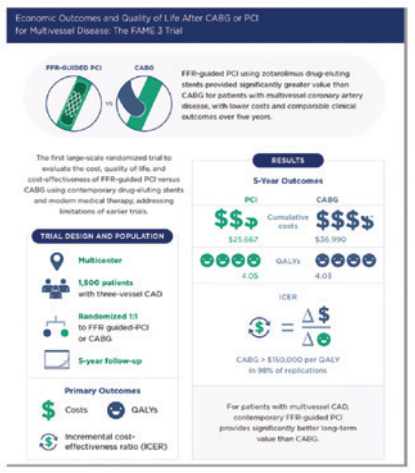
Economic Outcomes and Quality of Life After CABG or PCI for Multivessel Disease: The FAME 3 Trial
J Am Coll Cardiol. 2026 Apr 28;87(16):2147-2159.
EDITORIAL (Authors: Mark DB and Rao SV).
This study sought to compare the economic and quality of life outcomes of CABG vs PCI and determine their cost-effectiveness in the FAME (Fractional Flow Reserve vs Angiography for Multivessel Evaluation) 3 randomized trial.
2. Rinehart S, et al; DECIDE Investigators.
Guiding Preventive Care Strategies for Patients With Atherosclerotic Plaque on Coronary CTA: Primary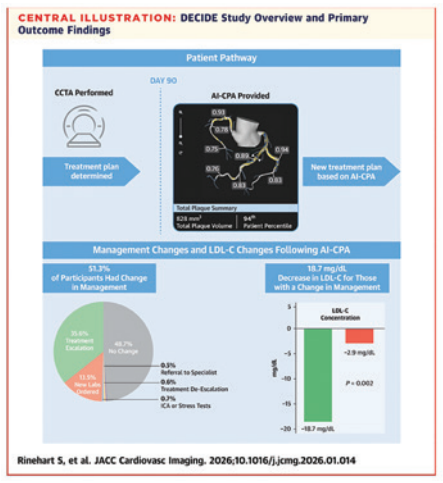 Outcomes of the DECIDE Registry
JACC Cardiovasc Imaging. 2026 Mar 11:S1936-878X(26)00087-2
EDITORIAL (Authors: Nerlekar N and Lin A).
This study sought to define changes in management guided by AI-CPA as compared with management guided by measures of nonobstructive and obstructive stenosis on coronary computed tomographic angiography (CTA) alone.
3. Shlofmitz E,et al.
Angiography-Derived Physiology for Coronary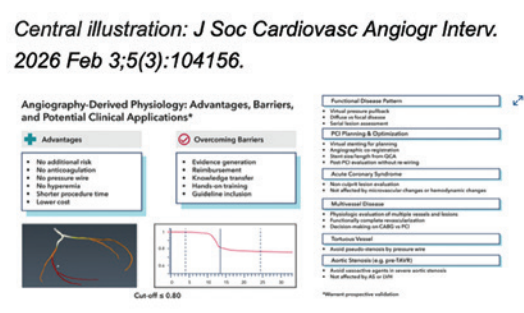 Artery Disease Assessment: Expert Opinion From a SCAI Roundtable
J Soc Cardiovasc Angiogr Interv. 2026 Feb 3;5(3):104156.
This document represents expert opinion from a scientific roundtable on angiography-derived physiology (ADP) for coronary artery assessment sponsored by the Society for Cardiovascular Angiography and Interventions. It provides a comprehensive overview of the underlying concepts of ADP, outlines its optimal clinical application based on current evidence, highlights key advantages and limitations, reviews available software solutions, and discusses future directions.

TOOLS & TECHNIQUE
Fezzi S, et al.
Predicting Functional Results of Percutaneous Coronary Intervention Using Machine Learning Modelling
Int J Cardiol. 2026 Apr 15;449:134183.
EDITORIAL (Author: Šarenac D)
Jamileh E, et al.
Comparative Outcomes of Fractional Flow Reserve and Intravascular Ultrasound Guidance for Percutaneous Coronary Intervention in Intermediate Lesions: A Systematic Review and Meta-Analysis
Cardiovascular Therapeutics, 2026; 2026:6570642
Patel S, et al.
Fractional Flow Reserve Versus Intravascular Ultrasound Guidance for Percutaneous Coronary Intervention in Intermediate Coronary Stenoses: A Systematic Review and Meta-Analysis
Precision Medical Sciences. 2026;1–11.
CONTROVERSIES
Ahmed-Jushuf F, et al.
Determining the Physiological Threshold for Angina (ORBITA-FIRE): A Double-Blind, Randomized, Placebo-Controlled Study
Circulation May 8, 2026.
Weerts V, et al.
Vessel-Specific Differences in Fractional Flow Reserve Among Intermediate Coronary Lesions
J Clin Med. 2026; 15(9): 3465
UTILIZATION TRENDS
Carvalho PEP, et al.
Contemporary Coronary Physiology Practice: An International Survey of Interventional Cardiologists
Cardiovasc Revasc Med. 2026 Mar 29:S1553-8389(26)00056-4.
POST PCI
Lee SY, et al.
Relative Fractional Flow Reserve Increase and Final Fractional Flow Reserve After Percutaneous Coronary Intervention
JACC Cardiovasc Interv. 2026 Apr 27;19(8):976-987. doi: 10.1016/j.jcin.2026.02.020. PMID: 42055659.
EDITORIAL (Authors: Uretsky BF and Hakeem A)
ANGIOGRAPHY-DERIVED CORONARY PHYSIOLOGY
Shen X, et al.
Post-PCI Global QFR and Long-Term Outcomes in ACS: Findings From the FAVOR III China Trial
JACC Cardiovasc Interv. 2026 Apr 13;19(7): 889-901
EDITORIAL (Author: Narins CR)
NONINVASIVE / CCTA
Fazzari F, et al.
Deep Learning and Fluid Dynamics On-Site CT-FFR Solution Compared to Off-Site FFRct and Invasive FFR
JACC Cardiovasc Imaging. 2026 Apr;19(4): 494-512.
EDITORIAL (Authors: van Assen M; Young J)
MICROCIRCULATION
Mahendiran T, et al.
Coronary autoregulation: the complex interplay between epicardial and microvascular resistance
Eur Heart J. 2026 Mar 28:ehag145.
Chiew K, et al.
Focal and Diffuse Coronary Artery Disease Patterns and Placebo-Controlled Angina Relief With Percutaneous Coronary Intervention: ORBITA-2
J Am Coll Cardiol. 2026 Apr 22:S0735-1097(26)05732-3.
Physicians can sign up for free, quarterly delivery of Coronary Physiology News from Mona Tirén of Tirén Technology at CoronaryFlow@gmail.com.