4 Ways to Maximize Learning in Your Scenarios
It’s 2 a.m. and, medically speaking, this call is as straightforward as it is urgent. The call notes read “36-year-old female, tongue swelling.” You arrive and find that this is completely accurate. Furthermore, the rash on her face is clawing its way down her neck, too. Her speech is slurred and she starts to rub her throat while she grunts intermittently.
“Give her the epi shot right away,” you tell your team. Someone puts a nonrebreather on her face without needing specific direction while you establish a line, which you should not have had time to finish before she received her epinephrine.
You look over to see how the IM injection is coming along. Clara is relatively new to the service, with less than six months of experience. She’s typically capable and effective. But right now the panic on her face is reflected in the patient’s. You realize the problem immediately: she hasn’t removed the plastic cover from the epinephrine vial. She’s trying to shove a needle through a piece of plastic, instead of the membrane beneath it that’s intended for that exact purpose. And she’s stuck on this one task, unable to pivot and address the problem.
You take the vial from her, remove the plastic cap, and hold your hand out. Your most experienced partner hands you a new needle. You inject her in the deltoid. Her tongue shrinks back down almost instantly; the immediate crisis is over.
How could this have happened? IM epinephrine injection is a crucial lifesaving BLS skill. Your shift is always practicing with any old oranges they can come by. Clara is smart and tends to have her procedures down cold.
The answer comes to you: You always practice this skill with old epinephrine vials, which don’t have the lid on them anymore. In this high-stress moment, she sank back to her muscle memory, which led her astray. She never practiced flipping the lid off first, so when it really mattered, she forgot to do it at all.
How can you make sure your training is close enough to real life to count, especially if you work at a department that can’t afford to use equipment and medication that can be used on patients for training instead?
Here are four completely free ways to make your scenarios as effective for training as possible:
1. Make the equipment as similar to the real thing as you can.
Ideally, you can use expired and unopened equipment for all of your trainings. Certainly, make a practice of saving expired equipment for this precise purpose. However, reality will often prevent you from having everything you need to make a perfect mock-up of your actual kits.
Get as close as you can with what you have. This applies to even the smallest of details. Tape things back into their packaging so that the trainee needs to rip open packaging, especially for practice AED pads and oxygen delivery devices. Glue lids back onto vials so that your rookies have to pop the lid off to draw up the drug. If your epinephrine comes in a check and inject kit, make something with as close a layout as you can. In lieu of a living human recipient of the injection, put moleskin over old fruit. This gives tactile feedback that’s much closer to giving an injection.
Most of these steps would only require tape and glue, and maybe plastic baggies to act as packaging. These are all things that you probably have at your quarters, if not on your rig. You’ll be surprised by how much more authentic these simple steps can make your scenarios.
2. Use sound effects.
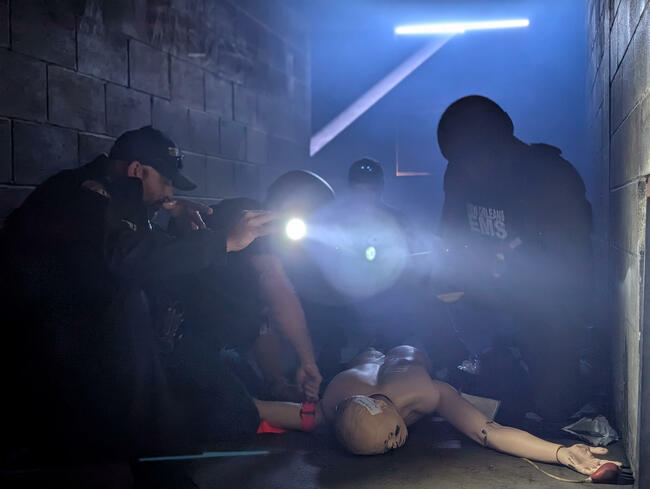
Don’t ever tell the person you’re testing with this scenario what something sounds like. You can find any sound you need on the internet and simply play it as prompted. It is a much more valuable learning experience for you to play a rales sound effect for the trainee and have them identify it than to simply say “you hear rales in the lower lobes.”
If you have a training AED that makes AED noises, use that. If you don’t, however, the AED charging noise for whatever type of machine your department could possibly carry is also available for free online. Play that in scenarios. Don’t put someone in the position of hearing the charging noise for the first time on their first code.
Finally, for one of my favorites, play the sound of oxygen running whenever they put oxygen on a patient in a scenario. Then, for extra learning, at some point turn off the sound. Wait two minutes and then tell them their patient is desaturating now.
This will help newbies learn that a critical breathing call absolutely can be too quiet. Oxygen tanks often make it down to empty before anyone notices, especially on sick patient calls. The more team members who have been taught to notice that the sound is gone now, the more promptly your group will notice this dire but solvable development.
3. Allow for second chances.
Let’s say the scenario is a standard narcotics overdose. The new EMT you’re teaching frantically assembles a Narcan preload with a mucosal atomizer—while failing to provide oxygen to this individual who is obviously not providing it for themselves.
Stop them. The mistake that’s being made is critical. Try to prompt them to arrive at the answer themselves to train critical problem solving. Ask leading questions: What is this person's main problem? How do narcotics overdoses actually kill? Hypoxia, that’s right. So, while you were right to go to Narcan since it was clearly indicated, what did you forget to do?
Then, don’t move on to the next scenario. Repeat the one you just did, exactly the way it was the first time.
The entire point of simulations is that they’re not real life. Real calls can’t be rewound and reattempted, but this can. Start completely over.
This provides several benefits. You’re letting this provider increase their confidence. In the event they did so poorly in their initial job you’re struggling to come up with a success you can point out, this gives you the power to honestly say “Great recovery. You listened to the feedback, absorbed it, adapted, and came back and did a great job.”
And that will actually be true because you provided the opportunity for that to happen.
It also lets someone practice performing well. Practicing flailing on a call, when it’s obvious that pivoting and recovering is beyond this particular provider, provides neither education nor training.
4. When you’re about to give feedback, ask yourself one crucial question:
Did this provider do something that was objectively wrong? Or is it just a little different than what you’d do?
If the trainee was rude to the person playing the patient, took a dangerous or not indicated intervention, or failed to take a life-preserving step that was clearly indicated, then that’s a true issue. If they tried to give an adult patient a 2 mg epinephrine injection or forgot to listen to lung sounds on a stab victim, then there is a genuine problem. This provider needs gentle correction as well as an explanation of why you’re asking them to do it differently, and then, as previously mentioned, another shot at the same scenario.
However, many EMS educators spend an amazing amount of time and energy trying to make someone do precisely what they would have done in that situation. This is problematic for multiple reasons. First, if every educator at your department is doing this, new providers will receive conflicting messages. Second, you’re not allowing them to develop their own style and judgement. EMS is a team sport. It brings me immense comfort to know that, especially on critical calls, we have so many distinct team members that can notice something subtle but critical or prevent a crucial mistake before it even happens.
This brings different perspectives—particularly ones you may not have considered at all, as well as a greater accountability. If you somehow succeed to create a provider who is just like you, you have deprived yourself of that unique perspective and opinion on some unknown day in the future when a human life hangs in the balance.
Third, and finally, even if you’re the final word on how medical calls are going to go, you’re overloading them. New providers have so much they’re trying to remember. Let them prioritize things that save lives. Don’t try and force them to memorize your personal preferences, too.