Answering the Call: Claiborne County Firefighters Complete Emergency Medical Responder Training
Editor’s Note: This article is a companion to the recent series on EMS training from John Dabbs. Read part 1 of that series.
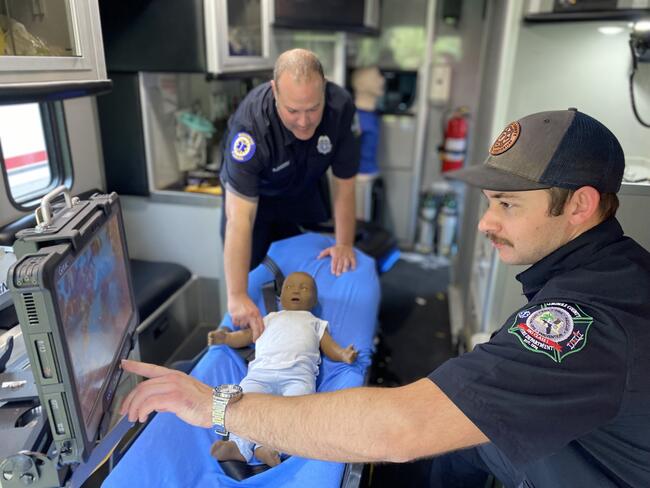
Members of the Tazewell-New Tazewell Fire Rescue and North Tazewell Fire Department recently completed an Emergency Medical Responder (EMR) course in Claiborne County, Tennessee, marking an important investment in the knowledge, skills, and capabilities of the responders, many who are volunteers that serve their communities.
While neither department is currently equipped or committed to participating in a formal medical first-response program within Claiborne County, the completion of the EMR course represents an important first step, and one that could have a meaningful impact long before any formal program is established.
The training was made possible through a collaborative effort between Claiborne EMS, local fire services, and Walters State Community College’s Claiborne County Campus. What began as an idea to provide additional training opportunities for local first responders ultimately became an example of what can be accomplished when organizations work together toward a common goal: improving emergency services for the residents and visitors of Claiborne County.
Recognizing a Need
After assuming his new role as Manager of Claiborne EMS, Jason Fox quickly encountered challenges familiar to EMS leaders across Tennessee and throughout the country: recruitment, retention, and the ability to provide timely responses with limited resources.
Those challenges are not unique to Claiborne County. EMS agencies everywhere continue to look for innovative ways to recruit qualified personnel, retain experienced providers, and ensure adequate resources are available when emergencies occur.
For Fox, however, the issue was not viewed solely through the lens of an EMS administrator. His experiences as both a paramedic and EMS educator provided another perspective.
As a provider, Fox understood that an ambulance crew frequently needs additional help at the scene of an emergency. A serious motor vehicle crash, cardiac arrest, difficult patient movement, mass-casualty incident, or other complex call can quickly require more hands than a single ambulance crew can provide.
Sending another ambulance may sound like the obvious solution, but in a rural EMS system, another ambulance may be miles away, committed to another emergency, or needed to maintain coverage elsewhere in the county.
The question became: How can Claiborne County develop additional trained resources without taking another ambulance out of service?
Part of the answer may already exist within the county’s volunteer fire departments.
A Servant’s Heart
As an EMS educator, Fox knew that the EMR curriculum could provide firefighters and other community responders with a foundation in emergency medical care. The educational material could be taught, skills could be practiced, and competencies could be evaluated.
Teaching the medicine, however, was only one part of the equation.
Finding the right people is often the greater challenge.
“You can teach someone the skills,” Fox said. “We can teach CPR. We can teach bleeding control. We can teach someone how to assess a patient and provide basic emergency care. What is much harder to teach is a servant’s heart, the willingness to get up in the middle of the night, leave your family, and help someone you may not even know.”
For Fox, the natural place to find those individuals was among Claiborne County’s volunteer firefighters.
Volunteer responders already demonstrate that commitment every time their pager or radio activates. They respond during nights, weekends, holidays, bad weather, and inconvenient moments, not because it is their job, but because someone in their community needs help.
That spirit of service made expanding access to EMR education a natural fit.
Removing the Financial Barrier
Recognizing the potential benefit, Fox began working to determine whether Claiborne EMS could make the EMR course affordable for interested volunteers.
The goal was simple: remove as many barriers to participation as possible.
Claiborne EMS agreed to provide the educational component of the program without charging tuition for its instruction. Under the arrangement, students or their respective departments were responsible only for expenses associated with textbooks, testing, and licensing.
Walters State Community College’s Claiborne County Campus provided another critical piece of the partnership by supporting the effort and providing a location where the course could be conducted.
Through that collaboration, a training opportunity that might otherwise have been cost-prohibitive became attainable.
Instead of one organization carrying the entire burden, each partner contributed what it could. Claiborne EMS brought instructors and EMS expertise. The fire departments brought motivated volunteers willing to commit their time to training. Walters State helped provide an environment where that education could take place.
The result was a shared investment in Claiborne County.
More Than Another Certification
Emergency Medical Responders are trained to provide immediate lifesaving care during the critical period before more advanced EMS resources arrive.
For firefighters, those skills can be particularly valuable.
Fire departments are already dispatched to many incidents where fire, rescue, and emergency medical needs overlap. Motor vehicle crashes, structure fires, technical rescues, and other emergencies can involve injured or ill patients requiring immediate attention.
EMR education provides responders with additional knowledge to recognize medical emergencies, assess patients, perform CPR, use an automated external defibrillator, control serious bleeding, manage basic airways, provide oxygen when appropriate, assist with patient movement, and support arriving EMS crews.
In a cardiac arrest, severe bleeding, airway emergency, or other time-critical situation, minutes matter.
The ability to begin appropriate care before an ambulance arrives has the potential to make a meaningful difference.
Just as importantly, medically trained firefighters can become an additional resource once EMS arrives. An ambulance may bring two clinicians to a scene, but some emergencies require far more than four hands.
Having personnel who understand basic patient assessment, medical terminology, equipment, and the priorities of emergency care can improve communication and teamwork between agencies.
That interoperability benefits everyone, but most importantly, it benefits the patient.
The First Step, Not the Finish Line
Completion of the EMR course does not automatically establish a first-response program, nor does it mean that Tazewell-New Tazewell Fire Rescue or North Tazewell Fire Department will begin responding to routine medical calls.
What it does accomplish is creating a group of individuals with additional education and a pathway toward obtaining EMR licensure.
That distinction is important.
A formal first-response system requires considerably more than completing a class. Departments must consider medical oversight, equipment, policies, protocols, dispatch procedures, quality assurance, continuing education, funding, and the willingness and availability of their members.
However, none of those conversations can progress very far without trained people.
These graduates represent that starting point.
If first-response programs are developed in the future, strategically positioned trained responders could potentially help shorten the time between a 911 call and the arrival of someone capable of beginning emergency medical care.
In rural communities, where geography and ambulance availability can create unavoidable challenges, those minutes can be invaluable.
A future first-response system could also provide additional manpower at complex scenes, improve coordination between fire and EMS, and help ensure that basic lifesaving interventions begin as quickly as possible.
Creating Another Path Into EMS
The benefits of the program may extend beyond immediate response capabilities.
Fox believes exposing volunteer firefighters to emergency medicine could introduce some participants to a profession they may never have previously considered.
For some, EMR may simply provide additional knowledge that makes them a better firefighter and community responder. Others may decide to continue their education and become Emergency Medical Technicians, Advanced Emergency Medical Technicians, or paramedics.
Either outcome is a success.
But for an EMS system facing the same recruitment challenges seen across the profession, the second possibility is particularly exciting.
Instead of trying only to recruit individuals unfamiliar with public safety, EMS may have an opportunity to develop future providers from a group of people who have already demonstrated one of the most difficult qualities to recruit: a desire to serve.
“The hope is that some of these students discover that they love emergency medicine,” Fox said. “Maybe EMR is as far as they ever want to go, and that is perfectly fine. But maybe someone in this class decides to become an EMT. Maybe that turns into AEMT or paramedic school. Someday, one of these volunteers could be sitting in an ambulance serving the same community they started serving through the fire department.”
That creates a potential workforce pipeline that benefits both fire and EMS while keeping local people involved in serving their own communities.
Neighbors Helping Neighbors
At its core, the project reflects something rural communities have relied upon for generations: neighbors helping neighbors.
Emergency services have changed dramatically over the years. Ambulances carry increasingly sophisticated equipment. Paramedics provide treatments once available only inside hospitals. Technology, regulation, and education continue to advance.
Yet emergency response still depends on people.
It depends on someone being willing to answer when the call comes.
Volunteer firefighters have been answering those calls in Claiborne County for decades. Providing them with additional medical education builds upon the commitment they have already demonstrated.
For Claiborne EMS, the initiative also represents a philosophy that strengthening emergency medical services does not necessarily mean building EMS in isolation. It means strengthening relationships among the organizations that already serve the county.
Fire departments, EMS, law enforcement, rescue organizations, healthcare providers, educational institutions, emergency management, and community partners each bring different capabilities to the table. When those resources are coordinated, the entire emergency response system becomes stronger.
An Investment in Claiborne County
There is still work ahead.
Graduates who choose to pursue EMR licensure must complete the applicable testing and licensing requirements. Departments interested in expanding medical response capabilities will have additional decisions to make, and any future first-response program will require thoughtful planning and collaboration.
But every significant change begins somewhere.
For Claiborne County, it may begin with a classroom filled with volunteer firefighters who were willing to learn something new, not because they had to, but because the knowledge might someday allow them to help someone in need.
The true value of the training may not be measured by the number of certificates issued or tests passed.
It may someday be measured in minutes saved before care reaches a patient.
It may be measured by an extra set of trained hands arriving when an ambulance crew desperately needs assistance.
It may be measured by a volunteer firefighter who discovers a passion for emergency medicine and eventually becomes an EMT or paramedic.
And ultimately, it may be measured by a patient whose outcome is different because someone nearby had the training, knowledge, and willingness to act.
Claiborne County cannot eliminate every challenge associated with rural emergency medical services. Geography will remain. Ambulances will sometimes be committed to other calls. Recruitment and retention will continue to require attention.
But communities can invest in the people who are already willing to serve.
Through the combined efforts of Claiborne EMS, Tazewell-New Tazewell Fire Rescue, North Tazewell Fire Department, Walters State Community College’s Claiborne County Campus, and the volunteers who committed themselves to completing the Emergency Medical Responder course, Claiborne County has taken an important step toward doing exactly that.
The course may have started as an educational opportunity.
What comes next could be much more.