Your Captain Speaking: The Peds Call Doesn’t Have to Feel Like Russian Roulette
Dick: Samantha, pediatric calls are never a favorite call for EMS. You know the feeling. The tones drop for a pediatric respiratory distress, or worse, a code. But before we get into some ways to make things go more smoothly, let’s start before we even open the door from the ambulance at arrival. While it's implied in the Pediatric Advanced Life Support (PALS) book, it's not specifically addressed.
Samantha: Dang, you come up with things that we often miss, so I’m dying to hear what it is!
Here’s the scene: The house is chaotic, the parent is terrified, and somewhere in the back of your mind the math starts. Weight? Color zone? Milligrams per kilogram? How many milliliters of the 0.1 mg/mL epinephrine? In the middle of all that, the chance of a critical dosing error is not theoretical — studies have shown error rates in the 17% – 39% range during simulated pediatric resuscitations when crews rely on standard syringes and mental math.1
Be A Duck
Get your game face on and be a “duck.” Your body language communicates a vast amount of information to the child patient, to the parents, to your partner. Put your calm, confident, professional face on, first thing. If you want an excellent article from EMS World click on this one: Your Captain Speaking: Be a Duck. Short version: it’s OK to paddle like crazy under the surface, but above the surface everything looks calm. The article is a must read.
Samantha Greene, a paramedic and field training officer who has co-authored multiple pieces in this series, puts it plainly after seeing a tool called Certa Dose® in action: Crews are often scared of pediatrics. For good reason. We don’t run them often enough to stay sharp. Adult doses for many drugs stay relatively consistent; pediatric doses change with every patient. And the training we get is uneven. Medics usually take PALS every couple of years. Basics on an ALS truck may never have taken PALS or the Neonatal Resuscitation Program (NRP). That gap shows up as anxiety, hesitation, and mistakes when seconds matter.
Two Improvements
Certa Dose® is one of those rare products that attacks the problem at the point of care.2 The PALS Syringe Holder Kit uses color-coded sleeves that slip over standard Bristoject-style syringes for epinephrine, atropine, and lidocaine. You measure the child with the included length-based tape (or use a known weight), match the color zone the same way you would with a Broselow tape, and the sleeve gives you a vis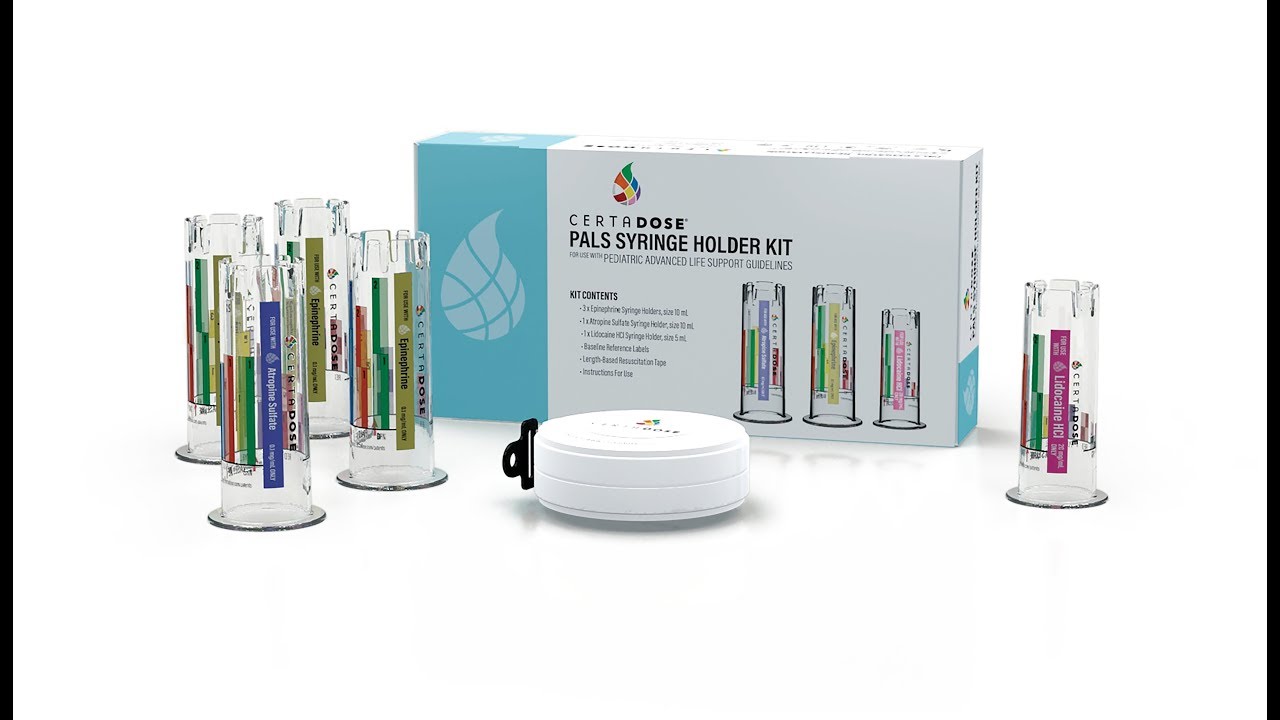 ual stop for the correct volume. No three-way stopcock, no calculator in the dark, and the system is designed so the next dose lines up the same way. Simulated studies have shown these color-coded approaches can drop critical dosing errors dramatically — sometimes to zero in the tested scenarios — while also speeding administration.3 Some services, including Columbia EMS, among others, put the kits on every truck. There is also an anaphylaxis version with a color-matched epinephrine syringe that covers patients from neonate size up to the standard 0.3 mg dose, and is FDA-cleared and usable by BLS providers under the right protocols.
The tool doesn't replace clinical judgment or PALS guidelines. You still decide when to give the drug, how the patient is responding, and whether you need the second or third dose. What it removes is the arithmetic under stress. When you are not calculating milliliters, you can watch the monitor, manage the airway, and talk to the parent.
That last part matters more than many of us admit. On most pediatric calls the parent or caregiver is the expert in the room about that specific child. They know the baseline, the usual seizure pattern, the last time the trach was changed, or which hospital the child normally goes to. Treat them that way. Ask clear questions, listen, and document what they tell you. It is not weakness; it is good scene management. Mind your body language.
STARS
For the subset of kids who live with complex medical needs — tracheostomies, home ventilators, atypical seizures, shunts, technology dependence — the STARS program (Special Needs Tracking and Awareness Response System) takes that idea further.4 Originating in the St. Louis area and now used by multiple hospitals and EMS agencies, STARS creates patient-specific emergency care plans that are physician-reviewed and stored in a secure system. When 9-1-1 is called, the dispatcher can relay the child’s STARS number. Responding crews log in and pull the plan: baseline vitals, equipment needs, “if/then” scenarios, protocol deviations, allergies, and contact information. The plans exist because standard algorithms can harm these children. A crew that treats every seizure the same way, or every respiratory distress the same way, can make things worse for a child whose physiology is nothing like the textbook case. Knowing the plan exists, and actually opening it, turns an unfamiliar call into a prepared one. The caregiver is still the on-scene expert; the STARS plan simply gives the rest of the team a head start.
Where to Go? There is an Easy Button.
Transport decisions are the other place where pediatric calls expose gaps. The closest hospital is not always the right hospital. Ask three questions on scene or en route:
- Can this facility manage the immediate problem, or will the child need transfer within hours?
- Is there a community hospital a short distance farther that keeps pediatricians or pediatric-capable staff in-house?
- Is a children’s hospital reachable in a reasonable time given the child’s condition and local resources?
Local protocols, online medical control, and the caregiver’s preference all factor in. A stable child with a known chronic issue may do fine at the nearest appropriate facility. A child in refractory shock, status epilepticus, or with a compromised airway often belongs at a center that sees these patients every day. Document the decision and the rationale. When I had a tough call, that was my signal to call medical control—the easy button. If you are transporting past a closer hospital, be ready to explain why—medical control and the receiving facility both need the context. If you have already coordinated with them, there is no problem.
None of this replaces training. Agencies that only check the PALS box every two years and never run pediatric scenarios will still hesitate when the real call comes. High-fidelity simulation, regular review of weight-based dosing, and deliberate practice with the tools you carry (Certa Dose® or otherwise) close the gap faster than another classroom lecture. Know your epinephrine auto-injector or convenience kit inside and out, practice the color system if you carry one, and know when to call for ALS assist or air medical early.
Pediatric calls will always feel different. The stakes are higher, the numbers change, and the parent is watching every move. Tools like Certa Dose® reduce the math.5 Programs such as STARS reduce the surprise. Clear transport thinking and respectful partnership with caregivers reduce the chaos. None of them eliminates the need for solid assessment and airway management, but together they make the call less like a coin flip and more like the practiced skill it should be.
The next time the tones drop for a child, you will still feel the tension. That's normal. What you do with the next 60 seconds is what separates a confident crew from one that is guessing. Measure, match the color, listen to the parent, and move the patient to the facility that can finish what you started. That is the job.
References
1. Life-Assist. “PALS Syringe Holder Kit Background.” Compiled simulation data citing pediatric ED critical dosing error rate of 17% and prehospital rate of 39% with standard syringes, plus elimination of critical errors (including 10-fold overdoses) with color-coded systems. Available at: https://www.life-assist.com/Content/Docs/PALS_Syringe_Holder_Kit_Background.pdf
2. Certa Dose®. “Human Factors Validation Study” summary (white paper comparison of standard TB syringe vs. Certa Dose® pediatric epinephrine syringe). 50% of draws with standard syringe were 10-fold overdoses; no clinically significant errors with Certa Dose syringe across weight-based doses, including color-blind participants. Referenced in manufacturer materials and available via https://www.certadose.com (related technical documentation).
3. Stevens AD, et al. “Color-coded prefilled medication syringes decrease time to delivery and dosing errors in simulated prehospital pediatric resuscitations: A randomized crossover trial.” Resuscitation. 2015 Nov;96:85-91. (Referenced in UH EMS-I Pharmacy Phriday and manufacturer materials as demonstrating reduced critical errors and faster administration with color-coded syringes.)
4. St. Louis Children’s Hospital and collaborating STARS program sites. Program description and EMS access details. Available at: https://www.stlouischildrens.org/conditions-treatments/emergency-room/STARS-program and https://info.starsprogram.org/
5. Certa Dose® product information (PALS Syringe Holder Kit and Anaphylaxis Kit). Available at: https://www.certadose.com
6. Moreira ME, et al. “Color-coded prefilled medication syringes decrease time to delivery and dosing error in simulated emergency department pediatric resuscitations: A randomized crossover trial.” Annals of Emergency Medicine. 2015 Aug;66(2):97-106.e3.
7. Pintea M, Finney J, Salzman N, et al. “Enhancing Prehospital Care for Medically Complex Children: The Evolution of the STARS Program.” Pediatric Emergency Care. 2026 Apr 23. (Reports enrollment of 2,424 patients, reduced unnecessary transports, and expansion of patient-specific EMS care plans.)
About the Authors
Dick Blanchet (Retired), BS, MBA, worked as a paramedic for Abbott EMS in St. Louis, MO, and Illinois for more than 22 years. As a Captain with Atlas Air for 22 years on the Boeing 747, he has more than 21,000 flight hours. A USAF pilot for 22 years, he flew the C-9 Nightingale Aeromedical aircraft and retired as a Lt. Colonel. A USAF Academy graduate with a Bachelor of Science degree, his Master’s in Business Administration is from Golden Gate University. Email contact: ACLS911@aol.com
Samantha Greene is a paramedic and field training officer for the Illinois Department of Public Health Region IV Southwestern Illinois EMS system, a paramedic and FTO for Columbia (IL) EMS, and was a full-time paramedic and House Supervisor at the St. Louis South City Hospital Emergency Department. She was previously recognized as a GMR Star of Life.