Beyond Pulmonary Vein Isolation for Persistent Atrial Fibrillation: Are We Finally Making Progress?
© 2026 HMP Global. All Rights Reserved.
Any views and opinions expressed are those of the author(s) and/or participants and do not necessarily reflect the views, policy, or position of EP Lab Digest or HMP Global, their employees, and affiliates.
EP LAB DIGEST. 2026;26(11):5,18.
Bradley P Knight, MD, FACC, FHRS
Dear Readers,
Pulmonary vein isolation (PVI) remains the cornerstone of catheter ablation for atrial fibrillation (AF). Although the effectiveness of PVI for patients with paroxysmal AF is well established, outcomes in patients with persistent AF have been less satisfactory. In the STOP Persistent AF trial, the 1-year success rate following cryoballoon PVI alone was only 55%. This raises an important question that electrophysiologists have been trying to answer for more than 2 decades: What additional ablation should be performed beyond PVI in patients with persistent AF? Which studies need to be repeated with pulsed field ablation (PFA) technology?
There is no shortage of potential ablation targets. These include the posterior left atrial (PLA) wall, linear lesions, complex fractionated atrial electrograms (CFAEs), areas of fibrosis or low voltage, and sites identified by advanced mapping techniques coupled with artificial intelligence (AI). However, demonstrating that additional ablation improves clinical outcomes has proven surprisingly difficult.
The landmark STAR AF II trial demonstrated that adding linear lesions or CFAE ablation to PVI did not improve outcomes in patients with persistent AF, despite increasing procedure duration. More recently, the CAPLA trial found no significant benefit from adding posterior wall isolation to PVI. Even more relevant to today’s practice, the recently published PIFPAF-PFA trial found no benefit from adding PLA ablation to PVI when using PFA. Similarly, the DECAAF II trial failed to demonstrate improved outcomes when magnetic resonance imaging-defined atrial fibrosis was targeted for ablation. These studies have challenged the assumption that more extensive ablation necessarily produces better results.
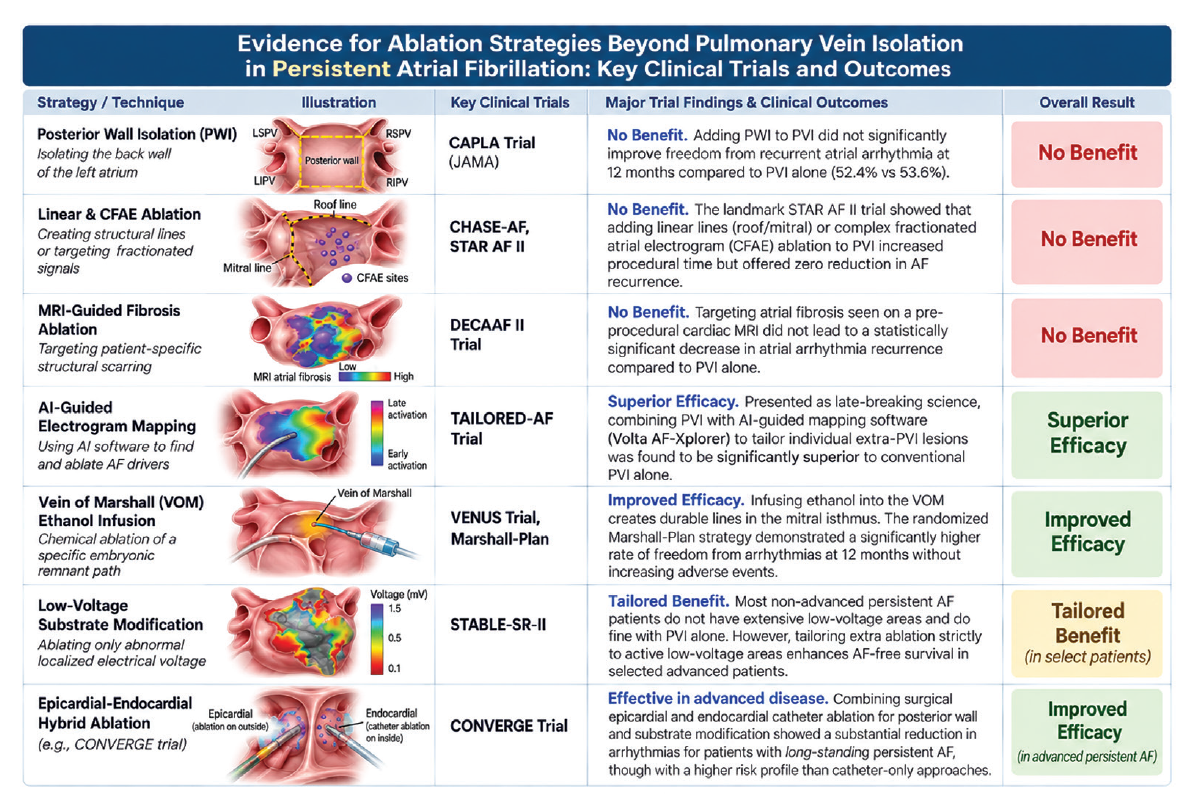
However, several more recent studies suggest that additional ablation may be beneficial when the targets are selected more carefully. The VENUS trial demonstrated improved outcomes with ethanol infusion into the vein of Marshall in patients undergoing ablation for persistent AF. The Marshall-Plan ablation approach has provided further support for this strategy. Similarly, studies of low-voltage substrate modification suggest that targeting abnormal atrial tissue may be beneficial in selected patients with more advanced atrial disease.
Perhaps the most intriguing development is the use of electrogram-based approaches and artificial intelligence (AI) to identify patient-specific ablation targets. The TAILORED-AF trial demonstrated improved efficacy when PVI was combined with additional ablation guided by the AI-based Volta electrogram mapping system. This approach represents a departure from performing the same anatomical lesion set in every patient. Rather than assuming that all patients with persistent AF have the same substrate, it attempts to identify the regions that are most important for maintaining AF in an individual patient. It is important to note, however, that although the TAILORED-AF trial showed improved freedom from recurrent AF, it showed no improvement in freedom from all atrial arrhythmias after a single procedure. Many other electrogram-based approaches are under development.
Hybrid epicardial-endocardial ablation is another strategy that has demonstrated improved outcomes, particularly in patients with long-standing persistent AF. The CONVERGE trial demonstrated greater efficacy with a hybrid approach than with catheter ablation alone. However, this improved efficacy must be balanced against the additional procedural complexity and risks associated with surgical epicardial ablation.
These findings are particularly relevant as PFA becomes increasingly available. PFA makes it easier and faster to create extensive atrial lesions, including posterior wall ablation. However, the ability to create more lesions does not establish that they are necessary or beneficial. The challenge is no longer simply how to create additional lesions, but how to determine which lesions should be created.
The accompanying figure summarizes the major clinical trials evaluating ablation strategies beyond PVI. The results suggest that routine empirical ablation has generally been disappointing, while approaches that identify specific targets or address more advanced atrial disease show promise.
What should electrophysiologists do today? PVI should remain the foundation of catheter ablation for persistent AF. Additional ablation should not be performed simply because it is technically feasible. Instead, the decision should increasingly be guided by the patient’s atrial substrate, the available clinical evidence, and the risks of the proposed intervention. The future of persistent AF ablation may depend less on how much tissue we ablate and more on whether we are ablating the right tissue.
Disclosures: Dr Knight has served as a paid consultant to Medtronic and was an investigator in the PULSED AF trial. He has served as a consultant, speaker, investigator, and/or has received EP fellowship grant support from Abbott, AltaThera, AtriCure, Baylis Medical, Biosense Webster, Biotronik, Boston Scientific, CVRx, Philips, and Sanofi; he has no equity or ownership in any of these companies. Dr Knight reports payment or honoraria from Convatec for a lecture.