Different Strokes

When I accepted an academic dermatology position in Winston-Salem—a town that lent its name to 2 cigarette brands—the executive vice president for research and development at the local tobacco company was a dermatologist—a bright, dedicated physician. He had previously worked at drug companies, helping bring new products to market. His career also included leading research for major consumer products companies. Who knew that was a career a dermatologist could have?
For anyone devoted to improving patients’ lives, the appeals of the biotechnology and pharmaceutical industries include research budgets orders of magnitude larger than those of the studies I have done and the development of products that touch more lives in a single year than I will in my career. The money makes the highest-quality work possible. Critics may decry the high rate at which industry studies report positive results, but I read that rate differently. It is evidence that industry research is well targeted, well planned, and well performed. A company spending 8 figures on a trial has strong incentives to pick a question worth answering, one that will pay dividends in better care for patients and a better bottom line for the company. I see a lot of patients with psoriasis, and I am thankful companies have invested productively in developing drugs that dramatically improve psoriasis outcomes.
Another advantage: With those enormous budgets comes freedom from the administrative hassles that slow research in academic settings. Just joking. Academic research has its own growing thicket of paperwork, but it can be remarkably nimble. Industry research can be painfully slow, with layer upon layer of scientific review, business review, and legal review. Then again, COVID showed us what industry can do when executives decide conditions demand it. Vaccines in a year is not the usual pace of science by committee.
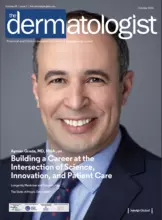
Different strokes for different folks. I am happy in academics, seeing patients a day or 2 a week and spending most of the rest of my time on research. Others thrive seeing patients 5 or 6 days a week and catching up on charts Sunday afternoon. A career in industry is another avenue—detailed in this issue’s interview with physician-scientist Dr Ayman Grada—and some of us, it turns out, relish it.
Steven R. Feldman, MD, PhD
Chief Medical Editor