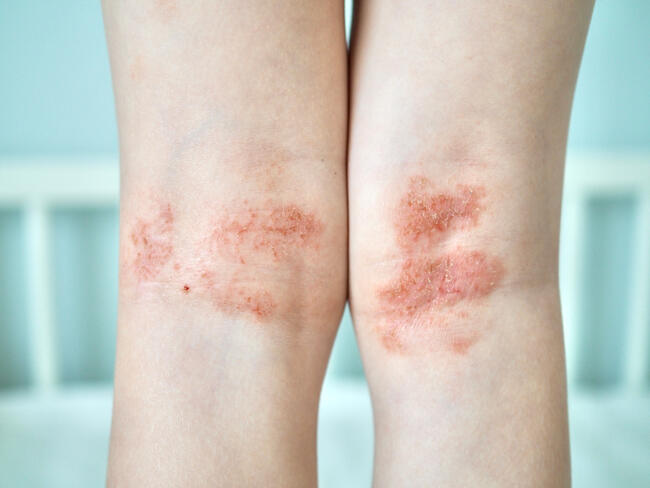
 Discontinuing breastfeeding and shifting to partially hydrolyzed whey formula (pHF-W) may help improve symptoms of atopic dermatitis (AD) and shorten its duration in breast-fed infants, according to a recent study.
In their prospective observational study, the researchers evaluated a total of 87 breast-fed infants with AD. Infants were classified into 3 different groups: breastfeeding only (BM group), partial breastfeeding and partial pHF-W (partial group) and pHF-W only (DC group). Patient-Oriented SCORing Atopic Dermatitis (PO-SCORAD) index was used to assess the extent and severity of AD at enrollment, 3 months, and 6 months.
________________________________________________________________________
Related Content
Study Assesses Quality of Life in AD, Asthma Patients
Costs Vary for Moisturizers Used to Ease Eczema in Babies
________________________________________________________________________
The researchers observed no significant differences in parental atopy history, PO-SCORAD scores, and medication scores at baseline. However, PO-SCORAD scores had decreased significantly at month 3 and month 6. Scores were also significantly different across groups at month 3, month 6, and also at the last time point when topical corticosteroids were administered.
According to results of a stepwise multiple linear regression analysis, both PO-SCORAD scores and stopping breastfeeding were significantly associated at 3 months. These results were adjusted for sex, age, baseline medication scores, partial breastfeeding and parental atopy history.
In addition, partial breastfeeding was significantly associated with PO-SCORAD scores at month 6. Furthermore, long-term follow-up showed that stopping breastfeeding was significantly associated with the last time point when topical corticosteroids were given.
“For exclusively breast-fed infants with AD, discontinuing breastfeeding and shifting to pHF-W might help to improve symptoms and shorten the duration of AD regardless of sex, age and parental atopy history,” the researchers concluded.
—Christina Vogt
Reference:
Lin HP, Chiang BL, Yu HH, et al. The influence of breastfeeding in breast-fed infants with atopic dermatitis [Published online July 14, 2017]. J Microbiol Immunol Infect. doi:10.1016/j.jmii.2017.06.004.
 Discontinuing breastfeeding and shifting to partially hydrolyzed whey formula (pHF-W) may help improve symptoms of atopic dermatitis (AD) and shorten its duration in breast-fed infants, according to a recent study.
In their prospective observational study, the researchers evaluated a total of 87 breast-fed infants with AD. Infants were classified into 3 different groups: breastfeeding only (BM group), partial breastfeeding and partial pHF-W (partial group) and pHF-W only (DC group). Patient-Oriented SCORing Atopic Dermatitis (PO-SCORAD) index was used to assess the extent and severity of AD at enrollment, 3 months, and 6 months.
________________________________________________________________________
Related Content
Study Assesses Quality of Life in AD, Asthma Patients
Costs Vary for Moisturizers Used to Ease Eczema in Babies
________________________________________________________________________
The researchers observed no significant differences in parental atopy history, PO-SCORAD scores, and medication scores at baseline. However, PO-SCORAD scores had decreased significantly at month 3 and month 6. Scores were also significantly different across groups at month 3, month 6, and also at the last time point when topical corticosteroids were administered.
According to results of a stepwise multiple linear regression analysis, both PO-SCORAD scores and stopping breastfeeding were significantly associated at 3 months. These results were adjusted for sex, age, baseline medication scores, partial breastfeeding and parental atopy history.
In addition, partial breastfeeding was significantly associated with PO-SCORAD scores at month 6. Furthermore, long-term follow-up showed that stopping breastfeeding was significantly associated with the last time point when topical corticosteroids were given.
“For exclusively breast-fed infants with AD, discontinuing breastfeeding and shifting to pHF-W might help to improve symptoms and shorten the duration of AD regardless of sex, age and parental atopy history,” the researchers concluded.
—Christina Vogt
Reference:
Lin HP, Chiang BL, Yu HH, et al. The influence of breastfeeding in breast-fed infants with atopic dermatitis [Published online July 14, 2017]. J Microbiol Immunol Infect. doi:10.1016/j.jmii.2017.06.004.
Discontinuing breastfeeding and shifting to partially hydrolyzed whey formula (pHF-W) may help improve symptoms of atopic dermatitis (AD) and shorten its duration in breast-fed infants, according to a recent study.
In their prospective observational study, the researchers evaluated a total of 87 breast-fed infants with AD. Infants were classified into 3 different groups: breastfeeding only (BM group), partial breastfeeding and partial pHF-W (partial group) and pHF-W only (DC group). Patient-Oriented SCORing Atopic Dermatitis (PO-SCORAD) index was used to assess the extent and severity of AD at enrollment, 3 months, and 6 months.
________________________________________________________________________
Related Content
Study Assesses Quality of Life in AD, Asthma Patients
Costs Vary for Moisturizers Used to Ease Eczema in Babies
________________________________________________________________________
The researchers observed no significant differences in parental atopy history, PO-SCORAD scores, and medication scores at baseline. However, PO-SCORAD scores had decreased significantly at month 3 and month 6. Scores were also significantly different across groups at month 3, month 6, and also at the last time point when topical corticosteroids were administered.
According to results of a stepwise multiple linear regression analysis, both PO-SCORAD scores and stopping breastfeeding were significantly associated at 3 months. These results were adjusted for sex, age, baseline medication scores, partial breastfeeding and parental atopy history.
In addition, partial breastfeeding was significantly associated with PO-SCORAD scores at month 6. Furthermore, long-term follow-up showed that stopping breastfeeding was significantly associated with the last time point when topical corticosteroids were given.
“For exclusively breast-fed infants with AD, discontinuing breastfeeding and shifting to pHF-W might help to improve symptoms and shorten the duration of AD regardless of sex, age and parental atopy history,” the researchers concluded.
—Christina Vogt
Reference:
Lin HP, Chiang BL, Yu HH, et al. The influence of breastfeeding in breast-fed infants with atopic dermatitis [Published online July 14, 2017]. J Microbiol Immunol Infect. doi:10.1016/j.jmii.2017.06.004.