
Limb Salvage Utilizing the DETOUR Procedure in Dense Calcific Multilevel Disease
Key Summary
- This case report describes a 69-year-old man with end-stage renal disease, hypertension, coronary artery disease, peripheral arterial disease, and a dense calcific TASC D lesion with associated tissue loss who became unsuitable for open bypass following a stroke.
- DETOUR percutaneous transmural arterial bypass (Endologix) routed flow from the proximal SFA through the femoral vein into the P2 popliteal artery. Digit amputations healed, and patency persisted beyond 1 year without significant stenosis.
- This single case suggests DETOUR may be an option when standard endovascular treatment or bypass is unsuitable. The DETOUR2 clinical trial reported 3-year primary and secondary patency of 58.2% and 96.2%, respectively.
© 2026 HMP Global. All Rights Reserved.
Any views and opinions expressed are those of the author(s) and/or participants and do not necessarily reflect the views, policy, or position of Vascular Disease Management or HMP Global, their employees, and affiliates.
VASCULAR DISEASE MANAGEMENT. 2026;23(10):E158-E161
Abstract
Chronic limb-threatening ischemia is the end-stage of peripheral arterial disease, characterized by gangrene, ulceration, or rest pain. Treatment strategies for CLTI continue to evolve with advances in endovascular technology. Patients with significant femoropopliteal occlusive disease were previously limited to conventional stent placement or surgical bypass. The DETOUR system (Endologix) provides physicians with an off-the-shelf percutaneous transmural arterial bypass option to address femoropopliteal disease while avoiding pitfalls of stent compression due to significant calcific disease. This case report describes the use of the DETOUR system to successfully treat a dense calcific TASC D lesion with associated tissue loss and ultimate limb salvage.
Introduction
Chronic limb-threatening ischemia (CLTI) is the end stage of peripheral arterial disease, characterized by gangrene, ulceration, or rest pain.1 Twenty-five percent of patients will progress to limb loss within 1 year and have an annual mortality of 20% to 25%.1,2 Treatment strategies for CLTI continue to evolve with advances in endovascular technology. Patients with significant femoropopliteal occlusive disease were previously limited to conventional stent placement or surgical bypass. James Joye, MD previously described a novel percutaneous transmural arterial bypass (PTAB) technique to provide an alternative to conventional superficial femoral artery (SFA) stenting. The DETOUR system (Endologix) provides physicians with an off-the-shelf PTAB option to address femoropopliteal disease while avoiding the pitfalls of stent compression due to significant calcific disease. This case report describes the use of the DETOUR system to successfully treat a dense calcific TASC D lesion with associated tissue loss and ultimate limb salvage.
Case Presentation
A 69-year-old man with end-stage renal disease, hypertension, coronary artery disease, and peripheral arterial disease presented with bilateral lower extremity rest pain and new wounds on the left forefoot and digits. He underwent computed tomography angiography, which demonstrated bilateral SFA occlusions as well as external iliac artery stenoses. However, given the image quality, it was unclear if these were the culprit lesions.
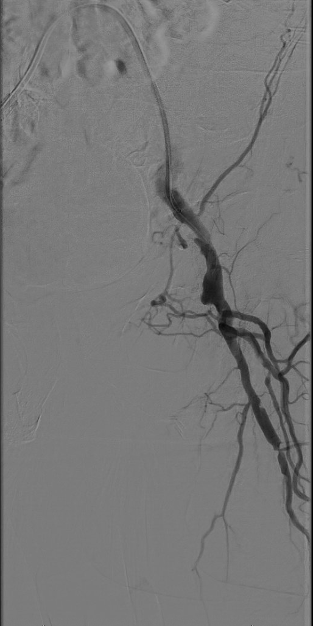
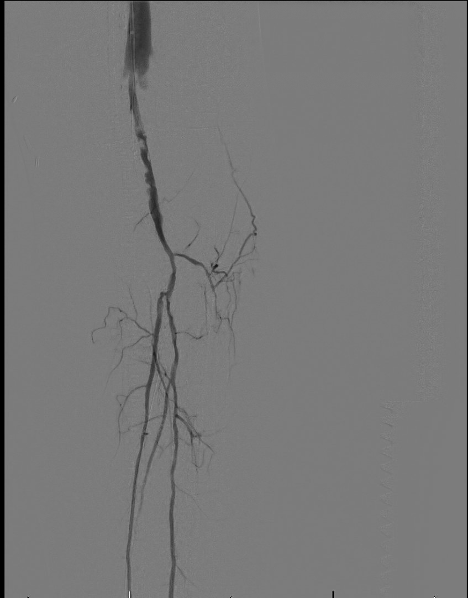
The decision was made to proceed with angiography. The patient subsequently underwent bilateral external iliac artery stenting with significant improvement in inflow disease. Angiography also demonstrated severe, heavily calcified SFA disease, including a flush SFA occlusion with distal reconstitution at the P2 segment of the popliteal artery and 2-vessel runoff (Figures 1 and 2). He was assessed postoperatively and his rest pain resolved; however, repeat noninvasive studies demonstrated reduced toe pressures not compatible with wound healing. Surgical bypass was planned, but unfortunately the patient developed a stroke and was no longer suitable for open bypass surgery.
As the DETOUR system is designed to facilitate percutaneous bypass without open surgery, the patient underwent PTAB from the proximal SFA to P2 portion of the popliteal artery. Given the flush occlusion with dense calcific cap, the SFA was accessed with a micropuncture kit in a retrograde fashion. A 0.035-inch Advantage Glidewire (Terumo) was then advanced retrograde into the abdominal aorta and subsequently snared from the right groin access. This allowed for crossing a difficult aortic bifurcation and obtaining access to the proximal SFA. Balloon angioplasty was then performed to dilate the proximal SFA, facilitating EndoCross delivery.
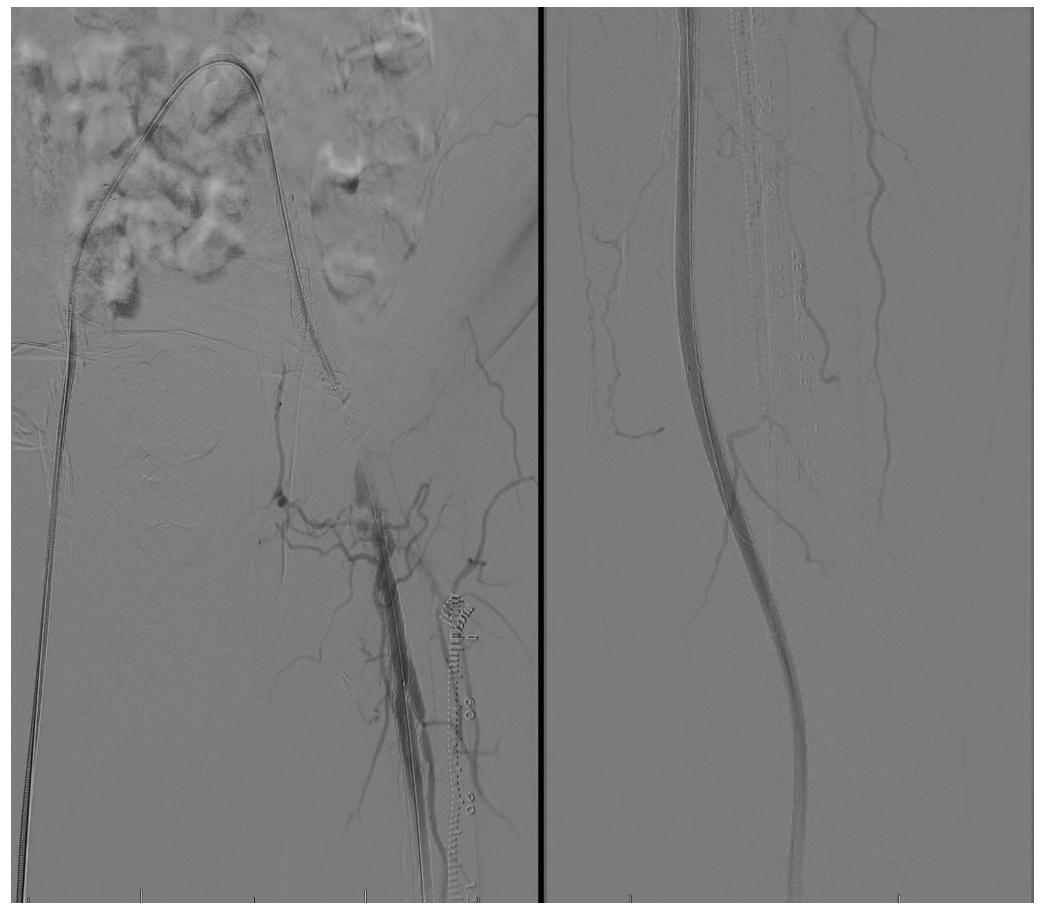
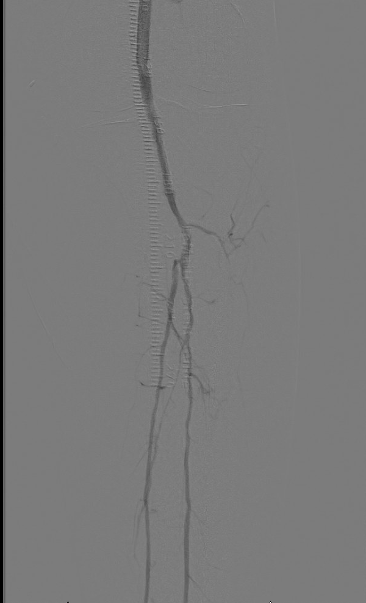
EndoCross was used to create a fistula between the proximal SFA and femoral vein and was then advanced to the level of the popliteal artery via the popliteal vein. The EndoCross was used to re-enter the artery. This distal fistula was dilated, and Torus stent placement was performed from the popliteal artery to the proximal superficial femoral artery. Completion angiogram demonstrated patent Torus stents with 2-vessel runoff to the foot (Figures 3 and 4). The patient’s digit amputations healed, and the revascularization has remained patent through all follow-up visits after 1 year with no significant stenoses.
Discussion
CLTI is a morbid disease with a high prevalence of limb loss and mortality. Approximately 25% of patients will progress to limb loss within 1 year and have an annual mortality of 20% to 25%.1,2 While endovascular therapy continues to evolve to treat more complex lesions, dense calcific stenoses are still a limitation. The DETOUR system provides an alternative approach to address these lesions. The system utilizes a crossing device to percutaneously cross through the SFA into the adjacent femoral vein before crossing back into the popliteal artery. This allows the DETOUR system to be free of external compression from the surrounding calcium as would be typical of SFA stents placed in calcific TASC C/D lesions. This technique aims to decrease restenosis and stent failure associated with endovascular treatment of TASC C/D lesions.
The multicenter prospective DETOUR2 trial demonstrated acceptable 3-year primary patency and secondary patency of 58.2% and 96.2%, respectively, in challenging lesions. The average lesion length was 32.7 cm, with 96% of these being chronic total occlusions and 70% being severely calcified.3 This data, at the very least, are comparable with other studies looking at endovascular treatment of TASC C/D lesions in the femoropopliteal segment.4,5 This case is representative of the trial demographics. The patient had multiple medical comorbidities and long-segment dense calcific disease that was not optimal for either typical endovascular or open reconstruction.
The dense calcification and flush SFA occlusion added significant complexity to this challenging case. In the scenario in which we are unable to obtain SFA access, luminal or subintimal, from an up-and-over approach, we employ accessing the target SFA directly and wiring retrograde to obtain through-and-through wire access. This allows us to track and dilate the lesion, as well as gain SFA access with our working sheath. This method allowed us to treat this complex lesion, achieve technical success, and restore inline flow in an otherwise unsuitable conventional revascularization candidate.
Conclusion
Endovascular advances such as the DETOUR system have continued to advance treatment options for restoration of blood flow needed to increase chances for limb salvage. TASC C/D lesions remain a challenge for endovascular therapy, with further advances needed to address both this population and the failure points of standard approaches. The DETOUR system is a novel approach that does just that, with acceptable patency data. This case highlights the utility of the DETOUR system in a densely calcific TASC D lesion that otherwise was not suitable for a bypass or standard endovascular therapy. n
Affiliations and Disclosures
From the Christiana Care Health System, Newark, Delaware.
Dr Fadoul has been a consultant for Endologix.
Manuscript accepted August 20, 2026.
Address for correspondence: Mikael Fadoul, MD, Christiana Care Health System, 4755 Ogletown-Stanton Rd, Ste 1E20, Newark, DE 19718. Email: mikael.fadoul@christianacare.org
References
1. Farber MA, Menard MT, Conte MS, et al; BEST-CLI Investigators. Surgery or endovascular therapy for chronic limb-threatening ischemia. N Engl J Med. 2022;387(25):2305-2316. doi:10.1056/NEJMoa2207899
2. Ventoruzzo G, Mazzitelli G, Ruzzi U, Liistro F, Scatena A, Martelli E. Limb salvage and survival in chronic limb-threatening ischemia: the need for a fast-track team-based approach. J Clin Med. 2023;12(18):6081. doi:10.3390/jcm12186081
3. Lyden SP, Schneider PA, Sood A, et al; DETOUR2 Trial Investigators. Durability of the DETOUR system for long and complex femoral-popliteal lesions: 3-year results from the DETOUR2 trial. J Soc Cardiovasc Interv. 2026;5(8):105457. doi:10.1016/j.jscai.2026.105457
4. La Marca MA, Bruno S, Gagliardo G, et al. Endovascular treatment outcomes for TASC C and D lesions in chronic peripheral arterial disease: a retrospective study and literature review. Biomedicines. 2025;13(11):2771. doi:10.3390/biomedicines13112771
5. Liu P, Zheng L, He X, et al. Midterm outcomes of endovascular therapy for TASC II D femoropopliteal lesions with critical limb ischemia: a retrospective analysis. Ann Vasc Surg. 2023;88:182-190. doi:10.1016/j.avsg.2022.08.004