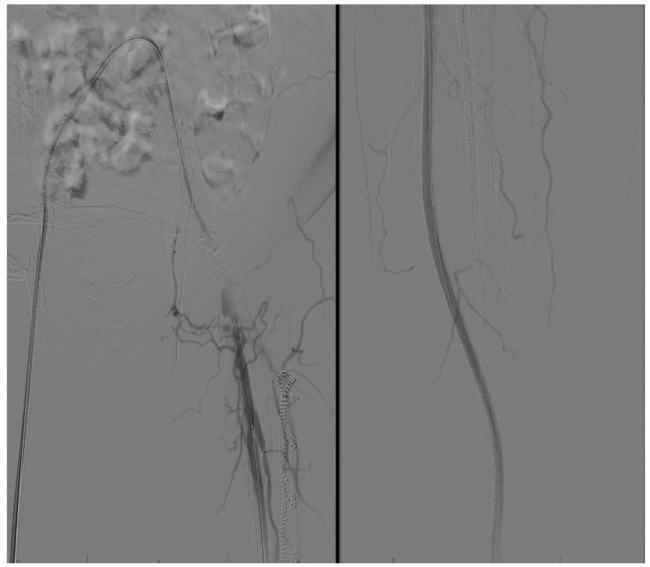
Creating a New Path for Long, Heavily Calcified Femoropopliteal Occlusions With the DETOUR™ System
© 2026 HMP Global. All Rights Reserved.
Any views and opinions expressed are those of the author(s) and/or participants and do not necessarily reflect the views, policy, or position of Vascular Disease Management or HMP Global, their employees, and affiliates.

RWJBarnabas Health, New Jersey
RWJBarnabas Health, New Jersey
Long, heavily calcified femoropopliteal occlusions can be difficult to treat. In this interview, Ramzan M. Zakir, MD, RPVI, FACC, FSCAI, and Haris Usman, MD, MS, FACC, FSCAI, from RWJBarnabas Health in New Jersey, discuss how the DETOUR™ System (Endologix) uses percutaneous transmural arterial bypass (PTAB) to create a pathway through the femoral vein and around the diseased arterial segment. They share how they select appropriate patients, navigate challenging anatomy, and increasingly consider the DETOUR System earlier in the treatment algorithm rather than reserving it solely for no-option patients.
How do you define a complex femoropopliteal patient in your practice, and how have you historically treated these patients?
Dr Zakir: A complex superficial femoral artery (SFA) lesion would be a long-segment occlusion that could be heavily calcified. When you have long-segment occlusions that are heavily calcified, often we can get through using different techniques coming from a pedal approach, an antegrade approach, or using a reverse CART (controlled antegrade and retrograde tracking) technique. While crossing the occlusion is great and we do get good results, long-segment calcified occlusions have high reintervention rates. I try to minimize using stents, but often these long-segment occlusions require a lot of scaffolding. Usually I use Supera stents (Abbott) in the popliteal artery up to the proximal SFA. If I need to go all the way to the ostium, I use an Eluvia drug-eluting stent (Boston Scientific). My algorithm is to use a vascular mimetic stent, like a Supera, which has excellent radial force and reacts to the body as far as bending goes; I’ve gotten good results with that approach.
Dr Usman: By the criteria that has been outlined by the Society of Vascular Surgery, American College of Cardiology, and vascular medicine societies, it typically is a lesion of the SFA extending to the level of the popliteal, over 150 to 200 millimeters in length, usually in association with either a heavily calcified vessel from the ostium or along the mid-segment, which is also circumferential. It’s not just calcification but a heavy calcium burden and, typically, circumferential lesions that are traversing the Hunter’s canal, which is a very tight zone and easily compressible by the overlying muscle. Complex femoropopliteal lesions are also physiologic in the sense that they are impenetrable with conventional endovascular guidewires and catheters, or not easily rectifiable with atherectomy and balloon angioplasty, including intravascular lithotripsy balloons. Those are the typical complex lesions that we deal with in our practice.
What factors or challenges make you feel that conventional treatment options may no longer be enough and that a different approach is needed?
Dr Zakir: When you have long-segment calcified occlusive disease, and you know the reintervention rates are high and you see patients coming back and there are long-segment stents, you have to worry about distal embolization every time you’re intervening. Each time it seems like the reintervention is more complicated than the initial one. It makes you think, is there a better way to treat these lesions? You have a conventional femoropopliteal bypass, but morbidity is associated with that as well. Also, is there a suitable great saphenous vein? That should be in your algorithm as well.
Dr Usman: When it comes to conventional treatment options, we have endovascular therapy with respect to atherectomy, debulking, balloon angioplasty, stenting, drug-coated balloon angioplasty, or surgical bypass. In an ideal world, the best option would be to revascularize with endovascular techniques so patients have decreased morbidity and resolution of treatment is short, and they are able to get back to their normal lives in a fastidious manner. The reality is that about a third of patients who undergo endovascular evaluation or treatment will require something more extensive, and surgical bypass would be the way to go. Unfortunately, data from large studies, including the BASIL trial or more recent registries, show that about half of these patients will not be able to undergo surgical bypass because they are anatomically nonviable or have other core morbidities, such as associated cardiovascular disease, extensive cardiomyopathy, coronary artery disease, or valvular heart disease, which preclude surgical bypass. Peripheral arterial disease of this complexity does not happen in isolation and typically occurs in concurrence with complex lung conditions or heart conditions, which also preclude surgical bypass. We have been subjecting them to repeat revascularizations through endovascular routes, balloon angioplasty, stenting, drug elution, or covered stents. Or we’ve been trying to do hybrid situations where they can get partial endovascular revascularization and then surgical bypass. That population has been difficult to treat.
When did the DETOUR System begin to become a part of your treatment decision-making, and what initially led you to consider it?
Dr Zakir: We were fortunate to be an early adopter of the DETOUR System after it received its FDA approval. I started using the DETOUR System in patients who had prior endovascular procedures or prior occluded femoropopliteal bypasses. Initially, it was for those types of cases but gradually started changing more to de novo cases.
Dr Usman: The first patient that I used PTAB with the DETOUR System for was considered “no option”. He had poor runoff, two-vessel runoff, which was also very thready. He also had been surgically revascularized once, and it failed. Then he had multiple stents across the entire femoropopliteal bed, all the way below his knee; that failed. Then he was at the stage where he was told he would need to undergo an above-knee amputation. He was 79 years old and had otherwise been very functional. For him, this was a do-or-die situation, and I decided to employ the DETOUR System. It has been about 2 years since, and the patient still comes to see me in my office. He walks to the office, and he has shown to me that this procedure occupies a space that traverses between what would have been conventional surgical bypass and traditional endovascular therapy in a scenario where there was no option from either one.
Today, how do you identify the right patient for the DETOUR System? What factors do you consider in their clinical history, prior interventions, and lesion anatomy?
Dr Zakir: At first, I used the DETOUR System in patients who required repeated interventions, who had prior stents placed; I saw it as a great option. If a patient has comorbidities and doesn’t have a suitable great saphenous vein, and they’re not appropriate for a femoropopliteal bypass, it’s easier to think about doing PTAB. I started using the DETOUR System in patients who had that upfront rather than trying to navigate through heavy calcium and stents that are often underexpanded in those areas. Upfront, you have a discussion with the patient that there is a new technique where we can perform a femoropopliteal bypass using the femoral vein as the conduit. Patients love the outcomes because the reintervention rates are low. And when I have reintervened, they have been easy to reopen. I haven’t had cases where the whole graft is closed. It’s usually just a proximal stenosis that needs to be fixed.
Dr Usman: It is classically going to be a population of patients who fit into that criteria where they have complex long lesions, undergone bypass, failed bypass, or had femoral endarterectomy with multiple surgeries to their groin, and the tissue precludes the ability to undergo bypass, and they have also been revascularized endovascularly with stents and balloons multiple times. To me, an ideal patient is somebody who has at least two-vessel runoff so the outflow from the TORUS™ Stent Graft conduit remains patent and has robust flow. Also, ideally it would be a patient who has some evidence of inflow at the level of the SFA, usually at the ostium, between 4 to 5 millimeters of length to allow for possible anastomosis. That’s the patient population I’m looking for. Anatomically speaking, a lot of these are patients who have associated cardiovascular disease, valvular heart disease, or heart failure, or have bad coronary artery disease or chronic obstructive pulmonary disease that precludes them from undergoing anesthesia or even undergoing surgery. These patients benefit significantly from the DETOUR System because it remains a purely percutaneous procedure.
How do specific challenges such as long or flush chronic total occlusions, severe calcification, in-stent restenosis, or multiple failed interventions influence your consideration of the DETOUR System?
Dr Zakir: Those are all great examples of when you would want to use the DETOUR System. We just had a case of a patient with a flush occlusion who had a prior femoropopliteal bypass, and the bypass was occluded and he had severe claudication. We had to use a retrograde approach and were able to enter the common femoral artery true lumen. There was an option, since you’ve externalized the wire, to do a conventional endovascular approach or PTAB. Given the long-segment occlusion and calcium, I thought I might as well do PTAB upfront.
Dr Usman: Flush occlusions make the process of proximal access into the artery challenging; that doesn’t mean it’s not achievable. A lot of these patients may require entry subintimally, and employment of certain chronic total occlusion crossing techniques such as dissection re-entry to initiate that initial channel, allowing for access into the proximal SFA. After that, the placement of the conduit is not really a challenge. So far as patency of the conduit is concerned, as long as we have veins that are at least 10 millimeters in width, and ideally patients who do not have a history of venous thromboembolism, they will have sufficient route to utilize the traversal from the proximal SFA into the common femoral vein, and then re-entry back into the popliteal artery. So flush occlusions are not prohibitive, but they are certainly more challenging. I will typically use the DETOUR System for patient populations with multiple reinterventions. That’s a population who have had very progressive disease, sometimes very aggressive disease, where the restenosis rates are upwards of 50% or 60% within a matter of 12 months. I know straight off that those patients will benefit from an alternative option to repeat revascularization with endovascular therapies. Patients who have stents, especially at the proximal or distal anastomosis re-entry sites, whether at the level of the popliteal artery or at the level of the proximal SFA, pose a challenge with respect to exit and re-entry. If there’s a stent at the level of the SFA, it is difficult to traverse into the vein. If there is one at the level of the popliteal artery, it is challenging to re-enter back from the vein into the popliteal artery. I’ve discovered in my own practice that the stent cells are expandable, even the woven stents, the traditional Supera stents that are more difficult to expand; even those can be stretched to accommodate the TORUS Stent Grafts that the DETOUR System has. It does make it more difficult to deploy the stents, but it’s not an absolute contraindication. It is certainly not something that should prohibit the utility of the device. In fact, those patients will benefit because they, unfortunately, cannot have surgical cutdowns. There is just no room for them to have surgery there because of the metal that is already in place. Calcified lesions pose similar challenges, but not as much as a previously placed stent because of the hardness of the vessel itself. Sometimes these areas need to be modified with intravascular lithotripsy balloons, or the other newer lithotripsy balloons. But after modification, the calcification burden is decreased, and the TORUS Stent Grafts can be deployed without any restenosis.
As your experience with the DETOUR System has grown, how has your definition of the ideal patient evolved? And where does the DETOUR System now fit into your overall treatment algorithm?
Dr Zakir: I think it fits earlier into the algorithm as opposed to later, as opposed to waiting for the patient to have failed endovascular interventions and recurrent in-stent restenosis. While you can do that with a conventional endovascular approach, knowing that factors into a discussion with the patient that we can do it the conventional endovascular way, but your chance of a reintervention is fairly high. Or we can take this novel approach where we use the femoral vein as a conduit and perform a bypass. And we know in those cases that the reintervention rates are going to be a lot lower. Patients are all agreeable when they hear that. So far, my experience has been just that, that these patients are not having many repeat interventions. The DETOUR System addresses an unmet clinical need that as endovascular operators we’ve been facing—that we know we can perform an endovascular intervention but also know that those repeated intervention rates are high. The fact that we have something to address that upfront and address those patients who have had repeated interventions is addressing an unmet clinical need. I’m glad it’s in my toolbox.
Dr Usman: The DETOUR System has gone from being a no-option device to one that I am utilizing for patients who I feel have limited options compared to what I would have classified as no option. Those are patients who, from my own experience and from the experience of my surgical colleagues, don’t perform well after bypass and have had recurrent revascularizations. They have chronic limb-threatening ischemia. They have complex lesions that are more than 200 millimeters in length. Instead of waiting for them to undergo repetitive revascularization, I will decide on utilizing the DETOUR System as first-line therapy if they are not surgical candidates. I still would prefer to see if my patients would be surgical candidates if they don’t have endovascular therapy options. But quickly after that, I employ the DETOUR System. That’s about 50% of patients who cannot get surgery because of their other comorbidities. And there is, in my opinion, very little value in repeat endovascular revascularization. Utilizing the DETOUR System helps reduce their revascularization rates, improve wound healing, and generally gives them a better quality of life. The DETOUR System is going from being what I would have classified initially as a niche device for only no-option patients to one that is a second alternative to surgical bypass in patients who cannot get bypass and have either been deemed non-revascularizable because of heavy calcium burden with endovascular therapy or have had repeat revascularizations without success. It’s gone from being a niche device to one that is a part of my regular armamentarium. n
This interview is sponsored by Endologix.
Indications and Important Safety Information for the DETOUR™ System
INDICATIONS: The DETOUR™ System is indicated for use for percutaneous revascularization in patients with symptomatic femoropopliteal lesions from 200 mm to 460 mm in length with chronic total occlusions (100 mm to 425 mm) or diffuse stenosis >70% who may be considered suboptimal candidates for surgical or alternative endovascular treatments. The DETOUR™ System, or any of its components, is not for use in the coronary and cerebral vasculature. CONTRAINDICATIONS: The DETOUR™ System is contraindicated in patients with: (1) a distal common femoral artery (CFA) <7 mm in diameter; (2) increased risk of deep vein thrombosis (DVT), such as patients with a recent history of DVT, thrombophilia, and disseminated malignancy; (3) untreated flow-limiting aortoiliac occlusive disease; (4) lack of patent single vessel tibial runoff to ankle; (5) known coagulopathy, bleeding diathesis, or thrombocytopenia that cannot be medically managed; (6) known hypersensitivities, allergies or contraindications to: Nitinol; PTFE; aspirin; heparin; antiplatelet; anticoagulant or thrombolytic therapy; or contrast media that cannot otherwise be medically managed. WARNINGS: In the DETOUR2 Clinical Study, venous event rates were higher in females than males. This should be considered in patient selection and post-procedure management. Inadvertent, partial, or failed deployment or migration of the stent graft may require surgical intervention. PRECAUTIONS: (1) Consider recent DVT history in the target limb in case planning and post-procedure anticoagulation as use of the DETOUR™ System uses a bypass conduit within the femoral vein. (2) Antiplatelet medication should be initiated prior to placement of the stent graft. (3) Effective dual antiplatelet therapy should be maintained following the procedure at a dosage deemed appropriate by the physician. (3) A knee prosthesis may prevent successful and accurate ENDOCROSS Device needle deployment. POSSIBLE ADVERSE EVENTS related to percutaneous transmural arterial bypass with the DETOUR™ System include: access vessel occlusion; amputation; aneurysm or pseudoaneurysm; arteriovenous fistula; bleeding complications; death; device or deployment malfunction/failure; drug reactions to antiplatelet agents or contrast medium; edema; embolism; fever in absence of infection; hemorrhage or hematoma; hypotension/hypertension; infection; malposition; migration; myocardial infarction; pain; peripheral ischemia; renal insufficiency or failure secondary to contrast medium; shock; side branch vessel occlusion; stenosis or occlusion; stroke or transient ischemic attack; thrombosis; vessel wall trauma; vessel spasm; venous flow disruption; worsening claudication. CAUTION: Federal (USA) law restricts this device to sale by or on the order of a physician. ATTENTION: See Instructions for Use for a complete listing of Indications, Contraindications, Warnings, Precautions, and Adverse Events. NOTE: Not all product components are available in every country. Please consult with your Rhevera representative to confirm product availability.
Rhevera Medical is the parent company of Endologix LLC. Endologix LLC is the manufacturer of the devices shown.
Endologix is a registered trademark of Endologix LLC in the United States, Europe and Japan, and Rhevera Medical, Rhevera, the Rhevera logo, and Detour are trademarks of Endologix LLC and its subsidiaries. All other trademarks are the property of their respective owners. ©2026 Endologix LLC. All rights reserved. MM3137-US Rev 01
Related Content