Healing Outcomes After Placental Membrane-Based Skin Substitute Allografts in Multiple Wound Types in Routine Care: A Retrospective Case Series from a Prospective Observational Wound Registry
© 2026 HMP Global. All Rights Reserved.
Any views and opinions expressed are those of the author(s) and/or participants and do not necessarily reflect the views, policy, or position of Wounds or HMP Global, their employees, and affiliates.
Abstract
Background. Real-world data on cellular, acellular, and matrix-like products (CAMPs) remain limited, particularly in mixed-etiology cohorts. Objective. To describe routine practice hard-to-heal wound healing outcomes among adults treated with placental membrane-based allografts. Methods. This retrospective case series drew on a prospective observational wound registry. Eligible adults had at least 1 application of a placental-derived CAMP and 1 follow-up visit. One index wound per patient was selected for primary analyses; secondary summaries covered all wounds. The primary endpoint was complete closure by 12 weeks; secondary endpoints were time to closure, at least 50% area reduction at 4 weeks, and percentage area reduction (PAR) at 12 weeks among open wounds. Results. The cohort included 44 patients with 60 CAMP-treated wounds; 75.0% of index wounds were lower extremity diabetic ulcers (LEDUs), and median baseline duration was 91 days. Closure by 12 weeks occurred in 17 of 44 index wounds (38.6%; 95% CI, 24.4%-54.5%) and 22 of 60 wounds (36.7%; 95% CI, 24.6%-50.1%). Median time to closure among healed wounds was 28 days. At 4 weeks, 52.3% of index and 56.7% of all wounds achieved at least 50% area reduction. Among open wounds at 12 weeks, median PAR was 48.8% (index) and 50.8% (all). In a complete-case subset, 22 of 26 wounds closed (84.6%; 95% CI, 65.1%-95.6%), interpreted cautiously because wounds without ascertainable 12-week status were excluded. Conclusions. Findings in this cohort, most with LEDUs and substantial comorbidity burden, provide pragmatic benchmarks for CAMP-treated wounds and support the need for larger, standardized comparative studies.
Cellular, acellular, and matrix-like products (CAMPs) are used as adjunctive therapy for hard-to-heal wounds that do not progress with standard wound management.1 Prospective randomized controlled trials (RCTs) in selected lower extremity diabetic ulcer (LEDU) and venous leg ulcer (VLU) populations have reported improved healing outcomes with CAMPs,2-4 and retrospective Medicare real-world analyses have corroborated that, in lower extremity wound populations, episodes of care that included CAMPs were associated with lower recurrence rates, fewer amputations, and reduced hospital utilization compared with episodes that did not include a CAMP.5-7 Emerging real-world evidence also suggests potential benefit of CAMPs in other hard-to-heal wound types, including pressure injuries (PIs).8 However, much of the existing evidence is derived either from controlled trial settings or from retrospective claims-based analyses that, although informative and often reflective of medically complex real-world populations, are typically focused on specific wound etiologies and may not provide the wound-level descriptive detail available from prospective observational wound registries in mixed-etiology routine practice.
Descriptive real-world analyses remain useful when they clearly define the treated population and present pragmatic outcome benchmarks without overstating comparative inference. The present study is a retrospective case series derived from a previously established prospective observational wound registry and describes routine care outcomes among adults with CAMP-treated wounds of mixed etiology. The aim was to characterize 12-week closure, time to closure among healed wounds, early improvement defined by at least 50% wound area reduction at 4 weeks, and percentage area reduction at 12 weeks among wounds that remained open.
Methods
Design, Setting, and Data Source
This study was a retrospective case series derived from a previously established prospective observational wound registry of routine wound care encounters. The parent registry, Clinical Registry Collecting Real-World Evidence on Wound Care Treatments (SIDDX) (ClinicalTrials.gov: NCT06328010; ISRCTN ID: 96261955), is a United States-based multicenter observational registry designed to capture real-world wound care data from outpatient, hospital-based, and post-acute care settings during usual clinical practice. The parent registry received ethics approval from Advarra IRB on September 27, 2023 (ID: SIDDXAC02). Patient consent was obtained under the parent registry protocol. Registry data include patient demographics, wound etiology and location, baseline wound characteristics, longitudinal wound measurements, product utilization, visit frequency, and clinician-documented wound status over time. Treatments were selected by the treating clinicians as part of routine care rather than by protocol.
The present study reports a registry-derived analytic subset rather than the entire registry population. This analysis included adult patients (aged ≥18 years) entered into the registry between February 2025 and the database lock for this analysis, October 14, 2025. Qualifying study subjects had at least one application of a study placental-derived CAMP and at least one post-index follow-up visit. Patients still actively receiving treatment at the time of the data freeze (October 14, 2025) were excluded from this analysis because 12-week outcome ascertainment was not possible. The parent registry had enrolled 74 patients at the time of the database lock, out of which 44 patients met criteria for inclusion in the analytic subset. This is the first analytic report from the parent registry.
For patients with multiple wounds receiving a study CAMP, one index wound per patient was selected for the primary patient-level summary analyses based on the largest baseline wound area or, if tied, based on the longest baseline wound duration. Separate secondary summaries were also performed at the all wounds level, in which all CAMP-treated wounds were included.
Exposure, Outcomes, and Assessments
Exposure was clinician-directed application of study CAMPs used in routine care: Acesso TL (Acesso Biologics; human placental membrane triple layer-A [PMTL-A]), NeoStim DL (Acesso Biologics; human placental membrane double layer [PMDL]), and NeoStim TL (Acesso Biologics; human placental membrane triple layer-B [PMTL-B]). The index visit was defined as the first visit at which a study CAMP was applied.
The primary endpoint was complete wound closure by 12 weeks, defined as 100% epithelialization with no drainage and no dressing requirement, based on clinician documentation of wound status in the registry. Secondary endpoints were (1) time to closure (days from the aforementioned index visit) to first documented closure among healed wounds, (2) early improvement at 4 weeks (≥50% reduction in wound area from the index visit), and (3) percentage area reduction at 12 weeks among wounds remaining open. Baseline variables included demographics, wound etiology (LEDU, VLU, PI, or other), wound location, baseline wound area at the index visit, and wound duration at the index visit (time from wound onset to index treatment). Wound area was calculated from clinician-recorded wound length and width measurements as length × width in cm².
Registry data were captured at routine clinical encounters rather than at fixed protocol-mandated time points. Accordingly, outcomes were assessed from the longitudinal visit record and summarized within clinically relevant windows anchored to index CAMP treatment initiation, including approximately 4 weeks and 12 weeks.
Statistical Analysis
Analyses were descriptive. Proportions were summarized with exact (Clopper–Pearson) 95% CIs, and continuous variables with mean (standard deviation) and median (IQR). The primary analytic set consisted of all index wounds with at least one post-index follow-up visit. Separate descriptive summaries were also generated for all CAMP-treated wounds.
Because follow-up in routine clinical practice is not protocol-mandated and may end before 12 weeks, particularly after wound closure, 12-week closure in the primary analytic set was estimated conservatively using the last observation carried forward (LOCF). For wounds without a 12-week visit, the last recorded wound status was carried forward to week 12; wounds with documented closure before loss to follow-up were counted as closed, and wounds without documented closure were counted as open. A complete-case summary of wounds with ascertainable 12-week status was also examined as a secondary descriptive analysis, but not as the principal effectiveness estimate.
Time to closure was summarized only among healed wounds and was measured as days from the index visit to first documented closure; no time-to-event modeling was performed. Early improvement was defined as a greater than or equal to 50% reduction in wound area at 4 weeks relative to baseline at the index visit. Percentage area reduction at 12 weeks was summarized descriptively from available longitudinal measurements, with LOCF applied where specified for the 12-week assessment. Product-specific summaries were descriptive only; the study was not designed or powered to compare outcomes between individual products. No other imputation was performed. Analyses were conducted using R (version 4.5.1; The R Project for Statistical Computing).
Results
Cohort and Baseline Characteristics
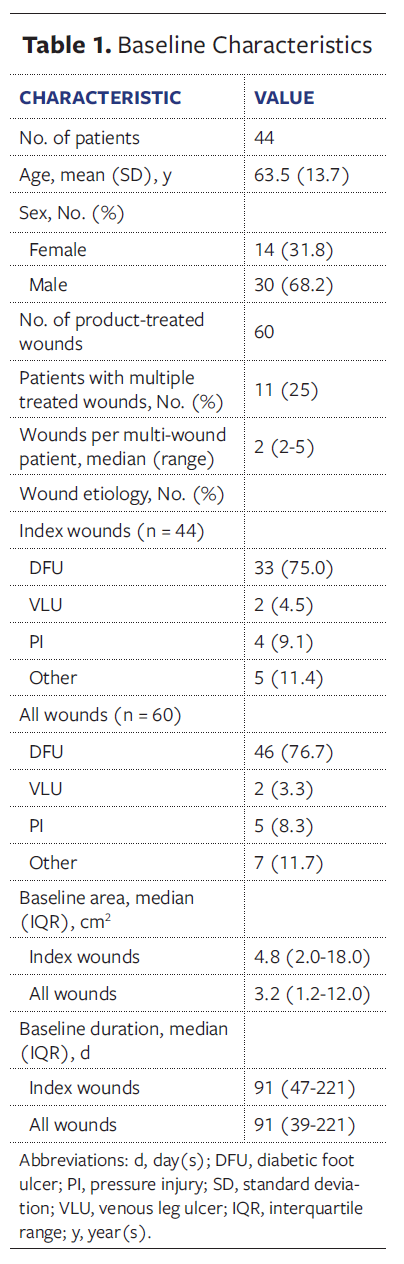
The analytic cohort included 44 patients with 60 total wounds treated with a CAMP; 11 patients (25.0%) had more than one treated wound. For the primary patient-level analyses, 1 index wound per patient was selected according to the prespecified rule described in the “Methods” section, yielding 44 index wounds. Separate secondary wound-level summaries were performed across all 60 CAMP-treated wounds.
Among the 44 index wounds, 33 (75.0%) were LEDUs, 2 (4.5%) were VLUs, 4 (9.1%) were PIs, and 5 (11.4%) were other wound types. Across all 60 wounds, 46 (76.7%) were LEDUs, 2 (3.3%) were VLUs, 5 (8.3%) were PIs, and 7 (11.7%) were other wound types. Median baseline wound area was 4.8 cm² (IQR, 2.0 cm²–18.0 cm²) for index wounds and 3.2 cm² (IQR, 1.2 cm²–12.0 cm²) for all wounds. Median baseline wound duration was 91 days (IQR, 47 days–221 days) for index wounds and 91 days (IQR, 39 days–221 days) for all wounds (Table 1). Across all 60 CAMP-treated wounds, wounds received a median of 5.5 CAMP applications (IQR, 3–8).
Primary healing endpoint
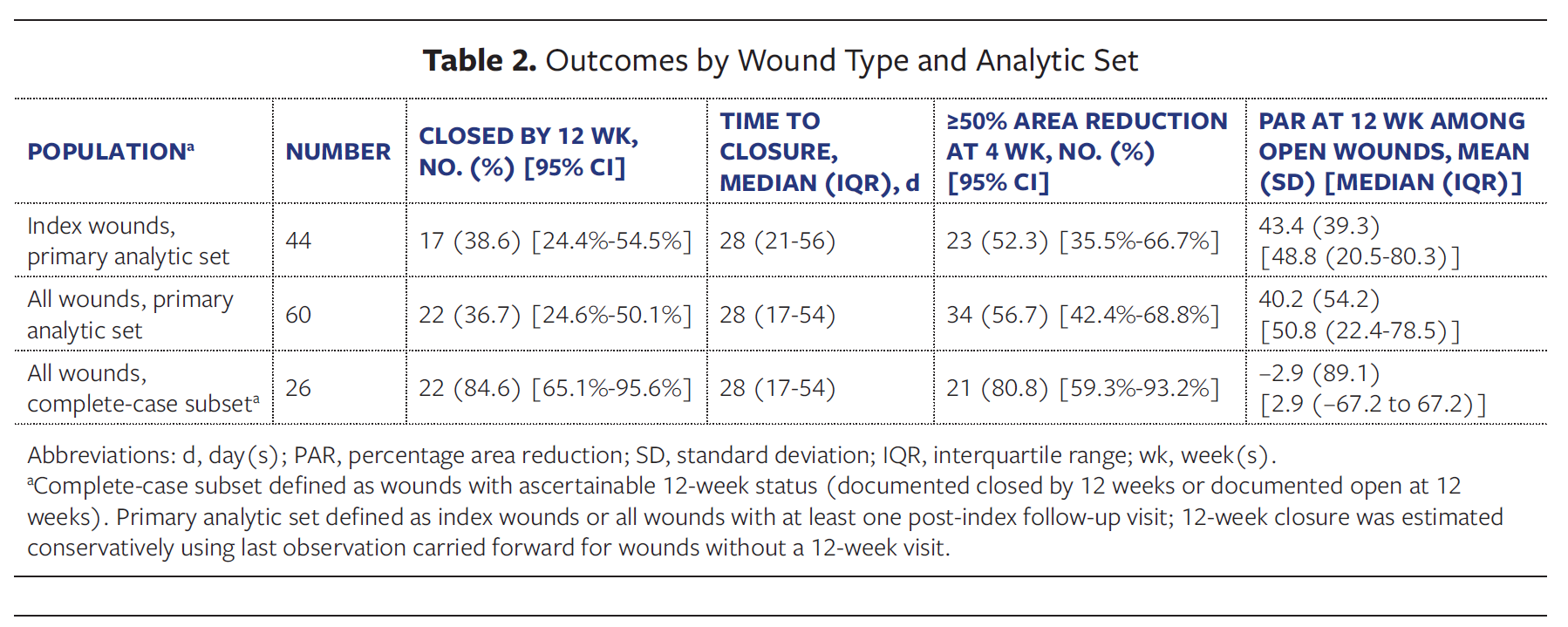
In the primary analytic set, complete wound closure by 12 weeks occurred in 17 of the 44 index wounds (38.6%; 95% CI, 24.4%-54.5%) and in 22 of all 60 wounds (36.7%; 95% CI, 24.6%-50.1%) (Table 2). In a secondary complete-case summary restricted to wounds with ascertainable 12-week status, closure was observed in 22 of 26 wounds (84.6%; 95% CI, 65.1%-95.6%). Because follow-up was incomplete in some patients and the complete-case subset excludes wounds without ascertainable 12-week status, this latter estimate should be interpreted descriptively rather than as the principal 12-week closure result.
Secondary healing endpoints
Among wounds that healed, median time from the index visit to documented wound closure was 28 days for both index wounds and all wounds. At 4 weeks, 23 of 44 index wounds (52.3%) and 34 of all 60 wounds (56.7%) achieved at least 50% area reduction from baseline. Among wounds remaining open at 12 weeks, the median percentage area reduction was 48.8% for index wounds and 50.8% for all wounds, indicating that many wounds that were not closed nevertheless demonstrated meaningful contraction during follow-up.
Outcomes by CAMP
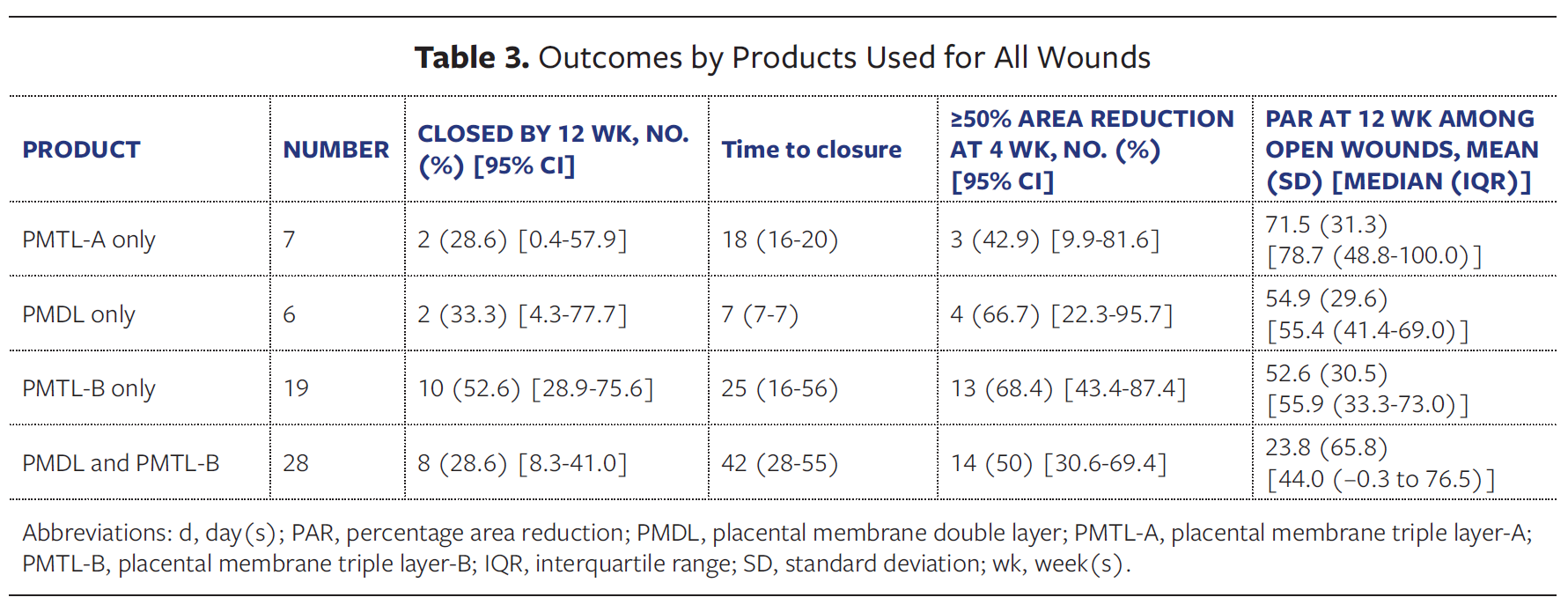
Product-specific outcomes were summarized descriptively only (Table 3). Because the study was not designed or powered to compare individual CAMPs, and because product selection likely reflected differences in wound severity and chronicity, no meaningful comparative inference should be drawn regarding healing rates or time to closure between products.
Discussion
This registry-derived case series provides pragmatic descriptive benchmarks for CAMP-treated wounds in routine clinical practice. In the primary analytic set, complete wound closure by 12 weeks occurred in 38.6% of index wounds and 36.7% of all treated wounds. Among wounds that healed, median time from first CAMP application to documented closure was 28 days, and approximately half of wounds achieved at least 50% area reduction by 4 weeks. Many wounds that remained open at 12 weeks nevertheless demonstrated substantial contraction over the course of follow-up.
Because LEDUs accounted for 75.0% of index wounds and 76.7% of all wounds, these findings should be interpreted primarily as a registry-based description of CAMP-treated LEDU care, with smaller contributions from VLUs, PIs, and other wound types including post-surgical and trauma wounds. Beyond wound etiology, the study population had substantial multimorbidity and hard-to-heal wound burden, with frequent diabetes-associated complications, peripheral vascular disease, chronic kidney disease, cardiovascular disease, prior amputation, and prolonged wound duration (Supplemental Table 1). Considerable heterogeneity in wound trajectories, wound duration, baseline area, and treatment exposure was observed across individual wounds (Supplemental Table 2). These characteristics are often underrepresented in RCTs and likely contributed to the modest 12-week closure proportion observed in this routine care cohort. The observed time to closure among healed wounds and the degree of area reduction in many of the wounds that had not closed by 12-week follow-up suggest heterogeneous but clinically meaningful wound responses in a medically complex real-world population.
This registry-derived case series complements both controlled trial evidence and claims-based real-world evidence. RCTs provide controlled efficacy data but often enroll more narrowly defined patient populations than those encountered in routine wound care, whereas administrative claims analyses are useful for characterizing broad population-level outcomes, including amputations, hospital utilization, recurrence, mortality, and costs. However, claims data generally do not capture direct wound-level measures such as wound area, wound duration, percentage area reduction, timing of closure, product exposure, number of applications, or clinician-documented wound status. Prospective observational wound registries can provide this clinical granularity, although they remain limited by smaller sample size, nonstandardized follow-up, and absence of a concurrent control group. Given this descriptive design, the present analysis should not be interpreted as demonstrating comparative effectiveness versus standard care, total contact casting, or other evidence-based interventions, nor can it isolate the independent contribution of CAMP application from the standard wound care and other co-interventions delivered in routine practice. Rather, the value of this registry-based case series is in characterizing the treated population, documenting care patterns, and providing wound-level outcome benchmarks that may help inform future controlled studies in more representative real-world patients.
This distinction is especially relevant when interpreting the complete-case analysis. The complete-case closure proportion was higher than the primary analytic estimate; however, because follow-up was incomplete in some patients and wounds without ascertainable 12-week status were excluded from that subset, the complete-case result should be interpreted cautiously and not as the principal effectiveness estimate. In routine care, follow-up may end for multiple reasons, including wound closure, transition of care, loss to follow-up, or continued management outside the registry, and these pathways cannot always be distinguished retrospectively. For that reason, the conservative primary analytic result is the more appropriate summary of 12-week closure in this report.
Limitations
This study has several limitations. First, it was a retrospective case series derived from a prospective observational wound registry and lacked a concurrent control group; therefore, no causal or comparative inference can be made regarding the effect of CAMP treatment relative to standard care or other advanced interventions. Second, the cohort was modest in size and heavily weighted toward LEDUs, thus limiting generalizability across wound etiologies. Third, follow-up occurred during routine clinical care rather than at fixed protocol-mandated intervals, resulting in incomplete ascertainment of 4-week and 12-week outcomes in some wounds and necessitating conservative imputation for the primary 12-week closure analysis. Fourth, wound management in routine practice includes multiple co-interventions, and the registry structure does not permit attribution of observed healing trajectories to CAMP application alone. The registry analysis was also limited to wound-level healing outcomes and did not evaluate recurrence, infection-related complications, amputations, hospital utilization, mortality, or costs. Finally, product-specific summaries were based on small, clinically selected subgroups and should not be interpreted as evidence of differences between individual products.
Conclusion
This registry-derived routine care cohort provides clinically interpretable wound-level benchmarks for placental membrane-based CAMP use in medically complex patients with hard-to-heal wounds, most of whom had LEDUs. The findings suggest that meaningful healing trajectories were observed in routine practice, including complete closure in a subset of wounds and substantial wound area reduction in many wounds that remained open during follow-up. Because this analysis was descriptive, lacked a concurrent control group, and included nonstandardized follow-up, the results should be interpreted as pragmatic real-world outcome benchmarks rather than evidence of comparative effectiveness. Larger controlled studies with standardized follow-up, broader wound-type representation, and appropriate comparator groups are needed to better define the role of placental membrane-based CAMPs across diverse wound care settings.
Author and Public Information
Authors: William Tettelbach, MD, CHWS1,2,3; Julie Schottenstein, MS, DPM, CIME4; Mohanad Eltahir, DPM5; Mario Cala, DPM6; Juliette Perez, DPM6; Fadi Jaafar, DPM7; Brian Gillette, PhD8; and Paul Fawson, DPM7
Affiliations: 1Duke University School of Medicine, Durham, NC, USA; 2Western University of Health Sciences, Pomona, CA, USA; 3RestorixHealth, Metairie, LA, USA; 4The Schottenstein Center, Miami, FL, USA; 5Pima Foot and Ankle Surgery, Casa Adobes, AZ, USA; 6PerfectFeetCare Podiatry Centers, Miami, FL, USA; 7Acesso Biologics, Las Vegas, NV, USA; 8Droice Research, New York, NY, USA
Funding: No external funding was received for preparation of this manuscript.
Disclosure: FJ and PF are affiliated with Acesso Biologics, the manufacturer of the study products. The remaining authors disclose no conflicts of interest.
Data Availability: The data supporting this analysis are derived from the SIDDX registry and are not publicly available because of patient privacy and registry governance restrictions. Deidentified aggregate data may be available from the corresponding author upon reasonable request and subject to applicable approvals.
Ethical Statement: The parent SIDDX registry received ethics approval from Advarra IRB on September 27, 2023 (ID: SIDDXAC02). This retrospective analysis used registry-derived data collected during routine clinical care. Patient consent was obtained under the parent registry protocol.
Correspondence: Paul Fawson, DPM, ABPM; Acesso Biologics, 1980 Festival Plaza Dr, Suite 850, Las Vegas, NV, 89135; paul@acessobio.com
Manuscript Accepted: May 27, 2026
Recommended Citation
Tettelbach W, Schottenstein J, Eltahir M, et al. Healing outcomes after placental membrane-based skin substitute allografts in multiple wound types in routine care: a retrospective case series from a prospective observational wound registry. Wounds. 2026;38(8):196-200. doi:10.25270/wnds/25138
References
- Wu S, Carter M, Cole W, et al. Best practice for wound repair and regeneration use of cellular, acellular and matrix-like products (CAMPs). J Wound Care. 2023;32(Sup4b):S1-S31. doi:10.12968/jowc.2023.32.Sup4b.S1
- Mohammed YA, Farouk HK, Gbreel MI, et al. Human amniotic membrane products for patients with diabetic foot ulcers. Do they help? A systematic review and meta-analysis. J Foot Ankle Res. 2022;15(1):71. doi:10.1186/s13047-022-00575-y
- Alomairi AA, Alhatlani RA, Alharbi SM, et al. Assessing the application and effectiveness of human amniotic membrane in the management of venous and diabetic ulcers: a systematic review and meta-analysis of randomized controlled trials. Cureus. 2024;16(3):e56659. doi:10.7759/cureus.56659
- Ruiz-Muñoz M, Martinez-Barrios FJ, Lopezosa-Reca E. Placenta-derived biomaterials vs. standard care in chronic diabetic foot ulcer healing: a systematic review and meta-analysis. Diabetes Metab Syndr. 2025;19(1):103170. doi:10.1016/j.dsx.2024.103170
- Armstrong DG, Tettelbach WH, Chang TJ, et al. Observed impact of skin substitutes in lower extremity diabetic ulcers: lessons from the Medicare Database (2015-2018). J Wound Care. 2021;30(Sup7):S5-S16. doi:10.12968/jowc.2021.30.Sup7.S5
- Tettelbach WH, Driver V, Oropallo A, et al. Treatment patterns and outcomes of Medicare enrolees who developed venous leg ulcers. J Wound Care. 2023;32(11):704-718. doi:10.12968/jowc.2023.32.11.704
- Tettelbach WH, Armstrong DG, Tucker T, et al. Rethinking regulatory tiers: Medicare real-world evidence shows CAMP outcomes are independent of FDA regulatory classification. J Wound Care. 2026;35(1):35-46. doi:10.12968/jowc.2025.0609
- Tettelbach WH, Armstrong DG, Oropallo A, et al. Real-world outcomes of cellular, acellular, and matrix-like products (CAMPs) in stage 3 pressure injury ulcers: a matched Medicare claims analysis (2016-2024). Int J Tissue Repair. 2026;2(1). doi:10.63676/dj8g4218