Maryland’s Oldest Active EMT Shifts Focus to Training Next Generation
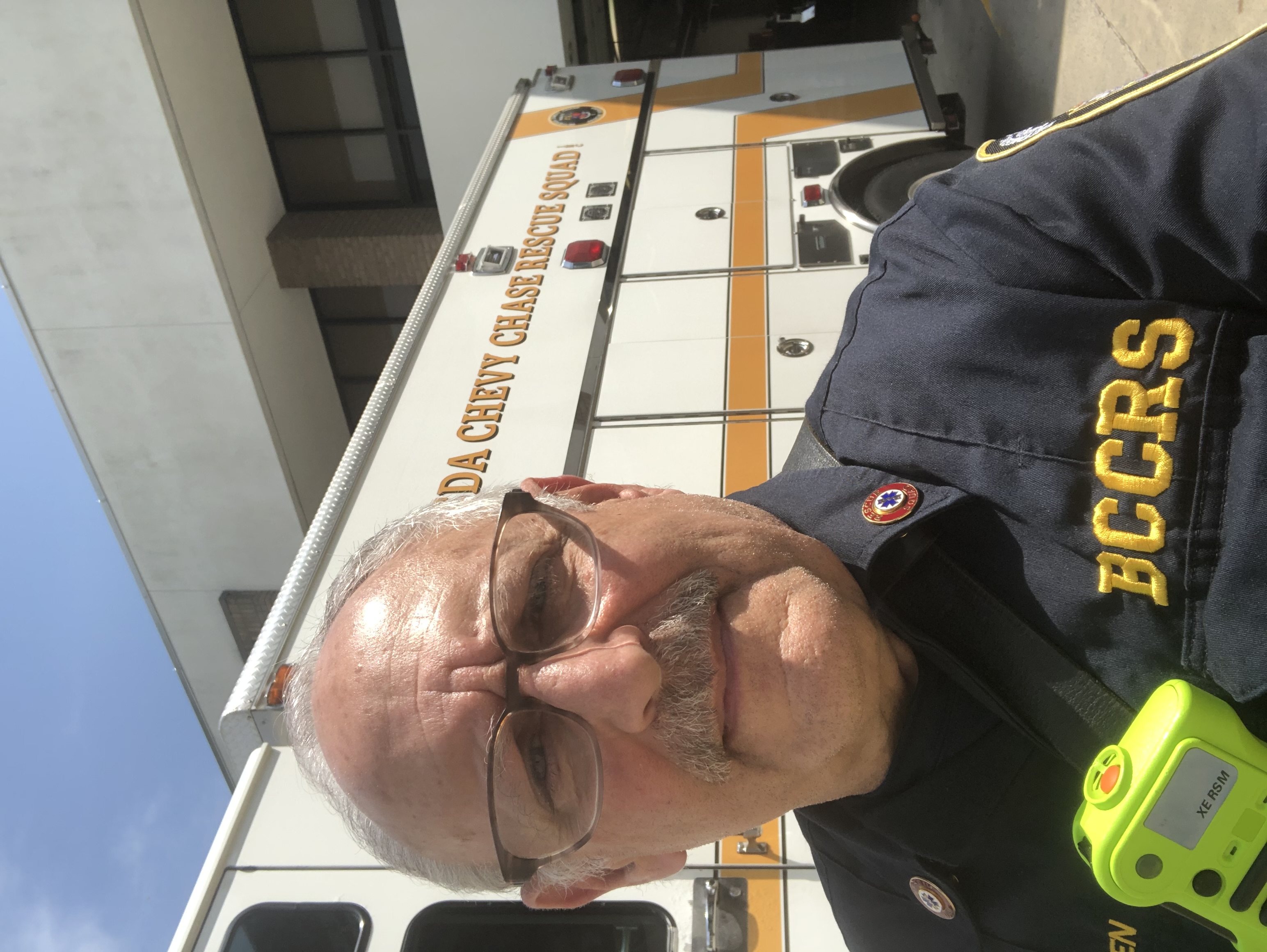
In 2013, Ed Levien drove by a digital billboard in front of the Bethesda-Chevy Chase Rescue Squad headquarters that indicated the agency was seeking volunteers. It caught his eye. Before long, Levien, now 76, would become the oldest active EMT in the state of Maryland.
In 2000, Levien sustained a moped injury while he and his wife were vacationing in Bermuda. It would become a driving factor in appreciating the help of strangers and wanting to volunteer in emergency medicine.
“It was a very strange accident where we were basically at a stop, something happened, we lost balance, fell over, and my arm hit the curb,” says Levien. “There wasn't a mark on me, but my arm broke in such a way that it severed my radial nerve.”
Realizing Levien had become paralyzed, rescue workers in Bermuda had him medically air evacuated back to the U.S.
Doctors told his family he would never use his left arm again. He challenged that assertion. “I was paralyzed for about two years, but I kept believing that I was going to make the impossible happen, because nerves do not regenerate,” he said. “Eventually, after about two years, I started to have minor movement. The surgeon who fixed the broken arm can think of only one possible explanation why I got any movement back, and that is when he went in to repair the bone, he moved two ends of the nerve that were severed and basically, he put one end on top of the other to get it out of his way.
“So it was just sitting on top. And that's why I have any movement at all. It was a silly mistake. And he said ‘how else could it happen?’ It took a long time for me to have full movement. I still have pain from it, but it's a long time ago.”
Levien notes his wife Robin “who is responsible for everything good and positive in my life was tired of me feeling sorry for myself. It was hard to recover from that accident. Strangers would see me struggling to eat if I were by myself, and they would help me—they would cut my food. It was very humbling to need help. It was awful.”
Robin Levien suggested her husband train Labrador retrievers to become service dogs for wounded Iraq veterans. “That was the first thing I did coming out of my self-pity stage,” Levien said. But he found it gut-wrenching to spend two years training a dog and then having to part with the dog.
Upon seeing the Bethesda-Chevy Chase Rescue Squad billboard, Levien’s initial thought was he could be a dispatcher, because he believed himself to be too old to be an EMT.
“They said, ‘if you can pass the physical, we would love to have you’,” Levien said, adding he had to “pass the same test as the 20-some year-olds do.”
Levien took the same training at the Public Service Training Academy as is required by the career professionals.
“Because volunteers are not full time, it's a six-month commitment—two evenings a week and one full weekend day until you become county certified,” Levien says. “Then you have to pass all of the state certifications.
“Once you become state certified, you then have to go through their proprietary training and skills to become qualified for Rescue 1. That takes a few more months until they believe you are as good as everybody else at the squad.”
The Bethesda-Chevy Chase Rescue Squad is a nonprofit that uses 125 professionally trained volunteers and a career staff of 13 personnel to provide emergency medical, fire, and rescue services to the Bethesda-Chevy Chase area and surrounding Maryland communities.
The squad staffs a Monday through Friday day crew and seven volunteer night/weekend/holiday crews that respond to incidents 24/7. Levien notes the day crew is paid; the remainder of the staff is volunteer. The squad’s fleet provides ALS and BLS services through six ambulance/medic units, two heavy rescue squads, and one medic chase car as well as utility and command vehicles.
Levien—who had a successful career as a creative director for large national advertising agencies—notes that volunteers come from all walks of life, including six people with doctorate degrees, adding “we have a lot of high-level professional people volunteering their time.”
To date, Levien has responded to more than 3,300 calls while putting in more than 13,000 volunteer hours. Levien said his age has informed his work in terms of building rapport with patients. He is a grandfather of four children, so he relates well to young people, he said. He said while some may view younger people’s bad decisions as evidence that they are ‘worthless,’ he instead sees it as a cry for help.
“I’m able to gain their trust very quickly and calm them down,” he said. “And then we can help them. I’m used to dealing with kids, even the smaller ones, whereas the younger folks just don't have that experience. On the other side of the coin, I’m the same age as some of these older people, so I know how frightened many of them are. Older people don’t want to go to the hospital because they’re afraid they'll never come out.”
Levien said he’s able to talk and reason with them and often does quite a bit of joking with them, such as quoting actress Bette Davis by saying ‘old age ain’t no place for sissies.”
Levien’s advice for agencies seeking more staff is to seriously consider seniors.
“My wife and I do not see ourselves as old, but older. Things do change, but we don't see ourselves as being incapacitated,” he said. “I say this all of the time—it’s OK to be retired from your career, but if you also choose to be retired from life, that's when it's over. My wife refers to what I've been doing as Ed 2.0. This is like a second career, a second lease on life. I think for anyone who is physically capable of doing it, there is nothing as rewarding as helping other people.”
Levien said that while in his first career, millions of people were aware of his work and he was successful in getting people to buy products, “I never had the impact on anyone or anything that I did being in the in the back of an ambulance. When you’re older and have life experience, that stands for a lot and means a lot in patient care.”
While working as an EMT, Levien wore hearing aids and managed his emphysema. He stopped working as an EMT in April 2025 and now does training. He’s also in the process of being certified as an American Heart Association BLS instructor for hospital workers.
“You never forget the first life you save,” Levien said. And while he doesn’t remember all the patients to whom he has rendered assistance, many of them remember him. He and his wife will be at a restaurant, and someone will come up to him and thank him for saving the life of a loved one.
“It’s sort of embarrassing because there is no one in the fire service or EMS service that does any of this for accolades or thanks, and everybody works together,” he said. “We see a side of life that very few people really do. This job is truly rewarding and it’s necessary. I don’t do it for the money. It’s really great when you have a reason to get up in the morning and have something useful to do. I refer to everyone in fire-rescue as invisible heroes.”