

Balancing Rigor With Reality: Leveraging Real-World Data and Technology to Enhance Drug Innovation
Key Takeaways
- Real-world data (RWD) remains underutilized despite growing demand: Although RWD has long supported population insights, unmet need assessments, and real-world effectiveness analyses, it is still often viewed as incomplete or methodologically limited across the biopharma industry.
- Perception challenges have constrained impact: Concerns around data quality, fragmentation, and insufficient clinical detail have limited trust, appeal, and broader adoption among commercial, market access, and medical leaders.
- Recent innovations are reshaping the landscape: Advances in data generation, linkage, and accessibility are addressing historical limitations, creating new opportunities to generate more robust, actionable real-world evidence (RWE).
- Now is the moment to act: Biopharma leaders should rethink how RWD is applied—leveraging new capabilities creatively to drive more meaningful insights and decision-making across the US health care ecosystem.
RWD and the resulting RWE have been “the next big thing” for over 25 years, always tantalizingly peering at us from just over the horizon. Advocates for RWD and RWE are many, ranging from RWD vendors, population health epidemiologists, and market research and health policy analysts to medical and pharmacy directors at payer organizations and the US Food and Drug Administration (FDA). The volume and breadth of available data have the potential to overcome some of the challenges of evaluating relationships between variables within small clinical trial datasets. Given ongoing challenges in the application of RWD and RWE in Europe, the US has a unique opportunity to facilitate an across-the-table dialogue with payers and other stakeholders.
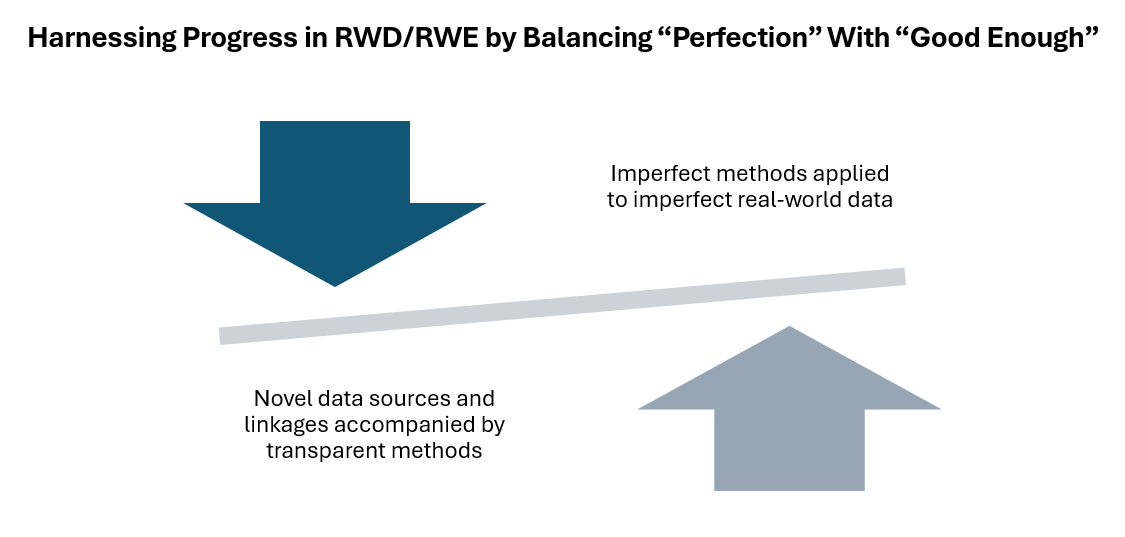
The August 2025 issue of Value & Outcomes Spotlight from The Professional Society for Health Economics and Outcomes Research (ISPOR) was themed “RWE to Improve Healthcare Decision Making.” In the issue, multiple authors noted strengths and concerns around the use of RWD.1 Positive attributes included expanding generalizability of randomized controlled trial (RCT) data, identifying knowledge gaps and unmet needs, enhancing trial design and execution, and supporting payer and regulatory decisions. However, challenges in RWE overreach were flagged including discerning causality, data dredging, methodologic transparency, and reproducibility (Figure 1).
Despite the increased attention and focus on the potential for RWD, acceptance remains relatively low, particularly in the clinical setting.2 In this article, we discuss recent advances in the RWD and RWE field that offer great promise for the biopharma innovator and the challenges that have limited its wider adoption.
Health Care Real-World Data: Growth and Challenges
Health care RWD has historically been characterized as data related to patient health status or care delivery. The data comes from different sources and include several elements, such as demographic, clinical, diagnostic, laboratory, imaging, medical procedure, therapeutic, and payer reimbursement information. It can also include health insurance coverage details, which can support descriptive analyses on disease and treatment-based cohorts. In recent years, social determinants of health (SDOH), prescription filling and abandonment details (eg, rejection, reversal) and patient out-of-pocket copayment costs, genomic profiles, and employment status have been embraced as RWD sources. These enhancements coincide with the increased acceptability of RWD by the FDA for advancing the development of products and strengthening their monitoring throughout the lifecycle.3
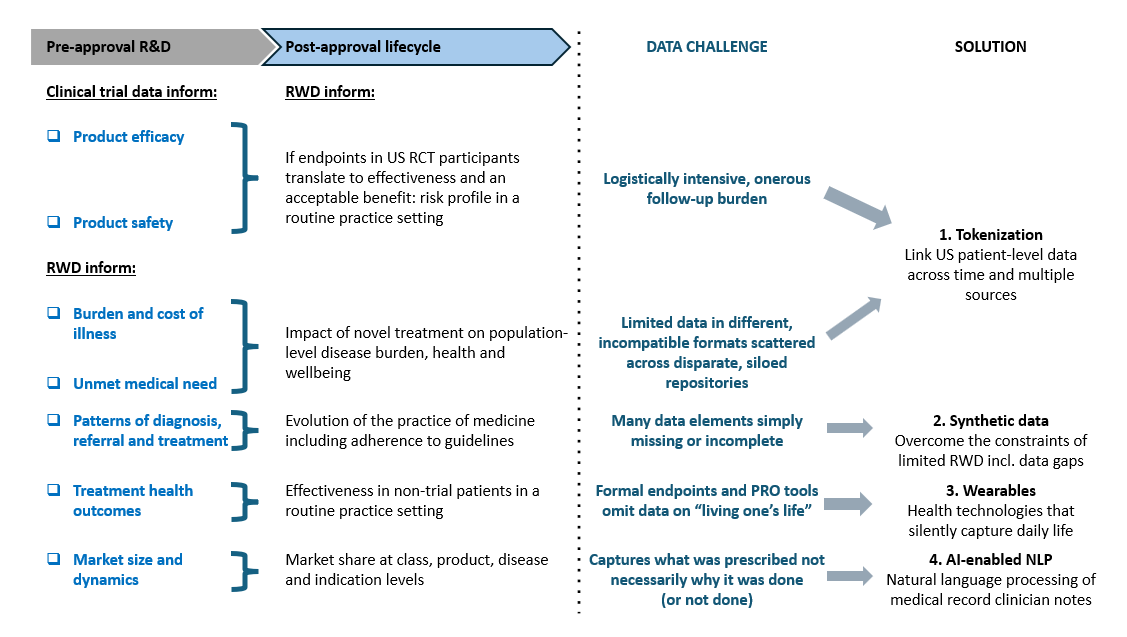
Despite increasing availability of content and growing acceptability, several challenges have limited adoption of RWD over the years (Figure 2). For instance, skeptics of RWD argue that it is “never the right data” in that it does not contain real-time patient experience or specifics about what a doctor has done and why. However, 4 emerging technological advances have the potential to overcome such limitations: tokenization, synthetic data, wearable technologies, and artificial intelligence (AI)-enabled natural language processing (NLP). These tools enable the use of richer, more robust, and a higher volume of RWD. They also allow access to insights from early clinical phases of research and throughout a product’s lifecycle. This can assist payers in making more informed coverage decisions for their managed populations.
Tokenization
Tokenization is the process of linking different databases through an encrypted identification “token” that is unique to a patient. It can enrich insights from a clinical trial by linking detailed information on patients’ health histories from electronic health records (EHR) and health care claims prior to study enrollment and beyond the end of follow-up. For example, in diabetes research, tokenization can enable deeper exploration of treatment durability and long-term metabolic outcomes, including glucose trends, HbA1c levels, and downstream complications. In oncology, it can help track signs of disease progression or recurrence after patients complete the formal clinical trial period, generating evidence that would otherwise require costly long-term clinical studies. This provides payers and other stakeholders with a longitudinal view into the patient’s journey not previously available.
While promising, tokenization is not without limitations. Methods are evolving but are not yet standardized across data sources, which can lead to mismatched or incomplete patient linkages.4 Even when data linkage is successful, the underlying data can be fragmented, incomplete, or inconsistent in format, making it difficult to mesh with carefully collected clinical trial data. Privacy concerns and regulatory skepticism further complicate adoption.
As data are linked across multiple sources, the risk of patient reidentification increases, which creates the potential for violations under the Health Insurance Portability and Accountability Act (HIPAA), General Data Protection Regulation (GDPR), and other frameworks. Operationally, sponsors must navigate a complex web of contracts, data rights, and vendor relationships to leverage RWD. Meanwhile, regulators are still evolving their guidance on how such linked RWD can be used to support clinical evidence. Finally, regulatory ambiguity and varying data privacy laws around the globe present additional headwinds to navigate.
Synthetic Data
Emerging data science techniques and tools such as autoencoders can create RWD observations that mimic actual data. Applying AI and large language model (LLM) technologies to an RWD file (ie, the learning dataset) allows the production of a larger, research-ready dataset with several practical advantages. These include the ability to create the data faster, fill in gaps in existing RWD, and bypass ethics and Institutional Review Board (IRB) review.5 Such synthetic datasets also enable exploration of temporal relationships between variables in the data where actual RWD may be constrained by EHR, health insurance claims-based date and time stamps, or privacy rules for combining different datasets in the EU. These sources offer biopharma companies a useful laboratory to explore data patterns and develop hypotheses for future validation in the RWD.
Wearable Technologies
Wearables hold promise in clinical research because they enhance efficiency through streamlined data collection and help to capture longitudinal real-world outcomes and post-market surveillance. These tools collect continuous, real-time data, offering insights into patient behavior, physiological patterns, and health status beyond what can be gathered during periodic site visits in a short-duration study.6 Devices like Fitbit, Apple Watch, and other sensor-enabled wearables can record step count, heart rate variability, sleep patterns, mood, and patient-reported symptoms, providing a dynamic and individualized view of a patient’s health in naturalistic settings. Furthermore, wearable technologies promote equity by allowing for remote participation, which can be important for elderly patients, those with mobility issues, and individuals in underserved or geographically isolated areas.
Despite their potential and increasing support for their use, wearables remain underutilized in clinical research.7 Barriers limiting their adoption include issues of standardization, data quality, validation, and bias. In terms of standardization, devices use different sensors, metrics, and proprietary algorithms. This limits comparability and complicates regulatory acceptance. For example, Fitbit’s internal algorithms for measuring step count and sleep quality are not disclosed, which makes it difficult to interpret or reproduce findings across platforms. Biases are introduced through inconsistent wear time, incorrect usage, and missing data. Research suggests that at least 10 hours of daily wear is needed to capture meaningful activity data, yet adherence often falls short without structured support or training, undermining the reliability and interpretability of wearable data .7
Further development of standardized frameworks and metrics could potentially advance and expand the use of wearables. Industry initiatives such as the Clinical Trials Transformation Initiative (CTTI) have laid the groundwork by recommending consistent endpoints and data formats to help facilitate comparison and regulatory review.8,9
AI-Powered NLP
AI-powered NLP algorithms automate labor intensive and tedious tasks with language processing algorithms. They use text systems and machine learning to analyze data and patterns from unstructured data, allowing for faster and richer insights to help users make more informed assessments and treatment decisions.10 While NLP methods have been around for many years, data and software limitations associated with them are substantial. Access to high quality data in systems with rigorous computational capacity for training the NLP models is critical, as is ensuring patient privacy. Encouragingly, NLP methods and software are advancing at a rapid place and the potential for widespread validation and application is clear.11
Strategic Priorities for Biopharma
With careful governance, validation processes, and strong regulatory engagement, these RWD tools can be transformative in modernizing clinical and observational research. For the biopharma industry, the required investment to develop these tools amounts to a fraction of the cost of clinical research. As such, it is worthwhile for the industry to move these advances forward faster, while focusing on a few key focus areas.
First, trust is essential in any data-driven approach to evidence generation. To build trust, these tools must be in compliance with HIPAA, GDPR, and other regulations to ensure the safeguarding of patient information. In addition, secure and consistent tokenization methods, encryption protocols, and consent management tools must be built into all systems collecting or storing wearable and RWD.
Second, payers have an important role to play when it comes to RWD. For instance, in a value-based care environment, RWD can help quantify treatment effectiveness in real-world settings, informing outcome-based contracts and coverage decisions. For this reason, aligning wearable and RWD outputs with payer-relevant outcomes that translate to value—such as hospitalization rates, quality of life, or time to progression—will be important for demonstrating return on investment.
Finally, engaging clinical champions and patient advocacy organizations can accelerate the cultural shift required for broad adoption of supplemental RWD. By highlighting the patient-centered benefits of these technologies and sharing success stories, the industry can build a more receptive environment for innovation.
Conclusion
To move these technological advances in RWD from potential to standard practice, industry stakeholders—including pharmaceutical manufacturers, regulators, payers, device manufacturers, and health systems—will need to work collaboratively to create a path forward that enhances both the scientific and practical utility of these data. Realizing this potential will require focused action across several dimensions including technical, regulatory, operational, and cultural. Early investment in pilot studies, standardization of metrics and devices, validation of endpoints, privacy protections, and alignment with payer priorities are all essential for further developing these RWD tools.
While the FDA has issued guidance on digital health technologies and supports the use of RWD in regulatory submissions, approved processes and frameworks continue to evolve. Outside the US, the adoption of wearable-generated data is slower, with the EU’s GDPR and other local laws imposing stricter requirements on data use and patient consent. The US is well-positioned to lead this evolution, given its supportive regulatory environment and growing openness to RWD in regulatory and payer reimbursement decisions. Harmonization across global markets will be essential for scaling these innovations. The ultimate goal is for the next wave of evidence generation to be more based in the real-world, patient-centric, and impactful.
References
- Abbott R. Using real-world evidence to improve healthcare decision making. Value & Outcomes Spotlight. 2025;11(4):5-6. https://www.ispor.org/publications/journals/value-outcomes-spotlight/vos-archives/issue/view/real-world-evidence-in-healthcare-decisions/using-real-world-evidence-to-improve-healthcare-decision-making
- Liu F, Panagiotakos D. Real-world data: a brief review of the methods, applications, challenges and opportunities. BMC Med Res Methodol. 2022;22(1):287. doi:10.1186/s12874-022-01768-6
- Khaowroongrueng V, Kim TE, Park SI, et al. Application of real-world evidence to support FDA regulatory decision making. AAPS J. 2025 May 28;27(4):98. doi:10.1208/s12248-025-01082-1
- Walters C, Langlais CS, Oakkar EE, Hoogendoorn WE, Coutcher JB, Van Zandt M. Implementing tokenization in clinical research to expand real-world insights. Front Drug Saf Regul. 2025;5:1519307. doi:10.3389/fdsfr.2025.1519307
- Foraker R, Morrow JD, Johnson JA, Wilcox AB, Forster AJ, Payne PRO. understanding synthetic data: artificial datasets for real-world evidence. BMJ Evid Based Med. 2025;bmjebm-2024-113617. doi:10.1136/bmjebm-2024-113617
- Doherty C, Baldwin M, Keogh A, Caulfied B, Argent R. Keeping pace with wearables: a living umbrella review of systematic reviews evaluating the accuracy of consumer wearable technologies in health measurement. Sports Med. 2024;54:2907-2926. doi:10.1007/s40279-024-02077-2
- Huhn S, Axt M, Gunga HC, Maggioni MA, Munga S, Obor D, Sié A, Boudo V, Bunker A, Sauerborn R, Bärnighausen T, Barteit S. The Impact of Wearable Technologies in Health Research: Scoping Review. JMIR mHealth and uHealth. 2022;10(1):e34384. doi:10.2196/34384.
- Goldhahn J, Brasier N, Kehoe L. Digitalizing health trials by the Clinical Trials Transformation Initiative. Nat Rev Bioeng. 2024;2:717-718. doi: 10.1038/s44222-024-00212-2
- Clinical Trials Transformation Initiative (CTTI). Measuring trials transformation. Accessed October 2025. https://ctti-clinicaltrials.org/about/ctti-projects/measuring-trials-transformation.
- Jerfy A, Selden O, Balkrishnan R. The growing impact of natural language processing in healthcare and public health. Inquiry. 2024;61:1-10. doi:10.1177/00469580241290095
- Khurana D, Koli A, Khatter K, Singh S. Natural language processing: state of the art, current trends and challenges. Multimed Tools Appl. 2023;82:3713-3744. doi:10.1007/s11042-022-13428-4.