Derm Dx

DERM DX: What is the Cause of the Tender Erythema?

August 2015

A 55-year-old man presented with tender erythema on his face, arms, chest and abdomen (Figure). There was normal appearing skin occupying the anterior neck and the fold created between his breast and abdomen. Earlier that day, the patient — wearing a short-sleeved shirt and running shorts — had completed a half marathon. After completing the race, he removed his shirt and sat outside in a chair for 30 minutes before returning to covered shelter and noticing that his exposed skin was painful and red.
WHAT IS YOUR DIAGNOSIS? 
 
To learn the answer, go to page 2
 
{{pagebreak}}
 
Diagnosis: Ibuprofen-associated Phototoxic Reaction     

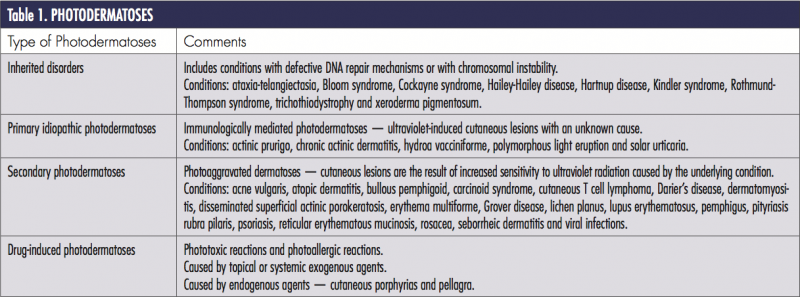
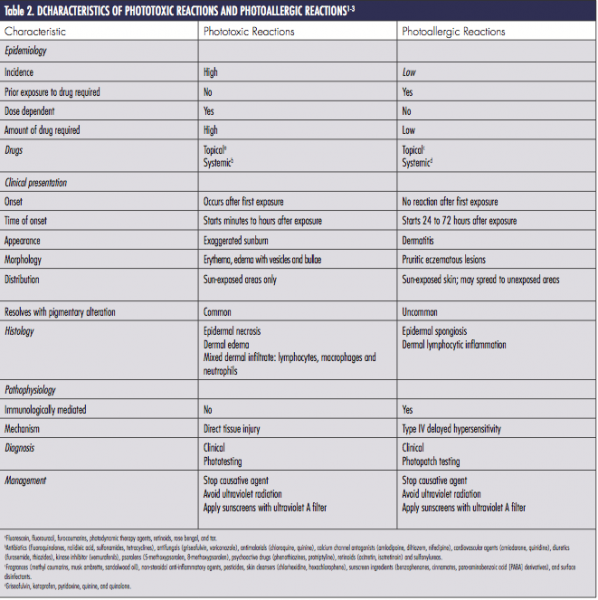
Phototoxic reactions and photoallergic reactions are drug-induced photodermatoses (Table 1). They can be caused by either topical or systemic exogenous agents. Features of phototoxic reactions and photoallergic reactions are summarized in Table 2.1-3

Phototoxic Reactions

Phototoxic reactions are caused by a phototoxic agent and ultraviolet (UV) radiation. They result from direct injury to the skin. Several mechanisms may contribute to the pathogenesis of phototoxic reactions: (1) cytotoxic injury from oxygen-dependent (type 1 or type 2) reactions following a UVA radiation energy-induced excited state of the photosensitizing drug; (2) tissue damage from stable photoproducts following irradiation of the drug and/or (3) tissue injury from biologically active substances after radiation-associated binding of the photosensitizing drug to the substrate.

A phototoxic reaction can occur minutes to hours after the first exposure to the drug and UV radiation. It does not require sensitization to the agent. However, the symptoms are dose dependent; they depend not only on the drug dose, but also the UV radiation dose.

Clinically, a phototoxic reaction presents as photodistributed sunburn with associated burning and stinging.  Areas not exposed to UV radiation are spared, such as the anterior neck and area below the breasts in the described patient (Figure).1-3

Photoallergic Reactions

Photoallergic reactions are a delayed-type hypersensitivity reaction that results when the eliciting chemical is modified by absorbing photon energy — usually UVA radiation. Photoallergic reactions are not dependent on the dose of the drug; yet, they require more than 1 episode of drug and UV radiation exposure to occur. In contrast to phototoxic reactions, photoallergic reactions occur between 24 to 72 hours after exposure to the photoallergen and UV radiation.1-3

Photoallergic reactions clinically present similar to an allergic contact dermatitis. The lesions are located on sun-exposed areas. However, they can also extend to covered areas of the body.1-3

Differential Diagnosis of Phototoxic and Photoallergic Reactions

The differential diagnosis of phototoxic reactions and photoallergic reactions includes contact dermatitis and other photodermatoses. Clinical involvement of the area under the chin, the eyelids, the nasolabial folds and the postauricular area — sites that receive minimal amounts of UV radiation or where sun exposure is unlikely — favor the diagnosis of an allergic contact dermatitis. Irritant contact dermatitis appears at sites of direct contact with the drug — occurring both in sun-exposed and sun-protected areas.

Polymorphous light eruption and solar urticaria can also mimic phototoxic reactions and photoallergic reactions. Polymorphous light eruption presents with photodistributed pruritic papules, plaques and rarely vesicles a few hours after sun exposure that resolves spontaneously in a few days. Solar urticarial — an IgE-medicated hypersensitivity reaction — appears on sun-exposed sites within minutes after the areas have been exposed to the sun and resolves spontaneously within hours.2,3

Ibuprofen-associated Cutaneous Reactions

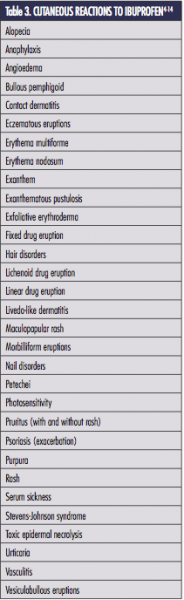
Ibuprofen (2-[4-isobutylphenyl] propionic acid) is a non-steroidal anti-inflammatory drug (NSAID). It is a member of the aryl propionic acid group. From December 1980 to July 1983, the Adverse Drug Reaction Reporting System of the American Academy of Dermatology received 135 reports of adverse drug reactions to NSAIDs; this represented 13% of all reactions reported during this period.4 Ibuprofen was the associated drug for 10 reactions: angioedema (N=2), erythema multiforme (N=1), fixed drug eruption (N=1), urticaria (N=4), vasculitis (N=1) and vesiculobullous eruption (N=1).4 Subsequent reports and reviews have confirmed these reactions and added to the profile of cutaneous reactions to ibuprofen, including photosensitivity (Table 3).4-14

NSAID-associated Photosensitivity

Photosensitivity associated with NSAIDs is usually characterized by a phototoxic reaction. Initially, investigators noted that phototoxic reactions most commonly occurred in patients who had received piroxicam — an oxicam class of NSAIDs. However, NSAID-associated phototoxicity has also been described in individuals who have received other classes of these drugs: anthranilic acids (mefenemic acid), heterocyclic acetic acids (indomethacin and sulindac), propionic acid derivatives (benoxprofen, fenbufen, fenoprofen, ibuprofen, naproxen and tiaprofenic acid) and pyrazolones (azapropazone).3-7,10

Ibuprofen-associated Photosensitivity

Ibuprofen-associated photosensitivity is less common as compared to photosensitivity caused by other propionic acid derivatives; however, 36 reports of photosensitivity (representing 5.3% of the cutaneous reactions to ibuprofen) were reported to the Committee on Safety of Medicines in London, England.7 A 41-year-old woman demonstrated photosensitivity to ibuprofen and a lowered minimal erythema dose for UVA after oral administration of the drug.6 The patient described had a phototoxic reaction to ibuprofen with cutaneous reaction appearing within 30 minutes after exposure to sunlight.

The Patient

The patient had taken 800 mg of ibuprofen 2 hours prior to running the half marathon; he was not taking any other medications and had not applied sunscreen. Most of the race had been completed prior to the sun being overhead. About 6 hours after taking the drug, the patient removed his shirt and relaxed in a chair that was located outside with continuous exposure to the sun.

Within 30 minutes not only the patient’s chest and abdomen but also his face and arms had a burning sensation and appeared red. The painful erythema slowly resolved spontaneously during the next 7 days.

Conclusion

Phototoxic reactions and photoallergic reactions are photodermatoses. Phototoxic reactions result from direct tissue injury secondary to the causative drug and UV radiation; it presents as an exaggerated sunburn within 30 minutes to hours after the initial exposure to the drug and UV radiation. Photoallergic reactions are a type IV hypersensitivity reaction resulting from UV radiation altering the eliciting drug; it does not occur at the time of the patient’s initial exposure to the drug and UV radiation. Photoallergic reactions present as dermatitis 24 to 72 hours after the inducing event. Ibuprofen is an NSAID that can cause numerous cutaneous adverse reactions, including a drug-associated phototoxic reaction. 


Dr. Cohen is with the department of dermatology at the University of California San Diego in San Diego, CA.


Disclosure: The authors report no relevant financial relationships. 


References

1. Drucker AM, Rosen CF:  Drug-induced photosensitivity:  culprit drugs, management and prevention.  Drug Saf 2011;34(10):821-837.

2. Kutlubay Z, Sevim A, Engin B, Tuzun Y. Photodermatoses, including phototoxic and photoallergic reactions (internal and external). Clin Dermatol. 2014;32(1):73-79.

3. Dawe RS, Ibbotson SH. Drug-induced photosensitivity. Dermatol Clin. 2014;32(3):363-368.

4. Stern RS, Bigby M. An expanded profile of cutaneous reactions to nonsteroidal anti-inflammatory drugs. Reports to a specialty-based system for spontaneous reporting of adverse reactions to drugs. JAMA. 1984;252(11):1433-1437.

5. Sanchez-Borges M, Capriles-Hulett A, Caballero-Fonseca F. Risk of skin reactions when using ibuprofen-based medicines. Expert Opin Drug Saf. 2005;4(5):837-848.

6. Bergner T, Przybilla B. Photosensitization caused by ibuprofen. J Am Acad Dermatol. 1992;26(1):114-116.

7. Halpern SM, Volans GN. Cutaneous toxicity of ibuprofen. Arch Dermatol. 1994;130(2):259-260.

8. Chaudhry T, Hissaria P, Wiese M, Heddle R, Kette F, Smith WB. Oral drug challenges in non-steroidal anti-inflammatory drug–induced urticarial, angioedema and anaphylaxis. Intern Med J. 2012;42(6):665-671.

9. Kwang LW, Kidon MI, Chin CW, Hoon LS, Hwee CY, Chong NK. Severe anaphylactic reaction to ibuprofen in a child with recurrent urticarial. Pediatrics. 2007;120(3):e742-e744.

10. Bigby M, Stern R. Cutaneous reactions to nonsteroidal anti-inflammatory drugs. A review. J Am Acad Dermatol. 1985;12(5 Pt 1):866-876.

11. Suarez SM, Cohen PR, DeLeo VA. Bullous photosensitivity to naproxen: “pseudoporphyria.” Arthritis Rheum.1990;33(6):903-908.

12. Davidson KA, Ringpfeil F, Lee JB. Ibuprofen-induced bullous leukocytoclastic vasculitis. Cutis. 2001;67(4):303-307.

13. Ben-Chetrit E, Rubinow A. Exacerbation of psoriasis by ibuprofen. Cutis. 1986;38(1):45.

14. Alfonso R, Belinchon I. Linear drug eruption. Eur J Dermatol. 2001;11(2):122-123.
A 55-year-old man presented with tender erythema on his face, arms, chest and abdomen (Figure). There was normal appearing skin occupying the anterior neck and the fold created between his breast and abdomen. Earlier that day, the patient — wearing a short-sleeved shirt and running shorts — had completed a half marathon. After completing the race, he removed his shirt and sat outside in a chair for 30 minutes before returning to covered shelter and noticing that his exposed skin was painful and red.


WHAT IS YOUR DIAGNOSIS? 
 
To learn the answer, go to page 2
 
{{pagebreak}}
 
Diagnosis: Ibuprofen-associated Phototoxic Reaction     

Phototoxic reactions and photoallergic reactions are drug-induced photodermatoses (Table 1). They can be caused by either topical or systemic exogenous agents. Features of phototoxic reactions and photoallergic reactions are summarized in Table 2.1-3

Phototoxic Reactions

Phototoxic reactions are caused by a phototoxic agent and ultraviolet (UV) radiation. They result from direct injury to the skin. Several mechanisms may contribute to the pathogenesis of phototoxic reactions: (1) cytotoxic injury from oxygen-dependent (type 1 or type 2) reactions following a UVA radiation energy-induced excited state of the photosensitizing drug; (2) tissue damage from stable photoproducts following irradiation of the drug and/or (3) tissue injury from biologically active substances after radiation-associated binding of the photosensitizing drug to the substrate.

A phototoxic reaction can occur minutes to hours after the first exposure to the drug and UV radiation. It does not require sensitization to the agent. However, the symptoms are dose dependent; they depend not only on the drug dose, but also the UV radiation dose.

Clinically, a phototoxic reaction presents as photodistributed sunburn with associated burning and stinging.  Areas not exposed to UV radiation are spared, such as the anterior neck and area below the breasts in the described patient (Figure).1-3

Photoallergic Reactions

Photoallergic reactions are a delayed-type hypersensitivity reaction that results when the eliciting chemical is modified by absorbing photon energy — usually UVA radiation. Photoallergic reactions are not dependent on the dose of the drug; yet, they require more than 1 episode of drug and UV radiation exposure to occur. In contrast to phototoxic reactions, photoallergic reactions occur between 24 to 72 hours after exposure to the photoallergen and UV radiation.1-3

Photoallergic reactions clinically present similar to an allergic contact dermatitis. The lesions are located on sun-exposed areas. However, they can also extend to covered areas of the body.1-3

Differential Diagnosis of Phototoxic and Photoallergic Reactions

The differential diagnosis of phototoxic reactions and photoallergic reactions includes contact dermatitis and other photodermatoses. Clinical involvement of the area under the chin, the eyelids, the nasolabial folds and the postauricular area — sites that receive minimal amounts of UV radiation or where sun exposure is unlikely — favor the diagnosis of an allergic contact dermatitis. Irritant contact dermatitis appears at sites of direct contact with the drug — occurring both in sun-exposed and sun-protected areas.

Polymorphous light eruption and solar urticaria can also mimic phototoxic reactions and photoallergic reactions. Polymorphous light eruption presents with photodistributed pruritic papules, plaques and rarely vesicles a few hours after sun exposure that resolves spontaneously in a few days. Solar urticarial — an IgE-medicated hypersensitivity reaction — appears on sun-exposed sites within minutes after the areas have been exposed to the sun and resolves spontaneously within hours.2,3

Ibuprofen-associated Cutaneous Reactions

Ibuprofen (2-[4-isobutylphenyl] propionic acid) is a non-steroidal anti-inflammatory drug (NSAID). It is a member of the aryl propionic acid group. From December 1980 to July 1983, the Adverse Drug Reaction Reporting System of the American Academy of Dermatology received 135 reports of adverse drug reactions to NSAIDs; this represented 13% of all reactions reported during this period.4 Ibuprofen was the associated drug for 10 reactions: angioedema (N=2), erythema multiforme (N=1), fixed drug eruption (N=1), urticaria (N=4), vasculitis (N=1) and vesiculobullous eruption (N=1).4 Subsequent reports and reviews have confirmed these reactions and added to the profile of cutaneous reactions to ibuprofen, including photosensitivity (Table 3).4-14

NSAID-associated Photosensitivity

Photosensitivity associated with NSAIDs is usually characterized by a phototoxic reaction. Initially, investigators noted that phototoxic reactions most commonly occurred in patients who had received piroxicam — an oxicam class of NSAIDs. However, NSAID-associated phototoxicity has also been described in individuals who have received other classes of these drugs: anthranilic acids (mefenemic acid), heterocyclic acetic acids (indomethacin and sulindac), propionic acid derivatives (benoxprofen, fenbufen, fenoprofen, ibuprofen, naproxen and tiaprofenic acid) and pyrazolones (azapropazone).3-7,10

Ibuprofen-associated Photosensitivity

Ibuprofen-associated photosensitivity is less common as compared to photosensitivity caused by other propionic acid derivatives; however, 36 reports of photosensitivity (representing 5.3% of the cutaneous reactions to ibuprofen) were reported to the Committee on Safety of Medicines in London, England.7 A 41-year-old woman demonstrated photosensitivity to ibuprofen and a lowered minimal erythema dose for UVA after oral administration of the drug.6 The patient described had a phototoxic reaction to ibuprofen with cutaneous reaction appearing within 30 minutes after exposure to sunlight.

The Patient

The patient had taken 800 mg of ibuprofen 2 hours prior to running the half marathon; he was not taking any other medications and had not applied sunscreen. Most of the race had been completed prior to the sun being overhead. About 6 hours after taking the drug, the patient removed his shirt and relaxed in a chair that was located outside with continuous exposure to the sun.

Within 30 minutes not only the patient’s chest and abdomen but also his face and arms had a burning sensation and appeared red. The painful erythema slowly resolved spontaneously during the next 7 days.

Conclusion

Phototoxic reactions and photoallergic reactions are photodermatoses. Phototoxic reactions result from direct tissue injury secondary to the causative drug and UV radiation; it presents as an exaggerated sunburn within 30 minutes to hours after the initial exposure to the drug and UV radiation. Photoallergic reactions are a type IV hypersensitivity reaction resulting from UV radiation altering the eliciting drug; it does not occur at the time of the patient’s initial exposure to the drug and UV radiation. Photoallergic reactions present as dermatitis 24 to 72 hours after the inducing event. Ibuprofen is an NSAID that can cause numerous cutaneous adverse reactions, including a drug-associated phototoxic reaction. 


Dr. Cohen is with the department of dermatology at the University of California San Diego in San Diego, CA.


Disclosure: The authors report no relevant financial relationships. 


References

1. Drucker AM, Rosen CF:  Drug-induced photosensitivity:  culprit drugs, management and prevention.  Drug Saf 2011;34(10):821-837.

2. Kutlubay Z, Sevim A, Engin B, Tuzun Y. Photodermatoses, including phototoxic and photoallergic reactions (internal and external). Clin Dermatol. 2014;32(1):73-79.

3. Dawe RS, Ibbotson SH. Drug-induced photosensitivity. Dermatol Clin. 2014;32(3):363-368.

4. Stern RS, Bigby M. An expanded profile of cutaneous reactions to nonsteroidal anti-inflammatory drugs. Reports to a specialty-based system for spontaneous reporting of adverse reactions to drugs. JAMA. 1984;252(11):1433-1437.

5. Sanchez-Borges M, Capriles-Hulett A, Caballero-Fonseca F. Risk of skin reactions when using ibuprofen-based medicines. Expert Opin Drug Saf. 2005;4(5):837-848.

6. Bergner T, Przybilla B. Photosensitization caused by ibuprofen. J Am Acad Dermatol. 1992;26(1):114-116.

7. Halpern SM, Volans GN. Cutaneous toxicity of ibuprofen. Arch Dermatol. 1994;130(2):259-260.

8. Chaudhry T, Hissaria P, Wiese M, Heddle R, Kette F, Smith WB. Oral drug challenges in non-steroidal anti-inflammatory drug–induced urticarial, angioedema and anaphylaxis. Intern Med J. 2012;42(6):665-671.

9. Kwang LW, Kidon MI, Chin CW, Hoon LS, Hwee CY, Chong NK. Severe anaphylactic reaction to ibuprofen in a child with recurrent urticarial. Pediatrics. 2007;120(3):e742-e744.

10. Bigby M, Stern R. Cutaneous reactions to nonsteroidal anti-inflammatory drugs. A review. J Am Acad Dermatol. 1985;12(5 Pt 1):866-876.

11. Suarez SM, Cohen PR, DeLeo VA. Bullous photosensitivity to naproxen: “pseudoporphyria.” Arthritis Rheum.1990;33(6):903-908.

12. Davidson KA, Ringpfeil F, Lee JB. Ibuprofen-induced bullous leukocytoclastic vasculitis. Cutis. 2001;67(4):303-307.

13. Ben-Chetrit E, Rubinow A. Exacerbation of psoriasis by ibuprofen. Cutis. 1986;38(1):45.

14. Alfonso R, Belinchon I. Linear drug eruption. Eur J Dermatol. 2001;11(2):122-123.
A 55-year-old man presented with tender erythema on his face, arms, chest and abdomen (Figure). There was normal appearing skin occupying the anterior neck and the fold created between his breast and abdomen. Earlier that day, the patient — wearing a short-sleeved shirt and running shorts — had completed a half marathon. After completing the race, he removed his shirt and sat outside in a chair for 30 minutes before returning to covered shelter and noticing that his exposed skin was painful and red.


WHAT IS YOUR DIAGNOSIS? 
 
To learn the answer, go to page 2
 
{{pagebreak}}
 
Diagnosis: Ibuprofen-associated Phototoxic Reaction     

Phototoxic reactions and photoallergic reactions are drug-induced photodermatoses (Table 1). They can be caused by either topical or systemic exogenous agents. Features of phototoxic reactions and photoallergic reactions are summarized in Table 2.1-3

Phototoxic Reactions

Phototoxic reactions are caused by a phototoxic agent and ultraviolet (UV) radiation. They result from direct injury to the skin. Several mechanisms may contribute to the pathogenesis of phototoxic reactions: (1) cytotoxic injury from oxygen-dependent (type 1 or type 2) reactions following a UVA radiation energy-induced excited state of the photosensitizing drug; (2) tissue damage from stable photoproducts following irradiation of the drug and/or (3) tissue injury from biologically active substances after radiation-associated binding of the photosensitizing drug to the substrate.

A phototoxic reaction can occur minutes to hours after the first exposure to the drug and UV radiation. It does not require sensitization to the agent. However, the symptoms are dose dependent; they depend not only on the drug dose, but also the UV radiation dose.

Clinically, a phototoxic reaction presents as photodistributed sunburn with associated burning and stinging.  Areas not exposed to UV radiation are spared, such as the anterior neck and area below the breasts in the described patient (Figure).1-3

Photoallergic Reactions

Photoallergic reactions are a delayed-type hypersensitivity reaction that results when the eliciting chemical is modified by absorbing photon energy — usually UVA radiation. Photoallergic reactions are not dependent on the dose of the drug; yet, they require more than 1 episode of drug and UV radiation exposure to occur. In contrast to phototoxic reactions, photoallergic reactions occur between 24 to 72 hours after exposure to the photoallergen and UV radiation.1-3

Photoallergic reactions clinically present similar to an allergic contact dermatitis. The lesions are located on sun-exposed areas. However, they can also extend to covered areas of the body.1-3

Differential Diagnosis of Phototoxic and Photoallergic Reactions

The differential diagnosis of phototoxic reactions and photoallergic reactions includes contact dermatitis and other photodermatoses. Clinical involvement of the area under the chin, the eyelids, the nasolabial folds and the postauricular area — sites that receive minimal amounts of UV radiation or where sun exposure is unlikely — favor the diagnosis of an allergic contact dermatitis. Irritant contact dermatitis appears at sites of direct contact with the drug — occurring both in sun-exposed and sun-protected areas.

Polymorphous light eruption and solar urticaria can also mimic phototoxic reactions and photoallergic reactions. Polymorphous light eruption presents with photodistributed pruritic papules, plaques and rarely vesicles a few hours after sun exposure that resolves spontaneously in a few days. Solar urticarial — an IgE-medicated hypersensitivity reaction — appears on sun-exposed sites within minutes after the areas have been exposed to the sun and resolves spontaneously within hours.2,3

Ibuprofen-associated Cutaneous Reactions

Ibuprofen (2-[4-isobutylphenyl] propionic acid) is a non-steroidal anti-inflammatory drug (NSAID). It is a member of the aryl propionic acid group. From December 1980 to July 1983, the Adverse Drug Reaction Reporting System of the American Academy of Dermatology received 135 reports of adverse drug reactions to NSAIDs; this represented 13% of all reactions reported during this period.4 Ibuprofen was the associated drug for 10 reactions: angioedema (N=2), erythema multiforme (N=1), fixed drug eruption (N=1), urticaria (N=4), vasculitis (N=1) and vesiculobullous eruption (N=1).4 Subsequent reports and reviews have confirmed these reactions and added to the profile of cutaneous reactions to ibuprofen, including photosensitivity (Table 3).4-14

NSAID-associated Photosensitivity

Photosensitivity associated with NSAIDs is usually characterized by a phototoxic reaction. Initially, investigators noted that phototoxic reactions most commonly occurred in patients who had received piroxicam — an oxicam class of NSAIDs. However, NSAID-associated phototoxicity has also been described in individuals who have received other classes of these drugs: anthranilic acids (mefenemic acid), heterocyclic acetic acids (indomethacin and sulindac), propionic acid derivatives (benoxprofen, fenbufen, fenoprofen, ibuprofen, naproxen and tiaprofenic acid) and pyrazolones (azapropazone).3-7,10

Ibuprofen-associated Photosensitivity

Ibuprofen-associated photosensitivity is less common as compared to photosensitivity caused by other propionic acid derivatives; however, 36 reports of photosensitivity (representing 5.3% of the cutaneous reactions to ibuprofen) were reported to the Committee on Safety of Medicines in London, England.7 A 41-year-old woman demonstrated photosensitivity to ibuprofen and a lowered minimal erythema dose for UVA after oral administration of the drug.6 The patient described had a phototoxic reaction to ibuprofen with cutaneous reaction appearing within 30 minutes after exposure to sunlight.

The Patient

The patient had taken 800 mg of ibuprofen 2 hours prior to running the half marathon; he was not taking any other medications and had not applied sunscreen. Most of the race had been completed prior to the sun being overhead. About 6 hours after taking the drug, the patient removed his shirt and relaxed in a chair that was located outside with continuous exposure to the sun.

Within 30 minutes not only the patient’s chest and abdomen but also his face and arms had a burning sensation and appeared red. The painful erythema slowly resolved spontaneously during the next 7 days.

Conclusion

Phototoxic reactions and photoallergic reactions are photodermatoses. Phototoxic reactions result from direct tissue injury secondary to the causative drug and UV radiation; it presents as an exaggerated sunburn within 30 minutes to hours after the initial exposure to the drug and UV radiation. Photoallergic reactions are a type IV hypersensitivity reaction resulting from UV radiation altering the eliciting drug; it does not occur at the time of the patient’s initial exposure to the drug and UV radiation. Photoallergic reactions present as dermatitis 24 to 72 hours after the inducing event. Ibuprofen is an NSAID that can cause numerous cutaneous adverse reactions, including a drug-associated phototoxic reaction. 


Dr. Cohen is with the department of dermatology at the University of California San Diego in San Diego, CA.


Disclosure: The authors report no relevant financial relationships. 


References

1. Drucker AM, Rosen CF:  Drug-induced photosensitivity:  culprit drugs, management and prevention.  Drug Saf 2011;34(10):821-837.

2. Kutlubay Z, Sevim A, Engin B, Tuzun Y. Photodermatoses, including phototoxic and photoallergic reactions (internal and external). Clin Dermatol. 2014;32(1):73-79.

3. Dawe RS, Ibbotson SH. Drug-induced photosensitivity. Dermatol Clin. 2014;32(3):363-368.

4. Stern RS, Bigby M. An expanded profile of cutaneous reactions to nonsteroidal anti-inflammatory drugs. Reports to a specialty-based system for spontaneous reporting of adverse reactions to drugs. JAMA. 1984;252(11):1433-1437.

5. Sanchez-Borges M, Capriles-Hulett A, Caballero-Fonseca F. Risk of skin reactions when using ibuprofen-based medicines. Expert Opin Drug Saf. 2005;4(5):837-848.

6. Bergner T, Przybilla B. Photosensitization caused by ibuprofen. J Am Acad Dermatol. 1992;26(1):114-116.

7. Halpern SM, Volans GN. Cutaneous toxicity of ibuprofen. Arch Dermatol. 1994;130(2):259-260.

8. Chaudhry T, Hissaria P, Wiese M, Heddle R, Kette F, Smith WB. Oral drug challenges in non-steroidal anti-inflammatory drug–induced urticarial, angioedema and anaphylaxis. Intern Med J. 2012;42(6):665-671.

9. Kwang LW, Kidon MI, Chin CW, Hoon LS, Hwee CY, Chong NK. Severe anaphylactic reaction to ibuprofen in a child with recurrent urticarial. Pediatrics. 2007;120(3):e742-e744.

10. Bigby M, Stern R. Cutaneous reactions to nonsteroidal anti-inflammatory drugs. A review. J Am Acad Dermatol. 1985;12(5 Pt 1):866-876.

11. Suarez SM, Cohen PR, DeLeo VA. Bullous photosensitivity to naproxen: “pseudoporphyria.” Arthritis Rheum.1990;33(6):903-908.

12. Davidson KA, Ringpfeil F, Lee JB. Ibuprofen-induced bullous leukocytoclastic vasculitis. Cutis. 2001;67(4):303-307.

13. Ben-Chetrit E, Rubinow A. Exacerbation of psoriasis by ibuprofen. Cutis. 1986;38(1):45.

14. Alfonso R, Belinchon I. Linear drug eruption. Eur J Dermatol. 2001;11(2):122-123.