Evolving Guidelines for the Management of High-Risk CSCC
 The management of high-risk cutaneous squamous cell carcinoma (CSCC) is evolving with advances in risk assessment and treatment options. Though existing guidelines support risk stratification, variability persists. Emerging trial data are helping further define high-risk features, reinforcing the need for early multidisciplinary involvement in surveillance and clinical decision-making.
CSCC is increasingly recognized as a heterogeneous disease, with a clinically distinct subset of tumors carrying a meaningful risk of recurrence, nodal metastasis, and disease-specific mortality.1,2 Historically, management of high-risk CSCC has centered on local control through surgical excision, sometimes supplemented by adjuvant radiation therapy.3 However, emerging data and expanding therapeutic options, including advances in systemic therapies, are prompting more emphasis on disease biology and risk stratification in clinical management decisions.4,5 In this context, there is a growing need to reassess how well current clinical guidelines reflect this evolving landscape.
Landscape of Current Staging Guidelines
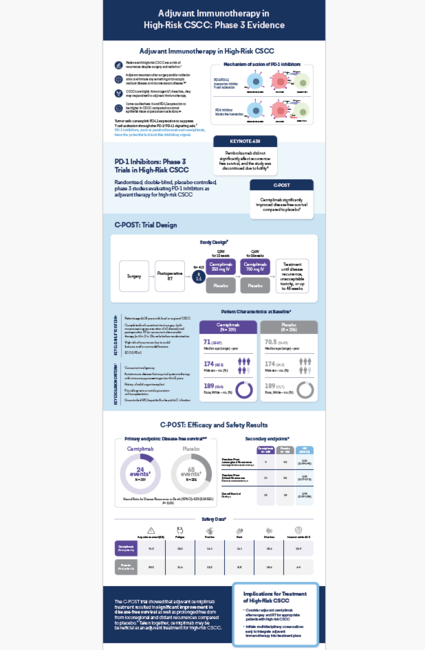
There are several frameworks that clinicians use to classify CSCC as high risk; the most commonly used for prognosis are the Brigham and Women’s Hospital (BWH) and the American Joint Committee on Cancer (AJCC) guidelines.5 Clinicians often use one or a combination of these systems, as they are complementary but not identical.6
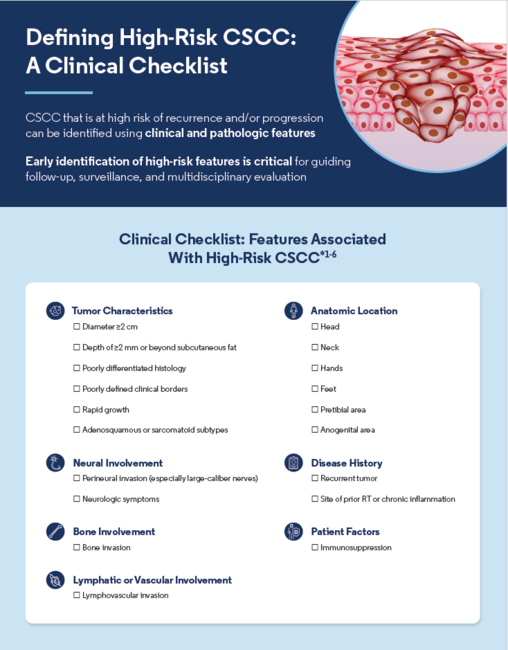
BWH tumor staging is based on the number of high-risk factors and assesses tumor features such as diameter, histology, and extent of invasion (perineural, beyond fat, or bone invasion).7 AJCC 8th edition (AJCC-8) tumor staging, which is limited to head and neck CSCC, evaluates similar factors such as tumor diameter and invasive features, with perineural, deep, or bone invasion (including gross cortical bone and/or skull base foramen involvement) defining higher-stage tumors.5,8 Generally, clinicians consider BWH stage ≥T2b and AJCC-8 stage ≥T3 to represent high-risk disease.6 Emerging clinical data are also shaping how high-risk disease is defined and managed, with studies often using similar criteria to identify patients at increased risk of recurrence or progression.4 Although there are no universally accepted criteria to classify high-risk CSCC, risk stratification is foundational to disease management.
Areas of Consensus in High-Risk CSCC Care
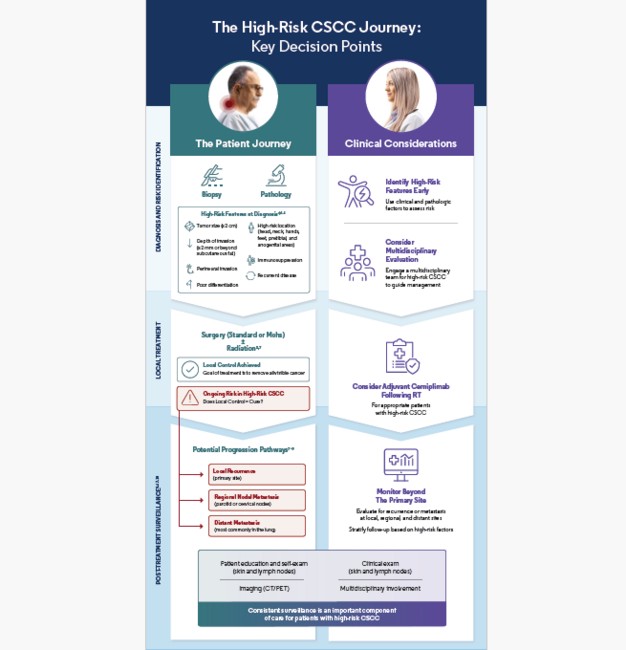
Surgery is a cornerstone of clinical treatment for CSCC, and the surgical technique used depends on the stage and risk status of the tumor. For high-risk CSCC, surgical options include standard excision and Mohs micrographic surgery (MMS).3,5,9 When MMS is not an option for high-risk lesions, wide surgical margins using standard excision are required; however, wide local excision is associated with higher recurrence rates compared with MMS.5,9,10 Radiation therapy may be used as a primary treatment if patients are considered nonsurgical candidates, or adjuvant radiation may be used following surgery for tumors with inadequate margins or extensive perineural involvement.3,5,9,11 Multidisciplinary evaluation is broadly recommended for patients with high-risk CSCC, as specialist opinions can benefit patients with more complex tumor features.3,9 Likewise, guidelines support escalation of care and follow-up based on risk features.3,5,9
Areas of Variability in High-Risk CSCC Care
Standardized guidance is lacking for surveillance of high-risk CSCC, with recommendations often left to clinician discretion rather than uniform protocols.3,9 This uncertainty is compounded by variability in how staging systems and guidelines are interpreted and applied, with differences between specialties and practice settings.6 Similarly, guidance on when to involve medical oncologists is not well defined, particularly for high-risk cases in which multidisciplinary input is encouraged but not consistently specified in timing.3,12 Criteria for initiating systemic therapy in the adjuvant setting also remain variable, as newer immunotherapy data are only recently being incorporated into practice.4,5 Established treatment guidelines may lag behind evolving therapeutic options; for example, the American Academy of Dermatology (AAD) and the American Society for Radiation Oncology (ASTRO) guidelines for CSCC were last updated in 2018 and 2020, respectively.3,11 Therefore, clinicians must make individualized decisions in gray areas, balancing patient-specific risk factors, emerging evidence, and evolving standards of care.
Practical Implications for Clinicians
A more proactive, risk-adapted approach to managing CSCC is warranted, emphasizing individualized care based on tumor biology and patient-specific factors. Early identification of high-risk features and incorporation of structured multidisciplinary collaboration is critical to optimize treatment planning.9 Additionally, surveillance strategies should extend beyond the primary tumor site during follow-up monitoring.5 The treatment landscape continues to evolve, with increasing consideration of adjuvant systemic therapy in select high-risk cases.4 As these advances are incorporated into clinical practice, management paradigms will continue to shift, and health care providers must apply clinical judgment to navigate areas where evidence and guidelines continue to evolve.
References:
- Beach SC, Cusick AS, Farberg AS, Trotter SC. A comprehensive narrative review of the challenges surrounding cutaneous SCC. Dermatol Ther (Heidelb). 2025;15(8):2015-2029. doi:10.1007/s13555-025-01470-7
- Karia PS, Morgan FC, Califano JA, Schmults CD. Comparison of tumor classifications for cutaneous squamous cell carcinoma of the head and neck in the 7th vs 8th edition of the AJCC Cancer Staging Manual. JAMA Dermatol. 2018;154(2):175-181. doi:10.1001/jamadermatol.2017.3960
- Alam M, Armstrong A, Baum C, et al. Guidelines of care for the management of cutaneous squamous cell carcinoma. J Am Acad Dermatol. 2018;78(3):560-578. doi:10.1016/j.jaad.2017.10.007
- Rischin D, Porceddu S, Day F, et al. Adjuvant cemiplimab or placebo in high-risk cutaneous squamous-cell carcinoma. N Engl J Med. 2025;393(8):774-785. doi:10.1056/NEJMoa2502449
- Trager MH, Gordon ER, Breneman A, et al. Management of cutaneous squamous cell carcinoma: A literature review and update. J Am Acad Dermatol. 2026;94(3):914-923. doi:10.1016/j.jaad.2025.11.043
- Patel VA, McCullum C, Sparks AD, et al. Cutaneous squamous cell carcinoma staging may influence management in users: A survey study. Cancer Med. 2022;11(1):94-103. doi:10.1002/cam4.4426
- Karia PS, Jambusaria-Pahlajani A, Harrington DP, Murphy GF, Qureshi AA, Schmults CD. Evaluation of American Joint Committee on Cancer, International Union Against Cancer, and Brigham and Women’s Hospital tumor staging for cutaneous squamous cell carcinoma. J Clin Oncol. 2014;32(4):327-334. doi:10.1200/JCO.2012.48.5326
- Amin MB, Edge SB, Greene FL, et al, eds. AJCC Cancer Staging Manual. 8th ed. New York, NY: Springer International Publishing; 2017.
- Paradela de la Morena S, Neri Morales C, Martín Loureiro I, Tejera Vaquerizo A, Fonseca Capdevila E. Management of cutaneous squamous cell carcinoma: review based on guidelines. Part 2: Treatment and follow-up. Actas Dermosifiliogr. Published online March 16, 2026. doi:10.1016/j.ad.2026.104612
- Wang DM, Vestita M, Murad FG, et al. Mohs surgery vs wide local excision in primary high-stage cutaneous squamous cell carcinoma. JAMA Dermatol. 2025;161(5):508-514. doi:10.1001/jamadermatol.2024.6214
- Likhacheva A, Awan M, Barker CA, et al. Definitive and postoperative radiation therapy for basal and squamous cell cancers of the skin: executive summary of an American Society for Radiation Oncology clinical practice guideline. Pract Radiat Oncol. 2020;10(1):8-20. doi:10.1016/j.prro.2019.10.014
- Claveau J, Archambault J, Ernst DS, et al. Multidisciplinary management of locally advanced and metastatic cutaneous squamous cell carcinoma. Curr Oncol. 2020;27(4):e399-e407. doi:10.3747/co.27.6015
© 2026 HMP Global. All Rights Reserved.