Early Detection and Timely Reintervention Drive Success After Deep Venous Arterialization

Northwell Health, Lake Success, New York
On Friday morning at the Amputation Prevention Symposium, Yana Etkin, MD, presented an in-depth review of strategies for identifying and managing failing deep venous arterialization (DVA), emphasizing that long-term success depends not only on creating the DVA circuit but also on maintaining its patency through vigilant surveillance and timely reintervention.
The presentation began by contrasting traditional arterial revascularization with DVA, explaining how the venous anatomy of the foot creates a "vein fortress" in which multiple venous valves initially limit blood flow to the tissues. Dr Etkin described the maturation process that allows the DVA circuit to gradually improve tissue perfusion, underscoring that maintaining uninterrupted flow is essential for this remodeling to occur.
Reviewing published trial data, Dr Etkin noted that reinterventions are common after DVA, reinforcing that these procedures should be anticipated as part of routine patient management rather than viewed as procedural failures. She stressed the importance of structured postoperative surveillance with duplex ultrasound to identify flow-limiting issues before clinical deterioration occurs.
Dr Etkin also shared outcomes from an institutional case series of 27 patients treated since March 2024. Reported results included an 88.4% 6-month survival rate, 84% 6-month limb salvage, and 80.9% amputation-free survival. At 1 year, limb salvage remained 84%, with overall survival of 66.3% and amputation-free survival of 60.7%. Among these patients, 44% required a total of 21 reinterventions, including inflow, in-stent, and outflow angioplasty or stenting, thrombectomy, and selective coiling, highlighting the ongoing maintenance often required to preserve DVA function.
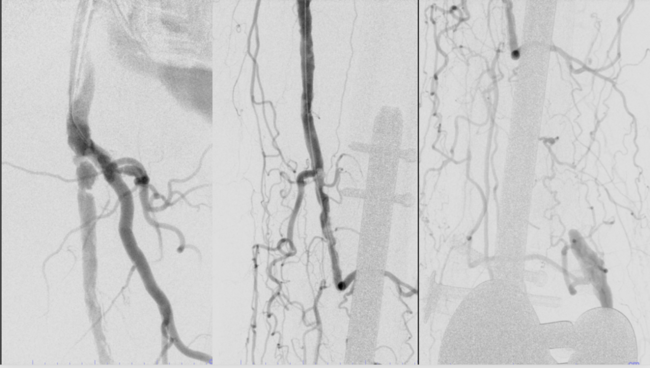
Through a series of clinical cases, Dr Etkin illustrated how targeted reinterventions can restore flow, promote maturation of the venous circuit, and accelerate wound healing. The session concluded with a clear message for vascular specialists caring for patients after DVA: maintaining flow is the cornerstone of long-term success. Close surveillance, prompt recognition of hemodynamic changes, and a low threshold for reintervention should be considered integral components of DVA management, with reinterventions viewed as expected steps in optimizing limb salvage rather than complications of treatment.