When is Epinephrine Dangerous?
Scenario
You’re responding to your local assisted living facility for a 78-year-old female with a chief complaint of “difficulty breathing.” Upon your arrival, you’re presented with an irritated-looking woman who has audible expiratory wheezes on each breath and hives marching down her back and arms.
“She started a new antifungal yesterday.” Her caregiver presses a packet of information into your hand: This patient has a dangerous, anaphylactic allergy to 23 separate medications.
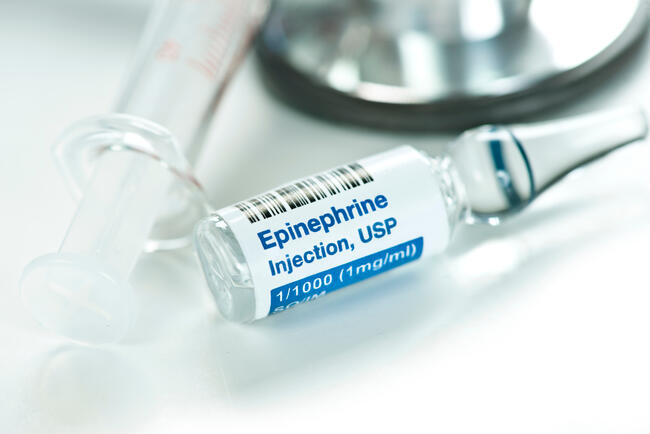
You explain the necessity of the injection as you start to draw up the epinephrine. Your partner stops you.
“She has a history of congestive heart failure,” he whispers.
You agree that yes, she does, and continue to tap the syringe so the bubbles go to the top.
“She’s barely anaphylactic anyway.”
You try to find the words to explain that anaphylaxis, like pregnancy, is essentially a positive or negative. There isn’t really a degree of anaphylaxis that doesn’t require treatment.
“Let’s just take her to the hospital so you don’t mess up her heart even more.”
Where do you go from here? The patient does have a weakened cardiovascular system, and the epinephrine will increase her heart rate. On the other hand, the problem she’s having right now is dangerous, even fatal. How should you choose?
The Under-Use of Epinephrine for Anaphylaxis
The under-use of epinephrine in patients with obvious anaphylaxis is alarming. An IM epinephrine injection is the only treatment that will reverse anaphylaxis. Early epinephrine use (“early” refers to epinephrine received prior to arrival at the emergency room) reduces rates of hospitalization. One 2015 study found that 43% of patients receiving epinephrine at the ER are hospitalized, whereas only 17% of their counterparts who receive epinephrine in a prehospital setting are.1
Early epinephrine administration also prevents mortality. A 2000 study looked at characteristics of patients who went into cardiac arrest due to anaphylaxis. One major trend emerged: Only 14% of patients who die of their anaphylaxis received epinephrine prior to cardiac arrest.2
Despite this, as few as 30% of patients with anaphylaxis, even when they have a known dangerous allergy, will be treated with epinephrine.3
There are a lot of reasons for this, such as difficulty diagnosing a complaint with such varied presentations and reasonable patient concerns about the expense of replacing the autoinjector. Another cause of under-use of epinephrine is concern about possible harm to patients, particularly those with a history of cardiac disease.
It’s true that epinephrine will force the heart to beat harder and faster. However, there are several reasons to not worry about that when presented with an anaphylactic patient.
Adverse Events Following Epinephrine Are Both Rare and More Survivable Than Anaphylaxis
One study found that, among 245 patients given an IM injection for anaphylaxis, three had adverse events. This is an exceptionally low number — less than 2%. Furthermore, the adverse events were a single case of angina and two cases of hypertension. In most contexts, these would be of interest to emergency personnel. However, hypertension and angina are both safer for your patient and less likely to lead to long-term harm than untreated anaphylaxis.
Even when you limit your dataset to older patients, the numbers barely change: There’s only a 3.5% rate of adverse cardiac event.3
Another study found similarly: Only 3% of patients will experience an adverse event from epinephrine given for anaphylaxis. The events included in this study were hypertension, EKG changes, and chest pain.4
The available data agrees: These adverse events are both extremely rare and much safer than anaphylaxis.
Many people intuitively feel that not treating a patient is somehow “playing it safe” over treating a patient. But choosing to withhold a medication is just as significant of a step as choosing to provide it. This bias is as common as it is dangerous. Fortunately, however, once you become aware of it in both yourself and your coworkers, it becomes much easier to address and overcome.
IV vs. IM
IM epinephrine, while not totally benign, is quite safe. The lethal dose, 50% (LD50) is the amount of a substance needed to cause death in half of the subjects being studied. In rats, the LD50 of IM epinephrine is a whopping 3500 milligrams per kilogram, thousands of times the normal dose, which for most autoinjectors doesn’t exceed .3 milligrams, and for drawing the medication is .01 milligram per kilogram.5 Unless you’re planning on injecting your patient with every vial of epinephrine in the county, you’re not likely to hurt your patient.
Another study had an odds ratio of 99.6% that adverse epinephrine events were due to IV epinephrine administration.3 The study was small, with only seven IV participants, but the result makes sense. The LD50 of IV epinephrine is 150 micrograms per kilogram, less than 0.01% of the LD50 for IM.
Also, every case study of patient harm caused by epinephrine used to treat anaphylaxis that could be found was from the intravenous route. For example, one 65-year-old Australian female did have heart damage from a dose of epinephrine for anaphylaxis. In Australia nebulized epinephrine is part of the standard anaphylaxis treatment. This led to an error in which this woman was given 5 mg of epinephrine IV rather than nebulized, which is an extraordinary overdose. Her long-term outcome isn’t known as she didn’t attend follow-up appointments.6
So, in summary, large doses of IV epinephrine are exclusively for patients who are already deceased. Otherwise, stick with IM and very small, thoughtful doses of IV. Provided you follow that general guideline, it’s almost impossible that you will harm your patient.
Scenario Conclusion
You continue to draw up the dose of epinephrine and inject the patient with it with an apology for the poke. You warn her that she’ll feel jittery and odd and immediately put her on cardiac monitoring. Her symptoms resolve in under two minutes; she requires no further dosing. You can tell your partner is upset but he helps you set up and load the patient just the same.
You drop the patient off with a harried resident who nods distractedly while peering down the patient’s airway with a light.
“I’m telling the chief that was 1000% your call,” your partner says as soon as you’re alone in the rig and driving back to district.
You tell him that’s absolutely fine and that you’ll make sure it’s known that you made this choice alone. You apologize for not being able to have a full conversation about the decision you made as the matter was urgent. You ask him if he wants to talk about it now.
He says yes and the debate on the way home is lively but friendly. The next morning you find him trying (and failing) to find a case study of harm caused by IM epinephrine and know the seed of change has been planted.
Works Cited
- Fleming JT, Clark S, Camargo CA, & Rudders SA. (2015). Early treatment of food-induced anaphylaxis with epinephrine is associated with a lower risk of hospitalization. The Journal of Allergy and Clinical Immunology: In Practice, 3(1), 57–62. https://doi.org/10.1016/j.jaip.2014.07.004
- Pumphrey. (2000). Lessons for management of anaphylaxis from a study of fatal reactions. Clinical & Experimental Allergy, 30(8), 1144–1150. https://doi.org/10.1046/j.1365-2222.2000.00864.x
- Prince BT, Mikhail I, & Stukus DR. (2018). Underuse of epinephrine for the treatment of anaphylaxis: missed opportunities. Journal of Asthma and Allergy, 11, 143–151. https://doi.org/10.2147/JAA.S159400
- Bernstein DI, Blaiss M, Dellon ES. Benefits of Epinephrine for Anaphylaxis Outweigh Potential Harm—A Safety Review. The Journal of Allergy and Clinical Immunology: In Practice. 2025. ISSN 2213-2198. https://doi.org/10.1016/j.jaip.2025.04.018.
- Mayo Clinic. (n.d.). Epinephrine (injection route). Mayo Clinic. https://www.mayoclinic.org/drugs-supplements/epinephrine-injection-route/description/drg-20072429
- Callum J, Rivlin M, & Carroll P. (2020). Intravenous epinephrine overdose in prehospital management of suspected anaphylaxis. BMJ Case Reports, 13(1), e232654. https://doi.org/10.1136/bcr-2019-232654