Who Let the Dogs Out?: History, Risks, and Dog Bite Prevention
Dogs, as they say, are “Man’s (and Woman’s) best friend.” They give us countless hours of companionship. Specially trained dogs provide emotional support, help with daily activities, and alert owners to impending health crises like seizures or hypoglycemia. Others work with emergency responders, law enforcement, and military personnel on dangerous missions. Their value is difficult to overstate. However, there are times when even our best friends can pose a risk. This article examines the domestication of dogs, the epidemiology of dog bites, public health considerations, and strategies to avoid injury.
History
Modern dogs are descendants of wolves that were domesticated ~15,000 years ago.
Dog Bites
While most dogs are wonderful and trustworthy companions, and no single breed is meant to be vilified here, dog bites do happen. Some occur when dogs are used for law enforcement, military, or other security purposes. These are called intentional bites and are not the focus of this article.
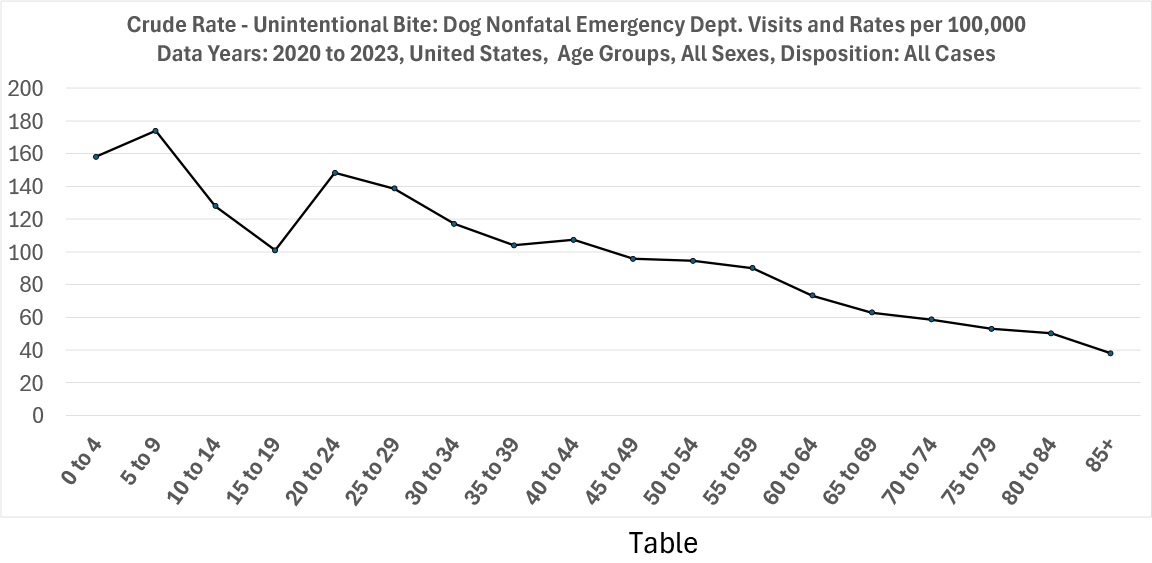
Between 2020 and 2023, there were 1,421,888 unintentional nonfatal dog bites associated with emergency room contact reported to U.S. state and territorial health agencies.
While genetics play a role in the likelihood that a dog will bite, other factors include early socialization, training, health of the dog, and the situation in which the bite occurs. For example, a dog might bite because they lack socialization or out of fear. They could be aggressive because they are ill; they might be protecting their food, territory, and or their offspring.
The popularity of a dog’s breed means there might be more of them owned in a community; thereby increasing the chance that their breed will be overrepresented among those who do bite. A confounding factor in labeling the breeds of biting dogs in the literature is the likelihood that witnesses will be unable to correctly identify the specific breed involved. However, several studies have attempted to determine which breeds are more likely to bite.5
Chen et al. found that the breeds of dogs involved in many attacks were unknown.6 When the breed was known, the dogs most likely to bite were Labrador retriever (14%), Rottweiler (5%), German shepherd (4%), Golden retriever (3%), pit bull (3%), Cocker spaniel (3%), and Collie (3%). The remaining breeds were each responsible for 2% or less of bites.
Sribnick et al. found that the breed of biting dogs was known ~55% of the time. When the breed was known, pit bulls were identified as the biter ~50% of the time. The next most likely to bite were Rottweilers (12%), Labradors (8%), German Shepherds (5%), and Chows (5%).4 The propensity for pit bulls (and similar terriers) to bite, and to cause significant injury, has been found in multiple studies.3,7 Golinko, Arslanian and Williams found that 53% of dog bites were by a family pet and 47% of the time the bite was unprovoked.
Risks For Infection
Dogs are known to carry several diseases that can be transmitted from animals to people. These are known as zoonotic diseases. They include (but are not limited to) cryptosporidiosis, Giardia, hookworms, MRSA, New World screwworm, plague, salmonella, tapeworms, tularemia, and rabies.
Rabies is spread through bites and scratches from infected mammals and is unlikely to be spread person-to-person.9,10 After being injured by an infected animal, rabies travels along a victim’s peripheral nerves to the spinal cord and on to their brain.11 Signs and symptoms of rabies include fever, headache, encephalitis, paralysis, and hydrophobia.
Dog bites are the most common risk of rabies transmission worldwide, but not the most common vector animal in the U.S. There were 3,579 rabid animals reported to U.S. state and territorial health authorities in 2022.12 The most common rabies-infected animals in the U.S. are bats (33.9%). Raccoons make up 28.1% of rabies-infected animals; skunks are 18.9%, foxes are 8.6%, cats are 5.9%, cattle are 1.1%, and dogs are 1%.9,13 Vaccination against rabies is common practice for pets like dogs and cats. It’s rare, but rabies can also be found in opossums and squirrels.14 Hawaii is the only U.S. state that is considered to be free of rabies.15
There are ~59,000 human rabies cases annually around the world, with most occurring in Africa and Asia.16 The United States has less than ~10 human cases of rabies each year.17 Human vaccination against rabies is not recommended for the general population in the U.S., but it is recommended for some people who work with animals that are known to be carriers. Any wound from a potentially infected animal should be immediately and thoroughly washed using soap and water; if available and safe to do so, a virucidal compound like diluted iodine should be used to irrigate the site. Persons who are exposed to rabies can be treated with post-exposure prophylaxis (PEP). PEP is administered into the victim’s extremities over a two-week period.18 Individuals with a known immune disorder may receive an additional dose. It’s critical to start PEP as soon as possible after an exposure. While there are limited reports of persons who have survived rabies by being placed in a therapeutic coma and undergoing extreme treatments; the current medical consensus is that once a person becomes symptomatic for rabies, the condition is almost guaranteed to be fatal.19
General Strategies
Dogs are more likely to be aggressive when traveling in a pack, even if the pack is as few as two or three animals. If facing a pack, be alert for signs of aggressive behavior. This is especially true if the group is made up of large, uncontrolled, poorly socialized dogs, or if one or more is in estrous.
If approached by a strange dog (or dogs), try not to immediately turn and run. Running can trigger the genetic predisposition for a dog to see you as prey. Try to remain calm, avoid eye contact and firmly tell the dog, “No!” and “Go home!” If the dog doesn’t retreat or doesn’t pass you by, slowly back away while keeping an eye on it. Look for items you can use to defend or shield yourself. Look for any nearby shelter. If your radio or phone has an emergency call feature (e.g., pressing a button multiple times that will automatically call for help), try to use it. Local animal control officers are able to secure aggressive animals using a variety of equipment and techniques. If a pack attacks, be prepared to fight. Use of chemical deterrents (i.e., pepper and CS spray) can be effective, but they are not guaranteed to work. Some dogs are bred to bite your head and neck, so be prepared to protect these areas.3
On Scene
When responding to calls where dogs are present, dispatchers will ask for them to be moved to a secure and separate location (like a nearby room or into a yard). If the dog is a service animal, ask the patient how best to assure the safety of the crew, the patient, and the animal. Service and support dogs may be needed (and helpful) as you interact with the patient. There may be a family member on the scene who can take control of a service dog and transport it to the hospital. If you are at a non-residential location, be prepared to enact your agency’s plan for securing and safely transporting the dog. The goal is to keep a service animal with the patient when safe and practical to do so; and in lieu of this, you should make the separation as short as possible.
Off Scene
EMS can be a strong advocate for, and a participant in, public education about dog-bite safety. We can promote rabies vaccinations for pets, including providing information on local free or low-cost prevention programs. Public agencies, like animal shelters, and private veterinary clinics are likely great resources for information. Local veterinarians may be willing to provide continuing education to your agency’s personnel.
Prevention
Over one third of U.S. states outlaw specific dog breeds.22 However, these laws don’t consider the impacts of early socialization and the care and supervision provided by an owner. Some insurance companies refuse to cover a home if specific breeds are owned. There are insufficient data showing that these laws and policies improve safety. Public education, promoting animal welfare, and following safety rules (e.g., promoting veterinary care, leash laws, and civil liability for owners) appear to have positive effects.
National organizations like the American Veterinary Medical Association promote dog bite awareness year-round, but they especially reach out about it during National Dog Bite Prevention Week.21 Preventing dog bites involves common sense approaches and remaining mindful of the potential danger.8,21 Some tips include:
- Don’t pet a strange dog without the handler’s permission (This is especially true for children)
- Don’t leave children around dogs without supervision
- Don’t approach sick or injured dogs (without training)
- Don’t put your hands between dogs and their food
- Don't engage in aggressive play with dogs
- Don’t disturb dogs caring for puppies
- Don’t stand between fighting dogs
- Don’t startle or scare sleeping dogs
Dogs can be, and generally are, kind, loyal, and caring companions. Some are trained to perform helpful and even lifesaving services. They are valuable members of our families and work teams, and they give much to us every day. However, bites to occur. Bites carry a risk of disease transmission. Reducing the risk of dog bites requires a multi-faceted approach; like better owner education, promoting veterinary care, increasing public awareness, and enforcing public safety laws (i.e., outlawing puppy mills and dog fighting). This author has had several great canine companions. With that experience, I know genetics play a role in a dog’s behavior; but it is not the sole factor in whether or not a dog will bite someone. It’s up to us all to act responsibly with dogs and to provide safe, healthy environments that promote socialization, adequate healthcare, and training to reinforce their best (safest) behavior. It’s up to us to be their best friend.
Works Cited
1. Domestication is not an ancient moment of selection for prosociality: Insights from dogs and modern humans. Losey, R. J. 2, 2022, Journal of Social Archaeology, Vol. 22, pp. 131–148.
2. Centers for Disease Control and Prevention National Center for Injury Prevention and Control. Web-based Injury Statistics Query and Reporting System (WISQARS) [online]). [Online] June 26, 2026. www.wisqars.cdc.gov.
3. Characteristics of 1616 Consecutive Dog Bite Injuries at a Single Institution. Golinko, M. S., Arslanian, B., & Williams, J. K. 4, 2017, Clinical Pediatrics, Vol. 56, pp. 316–325.
4. Dog bite injuries in children: Clinical implications for head involvement. Sribnick, E. A., Sarda, S., Sawvel, M. S., Reisner, A., & Chern, J. J. 3, 2016, Trauma, Vol. 18, pp. 210–215.
5. Pediatric dog bite injuries in the USA: a systematic review. Patterson, K. N., Horvath, K. Z., Minneci, P. C., Thakkar, R., Wurster, L., Noffsinger, D. L., Bourgeois, T., & Deans, K. J. 2, 2022, World Journal of Pediatric Surgery, Vol. 5, p. e000281.
6. Analysis of pediatric facial dog bites. Chen, H. H., Neumeier, A. T., Davies, B. W., & Durairaj, V. D. 4, 2013, Craniomaxillofacial Trauma & Reconstruction, Vol. 64, pp. 225–232.
7. Dog Bites in Children: A Descriptive Analysis. McGuire, C., Morzycki, A., Simpson, A., Williams, J., & Bezuhly, M. 4, 2018, Plastic Surgery, Vol. 26, pp. 256–262.
8. Centers for Disease Conrol and Prevtion. Healthy Pets, Healthy People. Dogs. [Online] April 8, 2026. https://www.cdc.gov/healthy-pets/about/dogs.html.
9. Centers for Disease Control and Prevention, National Center for Injury Prevention and Control. About Rabies. About Rabies. [Online] January 27, 2026. https://www.cdc.gov/rabies/about/index.html.
10. Centers for Disease Control and Prevention. [Online] July 15, 2025. https://www.cdc.gov/rabies/hcp/diagnosis/index.html.
11. Merk & Company Inc. Rabies. Merk Manual: Professional Version. [Online] April 2025. https://www.merckmanuals.com/professional/neurologic-disorders/brain-infections/rabies?query=rabies.
12. Rabies surveillance in the United States during 2022. Xiaoyue, M., Boutelle, C., Bonaparte, S., Orciari, L. A., Condori, R. E., Kirby, J. D., Chipman, R. B., Fehlner-Gardiner, C., Thang, C., Gutiérrez Cedillo, V., Aréchiga-Ceballos, N., Nakazawa, Y., & Wallace, R. M. 11, 2024, Journal of the American Veterinary Medical Association, Vol. 262, pp. 1518–1525.
13. Rabies surveillance in the United States during 2021. Xiaoyue M., Bonaparte, S., Corbett, P., Orciari, L. A., Gigante, C. M., Kirby, J. D., Chipman, R. B., Fehlner-Gardiner, C., Cin Thang, Cedillo, V. G., Aréchiga-Ceballos, N., Rao, A., & Wallace, R. M. 7, 2023, Journal of the American Veterinary Medical Association, Vol. 261, pp. 1045–1053.
14. Center for Disease Control and Prevention. CDC: Vitalsigns. Rabies: A Forgotten Killer. [Online] June 2019. [Cited: June 24, 2026.] https://www.cdc.gov/vitalsigns/rabies/pdf/vs-0612-wildlife-rabies-H.pdf.
15. State of Hawaii, Department of Health . Rabies. Disease Outbreak Control Division. [Online] October 2024. https://health.hawaii.gov/docd/disease_listing/rabies/.
16. World Health Organization. Global burden of dog-transmitted human rabies. [Online] 2026. https://www.who.int/teams/control-of-neglected-tropical-diseases/rabies/epidemiology-and-burden.
17. Centers for Disease Control and Prevention. Rabies is Still Here: Epidemiology, Outbreaks, and Costs of Prevention in the United States. Clinical Outreach and Communication Activity. [Online] April 30, 2026. https://www.cdc.gov/coca/hcp/trainings/rabies-is-still-here-epidemiology-outbreaks-and-costs-of-prevention-in-the-united-states.html#cdc_generic_section_1-overview.
18. —. Rabies Post-exposure Prophylaxis Guidance. Rabies. [Online] July 15, 2025. https://www.cdc.gov/rabies/hcp/clinical-care/post-exposure-prophylaxis.html.
19. American Association for the Advancement of Science. Surviving rabies is now possible . [Online] August 4, 2011. https://www.aaas.org/membership/qualia/surviving-rabies-now-possible.
20. American Society for the Prevention of Cruelty to Animals. What Is Breed-Specific Legislation? ASPCA. [Online] 2026. https://www.aspca.org/improving-laws-animals/public-policy/what-breed-specific-legislation.
21. American Venerinary Medical Association. National Dog Bite Prevention Week (April 12–18): AVMA emphasizes protecting children through education and supervision. [Online] April 9, 2026. https://www.avma.org/news/press-releases/national-dog-bite-prevention-week-april-12-18-avma-emphasizes-protecting.
22. The History of Farm Foxes Undermines the Animal Domestication Syndrome. Lord, K. A., Larson, G., Coppinger, R. P., & Karlsson, E. K. 2, 2020, Trends in Ecology & Evolution, Vol. 35, pp. 125–136.
23. Demise of the Milwaukee Protocol for Rabies. Jackson, A. C. 4, 2025, Clinical Infectious Diseases, Vol. 81, pp. e229–e232.