








Transdermal Nitroglycerin for Traumatic Hallux Ischemia: A Case Report
This case report describes successful hallux salvage following a severe crush injury complicated by progressive digital ischemia. Transdermal nitroglycerin was used alongside surgical stabilization and local wound care as an adjunct intended to improve microvascular perfusion.
Key Takeaways
-
Traumatic digital ischemia may develop despite palpable pedal pulses and preserved macrovascular flow, underscoring the importance of close monitoring after a crush injury.
-
In this case, daily transdermal nitroglycerin therapy resulted in gradual tissue recovery and complete epithelialization of the hallux without amputation.
-
Although transdermal nitroglycerin may be a practical adjunct in select cases, evidence remains limited, and future, broader study is warranted.
Pedal crush injuries resulting in fracture are a relatively common pathology encountered in the emergency department, accounting for up to 40% of lower extremity fractures in adults.1,2 These injuries typically result from high-energy trauma causing acute compression of the foot, most commonly when a heavy object falls onto it. Frequently, those injured in this way are in occupations involving heavy equipment or machinery. Such injuries can be particularly devastating in the setting of open fractures due to the risk of deep osseous or joint infection. In addition to structural deformity, vascular compromise is a significant concern, with blunt trauma accounting for up to 25% of peripheral vascular injuries, underscoring the vulnerability of the distal extremity to ischemic complications.3
The pedal digits are particularly vulnerable given their distal location, limited soft tissue envelope, and tenuous microvascular supply. Hallux injury can significantly impair ambulation, activities of daily living, and carries a high risk of long-term sequelae, particularly when amputation is required. Prompt management is essential and includes irrigation and debridement, antibiotics when indicated, and fracture stabilization, most commonly via open reduction and internal fixation (ORIF). Crush injuries represent a severe form of foot trauma involving combined osseous, soft tissue, and vascular injury that may result in endothelial disruption, vasospasm, and thrombosis, leading to progressive ischemia, necrosis, and gangrene.4,5 Severe injuries may require early amputation depending on tissue viability, whereas viable tissue is often observed to allow for demarcation, as the extent of vascular injury may not be immediately apparent. Close monitoring is essential given the risk of delayed ischemia and infection, with management options including local wound care, delayed amputation, and vascular consultation.6 Despite the importance of preserving viable tissue, there is no clear consensus regarding optimal management of ischemic digits following traumatic crush injury. Existing literature on digital gangrene primarily describes embolic, hypotensive, and iatrogenic etiologies.7-9 In these settings, topical or transdermal nitroglycerin has been used as an adjunct to improve microvascular perfusion through nitric oxide-mediated vasodilation and could potentially support tissue viability.10-12
To the authors’ knowledge, there are no reported cases describing the use of transdermal nitroglycerin patches to manage digital ischemia secondary to crush injury. We present the case of a 22-year-old male with a hallux crush injury complicated by progressive ischemia following initial open reduction and internal fixation, successfully addressed with adjunctive daily nitroglycerin patch application.
Key Points in the Case Presentation
A 22-year-old otherwise healthy male sustained a severe crush injury to the right hallux when a 23,000-pound trailer fell onto his foot. He sustained an open fracture involving the distal phalanx and base of the proximal phalanx with intra-articular extension into the first metatarsophalangeal (MTP) joint. He subsequently underwent urgent open reduction and internal fixation (ORIF) with Kirschner wire (K-wire) fixation at an outside hospital on the day of injury.
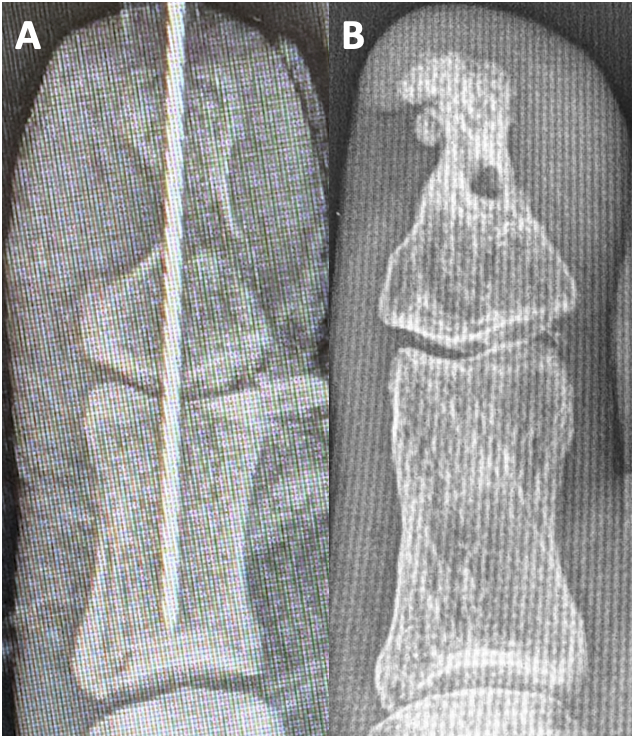
Nine days post-injury, the patient presented to our emergency department with abdominal pain, diarrhea, and fever. He also had a hepatocellular injury concerning for acetaminophen toxicity, attributed to its use for pain management following the injury. During this admission, the podiatry service received a consult to evaluate the hallux. On examination, early vascular compromise of the distal hallux was noted, with diffuse ecchymosis progressing to dry eschar involving the majority of the distal digit. Pedal pulses remained palpable; however, we could not assess capillary refill in the affected digit due to the overlying skin changes. There were no clinical signs of infection. Significant pain was present, and we counselled the patient regarding the high risk of amputation given the degree of vascular insult. Initial radiographs obtained at our institution demonstrated anatomic alignment with appropriate K-wire positioning (Figure 1a). Given the absence of infection, maintenance of appropriate alignment, and the presence of evolving demarcation, a hallux-salvage approach was pursued.
The digit underwent daily betadine wet-to-dry dressings for antisepsis and protection, and adjunctive application of a 0.1 mg/hr transdermal nitroglycerin patch placed proximal to the zone of vascular compromise at the level of the first MTP joint, with the goal of improving local perfusion. K-wire and suture removal took place at 6 weeks postoperatively, and the patient remained non-weight-bearing restrictions until that time. We followed him in the outpatient setting every 2–3 weeks for the first 5 months after presentation to our institution.
At approximately 1 month after injury, we observed progressive demarcation of the distal hallux necrosis with formation of stable, dry eschar. Over time, the eschar gradually sloughed and debridement in clinic revealed healthy underlying tissue with continued local wound care. He did develop mild localized erythema at the nitroglycerin patch site, which we managed by rotating the application site. As demarcation progressed, noninvasive vascular studies, including ankle-brachial index (ABI) and toe-brachial index (TBI) obtained at approximately 3 months post-injury, were within normal limits without evidence of arterial insufficiency. At approximately 5 months post-injury, we extended the follow-up intervals to monthly visits. The patient continued daily nitroglycerin patch application proximal to the affected area, along with betadine wet-to-dry dressings performed 2–3 times per week, throughout the remainder of the treatment course.
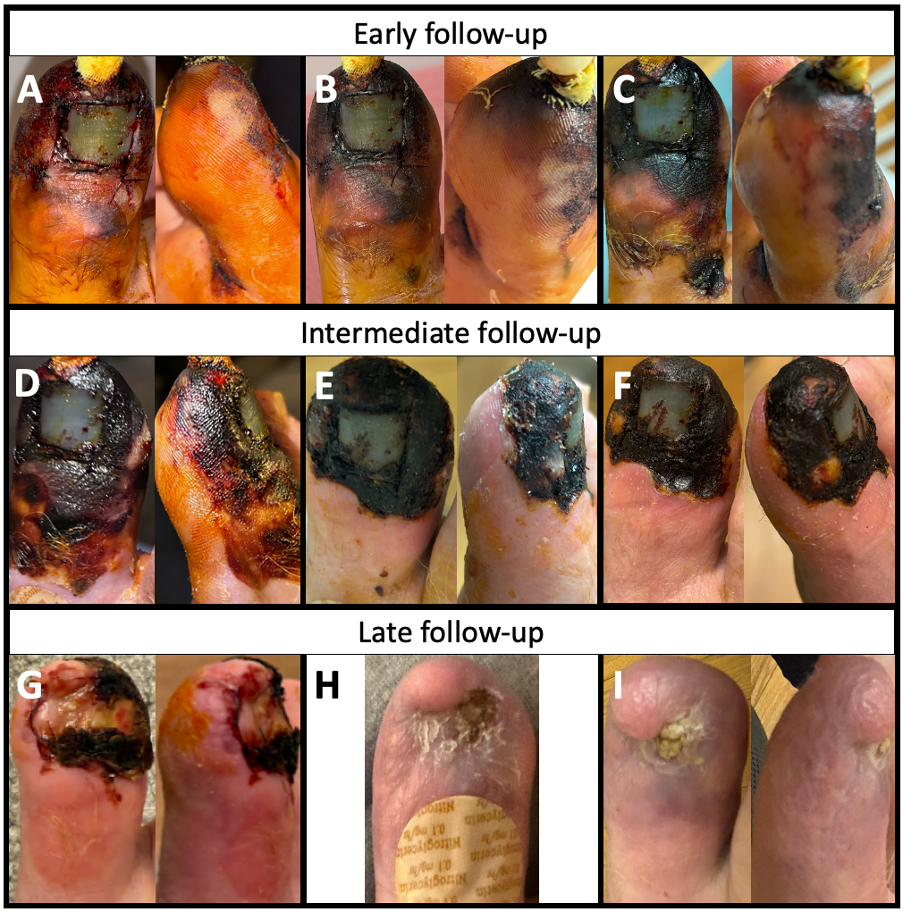
By approximately 40 weeks post-injury, the eschar had fully sloughed with complete epithelialization of the distal hallux. Figure 1b demonstrates robust osseous union across the fracture site with maintenance of deformity correction and appropriate alignment. The patient’s recovery was uncomplicated by infection. Mild residual paresthesia along the dorsal hallux and nail dystrophy were present but not functionally limiting. Clinical photographs of the hallux at early, intermediate, and late follow-up from initial presentation through 40 weeks postinjury are shown in Figure 2. Panels A–C correspond to early follow-up, D–F to intermediate follow-up, and G–I to late follow-up. The patient was counselled regarding the high likelihood of developing post-traumatic arthritis in the future. He was subsequently transitioned to follow-up on an as-needed basis. From the patient’s perspective, he reported satisfaction with the treatment course and outcome and was able to return to his full pre-injury activity level without limitation.
Discussion
To the authors’ knowledge, there is no published literature specifically describing the use of topical nitroglycerin patches for traumatic digital ischemia of the foot. However, there is a growing body of evidence supporting its use in both neonatal and adult populations for peripheral digital ischemia secondary to septic emboli, vasopressor use, intravenous extravasation injuries, and malpositioned intravenous catheters.7-9,13,14 In these settings, topical nitroglycerin has demonstrated improvement in perfusion and reversal of early ischemic changes, supporting its potential role as a microvascular adjunct in limb salvage. In the present case, we hypothesize that the crush mechanism may have produced intimal injury to the small vessels of the hallux, potentially leading to thrombosis and subsequent distal ischemia, a mechanism similarly described in traumatic digital injuries of the hand.15 Given this pathophysiology, we considered topical nitroglycerin as a possible means of improving local microvascular flow, serving as a low-cost and easily implemented adjunct to standard wound care following the index surgical intervention for initial injury management.
Nitroglycerin exerts its effect through conversion to nitric oxide, which activates guanylyl cyclase and increases intracellular cyclic guanosine monophosphate, resulting in reduced intracellular calcium and smooth muscle relaxation with improved microcirculatory perfusion.11-13,16 While effective in promoting local vasodilation, its use may be limited by systemic hypotension, which can manifest as headache, dizziness, syncope, nausea, vomiting, and, rarely, methemoglobinemia.16 Additional caution is warranted in patients receiving medications that potentiate hypotension or undergo hepatic metabolism, and concurrent use with phosphodiesterase-5 inhibitors is strictly contraindicated due to the risk of profound hypotension and syncope.16 In this case, the patient tolerated therapy well without systemic adverse effects, with only mild localized skin irritation that we managed through rotation of the patch application site.
Despite the favorable outcome observed in this case, we must acknowledge several limitations. This report describes a single patient without a control group or statistical comparison, limiting causal inference. It is important to note that the patient underwent emergent ORIF with stable fixation, did not develop infection throughout the recovery course, and was otherwise healthy with palpable pedal pulses and normal ABI and TBI measurements. These factors raise the possibility that spontaneous recovery may have occurred independent of the intervention. Nonetheless, given the temporal association between initiation of therapy and clinical improvement, as well as the low adverse effect profile, topical nitroglycerin may represent a reasonable adjunct in select cases of traumatic digital ischemia with preserved macrovascular flow. We therefore suggest that nitroglycerin patches, in conjunction with appropriate wound care and surgical stabilization when indicated, may be considered as part of a multimodal hallux salvage strategy in similar clinical scenarios.
Conclusion
In conclusion, our experience suggests that topical nitroglycerin may serve as a useful adjunct in the management of traumatic digital ischemia when macrovascular perfusion is preserved. In this case, we employed this option in conjunction with local wound care after his initial emergent surgical stabilization at a difference institution. He eventually went on to achieve successful hallux salvage without further complication. Further studies are warranted to better define this modality’s role in the treatment algorithm for ischemic digital injuries, particularly in the setting of trauma-induced ischemia.
Dr. Frey is a resident affiliated with the VA Eastern Colorado Health Care System, Rocky Mountain Regional VA Medical Center, Aurora, CO.
Dr. Nassau is an attending physician at the VA Eastern Colorado Health Care System, Rocky Mountain Regional VA Medical Center, Aurora, CO.
The authors have no non-financial or commercial, proprietary, or financial interest in the products or companies described in the manuscript. The author(s) did not receive grants or a consultant honorarium to conduct the study, write the manuscript or otherwise assist in the development of the above-mentioned manuscript.
The authors disclosed that AI was used to assist with grammar, editing, and improving clarity of the manuscript; all ideas, analyses, and original writing were developed by the authors, without any AI contribution to data analysis or interpretation.
References
-
Court-Brown CM, Caesar B. Epidemiology of adult fractures: A review. Injury. 2006;37(8):691-697. doi:10.1016/j.injury.2006.04.130
-
Lambers K, Ootes D, Ring D. Incidence of patients with lower extremity injuries presenting to US emergency departments by anatomic region, disease category, and age. Clin Orthop Relat Res. 2012;470(1):284-290. doi:10.1007/s11999-011-1982-z
-
Huber GH, Manna B. Vascular extremity trauma. In: StatPearls. Treasure Island (FL): StatPearls Publishing; updated April 19, 2023. Accessed September 29, 2026. https://www.ncbi.nlm.nih.gov/books/NBK536925/
-
Chen LE, Seaber AV, Urbaniak JR. Thrombosis and thrombolysis in crushed arteries with or without anastomosis: a new microvascular thrombosis model. J Reconstr Microsurg. 1996;12(1):31-38. doi:10.1055/s-2007-1006450
-
Barrett L, Curry N, Abu-Hanna J. Experimental Models of Traumatic Injuries: Do They Capture the Coagulopathy and Underlying Endotheliopathy Induced by Human Trauma?. Int J Mol Sci. 2023;24(13):11174. doi:10.3390/ijms241311174
-
Buttolph A, Marietta M, Sapra A. Gangrene. In: StatPearls [Internet]. Treasure Island (FL): StatPearls Publishing; 2025 Jan–. Updated July 20, 2025. Available from: https://www.ncbi.nlm.nih.gov/books/NBK560552/
-
Sushko K, Litalien C, Ferruccio L, et al. Topical nitroglycerin ointment as salvage therapy for peripheral tissue ischemia in newborns: a systematic review. CMAJ Open. 2021;9(1):E252-E259. doi:10.9778/cmajo.20200129
-
Choudhary R, Sachdeva G, Maria A, et al. Phenomenal role of nitroglycerin in the treatment of neonatal digital gangrene. Indian J Paediatr Dermatol. 2021;22(1):23-27. doi:10.4103/ijpd.ijpd_163_20
-
Jadhav DV, Mendonca D, Kotinatot S, Shankar S, Al Mazmi M. Nitroglycerin patch use in digital ischemia secondary to sepsis: a case report. J Neonatal Intensive Care. 2021;10:1-4. doi:10.5152/jnic.2021.20048
-
Murrell W. Nitro-glycerine as a remedy for angina pectoris. Lancet. 1879;113:80-81.
-
Abrams J. Pharmacology of nitroglycerin and long-acting nitrates. Am J Cardiol. 1985;58:12A-18A. doi:10.1016/0002-9149(85)90637-5
-
Kim PJ, Ballinger LC, Kushner D. Effect of a nitroglycerin patch on perfusion to the foot in healthy subjects. J Am Podiatr Med Assoc. 2006;96(3):218-222. doi:10.7547/0960318.
-
Alfraij A, Elseadawy M, Alghounaim M. The effect of topical nitroglycerin on symmetrical peripheral gangrene in a pediatric patient. Clin Case Rep. 2021;9:e4213. doi:10.1002/ccr3.4213.
-
Russo AT. Vasopressor-induced ischemia of bilateral feet in a previously healthy 34-year-old female. Foot & Ankle Surg Tech Rep Cases. 2022;2(2):100183.
-
Reagan DS, Grundberg AB, Reagan JM. Digital artery damage associated with closed crush injuries. J Hand Surg Br. 2002;27(4):374-377. doi:10.1054/jhsb.2001.0727
-
Kim KH, Adnan G, Schaller DJ. Nitroglycerin. In: StatPearls. Treasure Island, FL: StatPearls Publishing; 2025. Updated July 31, 2023. Accessed September 29, 2026. https://www.ncbi.nlm.nih.gov/books/NBK482382/
© 2026 HMP Global. All Rights Reserved.
Any views and opinions expressed are those of the author(s) and/or participants and do not necessarily reflect the views, policy, or position of Podiatry Today or HMP Global, their employees, and affiliates.





