 Pityriasis rubra pilaris (PRP) was not in my bucket list when I retired in 2005 after 34 years in publishing, public relations and marketing communications. I was staying active with 4-mile power walks, strenuous yard work and hour-plus workouts on a bicycle at a local fitness center. At the age of 66, my golden years seemed to be on course. Then came the storms.
The Journey Begins
In early August 2012, I noticed a red, dime-size blemish near my hairline and right temple. Within a few weeks, the spot had grown to the size of a quarter. While my scalp itched and was bumpy, it did not seem like dandruff. I was mildly concerned. The first available appointment with my dermatologist was in early September. By then, however, the red spot was a 1-inch wide red bar extending from temple to jaw. I sat quietly on the examination table wishing I had pushed for an earlier appointment in August.
In less than 5 minutes, the diagnosis was announced: seborrheic dermatitis. As a patient, I was relieved. My building angst was now in check. My dermatologist had everything under control. I was given a prescription that I hoped would work. When offered an array of her private-labeled creams, I purchased them with enthusiasm. I was told to return in 2 weeks. In my mind, I would be returning “spotless.”
Upon my return, however, the red bar had also appeared on the left side of my face and a combination of red spots and solid red patches had spread to my upper back and chest. While the diagnosis remained seborrheic dermatitis, the treatment now included prednisone.
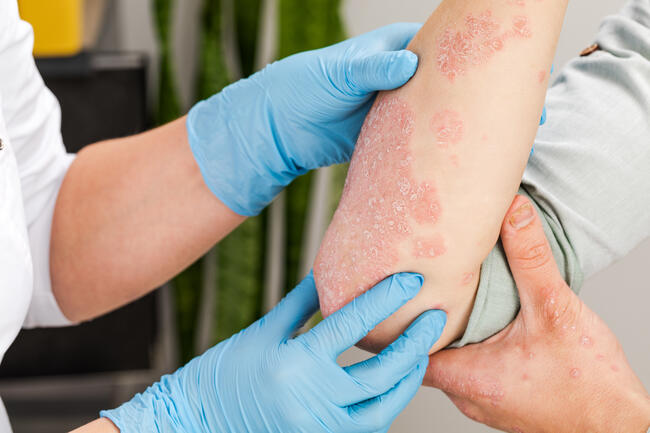
In the meantime, a biopsy was ordered that ruled out fungal diseases. Another 2 weeks elapsed. By then the red spots and patches had spread symmetrically down my body. My entire back was solid red, both of my arms, the top of my thighs and top of my feet. My armpits were just spotted, and there were islands of sparing on my stomach, outer thighs and lower legs. A second biopsy was inconclusive.
I started going to bed wearing wet long johns, slathered in ointment. It was a miserable existence. I needed meds for sleeping, for the itching and for pain. The diagnosis remained seborrheic dermatitis and the prednisone continued. As a patient, I deferred to my dermatologist and focused on following the daily regimen of ointments as prescribed. By late October, more than 60% of my body was in a state of what I called “hell and agony.” Every 2 weeks I would return to my dermatologist, and the strawberry red skin had migrated further. The meds were not working, yet the diagnosis remained seborrheic dermatitis.
On November 8, my dermatologist increased my evening dosage of prednisone to 60 mg. Early the following morning, I awoke in my bedroom with its vaulted ceiling to Technicolor hallucinations that included a giant, 20-foot rubber duck that were visible when my eyes were open or shut. Within a few hours, I was admitted to the Medical Center of Plano. When I saw the hospital’s on-call dermatologist, Michael Golden, MD, nearly 75% of my body was inflamed. He ordered a biopsy, continued the twice-daily application of triamcinolone ointment and added an array of drugs. While he offered no official diagnosis, I did hear “PRP” included with a litany of possible skin conditions. I left the hospital 6 days later — with no “official” diagnosis. Mercifully, seborrheic dermatitis had been abandoned.
It’s Official: Pityriasis Rubra Pilaris
A week after my discharge, I had the follow-up appointment at Dr. Golden’s office. My coverage was at 100%. My skin was a bright red and shedding profusely. The palms of my hands and soles of my feet were entombed in thick skin. My fingernails, toenails and body hair had vanished.
Then the stars came into alignment. I heard 3 words: pityriasis (pause), rubra (another long pause) and pilaris. I remember how Dr. Golden enunciated each syllable in almost a whisper. It was as if he did not want it to be PRP. While Dr. Golden had never personally treated PRP, he connected the dots and thought it might be the proper diagnosis. A biopsy was ordered with specific instructions to consider PRP. Within a few days, Dallas dermatopathologist, Clay Cockerell, MD, confirmed that my biopsy was consistent with PRP.
On November 28, nearly 4 months from onset, Dr. Golden made it official: classic adult onset PRP Type I. PRP, which has no known cause, has 6 distinct types: adult onset Types I and II (55%), juvenile onset Types III, IV and V (45%) and HIV-associated Type VI (too rare to have a percentage).

The Road To Remission
I was referred for treatment to the University of Texas Southwestern (UTSW) Medical Center in Dallas, a teaching hospital where Dr. Golden had trained as the chief resident of dermatology. Within a week I, was under the care of Arturo Dominguez, MD — my third dermatologist. The initial treatment for my version of PRP included acitretin and the twice daily application of triamcinolone (body), clobetasol propionate and urea lotion on my feet and hands and desonide topical on my face. The side effects were manageable.
On April 8, 20 months after discovering the spot on my forehead, I was declared in remission. But for me the journey was hardly over. PRP was done with me, but I was not done with PRP.
More Patient Support
According to the Rare Diseases Act of 2002, rare diseases and disorders are those with small patient populations typically under 200,000 individuals in the United States. Based on an estimated prevalence rate of 1 “active” person with PRP in 400,000, there are an estimated 800 active people with PRP in the United States. We are rare. While the PRP Patient Registry has identified more than 1,500 people with PRP going back to 1997, only 270 are “active” and of those, only 175 of these are in the United States.
A patient who is diagnosed with PRP gets an almost knee-jerk referral to the Internet. A referral to a specific support group is as rare as our disease. This is unfortunate, because the novice in search of answers is often bewildered and consumed by fear and hopelessness. Patients do not want information from a medical textbook that is too technical and quickly redundant.
It would be helpful if dermatologists refer patients with rare diseases to the Genetic and Rare Diseases Information Center (GARD), where support groups are listed under organizations. With many of the 6,000 rare diseases, this is the place to start. GARD lists the PRP Alliance as a supporting organization and the PRP Facebook Support Group as a social networking website.
Improving The Diagnosis of PRP
The process of PRP diagnosis must be improved. A survey of 264 patients with PRP confirmed that the official diagnosis of PRP was preceded by an erroneous diagnosis of psoriasis (53%). The timely diagnosis of PRP requires clinical observations and a supportive biopsy. PRP-savvy dermatologists can help to better define the onset of symptoms. Moreover, the use of biopsies as a diagnostic tool for PRP needs to be put under a microscope itself.
Improving The Treatment of PRP
Each patient has his or her own version of PRP. The PRP Alliance has harvested information on treating PRP since 2014. Our next focus is to gather data about the effectiveness of oral retinoids, immunosuppressants and biologics on the PRP population.
Increasing PRP Research
Leading research on PRP has been conducted by Dr. Jouni Uitto, chair, department of dermatology and cutaneous biology at Sidney Kimmel Medical College at Thomas Jefferson University, and his team of researchers: Matthew Keller, MD, Nicholas Ross, MD, Qiaoli Li, PhD, and Hye Jin Chung, MD. While these efforts, are significant, many questions still need to be asked and answered.
Increasing the Collaboration Between Dermatologists and Patients?
The most vocal components of the international PRP community are the 450-plus members of the PRP Facebook support group. Each month more than 100 new conversations begin and generate 1,100-plus comments that contribute to the body of knowledge about PRP. Since April 2013, the group has recorded more than 20,000 comments detailing almost every facet of PRP, from onset through remission. Patients with PRP want to be more involved in their treatment and are willing to do some of the heavy lifting.
Mr. McCue is the chief executive officer of the PRP Alliance, Inc. He founded the PRP Alliance in February 2013 in support of Rare Disease Day that year and publishes On the Road: the Journey from Onset through Remission and the PRP Survival Guide. Awarded 501(c)(3) tax-exempt status, PRP Alliance is now a member of the Coalition of Skin Diseases.
Disclosure: The authors report no relevant financial relationships.
 Pityriasis rubra pilaris (PRP) was not in my bucket list when I retired in 2005 after 34 years in publishing, public relations and marketing communications. I was staying active with 4-mile power walks, strenuous yard work and hour-plus workouts on a bicycle at a local fitness center. At the age of 66, my golden years seemed to be on course. Then came the storms.
The Journey Begins
In early August 2012, I noticed a red, dime-size blemish near my hairline and right temple. Within a few weeks, the spot had grown to the size of a quarter. While my scalp itched and was bumpy, it did not seem like dandruff. I was mildly concerned. The first available appointment with my dermatologist was in early September. By then, however, the red spot was a 1-inch wide red bar extending from temple to jaw. I sat quietly on the examination table wishing I had pushed for an earlier appointment in August.
In less than 5 minutes, the diagnosis was announced: seborrheic dermatitis. As a patient, I was relieved. My building angst was now in check. My dermatologist had everything under control. I was given a prescription that I hoped would work. When offered an array of her private-labeled creams, I purchased them with enthusiasm. I was told to return in 2 weeks. In my mind, I would be returning “spotless.”
Upon my return, however, the red bar had also appeared on the left side of my face and a combination of red spots and solid red patches had spread to my upper back and chest. While the diagnosis remained seborrheic dermatitis, the treatment now included prednisone.
In the meantime, a biopsy was ordered that ruled out fungal diseases. Another 2 weeks elapsed. By then the red spots and patches had spread symmetrically down my body. My entire back was solid red, both of my arms, the top of my thighs and top of my feet. My armpits were just spotted, and there were islands of sparing on my stomach, outer thighs and lower legs. A second biopsy was inconclusive.
I started going to bed wearing wet long johns, slathered in ointment. It was a miserable existence. I needed meds for sleeping, for the itching and for pain. The diagnosis remained seborrheic dermatitis and the prednisone continued. As a patient, I deferred to my dermatologist and focused on following the daily regimen of ointments as prescribed. By late October, more than 60% of my body was in a state of what I called “hell and agony.” Every 2 weeks I would return to my dermatologist, and the strawberry red skin had migrated further. The meds were not working, yet the diagnosis remained seborrheic dermatitis.
On November 8, my dermatologist increased my evening dosage of prednisone to 60 mg. Early the following morning, I awoke in my bedroom with its vaulted ceiling to Technicolor hallucinations that included a giant, 20-foot rubber duck that were visible when my eyes were open or shut. Within a few hours, I was admitted to the Medical Center of Plano. When I saw the hospital’s on-call dermatologist, Michael Golden, MD, nearly 75% of my body was inflamed. He ordered a biopsy, continued the twice-daily application of triamcinolone ointment and added an array of drugs. While he offered no official diagnosis, I did hear “PRP” included with a litany of possible skin conditions. I left the hospital 6 days later — with no “official” diagnosis. Mercifully, seborrheic dermatitis had been abandoned.
It’s Official: Pityriasis Rubra Pilaris
A week after my discharge, I had the follow-up appointment at Dr. Golden’s office. My coverage was at 100%. My skin was a bright red and shedding profusely. The palms of my hands and soles of my feet were entombed in thick skin. My fingernails, toenails and body hair had vanished.
Then the stars came into alignment. I heard 3 words: pityriasis (pause), rubra (another long pause) and pilaris. I remember how Dr. Golden enunciated each syllable in almost a whisper. It was as if he did not want it to be PRP. While Dr. Golden had never personally treated PRP, he connected the dots and thought it might be the proper diagnosis. A biopsy was ordered with specific instructions to consider PRP. Within a few days, Dallas dermatopathologist, Clay Cockerell, MD, confirmed that my biopsy was consistent with PRP.
On November 28, nearly 4 months from onset, Dr. Golden made it official: classic adult onset PRP Type I. PRP, which has no known cause, has 6 distinct types: adult onset Types I and II (55%), juvenile onset Types III, IV and V (45%) and HIV-associated Type VI (too rare to have a percentage).

The Road To Remission
I was referred for treatment to the University of Texas Southwestern (UTSW) Medical Center in Dallas, a teaching hospital where Dr. Golden had trained as the chief resident of dermatology. Within a week I, was under the care of Arturo Dominguez, MD — my third dermatologist. The initial treatment for my version of PRP included acitretin and the twice daily application of triamcinolone (body), clobetasol propionate and urea lotion on my feet and hands and desonide topical on my face. The side effects were manageable.
On April 8, 20 months after discovering the spot on my forehead, I was declared in remission. But for me the journey was hardly over. PRP was done with me, but I was not done with PRP.
More Patient Support
According to the Rare Diseases Act of 2002, rare diseases and disorders are those with small patient populations typically under 200,000 individuals in the United States. Based on an estimated prevalence rate of 1 “active” person with PRP in 400,000, there are an estimated 800 active people with PRP in the United States. We are rare. While the PRP Patient Registry has identified more than 1,500 people with PRP going back to 1997, only 270 are “active” and of those, only 175 of these are in the United States.
A patient who is diagnosed with PRP gets an almost knee-jerk referral to the Internet. A referral to a specific support group is as rare as our disease. This is unfortunate, because the novice in search of answers is often bewildered and consumed by fear and hopelessness. Patients do not want information from a medical textbook that is too technical and quickly redundant.
It would be helpful if dermatologists refer patients with rare diseases to the Genetic and Rare Diseases Information Center (GARD), where support groups are listed under organizations. With many of the 6,000 rare diseases, this is the place to start. GARD lists the PRP Alliance as a supporting organization and the PRP Facebook Support Group as a social networking website.
Improving The Diagnosis of PRP
The process of PRP diagnosis must be improved. A survey of 264 patients with PRP confirmed that the official diagnosis of PRP was preceded by an erroneous diagnosis of psoriasis (53%). The timely diagnosis of PRP requires clinical observations and a supportive biopsy. PRP-savvy dermatologists can help to better define the onset of symptoms. Moreover, the use of biopsies as a diagnostic tool for PRP needs to be put under a microscope itself.
Improving The Treatment of PRP
Each patient has his or her own version of PRP. The PRP Alliance has harvested information on treating PRP since 2014. Our next focus is to gather data about the effectiveness of oral retinoids, immunosuppressants and biologics on the PRP population.
Increasing PRP Research
Leading research on PRP has been conducted by Dr. Jouni Uitto, chair, department of dermatology and cutaneous biology at Sidney Kimmel Medical College at Thomas Jefferson University, and his team of researchers: Matthew Keller, MD, Nicholas Ross, MD, Qiaoli Li, PhD, and Hye Jin Chung, MD. While these efforts, are significant, many questions still need to be asked and answered.
Increasing the Collaboration Between Dermatologists and Patients?
The most vocal components of the international PRP community are the 450-plus members of the PRP Facebook support group. Each month more than 100 new conversations begin and generate 1,100-plus comments that contribute to the body of knowledge about PRP. Since April 2013, the group has recorded more than 20,000 comments detailing almost every facet of PRP, from onset through remission. Patients with PRP want to be more involved in their treatment and are willing to do some of the heavy lifting.
Mr. McCue is the chief executive officer of the PRP Alliance, Inc. He founded the PRP Alliance in February 2013 in support of Rare Disease Day that year and publishes On the Road: the Journey from Onset through Remission and the PRP Survival Guide. Awarded 501(c)(3) tax-exempt status, PRP Alliance is now a member of the Coalition of Skin Diseases.
Disclosure: The authors report no relevant financial relationships.
Pityriasis rubra pilaris (PRP) was not in my bucket list when I retired in 2005 after 34 years in publishing, public relations and marketing communications. I was staying active with 4-mile power walks, strenuous yard work and hour-plus workouts on a bicycle at a local fitness center. At the age of 66, my golden years seemed to be on course. Then came the storms.
The Journey Begins
In early August 2012, I noticed a red, dime-size blemish near my hairline and right temple. Within a few weeks, the spot had grown to the size of a quarter. While my scalp itched and was bumpy, it did not seem like dandruff. I was mildly concerned. The first available appointment with my dermatologist was in early September. By then, however, the red spot was a 1-inch wide red bar extending from temple to jaw. I sat quietly on the examination table wishing I had pushed for an earlier appointment in August.
In less than 5 minutes, the diagnosis was announced: seborrheic dermatitis. As a patient, I was relieved. My building angst was now in check. My dermatologist had everything under control. I was given a prescription that I hoped would work. When offered an array of her private-labeled creams, I purchased them with enthusiasm. I was told to return in 2 weeks. In my mind, I would be returning “spotless.”
Upon my return, however, the red bar had also appeared on the left side of my face and a combination of red spots and solid red patches had spread to my upper back and chest. While the diagnosis remained seborrheic dermatitis, the treatment now included prednisone.
In the meantime, a biopsy was ordered that ruled out fungal diseases. Another 2 weeks elapsed. By then the red spots and patches had spread symmetrically down my body. My entire back was solid red, both of my arms, the top of my thighs and top of my feet. My armpits were just spotted, and there were islands of sparing on my stomach, outer thighs and lower legs. A second biopsy was inconclusive.
I started going to bed wearing wet long johns, slathered in ointment. It was a miserable existence. I needed meds for sleeping, for the itching and for pain. The diagnosis remained seborrheic dermatitis and the prednisone continued. As a patient, I deferred to my dermatologist and focused on following the daily regimen of ointments as prescribed. By late October, more than 60% of my body was in a state of what I called “hell and agony.” Every 2 weeks I would return to my dermatologist, and the strawberry red skin had migrated further. The meds were not working, yet the diagnosis remained seborrheic dermatitis.
On November 8, my dermatologist increased my evening dosage of prednisone to 60 mg. Early the following morning, I awoke in my bedroom with its vaulted ceiling to Technicolor hallucinations that included a giant, 20-foot rubber duck that were visible when my eyes were open or shut. Within a few hours, I was admitted to the Medical Center of Plano. When I saw the hospital’s on-call dermatologist, Michael Golden, MD, nearly 75% of my body was inflamed. He ordered a biopsy, continued the twice-daily application of triamcinolone ointment and added an array of drugs. While he offered no official diagnosis, I did hear “PRP” included with a litany of possible skin conditions. I left the hospital 6 days later — with no “official” diagnosis. Mercifully, seborrheic dermatitis had been abandoned.
It’s Official: Pityriasis Rubra Pilaris
A week after my discharge, I had the follow-up appointment at Dr. Golden’s office. My coverage was at 100%. My skin was a bright red and shedding profusely. The palms of my hands and soles of my feet were entombed in thick skin. My fingernails, toenails and body hair had vanished.
Then the stars came into alignment. I heard 3 words: pityriasis (pause), rubra (another long pause) and pilaris. I remember how Dr. Golden enunciated each syllable in almost a whisper. It was as if he did not want it to be PRP. While Dr. Golden had never personally treated PRP, he connected the dots and thought it might be the proper diagnosis. A biopsy was ordered with specific instructions to consider PRP. Within a few days, Dallas dermatopathologist, Clay Cockerell, MD, confirmed that my biopsy was consistent with PRP.
On November 28, nearly 4 months from onset, Dr. Golden made it official: classic adult onset PRP Type I. PRP, which has no known cause, has 6 distinct types: adult onset Types I and II (55%), juvenile onset Types III, IV and V (45%) and HIV-associated Type VI (too rare to have a percentage).
The Road To Remission
I was referred for treatment to the University of Texas Southwestern (UTSW) Medical Center in Dallas, a teaching hospital where Dr. Golden had trained as the chief resident of dermatology. Within a week I, was under the care of Arturo Dominguez, MD — my third dermatologist. The initial treatment for my version of PRP included acitretin and the twice daily application of triamcinolone (body), clobetasol propionate and urea lotion on my feet and hands and desonide topical on my face. The side effects were manageable.
On April 8, 20 months after discovering the spot on my forehead, I was declared in remission. But for me the journey was hardly over. PRP was done with me, but I was not done with PRP.
More Patient Support
According to the Rare Diseases Act of 2002, rare diseases and disorders are those with small patient populations typically under 200,000 individuals in the United States. Based on an estimated prevalence rate of 1 “active” person with PRP in 400,000, there are an estimated 800 active people with PRP in the United States. We are rare. While the PRP Patient Registry has identified more than 1,500 people with PRP going back to 1997, only 270 are “active” and of those, only 175 of these are in the United States.
A patient who is diagnosed with PRP gets an almost knee-jerk referral to the Internet. A referral to a specific support group is as rare as our disease. This is unfortunate, because the novice in search of answers is often bewildered and consumed by fear and hopelessness. Patients do not want information from a medical textbook that is too technical and quickly redundant.
It would be helpful if dermatologists refer patients with rare diseases to the Genetic and Rare Diseases Information Center (GARD), where support groups are listed under organizations. With many of the 6,000 rare diseases, this is the place to start. GARD lists the PRP Alliance as a supporting organization and the PRP Facebook Support Group as a social networking website.
Improving The Diagnosis of PRP
The process of PRP diagnosis must be improved. A survey of 264 patients with PRP confirmed that the official diagnosis of PRP was preceded by an erroneous diagnosis of psoriasis (53%). The timely diagnosis of PRP requires clinical observations and a supportive biopsy. PRP-savvy dermatologists can help to better define the onset of symptoms. Moreover, the use of biopsies as a diagnostic tool for PRP needs to be put under a microscope itself.
Improving The Treatment of PRP
Each patient has his or her own version of PRP. The PRP Alliance has harvested information on treating PRP since 2014. Our next focus is to gather data about the effectiveness of oral retinoids, immunosuppressants and biologics on the PRP population.
Increasing PRP Research
Leading research on PRP has been conducted by Dr. Jouni Uitto, chair, department of dermatology and cutaneous biology at Sidney Kimmel Medical College at Thomas Jefferson University, and his team of researchers: Matthew Keller, MD, Nicholas Ross, MD, Qiaoli Li, PhD, and Hye Jin Chung, MD. While these efforts, are significant, many questions still need to be asked and answered.
Increasing the Collaboration Between Dermatologists and Patients?
The most vocal components of the international PRP community are the 450-plus members of the PRP Facebook support group. Each month more than 100 new conversations begin and generate 1,100-plus comments that contribute to the body of knowledge about PRP. Since April 2013, the group has recorded more than 20,000 comments detailing almost every facet of PRP, from onset through remission. Patients with PRP want to be more involved in their treatment and are willing to do some of the heavy lifting.
Mr. McCue is the chief executive officer of the PRP Alliance, Inc. He founded the PRP Alliance in February 2013 in support of Rare Disease Day that year and publishes On the Road: the Journey from Onset through Remission and the PRP Survival Guide. Awarded 501(c)(3) tax-exempt status, PRP Alliance is now a member of the Coalition of Skin Diseases.
Disclosure: The authors report no relevant financial relationships.