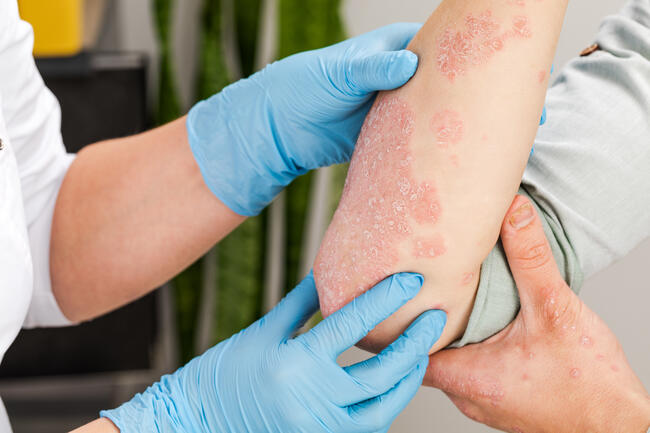
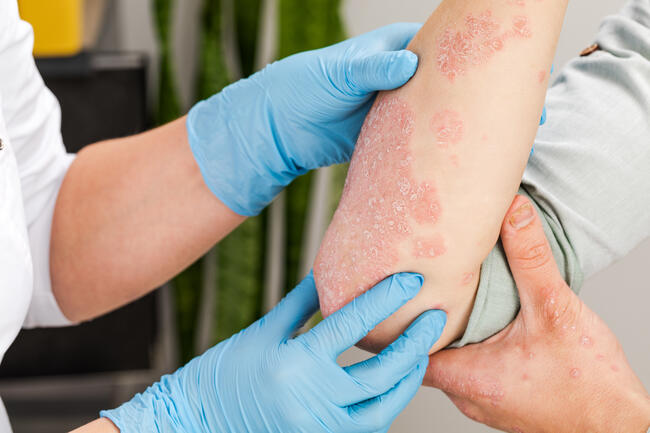
A 30-year-old woman with interstitial pneumonitis was being treated with prednisone (initially 20 mg, which had been tapered to 10 mg) and azathioprine. She presented with a 2-month history of rash on the antecubital fossa that has a burning sensation. She has failed therapy with a topical azole antifungal, pimecrolimus, and sulfacetamide lotion, 10%.
What could be responsible for this woman’s upper extremity rash?
A. Atopic dermatitis
B. Psoriasis
C. Dermatophyte infection
D. Cutaneous candidiasis
E. Impetigo
F. Fixed drug eruption
To learn the answer, go to page 2
{{pagebreak}}
Answer: Psoriasis
A biopsy confirmed the diagnosis of psoriasis in the immunocompromised patient. Her psoriasis cleared with the use of topical corticosteroid therapy alone.
The rash in this case is unusual in its location (typically, atopic dermatitis affects the antecubital fossa), the presence of a burning sensation (rather than an itching sensation), its asymmetry (psoriasis typically is symmetric), and that immunosuppresive medications normally would keep psoriasis in check.
Dr Kaplan is an assistant professor of dermatology at the University of Missouri—Kansas City School of Medicine in Kanas City, MO, and at the University of Kanas School of Medicine in Kansas City, KS. He practices adult and pediatric dermatology in Overland Park, KS.
This article originally appeared in Consultant. 2016;56(6):536-538.
A 30-year-old woman with interstitial pneumonitis was being treated with prednisone (initially 20 mg, which had been tapered to 10 mg) and azathioprine. She presented with a 2-month history of rash on the antecubital fossa that has a burning sensation. She has failed therapy with a topical azole antifungal, pimecrolimus, and sulfacetamide lotion, 10%.
What could be responsible for this woman’s upper extremity rash?
A. Atopic dermatitis
B. Psoriasis
C. Dermatophyte infection
D. Cutaneous candidiasis
E. Impetigo
F. Fixed drug eruption
To learn the answer, go to page 2
{{pagebreak}}
Answer: Psoriasis
A biopsy confirmed the diagnosis of psoriasis in the immunocompromised patient. Her psoriasis cleared with the use of topical corticosteroid therapy alone.
The rash in this case is unusual in its location (typically, atopic dermatitis affects the antecubital fossa), the presence of a burning sensation (rather than an itching sensation), its asymmetry (psoriasis typically is symmetric), and that immunosuppresive medications normally would keep psoriasis in check.
Dr Kaplan is an assistant professor of dermatology at the University of Missouri—Kansas City School of Medicine in Kanas City, MO, and at the University of Kanas School of Medicine in Kansas City, KS. He practices adult and pediatric dermatology in Overland Park, KS.
This article originally appeared in Consultant. 2016;56(6):536-538.
A 30-year-old woman with interstitial pneumonitis was being treated with prednisone (initially 20 mg, which had been tapered to 10 mg) and azathioprine. She presented with a 2-month history of rash on the antecubital fossa that has a burning sensation. She has failed therapy with a topical azole antifungal, pimecrolimus, and sulfacetamide lotion, 10%.
What could be responsible for this woman’s upper extremity rash?
A. Atopic dermatitis
B. Psoriasis
C. Dermatophyte infection
D. Cutaneous candidiasis
E. Impetigo
F. Fixed drug eruption
To learn the answer, go to page 2
{{pagebreak}}
Answer: Psoriasis
A biopsy confirmed the diagnosis of psoriasis in the immunocompromised patient. Her psoriasis cleared with the use of topical corticosteroid therapy alone.
The rash in this case is unusual in its location (typically, atopic dermatitis affects the antecubital fossa), the presence of a burning sensation (rather than an itching sensation), its asymmetry (psoriasis typically is symmetric), and that immunosuppresive medications normally would keep psoriasis in check.
Dr Kaplan is an assistant professor of dermatology at the University of Missouri—Kansas City School of Medicine in Kanas City, MO, and at the University of Kanas School of Medicine in Kansas City, KS. He practices adult and pediatric dermatology in Overland Park, KS.
This article originally appeared in Consultant. 2016;56(6):536-538.